
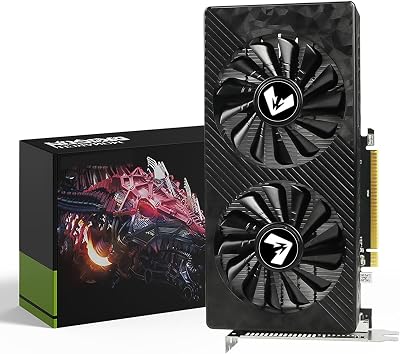


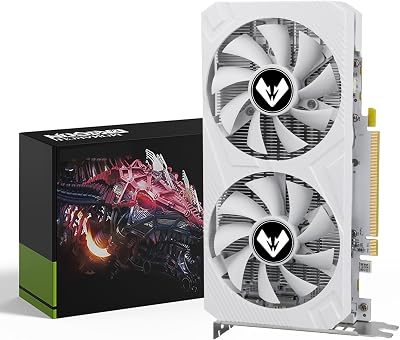
RTX 2060 vs RX 580 is the comparison almost nobody makes videos about any more, because there are no views in $80 graphics cards. That is exactly why you are reading a page instead. If this is your first build, or you are putting a machine together for a student on a real budget, you have three questions that no benchmark chart answers: which is actually faster, which one is more likely to survive being someone else’s ex-mining card, and which one costs less to run. All three are below, with numbers.
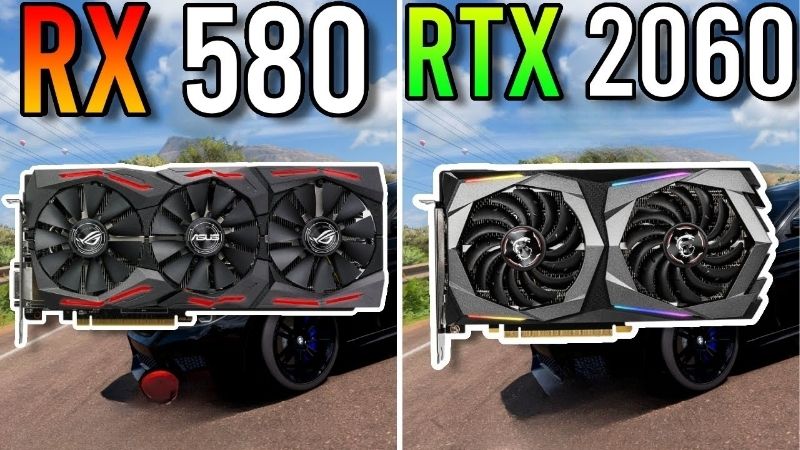
The Quick Verdict: RTX 2060 vs RX 580 in One Minute
The RTX 2060 wins and it is not close — roughly 55-70% faster depending on the title, while drawing less power. That combination is unusual and it settles most of the argument. The RX 580 has exactly two things going for it: it is cheaper, and it has 8GB against the 2060’s 6GB. Neither rescues it. A card that is 60% slower is a different class of experience, and the 8GB advantage matters far less at the settings a card this slow can actually run. Buy the RTX 2060 unless the RX 580 is less than half its price. And whichever you buy, read the mining section before you hand anyone money, because it is the part that will actually cost you.
As an Amazon Associate we earn from qualifying purchases at no extra cost to you.




Who Should Buy the RTX 2060
Almost everyone reading this. At 1080p it plays modern titles at Medium settings around 50-60 FPS and older ones comfortably above 100. It has DLSS, which the RX 580 has no equivalent for, and NVENC for recording. And it draws 160W against the 580’s 185W while being far faster.
If you are building a first PC and the difference is $30-40, take the 2060. That gap is one month of not having to lower settings, and it is a card that stays useful roughly two years longer.
Who Should Buy the RX 580
One honest scenario: your budget is absolutely fixed at around $60-70 and the 2060 is $110+. In that case a working RX 580 plays every esports title at 1080p above 100 FPS, handles older AAA games at Medium, and is a real machine rather than a theoretical one. Nobody should feel bad about this.
A second, narrower case: your power supply is a genuinely unknown quantity but you have two 8-pin cables. Some RX 580 models are more forgiving of weak PSUs than the 2060’s transient behaviour — though at 185W that argument is thin, and honestly if your PSU is a mystery, that is the component to fix first.
Outside those, the 580 is a card whose remaining life is measured in months rather than years.
The Question You Actually Have: Which One Lasts?
This is the durability question, and it deserves a real answer rather than a shrug. The RX 580 was the mining card of the 2017-2018 era — a huge fraction of the ones on the used market ran 24 hours a day for years. The 2060 saw mining too, but less of it and for a shorter window.
What that means practically: on an RX 580, assume the fan bearings are worn and the thermal paste is dead until proven otherwise. Fans are the most common failure point on these cards and they are the cheapest thing to replace, but a card with a seized fan will throttle to unusability within minutes.
Neither card is fragile in itself. Polaris and Turing are both durable silicon. The risk is entirely about what the previous owner did, and the base rates are meaningfully worse for the 580.
Specs, Frame Rates and Running Costs
Two cards from different eras with a genuine performance chasm between them. The bandwidth rows look close; the results do not.
Core Specifications Side by Side
| Specification | RTX 2060 (6GB) | RX 580 (8GB) |
|---|---|---|
| Architecture | Turing (TU106) | Polaris 20 |
| Launch year | 2019 | 2017 |
| Shader units | 1,920 | 2,304 |
| VRAM | 6GB GDDR6 | 8GB GDDR5 |
| Memory bus | 192-bit | 256-bit |
| Bandwidth | 336 GB/s | 256 GB/s |
| Tensor cores (DLSS) | 240 | None |
| RT cores | 30 | None |
| Encoder | NVENC (Turing) | VCE (dated) |
| TDP | 160W | 185W |
| Power connector | 1x 8-pin | 1x 8-pin (some 2x) |
| PSU recommended | 500W | 500W |
The 580 has 20% more shader units and a wider bus, and loses by 60%. That is what a two-generation architecture gap does — Polaris was a 2016 design refreshed in 2017, and it was already behind when it launched. GDDR5 against GDDR6 costs the 580 its bus width advantage entirely.
The power rows are bolded because they matter more to this buyer than to any other. The slower card uses 16% more electricity. That is the opposite of how this normally works.
1080p Frame Rates in Real Games
1080p, Medium preset — the setting these cards actually run at. Ctrl+F your game.
| Game (1080p Medium) | RTX 2060 | RX 580 | Gap |
|---|---|---|---|
| Counter-Strike 2 | ~215 FPS | ~135 FPS | +59% |
| Valorant | ~250 FPS | ~165 FPS | +52% |
| Fortnite (Performance) | ~145 FPS | ~88 FPS | +65% |
| GTA V Enhanced | ~105 FPS | ~65 FPS | +62% |
| Elden Ring | ~52 FPS | ~31 FPS | +68% |
| Cyberpunk 2077 | ~48 FPS | ~27 FPS | +78% |
| Hogwarts Legacy | ~42 FPS | ~24 FPS | +75% |
The pattern is brutally consistent and it widens with newer games. In esports both cards are playable and the 2060 gives you headroom. In anything modern, 27 FPS is not a game and 48 FPS is.
Add DLSS and the gap becomes absurd. The 2060 running DLSS Quality in Cyberpunk reaches roughly 65 FPS. The RX 580 has no path to that at all — FSR 1 exists for it, and it looks like what it is.
What Each Costs You Per Year to Run
Nobody puts this in a comparison and for this buyer it matters more than for anyone else.
Assume four hours of gaming a day. The 2060 at 160W uses roughly 234 kWh a year; the RX 580 at 185W uses roughly 270 kWh. That is a 36 kWh difference — modest in absolute terms, worth roughly $4-11 a year depending on your region’s electricity rates.
Small. But now weight it by performance: the 2060 delivers about 60% more frames for 14% less power. In frames-per-watt the 2060 is nearly twice the card. And if your $60 saving on the 580 is eaten by five years of higher bills plus a $15 fan replacement, the saving was not real. Run that sum before you decide — it is the kind of arithmetic that a spec sheet will never do for you.
Deep Dive Face-Off: Where the 580 Still Has an Argument
The 2060 wins on speed, power and features. The 580’s case rests on two things, and both deserve a fair hearing rather than dismissal.
The 8GB vs 6GB Question, Honestly
The RX 580’s 8GB against the 2060’s 6GB is a real advantage and it is the strongest thing the 580 has. In 2026, 6GB is genuinely tight and there are titles where the 2060 hits its buffer.
But look at the frame rate table again before you weight it heavily. VRAM matters when a card is fast enough to run the settings that consume it. The RX 580 manages 24 FPS in Hogwarts Legacy — it will never reach the texture settings where 8GB becomes an advantage over 6GB, because it cannot render the frames to begin with. Its extra memory is capacity it has no speed to use.
The 2060’s 6GB is a real ceiling and it is a fair criticism of the card. It is simply a ceiling that sits above where the 580 can reach at all.
Drivers, Longevity and the Feature Gap
AMD has moved Polaris to legacy driver status, meaning security and critical fixes rather than game-day optimisation. The 2060 still receives current Game Ready drivers and, notably, still receives DLSS model updates through the Nvidia app.
That last point is worth understanding, with one caveat. Nvidia ships newer DLSS models to all RTX cards via the app rather than requiring game patches, so a 2019 card keeps getting improvements. But DLSS 4.5’s newest models — M and L — rely on native FP8, which Turing does not have. Nvidia’s own guidance is that RTX 20 series owners should generally stay on Model K, the DLSS 4.0 model. So the 2060 gets DLSS and gets updates, just not the very latest models at full benefit. That is still infinitely more than the RX 580, which gets nothing.
On encoding: if you plan to record or stream at all, NVENC on the 2060 against AMD’s dated VCE block is not a close comparison. This alone decides it for anyone touching OBS.
Pros and Cons of Each Card
| RTX 2060 | RX 580 | |
|---|---|---|
| Pros | 55-70% faster; 160W is less than the 580; DLSS support; NVENC for recording; still on current drivers; roughly 2x the frames per watt | Cheapest way into 1080p gaming; 8GB buffer; fine for esports at 1080p; open-source Linux drivers; parts and coolers widely available |
| Cons | 6GB is a genuine ceiling; costs more; no FP8, so DLSS 4.5’s best models hurt it; no Frame Generation ever | 60% slower and 16% more power; heavy mining history on the used market; Polaris is on legacy drivers; no upscaling worth using; unplayable in modern AAA |
The asymmetry is stark. The 580’s pros are all about the price on the listing. The 2060’s are about everything that happens after you install it.
Buying Used Without Getting Burned
Both cards are seven and nine years old respectively, so condition matters more than specification. This is the section that actually saves you money.
The Five Checks Before You Pay
- Photo of the card running with a temperature reading on screen. A seller who will not do this has a reason.
- Ask about mining directly. A seller who says “I don’t know” on an RX 580 is telling you it was mined on.
- Listen to the fans. Ask for a video. Grinding or clicking means bearings are gone — $15 to fix, but you should know.
- Check the PCIe fingers and bracket. Scraping and bending mean it has been in and out of many machines, which is a mining-farm signature.
- Budget $15 for thermal paste and pads regardless. On a card this age it is maintenance, not optional. It is the difference between 68C and 85C.
None of this makes a used card a bad idea. It makes it a decision with known risks rather than unknown ones.
Why These Cards Have Not Become Free
Component and laptop prices have kept trending upward instead of settling back, and entry-level new cards have absorbed the hardest share of that pressure because memory is a large fraction of what they cost to build. When the cheapest acceptable new card refuses to fall, everything beneath it on the used market is anchored by it.
That is why a 2017 RX 580 still costs real money — a card two generations retired, on legacy drivers, that cannot play a modern game. Its price is not set by what it is worth. It is set from above, by a new market that has stopped correcting downward. The same anchor keeps the 2060 from becoming the bargain its age suggests.
For a buyer at this budget level, that is genuinely bad news and it deserves saying plainly rather than dressing up.
Prices Flattened, But Cheap Is Not Coming Back
There is real good news, stated precisely. The steep climb of late 2025 has eased. Framework, which publishes unusually candid component pricing notes, has reported a stretch of relative stability while still warning that volatility persists. Prices stopped accelerating; they did not reverse.
Supply is opening. OEMs can now source DDR5 from Chinese manufacturers such as CXMT, and Micron is building two fabs in Idaho. Both add genuine capacity. Neither runs before 2027-2028 — by which point an RX 580 will be a decade old and genuinely finished.
So: flat, not falling, and waiting will not help you. If a clean RTX 2060 is available at a fair price today, compare it against current used and new listings and take the one in front of you — the market that would reward patience is not the market you are shopping in.
See More:
- GTX 1650 vs RTX 3050
- Nvidia DIGITS
- Nvidia cuDNN
- Radeon RX 9070 XT vs RTX 5090
- PNY GeForce RTX 5080 review
Final Verdict: RTX 2060 vs RX 580
The rtx 2060 vs rx 580 question has one answer for nearly everyone: buy the RTX 2060. It is 55-70% faster, it draws 25W less while doing it, it has DLSS and a real encoder, and it is still on current drivers while Polaris has moved to legacy. Roughly twice the frames per watt is not a preference, it is a different class of card. Its 6GB is a genuine limitation and a fair criticism — it is simply a limitation that sits above where the 580 can reach at all.
Take the RX 580 only if your budget is genuinely fixed and the 2060 is nearly double the price, and your library is esports. That buyer is real, the 580 will serve them, and there is no shame in it. But whichever you choose, spend your attention on condition rather than specification: ask about mining, get a photo of it running, listen to the fans, and budget $15 for paste. On a card this age, the seller matters more than the silicon.
Frequently Asked Questions
How much faster is the RTX 2060?
Substantially. The RTX 2060 is roughly 45 to 60 percent faster than an RX 580 8GB at 1080p, and the gap grows in newer engines. It also adds DLSS, hardware ray tracing and the far better NVENC encoder, all of which the Polaris based RX 580 simply does not have.
Does the RX 580 8GB beat the 2060 6GB on VRAM?
On paper the 580 has more memory, but the 2060 6GB is rarely limited by capacity at the settings it can actually run. The 580 does not have the shader throughput to use its 8GB in the games that would need it, so the extra memory is mostly theoretical at this point.
Are RX 580 drivers still updated?
AMD moved Polaris cards to a maintenance branch years ago, meaning security and critical fixes rather than per-game optimisation. Games still work, but do not expect day one profiles or fixes for new engine bugs. Turing cards including the 2060 remain on the mainline Nvidia release schedule.
What are the power and PSU differences?
The RX 580 draws around 185W with an 8-pin and is notorious for spiky draw on some partner cards, so a solid 550W unit is advisable. The RTX 2060 is 160W with an 8-pin and is more efficient. If you are replacing a 580, your existing supply will handle the 2060 easily.
Which is the better used buy in 2026?
The RTX 2060 unless the RX 580 is nearly free. Expect to pay roughly 100 to 140 dollars for a 2060 and 50 to 70 for an RX 580. At that spread the 2060 is comfortably better value per dollar, and the RX 580 only makes sense as a stopgap or a second-PC card.

Write Your Review
No reviews yet. Be the first to share your experience!