
- Top Pick: ASRock Radeon RX 7700 XT Challenger 12GB OC Graphics Card, AMD RDNA 3 Architecture, 12GB GDDR6, 2584 MHz Boost Clock, 3X DisplayPort 2.1, 1x HDMI 2.1, Dual Fan Cooling
- Best Value: ASRock Radeon RX 9060 XT Challenger 16GB OC, RDNA 4, 3290MHz Boost, 16GB GDDR6 128-bit, PCIe 5.0, Dual Fans, 0dB Silent, LED Indicator, DisplayPort 2.1a, HDMI 2.1b
- Premium Choice: GIGABYTE Radeon RX 9070 XT Gaming OC 16G Graphics Card, PCIe 5.0, 16GB GDDR6, GV-R9070XTGAMING OC-16GD Video Card

Prime
Best Seller
ASUS SFF-Ready Prime NVIDIA GeForce RTX 5070 Graphics Card (PCIe 5.0, 12GB GDDR7, HDMI/DP 2.1, 2.5-Slot, Axial-tech Fans, Dual BIOS), 3 Year Warranty


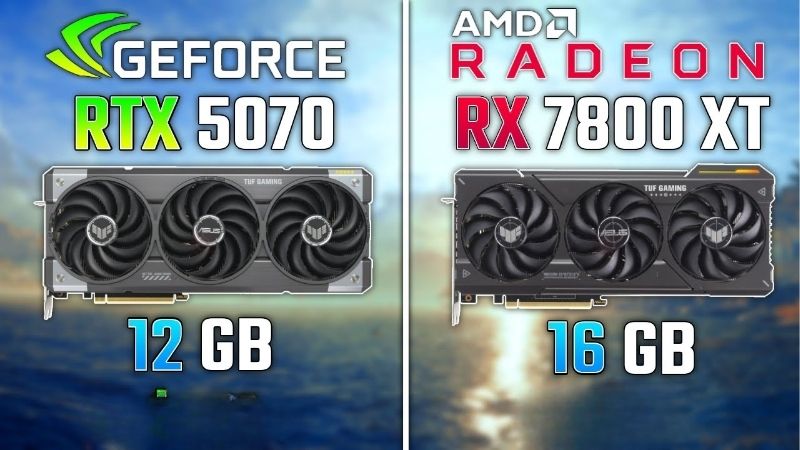
RTX 5070 vs RX 7800 XT is a genuinely close 1440p matchup, and it pits two different philosophies against each other: Nvidia’s newer RTX 5070 with its DLSS 4 feature set and 12GB of fast memory, versus AMD’s proven RX 7800 XT with 16GB and strong rasterized value. One leans on cutting-edge software and efficiency; the other on raw memory and price. With GPU prices still elevated in 2026, choosing between them comes down to what you value — the latest features or more memory and often a lower price. This comparison gives you the quick verdict, a clear spec table, a feature-by-feature face-off, an alternative if neither fits, and a direct recommendation for each type of buyer.
As an Amazon Associate we earn from qualifying purchases at no extra cost to you.





The quick verdict and how to read the price gap
For readers who want the answer first: the RTX 5070 is the better pick if you want the newest features, strong ray tracing, and Nvidia’s DLSS 4 frame generation, while the RX 7800 XT is the smarter buy if you prioritize a larger 16GB memory buffer and raw rasterized value, often at a lower price. Both are excellent 1440p cards; the winner depends on whether you weight features or memory and cost more heavily.
The fast answer for busy buyers
If you care about future-facing features, ray tracing, and the frame-rate boost of DLSS 4, the RTX 5070 is the card to get. If you want more memory for demanding, texture-heavy games and the best raw rasterization per dollar, the RX 7800 XT delivers, frequently at a friendlier price.
Neither is a wrong choice for 1440p gaming. The rest of this comparison exists so you can decide which set of strengths matters more for the games you play and the budget you have.
Spec comparison at a glance
Here are the core numbers that drive the decision. Treat MSRP as a reference point, since street prices in the current market frequently differ from list.
| Spec | RTX 5070 | RX 7800 XT |
|---|---|---|
| Architecture | Nvidia Blackwell (newer) | AMD RDNA 3 |
| Memory | 12GB GDDR7 | 16GB GDDR6 |
| Reference MSRP | around $549 | around $499 |
| Typical power draw | roughly 250W | roughly 263W |
| Upscaling / frame gen | DLSS 4 with multi-frame generation | FSR |
| Best fit | 1440p with strong ray tracing | 1440p rasterization, memory-heavy games |
The table captures the core trade-off: the RTX 5070 brings newer architecture, faster memory, and a stronger feature set, while the RX 7800 XT counters with more memory capacity and typically a lower price. Neither dominates outright, which is exactly why this comparison is so close.
How to read the price gap in 2026
The MSRP gap looks like roughly $50 in the 5070’s favor to pay, but the real gap on store shelves is noisier, and that is where current market conditions matter. Component and memory costs have kept GPU prices elevated into 2026, so both cards frequently sell above reference prices, and the actual difference you encounter can be wider or narrower than the sticker suggests.
There is cautious context worth factoring in. Prices have flattened after the steep climb of late 2025, and some hardware makers report a stretch of relative stability, while warning that volatility is not over. New memory supply is opening up, but the plants that would ease prices are not expected to run until 2027 to 2028, so meaningful relief is years away. For this matchup, the takeaway is to buy on your budget now rather than waiting for a discount the supply chain is not promising, and to always check the live price of both cards, since the real-world number should decide a race this close.
This pricing reality actually simplifies the decision in a helpful way. When two cards are this evenly matched, a meaningful price difference on the day you shop can be the deciding factor all by itself. If the 7800 XT is selling well below the 5070, its value case becomes hard to argue against for a rasterization-focused buyer; if the two are priced close together, the 5070’s newer features tip the scales. Rather than treating price as an afterthought, use it as the tie-breaker it deserves to be — check both cards at the moment you are ready to buy, and let the current numbers, not last month’s MSRPs, guide the final call.
Deep dive face-off by the features that matter
A spec table tells you what the cards are; this section shows how those specs translate into the experience you get. We break it down by rasterized performance, by ray tracing and upscaling, and by memory and system fit, because those three axes settle the decision for most buyers.
Rasterized performance
In traditional rasterized rendering, the two cards are remarkably close at 1440p, trading blows depending on the title. The RX 7800 XT has long been a strong rasterization value, and the RTX 5070’s newer architecture keeps it competitive, so in pure raster you will not find a night-and-day gap between them.
The practical reading is that both deliver excellent 1440p rasterized gaming, and neither will disappoint at that resolution. Because raw raster is close, the decision hinges more on the other factors — features, memory, and price — than on outright rasterized frame rates, where the two are effectively matched.
It is worth being concrete about what “close” means in practice. In a lineup of games, one card may edge ahead in some titles while the other leads in others, and the differences are usually small enough that you would not notice them without a frame-rate counter on screen. That is actually good news for a buyer: it means you are not sacrificing meaningful rasterized performance whichever way you lean, so you can choose based on the features and memory that will shape your experience over the card’s lifetime rather than agonizing over a handful of frames. When two cards are this evenly matched in raw rendering, the smart move is to let the tie-breakers decide.
Ray tracing and the upscaling battle
This is where the RTX 5070 pulls ahead. Nvidia’s card offers stronger ray-tracing performance and, crucially, DLSS 4 with multi-frame generation, which can significantly boost frame rates in supported games and makes heavier ray-traced settings more playable. For buyers who value ray tracing and want the newest AI-assisted rendering, this is a decisive advantage.
The RX 7800 XT answers with FSR upscaling and solid ray-tracing for its generation, but it does not match the 5070’s ray-traced ceiling or its frame-generation capability. The experimental edge clearly favors Nvidia here; the 7800 XT’s counter is that its raw rasterization and larger memory keep it highly competitive where ray tracing is not the priority.
How much this advantage matters depends entirely on how you play. If you routinely enable ray tracing and want every visual bell and whistle, the 5070’s stronger ray-traced performance and multi-frame generation genuinely change the experience, letting you run heavier settings while holding a smooth frame rate. If you mostly play with ray tracing off — as many competitive and value-focused gamers do — the feature gap shrinks to something you rarely encounter, and the 7800 XT’s raw strengths come to the fore. Being honest with yourself about your own habits is the fastest way to resolve this comparison: the 5070’s headline advantage is real, but it only pays off for players who actually use it.
Memory, power, and system fit
Memory is the RX 7800 XT’s trump card: its 16GB buffer exceeds the RTX 5070’s 12GB, which matters in the most memory-hungry modern games and for creative work. As games demand more memory, that larger buffer is a genuine long-term advantage, even if the 5070’s memory is faster.
On power, the two are similar, both drawing enough that a capable power supply and decent airflow are advisable. Neither is a low-power card, so factor a suitable power supply into your build if you are upgrading. The practical point is that the 7800 XT’s memory edge favors longevity in demanding titles, while the 5070’s faster memory and features favor cutting-edge performance — another expression of the same core trade-off.
The 12GB-versus-16GB question deserves a clear-eyed look, because it is the axis most likely to matter in a few years. Today, 12GB is sufficient for most 1440p gaming, and the 5070’s faster memory helps it move data quickly. But games have trended toward higher memory use, and a card that comfortably fits future titles without dropping settings ages more gracefully. That is the 7800 XT’s quiet strength: its extra memory is insurance against the day a game wants more than 12GB. Whether that insurance is worth trading the 5070’s features for depends on how long you plan to keep the card — buyers who upgrade often may never feel the limit, while those who hold hardware for years may value the headroom highly.
Value, the alternative, and the final recommendation
With performance, features, and memory weighed, the decision comes down to value at your budget and which strengths you prioritize. This section gives the honest pros and cons, offers an alternative if neither fits, and delivers a direct recommendation for each buyer.
Pros and cons at each price
Here is the straight balance sheet for the RTX 5070 vs RX 7800 XT decision.
| Pros | Cons | |
|---|---|---|
| RTX 5070 | Newer architecture; DLSS 4 frame gen; stronger ray tracing; fast GDDR7 | Only 12GB; often a higher price |
| RX 7800 XT | 16GB memory; strong raster value; frequently cheaper | Weaker ray tracing; older feature set; no multi-frame gen |
Read this against your games and budget. If ray tracing and the newest features drive your decision, the 5070’s advantages are worth the price; if raw value and memory headroom matter more, the 7800 XT is the stronger buy, especially when it undercuts the 5070’s price.
The alternative if neither fits
If the RTX 5070 is more than you want to spend but you want its features, a step down in Nvidia’s newer lineup keeps DLSS 4 at a lower price, though with less performance. If you want even more memory and value than the 7800 XT, a higher-tier Radeon offers more headroom for a modest premium. These alternatives slot into the gaps around this matchup in both price and capability.
Because street prices shift in the current market, it is worth checking current listings for these nearby options too, since a well-timed price sometimes makes an adjacent card the best overall value of the group.
Final verdict and who should buy which
Buy the RTX 5070 if you want the newest features, care about ray tracing, value DLSS 4’s frame generation, and are comfortable with 12GB of fast memory for 1440p gaming. It is the more future-facing card for buyers who prioritize cutting-edge rendering.
Buy the RX 7800 XT if you want maximum rasterized value, prefer a larger 16GB memory buffer for demanding and memory-heavy games, and want to spend less — especially when it is priced below the 5070. It remains an outstanding 1440p value. Whichever you choose, check the current price and availability of both on Amazon before buying, because in a matchup this close, today’s real-world price should tip the decision.
See More:
- Nvidia CEO LinkedIn
- Nvidia driver rollback
- Nvidia roll back driver
- RX 9070 XT vs 5060 Ti
- Nvidia driver uninstaller
Conclusion
The RTX 5070 vs RX 7800 XT decision comes down to a clear trade-off: the 5070 wins on features, ray tracing, and DLSS 4 frame generation, while the 7800 XT wins on memory capacity and raw rasterized value, often at a lower price. Both are excellent 1440p cards, so the right pick depends on whether you weight cutting-edge features or memory and cost. With prices elevated and real relief years away, buy the card that fits your priorities and budget now rather than waiting on a drop that is not coming. Compare current prices for both — and the nearby alternatives — on Amazon, and lock in the one that matches how you play.
Frequently Asked Questions
Which is faster at 1440p?
The RTX 5070 is generally ahead in rasterized 1440p by a modest margin, roughly 10 to 20 percent depending on title, and pulls much further ahead once ray tracing is enabled. The RX 7800 XT is an RDNA 3 card from the previous generation, so it competes on price and memory rather than on peak throughput.
Is 16GB on the 7800 XT better than 12GB on the 5070?
For longevity at high texture settings, yes. The 7800 XT has 16GB on a 256-bit bus with significantly higher raw memory bandwidth, which helps at 4K and in VRAM hungry titles. The RTX 5070 counters with faster GDDR7 and better compression, but 12GB is the tighter budget over a long ownership period.
How do upscalers compare between the two?
The RTX 5070 gets DLSS 4 with the transformer model plus Multi Frame Generation. The 7800 XT is RDNA 3, so it does not get FSR 4’s machine learning path, which is limited to RDNA 4 hardware, and relies on FSR 3.1 instead. That upscaling quality gap is one of the strongest arguments for the Nvidia card.
What are the power and PSU differences?
The RX 7800 XT is rated at 263W and uses two 8-pin PCIe connectors, with a 700W supply recommended by most partners. The RTX 5070 is rated at 250W with a 12V-2×6 connector and a 650W recommendation. Real world efficiency per frame favors the newer Blackwell card, particularly at partial load and idle.
Which is the better buy if the 7800 XT is discounted?
If the 7800 XT is 100 US dollars or more cheaper and you play at 1440p without ray tracing, it is defensible, especially for the extra VRAM. If you care about ray tracing, upscaling quality, streaming encode, or any CUDA accelerated creative work, pay the difference for the RTX 5070.

Write Your Review
No reviews yet. Be the first to share your experience!