
- Top Pick: acer Nitro V 15.6” FHD IPS 165Hz Gaming Laptop, Intel Core i5-13420H, NVIDIA GeForce RTX 5050 with 8GB GDDR7 VRAM, Win11H, w/Mouse pad (16GB RAM, 512GB PCIe SSD)
- Best Value: ZOTAC Gaming GeForce RTX 5050 Twin Edge OC DLSS 4 8GB GDDR6 128-bit 20 Gbps PCIE 5.0 Gaming Graphics Card, SFF-Ready Compact Card, ZT-B50500H-10M
- Premium Choice: Alienware 16 Aurora Gaming Laptop, RTX 5050, Intel Core 7 240H
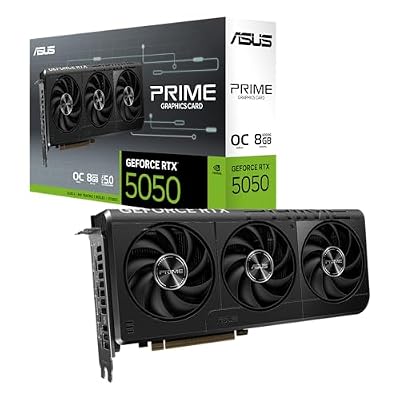

Understanding the rtx 5050 specs is the fastest way to know whether Nvidia’s cheapest Blackwell card belongs in your build. At $249 it is the most affordable path into the RTX 50 family, pairing 2,560 CUDA cores with 8GB of GDDR6 and full DLSS 4 Multi Frame Generation. But the numbers also reveal its limits: a narrow bus, an 8GB buffer, and slower memory than its siblings. This review breaks down every key spec, weighs what owners praise and criticize, and shows exactly who the RTX 5050 is really for.
RTX 5050 Specs Overview and First Impressions
The RTX 5050 is Nvidia’s entry-level 50-series desktop card, built on the Blackwell GB207 die and aimed squarely at 1080p gaming. On paper it is a modest chip, but it carries the full modern feature set of its pricier siblings, which is the heart of its appeal. Owners describe it as a cool, quiet, affordable way to run current games with DLSS 4, provided you keep your expectations at 1080p.
As an Amazon Associate we earn from qualifying purchases at no extra cost to you.


RTX 5050 Core Specs That Define It
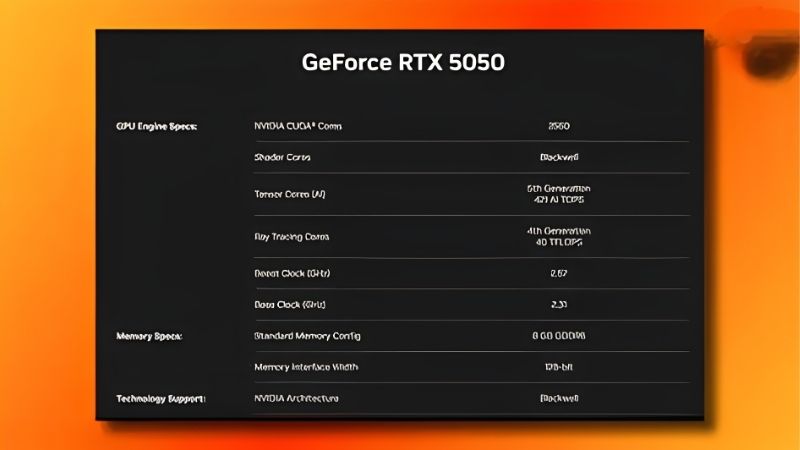
The headline numbers are straightforward. The RTX 5050 ships with 2,560 CUDA cores, 80 fifth-generation Tensor cores, 20 fourth-generation RT cores, and a boost clock around 2.57GHz, paired with 8GB of GDDR6 memory on a 128-bit bus and a 130W board power.
Two choices stand out as cost-saving measures. The desktop card uses GDDR6 rather than the faster GDDR7 found in higher 50-series models, and the 128-bit bus keeps bandwidth modest, both of which cap performance but help hit the $249 price.
The card also uses a PCIe 5.0 x8 interface and supports the full modern platform, including DLSS 4 Multi Frame Generation, AV1 encode and decode, and the latest display outputs. For a budget card, the feature list is notably complete rather than stripped down. That completeness is a deliberate part of Nvidia’s pitch, giving budget buyers the same software ecosystem as pricier cards even when the raw hardware is modest, which is a meaningful part of the value here.
What RTX 5050 Owners Praise
Aggregating the positive owner feedback, a few themes repeat. Buyers consistently praise the price-to-entry, calling the RTX 5050 the cheapest way into the RTX 50 generation and its DLSS 4 features without stretching the budget.
Efficiency and acoustics earn frequent compliments too. At 130W the card runs cool and quiet, and owners upgrading from older GTX 10-series or 16-series cards report a smooth, modern 1080p experience with high frame rates in most titles.
The third recurring positive is the feature set. Owners highlight DLSS 4 Multi Frame Generation and Nvidia’s mature software as genuine advantages over older budget cards, valuing the access to modern upscaling that keeps demanding games playable at 1080p. Several owners also note that the card has been trouble-free in daily use, the kind of quiet reliability that matters most to a first-time builder spending carefully.
What RTX 5050 Owners Criticize
The critical feedback centers on the memory and raw power. The most common complaint is the 8GB VRAM buffer, which owners note can run short in the most texture-heavy modern titles even at 1080p, limiting the card’s headroom.
Raw performance draws criticism too. In native rendering the RTX 5050 falls slightly behind the older RTX 4060 and only pulls ahead through Multi Frame Generation, which some owners feel is an uneven way to claim a performance win.
A smaller thread of criticism concerns the GDDR6 memory and narrow bus, which owners see as aggressive cost-cutting, and the fact that Nvidia did not supply review samples, leaving early buyers to rely on partner and community benchmarks rather than independent reviews. That lack of official review coverage frustrated informed buyers, who had to piece together expectations from scattered community testing, and it remains a fair criticism of how the card was launched.
What the RTX 5050 Specs Mean for Performance
Specs only matter in how they play, so here is how the RTX 5050’s numbers translate into real gaming, modern features, and 2026 value. This section connects the hardware to the experience you can actually expect.
Real 1080p Gaming Performance
At 1080p the RTX 5050 delivers a solid experience, landing roughly on par with the older RTX 3060 and often outpacing it, while sitting just behind the RTX 4060 in native rendering. For its price, that is a competent 1080p result.
Owners report high frame rates in lighter and esports titles, where the card is comfortably fast, and playable frame rates in demanding single-player games once settings are tuned sensibly. It is built for 1080p rather than 1440p, and pushing beyond that resolution quickly meets the 8GB and bandwidth limits.
The practical guidance from owners is to treat the RTX 5050 as a strong 1080p card and lean on DLSS 4 for the heaviest games. Managed that way, it delivers a smooth modern experience that belies its low price. The key is realistic expectations: buyers who treat it as a 1080p card get exactly what they hoped for, while those expecting 1440p headroom quickly meet its limits and come away disappointed.
DLSS 4, Ray Tracing and AI Features
DLSS 4 Multi Frame Generation is the experimental centerpiece of the RTX 5050’s pitch. By inserting AI-generated frames in supported titles, it can lift frame rates well beyond what the raw silicon delivers, which is how the card posts its most impressive numbers.
The honest caveat is image quality. At higher frame-generation multipliers the technique can add latency and visual artifacts, so it works best as a smoothness bonus in supported games rather than a substitute for raw rendering power, especially when the base frame rate is already low.
Ray tracing is possible but limited by the card’s modest RT hardware, so it is best reserved for lighter titles or enabled alongside DLSS. Looking ahead, the fifth-generation Tensor cores and DLSS 4 support mean the RTX 5050 should keep gaining from future driver and game updates.
RTX 5050 Price Reality in 2026
This is the section that decides value. The RTX 5050 launched at a $249 MSRP, with partner models often between $269 and $299, but a tight 2026 memory market has pushed budget GPU prices up rather than down, and component prices across PC parts have trended higher.
There is cautious good news, but it is weak and in the future. Prices have stopped climbing as steeply as they did in late 2025, and some hardware makers have reported a stretch of relative stability, while still warning that volatility is not over. For a budget buyer, the free-fall has paused rather than reversed.
Fresh supply is coming but is years away. New memory capacity, including DDR5 from Chinese suppliers and two Micron plants in Idaho, is not expected to run until 2027-2028. The practical takeaway: an RTX 5050 near its $249 MSRP with a warranty is a fair budget buy today, and waiting for a dramatic price drop is a weak strategy.
Is the RTX 5050 Worth It? Pros, Cons and Buying Advice
With the specs, performance, and pricing on the table, the verdict comes down to matching the card to the right buyer. This section gives the honest pros and cons, the build notes that prevent regret, and the tactics for landing the best deal.
RTX 5050 Pros and Cons at a Glance
The pros are compelling for the price: the cheapest entry to DLSS 4, strong 130W efficiency, cool and quiet operation, competent 1080p gaming, and a full modern feature set including AV1 and the latest display outputs.
The cons cluster around the cost-cutting: an 8GB VRAM buffer that limits headroom, a narrow 128-bit bus with slower GDDR6, native performance that trails the older RTX 4060, and a PCIe 5.0 x8 link that can lose bandwidth on older boards.
Net assessment: the RTX 5050 is an easy recommendation as a budget 1080p card for new buyers, but a weak upgrade for anyone already on an RTX 3060 or better. The specs suit first-time builders and owners of much older cards rather than recent upgraders. Read that way, the RTX 5050 is less a card with flaws and more a card with a clearly defined audience, and judging it against that audience rather than against pricier siblings is the fair way to assess it.
Who Should Buy It and Build Compatibility Notes
The ideal buyer is someone upgrading from an older GTX 10-series, 16-series, or entry RTX 20-series card, or a first-time builder wanting modern features on a tight budget. For those users the RTX 5050 is a meaningful, affordable step up.
On compatibility, the card’s modest 130W makes a 450W to 550W power supply plenty, and it pairs best with a mid-range CPU such as a current Core i5 or Ryzen 5 to avoid bottlenecks. Its low power and compact size suit small-form-factor builds well.
One caveat deserves attention: the PCIe 5.0 x8 interface means an older PCIe 3.0 motherboard runs the card at reduced bandwidth, which can trim performance. Buyers on aging platforms should factor that in before choosing the 5050 over an alternative. On a modern PCIe 4.0 or 5.0 board the point is moot, but on an older system pairing the 5050 with a card that uses a full-width slot could deliver more consistent performance for the money.
Best-Buy Tips and Final Recommendation
Practical tactics help at this tier. Target models near the $249 MSRP rather than heavily overclocked partner cards whose small gains rarely justify their markups, and check that any deal includes a solid warranty given the tight 2026 market.
If your budget can flex slightly, the RTX 5060 at $299 or the RX 9060 XT 16GB near $349 offer more performance and, in the AMD case, more VRAM, so it is worth comparing before committing to the entry card.
When you find the RTX 5050 at or near MSRP with a clean warranty, it is a sensible budget buy for a modern 1080p build. Use the link to compare current prices and availability across sellers and lock in the best deal before stock shifts.
See more:
- amd driver auto-detect tool
- nvidia geforce rtx 5080 best buy
- TechPowerUp GPU-Z
- nvidia china
- nvidia etf price
Conclusion
The rtx 5050 specs tell a clear story: this is a cool, efficient, affordable 1080p card that trades raw power and VRAM for a low price and full DLSS 4 features. It is the cheapest way into the RTX 50 generation and a genuine upgrade for owners of much older cards, though its 8GB buffer and modest bus mean it is best kept to 1080p. In a 2026 market where prices have merely flattened and real relief is years out, an RTX 5050 near its $249 MSRP is a fair budget buy. Compare current prices through the link above and secure the GPU that fits your build today.
Frequently Asked Questions
How much VRAM does the RTX 5050 have, and is 8GB enough in 2026?
The RTX 5050 ships with 8GB of GDDR6 on a 128-bit bus, not the faster GDDR7 used by the RTX 5060 and above. At 1080p with medium to high settings, 8GB is still workable in most titles, but texture-heavy games like Indiana Jones, Hogwarts Legacy and Cyberpunk 2077 with ray tracing can exceed it, forcing texture pop-in or stutter. Treat it as a strict 1080p card.
What power supply and connector does the RTX 5050 need?
The RTX 5050 has a 130W total board power and uses a single 8-pin PCIe connector rather than the 12V-2×6 plug found on higher Blackwell cards. NVIDIA recommends a 550W power supply, though a quality 450W to 500W unit from a reputable brand handles it comfortably with a mainstream six or eight core CPU. No adapter is required.
Will the RTX 5050 fit in a small form factor or prebuilt case?
Most partner RTX 5050 models are compact dual-fan cards between 200mm and 250mm long and two slots thick, so they drop into mini-ITX and slim mid-tower cases that struggle with larger GPUs. Because the card draws only 130W, it also works in prebuilt systems with modest stock power supplies, which is a common upgrade scenario for older office desktops.
Does the RTX 5050 support DLSS 4 and multi frame generation?
Yes. The RTX 5050 is a Blackwell part, so it supports the full DLSS 4 feature set including the transformer-model super resolution, ray reconstruction, and multi frame generation that inserts up to three generated frames. Multi frame generation is exclusive to the 50-series, and it is the main reason the 5050 posts much higher marketing frame rates than its raw shader count suggests.
What CPU should I pair with an RTX 5050?
Because the RTX 5050 targets 1080p, it pairs well with midrange chips like the Ryzen 5 7600, Ryzen 5 9600X, or Core i5-13400F. Anything faster is largely wasted at this tier. Note the card runs a PCIe 5.0 x8 interface, so on older PCIe 3.0 motherboards you effectively get x8 3.0 bandwidth, which can cost a few percent in demanding titles.

Write Your Review
No reviews yet. Be the first to share your experience!