
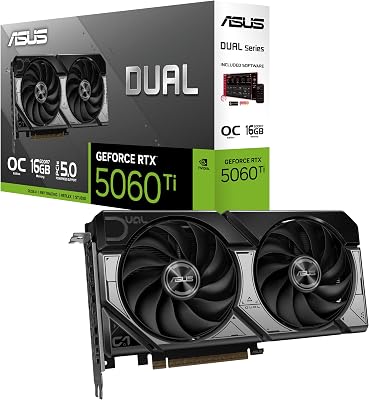
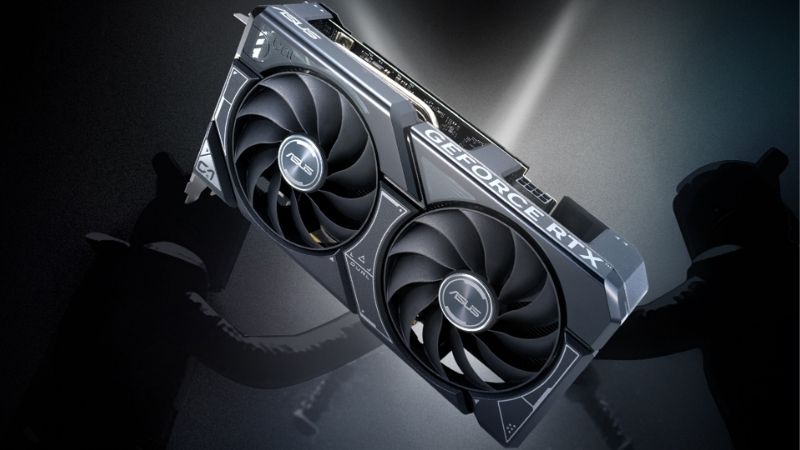
- Top Pick: ASUS Dual GeForce RTX 5060 Ti 16GB GDDR7 OC Edition Gaming Graphics Card
- Best Value: ASUS Prime GeForce RTX 5060 Ti 16GB GDDR7 Gaming Graphics Card
- Premium Choice: ZOTAC Gaming GeForce RTX 5060 Ti 16GB Twin Edge OC White Edition DLSS 4 16GB GDDR7 128-bit 28 Gbps PCIE 5.0 Gaming Graphics Card, IceStorm 2.0 Cooling, SFF-Ready, ZT-B50620Q-10M
RTX 4060 Ti 16GB vs RTX 5060 Ti 16GB is the exact fork in the road for anyone shopping the 16GB mid-range in 2026. Both cards carry the roomy frame buffer that 1440p gamers want, but one is a last-generation value play and the other is a newer, faster, DLSS 4-capable upgrade. This head-to-head cuts through the spec sheets and the marketing so you know precisely which one deserves your money today — and just as importantly, at what price.


The Quick Verdict: RTX 4060 Ti 16GB vs RTX 5060 Ti 16GB
If you want the short answer: the RTX 5060 Ti 16GB is the better card and the smarter buy at anything close to its $429 MSRP, thanks to far higher memory bandwidth and DLSS 4 Multi Frame Generation. The RTX 4060 Ti 16GB only makes sense if it is meaningfully cheaper than the 5060 Ti and you specifically want the 16GB buffer for editing or heavily modded games on a tight budget. Everything below explains why, and where the exceptions apply.
As an Amazon Associate we earn from qualifying purchases at no extra cost to you.


Keep one framing in mind throughout: these are sister cards aimed at the same buyer, one generation apart. The comparison is therefore less about which is faster — the newer one clearly is — and more about whether the price you are quoted makes the older card a genuine bargain or a quiet trap.
Who Wins on Raw Performance
The RTX 5060 Ti 16GB wins clearly. Across most 1440p titles it lands roughly 15-20% ahead of the 4060 Ti 16GB, and the gap widens in bandwidth-hungry scenes because of its GDDR7 memory. This is the newer, faster card, and no amount of tuning closes that gap on the older one.
For competitive players chasing high frame rates, that margin is the difference between comfortably clearing a refresh target and just missing it. If raw performance is your only metric, stop reading and pick the 5060 Ti.
It is also worth noting that the 5060 Ti’s lead grows as settings climb. At 1080p the two are closer, but push to 1440p with high textures and ray tracing and the newer card’s bandwidth advantage stretches the gap — which is exactly the scenario a 16GB buyer is usually building for in the first place.
Who Wins on Value Right Now
Value depends entirely on the street price you can actually find. At MSRP the 5060 Ti is the obvious pick, since it launched $70 cheaper than the 4060 Ti did while performing better. But in a market where both cards drift above their launch prices, a heavily discounted 4060 Ti 16GB can still be the rational choice for a strict budget.
The trap to avoid is paying near-5060 Ti money for a 4060 Ti. If the price gap is small, the newer card wins on every axis; only a large discount flips the math.
Specification Comparison Table
Here are the core numbers side by side, drawn from each card’s official specifications, so the technical gap is visible at a glance before we dig into what it means in real games. Pay special attention to the bandwidth and DLSS rows — they carry more weight than the near-identical core counts.
| Spec | RTX 4060 Ti 16GB | RTX 5060 Ti 16GB |
|---|---|---|
| Architecture | Ada Lovelace | Blackwell |
| CUDA cores | 4,352 | 4,608 |
| Memory | 16GB GDDR6 | 16GB GDDR7 |
| Memory bus | 128-bit | 128-bit |
| Bandwidth | 288 GB/s | 448 GB/s |
| TDP | 165W | 180W |
| DLSS Multi Frame Gen | No | Yes (DLSS 4) |
| Launch MSRP | $499 | $429 |
Deep Dive Face-Off: Architecture, Features, and Real Gaming
The table shows near-identical core counts, which is why some shoppers wrongly assume these cards are close. They are not. The differences that actually matter live in memory technology, software features, and system fit, so this is where the real comparison happens and where the newer card justifies its existence.
Architecture and Memory: GDDR6 vs GDDR7
Both cards share a 128-bit bus, but the RTX 5060 Ti 16GB pairs it with GDDR7 for 448 GB/s of bandwidth against the 4060 Ti’s 288 GB/s on GDDR6. That is a 55% bandwidth advantage from the same bus width, and it directly addresses the narrow-bus bottleneck that held the 4060 Ti back at higher resolutions and in ray-traced scenes.
The practical result is that the newer card holds its frame rates far better at 1440p and in texture-heavy titles. The 16GB buffer on both means neither runs out of VRAM in most 2026 games, so the deciding factor is how quickly each card can feed that memory — and the 5060 Ti feeds it much faster.
Move to the Blackwell architecture and you also gain generational efficiency and updated encode/decode blocks, which matter to streamers and creators as much as gamers.
None of this makes the 4060 Ti slow — it remains a competent 1080p and light-1440p card that plays today’s games well. It simply means the 5060 Ti extracts more from the same 128-bit bus and the same 16GB of memory, and that efficiency is the entire story of a worthwhile generational refresh.
DLSS 4 Multi Frame Generation: The 5060 Ti’s Real Edge
This is the feature gap that decides the matchup for many buyers. The RTX 5060 Ti supports DLSS 4 with Multi Frame Generation, an exclusive Blackwell-era capability that can multiply frame output in supported games, while the 4060 Ti is limited to the earlier DLSS feature set and cannot access Multi Frame Generation at all.
Paired with Nvidia Reflex for lower latency and an expanding library of more than 100 supported titles, this is where the 5060 Ti’s forward-looking value lives. If you care about maximizing frame rates in the newest games and want a card positioned to benefit from future driver and DLSS optimizations, the software advantage is every bit as important as the raw hardware lead.
It is worth being clear-eyed, too: frame generation adds frames, not raw responsiveness, which is why Reflex is bundled to keep latency in check. For single-player and visually rich games, that trade is a clear win.
Power, Thermals, and System Fit
From a build standpoint the two are almost interchangeable. The 4060 Ti draws 165W and the 5060 Ti 180W, so both are comfortable on a quality 550-600W power supply and slot easily into compact cases without exotic cooling.
Neither card demands a PSU upgrade for most existing mid-range systems, which removes a hidden cost from the decision and keeps the comparison focused on performance, features, and price. If you are upgrading from something like a GTX 1660 or RTX 2060, either card drops in without drama.
Price, Availability, and Market Timing in 2026
Specs decide which card is better; the market decides which card is worth buying this week. In 2026 that distinction is everything, because both of these GPUs have spent much of the year selling above their launch prices, and the reasons behind that are worth understanding before you check out.
Where MSRP Ended and Street Prices Went
The 5060 Ti 16GB launched at $429 and the 4060 Ti 16GB at $499, but rising memory costs pushed real-world prices up across the mid-range. It is common to see the 5060 Ti 16GB listed around $500-$550, while older 4060 Ti stock is priced unpredictably depending on the retailer and whether it is new or used.
Supply pressure made it worse: Nvidia moved to cut RTX 50-series production by up to 40% in early 2026, tightening availability just as demand held steady. The lesson for this matchup is to treat each card’s MSRP as the fair-price anchor and judge every listing against it, rather than against whatever the retailer happens to be asking.
One practical note specific to this matchup: because the 4060 Ti is older, its pricing swings more between new and used listings than the 5060 Ti’s does. That volatility is where the occasional genuine bargain hides, but it is also where overpriced leftover stock lingers, so the MSRP anchor matters even more when you are eyeing the older card.
Is Price Relief Coming?
There is cautiously good news. The steep climb of late 2025 has eased, and the market has shown a stretch of relative stability, though makers still warn of volatility ahead. In other words, prices have levelled off rather than actually dropped.
Longer term, new memory supply is being built — CXMT is expanding DDR5 output and Micron is constructing two Idaho fabs — but those come online around 2027-2028. So genuine relief exists on the horizon, not on the shelf, which strongly argues for buying when a card hits a fair price today rather than waiting for a crash that is years away.
The Alternative If Both Feel Overpriced
If neither 16GB card lands at a price you like, the standard RTX 5060 8GB at a $299 MSRP is the natural fallback for pure 1080p gaming, keeping DLSS 4 support while cutting cost. On the AMD side, a comparably priced Radeon in this bracket can offer strong rasterization value if you do not need Nvidia’s specific feature set.
These alternatives exist precisely so you are never forced to overpay for the “obvious” choice. Check the live price on all three before deciding — in a strange market, the compromise card is sometimes the only one sitting near its MSRP.
Just be sure you are comparing like with like. An 8GB alternative trades away the very buffer that brought you to this 16GB comparison in the first place, so it suits 1080p players far more than 1440p ones. If the 16GB capacity is non-negotiable for your workload, the real decision stays firmly between these two cards.
Final Verdict: RTX 4060 Ti 16GB vs RTX 5060 Ti 16GB
This one is not particularly close on merit. The 5060 Ti 16GB is faster, has vastly more bandwidth, and carries DLSS 4 — so the only real question is what each card costs at the moment you are ready to buy. Match the card to your budget and your resolution, and the right pick becomes obvious.
Who Should Buy the RTX 5060 Ti 16GB
Most people. If you play at 1440p, want the newest DLSS features, and can find it anywhere near $429-$500, the 5060 Ti 16GB is the confident, future-facing choice and the better long-term value. It is the card you will still be happy with two years from now.
Who Should Buy the RTX 4060 Ti 16GB
Budget builders and creators who find it clearly cheaper than the 5060 Ti and mainly want the 16GB buffer for 1080p gaming, modded titles, or light content work. If the discount is real and substantial, it remains a perfectly capable card that will not embarrass itself.
See More:
- TechPowerUp GPU
- Nvidia H200 GPU price
- RTX 5050 Mobile
- Nvidia competitors
- Nvidia Reflex low latency on or off
Pros and Cons at a Glance
The summary below distills the whole comparison into the trade-offs that actually change a purchase decision, so you can match a column to your own priorities in seconds.
| RTX 4060 Ti 16GB | RTX 5060 Ti 16GB | |
|---|---|---|
| Best for | Tight budgets, 1080p, big VRAM cheap | 1440p, newest features, best value at MSRP |
| Strength | Can be found discounted; 16GB buffer | +55% bandwidth, DLSS 4, faster overall |
| Weakness | Bandwidth-limited, no DLSS 4 MFG | Often sells above its $429 MSRP |
To wrap up the RTX 4060 Ti 16GB vs RTX 5060 Ti 16GB debate: buy the 5060 Ti 16GB unless the 4060 Ti is dramatically cheaper, in which case the older card is a fair budget compromise. Whichever you choose, prices move fast in this market, so tap the link on our site to check today’s live price and stock before you commit.
Frequently Asked Questions
How much faster is the RTX 5060 Ti 16GB in real games?
Expect roughly fifteen to twenty per cent more raster performance at 1440p. The Blackwell card keeps a similar shader count but pairs it with GDDR7 memory delivering about 448GB per second versus 288GB per second on the Ada card, and that bandwidth jump is what unlocks the gap in texture-heavy and ray traced scenes rather than raw core count.
Do both cards need the same power supply?
Close, but not identical. The 4060 Ti 16GB draws about 165W and the 5060 Ti 16GB about 180W, and both use a single conventional eight-pin PCIe connector on nearly every partner design. A quality 550W to 600W unit handles either card with a modern six or eight core CPU, so no 12V-2×6 adapter drama is involved.
Is 16GB of VRAM overkill at 1080p and 1440p?
Not any more. Games such as modern Unreal Engine 5 titles with ray tracing, high texture packs and frame generation can exceed 10GB at 1440p, and frame generation itself reserves extra memory. The 16GB buffer mainly buys longevity and lets you run maxed textures, which are nearly free in performance terms, plus local AI and video work.
Does the 5060 Ti get DLSS features the 4060 Ti cannot use?
Yes, one important one. Both support DLSS super resolution, ray reconstruction and the transformer model upgrades, but multi frame generation, which inserts several generated frames per rendered frame, is exclusive to Blackwell hardware. On the 4060 Ti you are limited to single frame generation, so headline frame rate figures for the newer card are not directly comparable.
Do the PCIe x8 interfaces cause problems on older motherboards?
Both cards use only eight PCIe lanes. On a PCIe 4.0 board that is harmless, but on an older PCIe 3.0 system the 4060 Ti loses noticeable performance in VRAM-limited scenes, while the 5060 Ti is PCIe 5.0 capable and therefore falls back further relative to its potential. Pair either with a 4.0 or 5.0 slot when possible.
Ready to decide? Our #1 pick for 2026 is the Architecture.
Live price & availability on Amazon.


Write Your Review
No reviews yet. Be the first to share your experience!