
- Top Pick: msi MAG 275CQDF X24 27-inch 2560 x 1440 (QHD) Gaming Monitor, AMD FreeSync Premium, Dual Mode with WQHD 240Hz and HD 400Hz, HDR Ready, HDMI, VGA Port, VESA, Tilt, 0.5ms, Black
- Best Value: msi MAG 255XF 25-inch 1920 x 1080 (FHD) Gaming Monitor, 300Hz, AMD FreeSync Premium, HDMI, DisplayPort, VGA Port, VESA, Tilt, Speaker, 0.5ms, Black
- Premium Choice: msi MAG 274CF X24 27-inch 1920 x 1080 (FHD) Gaming Monitor, 240Hz, AMD FreeSync Premium, HDR Ready, HDMI, VGA Port, VESA, Tilt, 0.5ms, Black
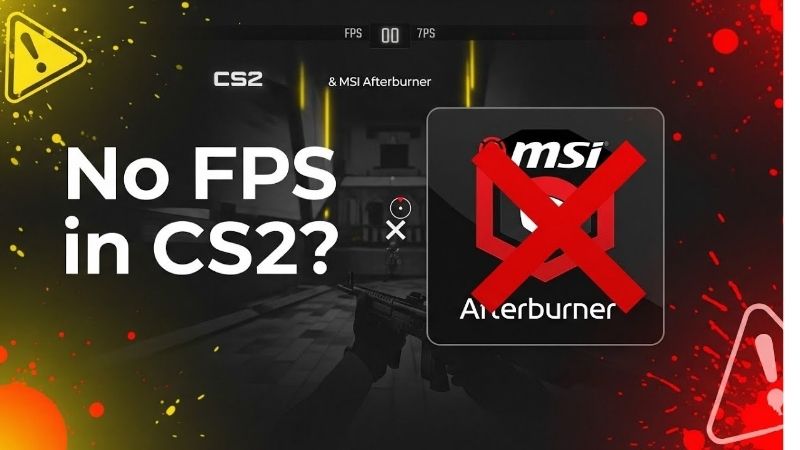
MSI Afterburner not showing FPS is almost never a problem with Afterburner. That single fact resolves most cases, and it is the reason people spend an hour reinstalling the wrong program. Afterburner does not draw the overlay — a separate application does, and if that one is not running, configured and unblocked, nothing appears no matter what you tick in Afterburner’s settings. Below are nine fixes in the order to try them, numbered so you can work through them with Afterburner open on your other monitor rather than scrubbing back through a video.
Why MSI Afterburner Is Not Showing FPS
The overlay pipeline has three parts and any one of them can break it: Afterburner collects the data, RivaTuner Statistics Server (RTSS) injects and draws the overlay into your game, and the game’s rendering API has to permit that injection. Most people only know about the first part, which is why the diagnosis usually starts in the wrong place.
The RTSS Truth: Afterburner Does Not Draw the Overlay
RivaTuner Statistics Server is bundled with Afterburner and installs alongside it, which is why nobody notices it is a separate program. It is the component that hooks into your game and renders text on top. Afterburner is just a sensor-reading and overclocking tool that hands numbers to RTSS.
The practical consequence: if RTSS is not running, your OSD does not exist. Not “is misconfigured” — does not exist. And RTSS does not always start with Afterburner, particularly after a Windows update, an Afterburner update, or if something in your startup chain reordered itself.
Check your system tray right now. If you do not see the RTSS icon there, you have found your problem and fixes 1 and 2 will solve it in under a minute.
The 60-Second Diagnostic
Work through this before touching any setting. It will tell you which of the three failure types you have.
- Is the RTSS icon in your system tray? No → failure type A (RTSS not running)
- Open RTSS. Launch your game. Does the game appear in RTSS’s left-hand application list? No → failure type B (injection blocked)
- Game appears in RTSS but no overlay on screen? → failure type C (configuration or conflict)
That is the whole diagnosis. Type A is trivial. Type B is usually anti-cheat or API detection. Type C is usually a conflicting overlay or an unset hotkey.
Which Failure Type You Have Decides Everything
This matters because the fixes are not interchangeable, and applying a type C fix to a type B problem is how people conclude the software is broken.
Type A and C are both solvable in minutes. Type B is where you may hit a wall that no configuration change gets past — some anti-cheat systems will never allow RTSS to inject, by design, and the correct response is to stop trying rather than to keep reinstalling. The last section covers which games those are.
The Nine Fixes, In the Order to Try Them
Ordered by how often they work, not by how technical they are. Most people are fixed by number three.
Fixes 1 to 3: RTSS and the Monitoring Tab
Fix 1 — Start RTSS manually. Find RivaTuner Statistics Server in your Start menu and launch it. If the overlay appears immediately, the problem was only that it was not running. Set it to start with Windows in its General settings so it does not recur.
Fix 2 — Reinstall RTSS specifically, not Afterburner. If RTSS will not launch or crashes on start, uninstall RivaTuner Statistics Server alone and reinstall it. Afterburner installers bundle a specific RTSS version, and mismatches after a partial update are a known cause. Do not reinstall Afterburner — that is the reflex, and it is the wrong program.
Fix 3 — Enable Framerate in the Monitoring tab. This is the single most common configuration mistake. Open Afterburner, click the gear icon, go to the Monitoring tab. Scroll the graph list and click on Framerate to highlight it. Then — and this is the step everyone misses — tick “Show in On-Screen Display” in the box beneath the list. Selecting the item is not the same as enabling its OSD. Apply, then OK.
If Framerate now shows but you want more, repeat for GPU temperature, GPU usage and memory usage. Each needs its own tick.
Fixes 4 to 6: Overlay Conflicts
Fix 4 — Check the OSD hotkey is actually set. In Afterburner’s settings, open the On-Screen Display tab. “Toggle On-Screen Display” is frequently unassigned by default. Assign a key you do not use in games — F10 is a common choice — and press it in-game. A surprising number of “broken” installs are simply toggled off.
Fix 5 — Disable competing overlays. Two overlays hooking the same game frequently means neither draws. The usual suspects: the Nvidia App’s performance overlay (Alt+R), Steam’s in-game overlay, Discord’s overlay, and Xbox Game Bar. Turn all of them off, confirm Afterburner works, then re-enable them one at a time to find the culprit.
Fix 6 — Set RTSS application detection level to High. Open RTSS, find Application detection level in the main settings, and change it from Low or Medium to High. This governs how aggressively RTSS hooks processes, and DirectX 12 and Vulkan titles frequently need High to be detected at all. This one fix resolves a large share of “works in some games, not others” cases.
Fixes 7 to 9: API, Admin and Display Mode
Fix 7 — Run both as administrator. Right-click each of Afterburner and RTSS, Properties, Compatibility tab, tick Run this program as an administrator. RTSS injects into other processes, and without elevation Windows blocks it for anything running elevated itself. Do this for both programs, not just one.
Fix 8 — Switch the game to borderless windowed. Exclusive fullscreen bypasses parts of the compositor and can defeat injection, particularly on Windows 11 with HDR enabled. Borderless windowed costs you nothing measurable on a modern system and frequently makes the overlay appear instantly.
Fix 9 — Add the game executable manually in RTSS. If RTSS still does not list your game, click Add in its application list and browse to the actual .exe. Watch for launcher wrappers — the file you click on your desktop is often not the process that renders. Add the real executable from the game’s binaries folder, not the shortcut.
Pros and Cons of Afterburner vs the Alternatives
Worth asking honestly, particularly if you have already spent an hour here: is Afterburner still the right tool? For some people in 2026 it is not, and there is no prize for loyalty to a monitoring overlay.
Where Afterburner Still Wins
Breadth of data, and it is not close. Per-core CPU usage, GPU power draw, voltage, fan RPM, VRAM allocation, frame times, per-game profiles, custom OSD layouts — no competitor exposes this much. If you undervolt, tune fan curves or diagnose thermal behaviour, nothing else does the job.
It is also vendor-agnostic. It works on Nvidia, AMD and Intel cards equally, which matters if you switch brands or run mixed systems. Nvidia’s own overlay does not.
And it is free, with a decade of accumulated documentation behind it — which is precisely why you found this page rather than a dead forum thread.
Where It Now Falls Behind
Setup friction is the honest complaint. Two programs, a non-obvious tick box, an unassigned hotkey, and a detection level buried in a second application. The Nvidia App shows FPS with Alt+R and no configuration whatsoever. For someone who only wants a frame counter, Afterburner is a considerable amount of ceremony.
Anti-cheat compatibility is the second issue and it is getting worse rather than better. Injection-based overlays are exactly what kernel-level anti-cheat is built to stop, and that trend has one direction.
Third: development pace. Afterburner’s release cadence has been slow for years, and support for the newest hardware sensors sometimes lags behind vendor tools by months.
Pros and Cons Summary
| Pros | Cons |
|---|---|
| Deepest sensor data available anywhere, free | Two-program architecture confuses almost everyone |
| Works on Nvidia, AMD and Intel alike | Blocked outright by several anti-cheat systems |
| Per-game profiles and fully custom OSD layout | Nvidia App does basic FPS with zero setup |
| Essential for undervolting and fan curves | Slow release cadence; new sensors lag |
| Frame time graphs, not just averages | Needs admin rights for injection to work |
The honest summary: if you only want a number in the corner, use the Nvidia App and stop reading. If you want to know why your card is throttling at 83C, keep Afterburner and finish the fixes above.
When It Is Not Afterburner’s Fault
Three situations where every fix on this page will fail, and recognising them saves you the evening you were about to lose.
Anti-Cheat That Will Never Allow It
Riot Vanguard is the clearest case. It runs at kernel level and blocks RTSS injection by design, in Valorant and increasingly across Riot’s catalogue. This is not a bug and there is no setting. Easy Anti-Cheat and BattlEye are inconsistent — some titles work, some do not, and it varies by how the developer configured it.
If your overlay works everywhere except one competitive shooter, stop troubleshooting. Use that game’s built-in FPS counter, which most now include precisely because of this.
The Nvidia App Overlay Conflict
Worth its own section because it has become the most common conflict, and because the Nvidia App is now installed on most systems by default rather than opted into.
Its performance overlay hooks the same way RTSS does. Two hooks, one game, unpredictable results. Nvidia has also been patching its own overlay’s FPS accuracy — recent release notes fix cases where the counter reported wrong values with Smooth Motion enabled — which tells you the layer is actively in flux.
Pick one. Running both is not a configuration, it is a race condition.
When Low FPS Is the Real Problem
Sometimes the overlay works fine and the number it shows is the actual complaint. If you came here because the counter vanished during a stutter, that is not an overlay failure — it is a card running out of VRAM, and the overlay is the messenger.
Add Memory usage to your OSD alongside Framerate. If allocation is pinned at your card’s ceiling during the stutters, you have diagnosed something more useful than a missing overlay. If your 8GB card is sitting at 7.9GB in modern titles, no monitoring tool will fix that — compare what a 12GB or 16GB card costs before spending more evenings on software.
See More:
- GTX 1650 vs RTX 3050
- Nvidia DIGITS
- Nvidia cuDNN
- Radeon RX 9070 XT vs RTX 5090
- PNY GeForce RTX 5080 review
Conclusion: Fixing MSI Afterburner Not Showing FPS
MSI Afterburner not showing FPS comes down to three causes in almost every case: RTSS is not running, “Show in On-Screen Display” was never ticked for Framerate, or another overlay is fighting for the same hook. Run the 60-second diagnostic first, then work the nine fixes in order — most people are done by fix three, and fixes 1 through 6 cover the overwhelming majority of everything else.
Two things to remember afterwards. Set RTSS to launch with Windows so this does not recur after the next update. And if the game is Valorant or anything on Vanguard, stop — the block is deliberate, permanent, and no amount of reinstalling will move it. Bookmark this page; the RTSS detection level fix is the one everyone forgets by next year.
Frequently Asked Questions
Why is the overlay not appearing at all?
The frame rate display comes from RivaTuner Statistics Server, not Afterburner itself, so first confirm RTSS is installed and running in the system tray. Then check that Show On-Screen Display is enabled in Afterburner monitoring tab for each item, and that the global On-Screen Display support toggle inside RTSS is set to On.
Why does it work in some games but not others?
Most often the game uses a rendering API or anti-cheat that blocks injection. In RTSS, set Application detection level to High and add the game executable as a profile. Vulkan and DirectX 12 titles sometimes need the specific per-application toggle, and UWP or Game Pass titles frequently refuse overlays outright.
Does anti-cheat software block the overlay?
Yes. Valorant with Vanguard, some Easy Anti-Cheat and BattlEye titles, and several online shooters deliberately block overlay injection because it hooks the same way cheats do. In those games use the built-in performance counter or the Nvidia app overlay instead of trying to force RTSS through.
How do I stop overlay conflicts?
Running Steam, Discord, the Nvidia app, Xbox Game Bar and RTSS overlays at once causes one or more to fail silently. Disable everything except RTSS, confirm it works, then re-enable them one at a time. Discord hardware acceleration and the Xbox Game Bar are the two most common offenders.
Do I need to run Afterburner as administrator?
Yes for most cases. Games running elevated or with anti-cheat drivers will not accept a hook from a non-elevated process. Right click both Afterburner and RTSS, choose Properties, Compatibility, and tick Run this program as an administrator so the setting persists across reboots.
As an Amazon Associate we earn from qualifying purchases at no extra cost to you.


Ready to decide? Our #1 pick for 2026 is the Deepest sensor data available anywhere, free.
Live price & availability on Amazon.

Write Your Review
No reviews yet. Be the first to share your experience!