
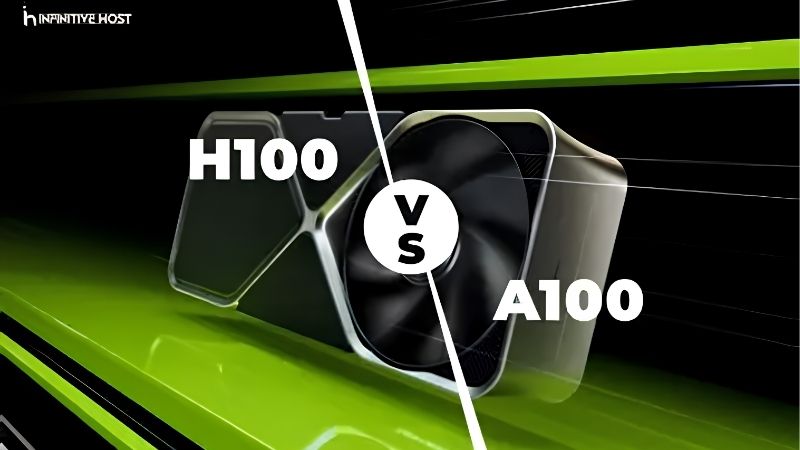
H100 vs A100 is the comparison that decides how far your AI budget stretches in 2026, because these two data-center GPUs sit at the center of nearly every training and inference cluster being built today. One is the reigning workhorse that made large-model training mainstream; the other is the faster successor that changed the economics of transformers. If you are speccing a cluster, weighing a cloud contract, or justifying a purchase order to finance, this face-off gives you the quick verdict, a hard-numbers table, and a feature-by-feature breakdown so you can decide with data rather than hype.
H100 vs A100: The Quick Verdict
For any workload built around modern transformers, the H100 wins decisively on speed and efficiency, while the A100 wins on one axis that still matters: acquisition cost, especially on the used and cloud-rental market. Below is who should pick which, so readers short on time get a straight answer before the deep dive.
Who Should Choose the H100
Choose the H100 if you train or serve large language models, run FP8 workloads, or need the lowest possible time-to-result. Its Transformer Engine and fourth-generation Tensor cores deliver several times the throughput of an A100 on transformer math, which compresses training runs from weeks into days.
The analytical case is about total cost, not sticker price. When an H100 finishes a job three to four times faster, the higher hourly or capital cost is often offset by shorter run times and fewer GPUs needed to hit the same deadline. For teams measuring cost per finished model, the H100 usually comes out ahead.
There is also a scaling argument. Faster NVLink and higher memory bandwidth mean H100 clusters lose less time to communication overhead, so the advantage widens as you move from a single node to a large distributed run where efficiency compounds.
For a startup racing competitors to ship, that speed is strategic, not just technical. Getting a model into production weeks earlier can matter more than the hardware line on the budget, and the H100 is what buys that head start.
Who Can Still Rely on the A100
The A100 remains a rational choice for established pipelines, smaller models, and budget-constrained teams that find it far cheaper per card on the secondary and cloud markets. It is a proven, stable platform with a mature software ecosystem and plentiful availability.
For inference on models that comfortably fit in 80 GB, or for research groups running many modest experiments, the A100 delivers strong value without the H100 premium. Its MIG partitioning also lets one card serve up to seven isolated instances, which is genuinely useful for shared clusters.
The trade-off is honest: you forgo FP8 and the Transformer Engine, so on the newest large models the A100 simply cannot match the H100’s throughput. It is a value play for workloads that do not need the latest speed, not a performance play.
H100 vs A100 Comparison Table
Here are the core specifications side by side, the numbers most buyers drop straight into a budget model before deciding.
| Specification | Nvidia A100 (SXM4) | Nvidia H100 (SXM5) |
|---|---|---|
| Architecture | Ampere (2020) | Hopper (2022) |
| Memory | 40 / 80 GB HBM2e | 80 GB HBM3 |
| Memory bandwidth | ~2.0 TB/s | ~3.35 TB/s |
| Tensor cores | 3rd gen (no FP8) | 4th gen + Transformer Engine (FP8) |
| NVLink bandwidth | 600 GB/s | 900 GB/s |
| MIG instances | Up to 7 | Up to 7 |
| TDP | 400 W | Up to 700 W |
H100 vs A100 Deep Dive: Feature Face-Off
The verdict is clear, but the reasons behind it decide whether the H100 premium is worth it for your specific workload. This section compares the two on the axes that actually move training and inference numbers.
Architecture, Transformer Engine, and FP8
The biggest single difference is the H100’s Transformer Engine, which combines fourth-generation Tensor cores with FP8 precision. FP8 lets the GPU process transformer layers at roughly double the rate of FP16 while preserving accuracy through dynamic scaling, a capability the A100 lacks entirely.
On paper this shows up as a large gap: the H100 delivers dramatically higher effective tensor throughput than the A100 on the same model. The experimental upside is that as frameworks like TensorRT-LLM keep tuning for FP8, existing H100 hardware continues gaining speed through software updates alone.
For the A100, third-generation Tensor cores with TF32 and BF16 were a major step in 2020, and they remain capable. But they represent the previous era of deep-learning acceleration, and on the largest models that gap is impossible to close with tuning.
It is worth being concrete about magnitude: on FP8 transformer workloads the H100’s Transformer Engine can push several times the tokens per second of an A100, and because FP8 halves memory traffic per operation, the benefit shows up in both raw speed and effective capacity.
Memory: HBM3 vs HBM2e Capacity and Bandwidth
Both cards offer 80 GB in their common configurations, so capacity alone is not the divider here. Bandwidth is: the H100’s HBM3 delivers around 3.35 TB/s versus the A100’s roughly 2.0 TB/s, and memory bandwidth is often the true bottleneck in both training and inference.
That extra bandwidth matters most for inference on large models, where feeding the Tensor cores fast enough determines token throughput. In practice, the H100 sustains higher utilization on memory-bound workloads, turning its raw compute advantage into real-world speed.
The A100’s HBM2e is still fast and more than adequate for most established workloads, which is part of why it remains popular. But when your job is bandwidth-bound, the H100’s memory is a concrete, measurable advantage rather than a spec-sheet flourish.
For inference teams sizing clusters, that bandwidth edge translates directly into fewer GPUs for the same request rate, which is exactly the kind of number that survives scrutiny in a finance review.
Real Training and Inference Throughput
Vendor and community benchmarks consistently show the H100 delivering roughly three to six times the A100’s performance on large transformer training and inference, with the widest gaps appearing on FP8-optimized workloads. Your mileage varies by model and software stack, so benchmark your own workload before ordering.
Practically, that speed changes how teams work. Faster iteration means more experiments per week and shorter feedback loops, which is a productivity gain that does not show up on a spec sheet but shapes how quickly your team ships.
For inference at scale, the H100’s throughput lowers the number of GPUs needed to meet a given request rate, which can offset its higher unit cost. On smaller models, though, the two cards converge and the A100’s lower price wins.
The honest planning move is to benchmark both on your exact model and batch size. Published multipliers are a guide, but your architecture, sequence length, and software stack determine where on the three-to-six-times range you actually land.
Value, Alternatives, Pros and Cons in 2026
Neither card exists in a vacuum, and 2026 brings market forces that should shape your timing as much as the specs shape your choice. Here is the honest financial picture, plus the alternative worth considering before you commit.
The Alternative: H200 and When to Wait
The clearest alternative to both is the H200, which keeps the H100’s compute but adds 141 GB of faster HBM3e memory. For the largest models and longest context windows, that extra capacity removes stalls the H100 can hit, making the H200 the better long-term buy if your models are growing.
Notably, the United States has moved to permit Nvidia to sell the H200 into China, which broadens demand for Hopper-class parts. For a buyer, that is a signal that waiting for looser supply of H100 or H200 is a risky assumption rather than a safe bet.
If your workloads fit comfortably in 80 GB today, the H100 remains the sweet spot; if you are pushing memory limits, budgeting for the H200 may save a painful upgrade later.
The H200’s roughly 4.8 TB/s of HBM3e bandwidth, well above the H100, is the specific reason it handles long-context inference more gracefully, so if your roadmap trends toward larger context windows, it is the more future-proof anchor for a new cluster.
Still, do not over-buy on speculation. If your current and near-term models fit in 80 GB, the H100 remains the most cost-effective choice, and the H200 premium is only justified when memory capacity is a bottleneck you can already see coming.
Market Forces: Export Changes and Memory Prices
Two forces are holding data-center GPU prices firm. The export change above adds a large new market for Hopper silicon, and broad component prices climbed steeply through late 2025 before merely leveling off since, which is a pause rather than a cut.
New memory supply is coming, with OEMs able to source DDR5 from vendors such as CXMT and Micron building two Idaho plants, but those fabs will not reach volume until 2027 to 2028. The practical read is that neither the H100 nor the A100 is likely to get dramatically cheaper soon.
For planners, that argues against waiting on a price collapse. If a card fits your roadmap and your utilization justifies it, securing capacity now protects your schedule better than chasing a discount the supply timeline does not support.
H100 vs A100 Pros and Cons
The trade-offs that recur across buyer and operator feedback, distilled for a fast decision.
H100 pros: Transformer Engine and FP8; far higher throughput; 3.35 TB/s bandwidth; faster NVLink for scaling. H100 cons: high price; up to 700 W demanding cooling; overkill for small models.
A100 pros: much cheaper per card now; proven, stable, widely available; MIG partitioning; ample for many workloads. A100 cons: no FP8; lower bandwidth; slower on modern large models; an older software roadmap.
Read together, the pattern is clear: complaints about the H100 center on cost and power, while complaints about the A100 center on hitting performance limits on modern models. Deciding which trade-off you can live with usually settles the choice.
See More:
Final Verdict and Recommendation on H100 vs A100
The H100 vs A100 decision comes down to one question: are you optimizing for the fastest results and lowest cost per finished job, or for the lowest cost per card? Buy the H100 if you train or serve modern large models, need FP8, and measure value by throughput, because it is the faster machine and often the cheaper one over a project’s life. Choose the A100 when your models are modest, your pipeline is established, and the acquisition price is the constraint that rules the budget.
Whichever way you lean, supply pressure and a stubborn memory market both favor acting on a real need rather than waiting for relief that is years out. Compare current H100 vs A100 pricing, memory configurations, and availability through the link below, and lock in the option that fits your workload before demand tightens further.
Top-Rated Picks


| Product | Brand | Rating | Reviews | Price |
|---|---|---|---|---|
| ARCTIC MX-4 (4 g) – Premium Performance Thermal Paste… | ARCTIC | ★ 4.8 | 104k | $4.99 |
| ARCTIC MX-4 (incl. Spatula, 4 g) – Premium Performanc… | ARCTIC | ★ 4.8 | 71.9k | $5.49 |
| Crucial 8GB DDR4 RAM 3200MHz (PC4-25600), Downclockab… | Crucial | ★ 4.8 | 62.8k | $74.99 |
| AMD Ryzen 5 5600X 6-core, 12-thread unlocked desktop … | — | ★ 4.8 | 30.2k | $177.60 |
| NVIDIA Shield Remote; Voice Search, Motion-Activated,… | — | ★ 4.7 | 10.6k | $25.99 |
Frequently Asked Questions
How much faster is the H100 than the A100 in real training runs?
For mixed-precision transformer training, the H100 typically delivers two to three times the throughput of an A100 at BF16, and up to four to six times when the Transformer Engine’s FP8 path is used with frameworks that support it. Gains are smallest on convolutional vision models and data-loading-bound pipelines, where CPU and storage become the limit rather than the GPU itself.
Is the A100’s 80GB of memory still enough for modern LLM work?
Yes for fine-tuning and inference of models up to roughly 70 billion parameters when quantised or sharded across several cards. The A100 80GB offers about 2 TB/s of HBM2e bandwidth versus roughly 3.35 TB/s on the SXM H100, so token generation is noticeably slower even when the model fits. Memory capacity is rarely the blocker; bandwidth usually is.
What power and cooling do these cards need?
SXM5 H100 modules draw up to 700W each and require an HGX baseboard with heavy liquid or high-static-pressure air cooling, so they are not drop-in parts. The PCIe H100 is capped near 350W and the PCIe A100 near 250-300W, both dual-slot passive cards that still need a server chassis with directed airflow rather than a desktop tower.
Can I mix H100 and A100 cards in one system?
You can install both in a single server for separate jobs, but you cannot NVLink them together because Hopper’s fourth-generation NVLink is not compatible with Ampere’s third generation. Distributed training across mixed generations also runs at the speed of the slowest card, so most operators keep the two generations in separate nodes or separate cluster partitions.
Which one gives better value per dollar today?
Used and cloud-rental A100 80GB capacity has fallen sharply, making it the cheaper choice for research, fine-tuning and batch inference where absolute latency does not matter. The H100 wins on performance per watt and per rack unit, so it pays back faster in production serving or when datacentre space and power are the constrained resources rather than the purchase price.





Write Your Review
No reviews yet. Be the first to share your experience!