
- Top Pick: GIGABYTE GeForce RTX 3060 Gaming OC 12G (REV2.0) Graphics Card, 3X WINDFORCE Fans, 12GB 192-bit GDDR6, GV-N3060 Video Card
- Best Value: msi Gaming GeForce RTX 3060 Ventus 2X 12G OC V1 Graphics Card – 15 Gbps GDRR6 Boost Clock: 1807 MHz 192-Bit HDMI/DP PCIe 4 Torx Twin Fan Ampere
- Premium Choice: GIGABYTE GeForce RTX 3060 WINDFORCE OC 12G (rev. 2.0) Graphics Card, 2X WINDFORCE Fans, 12GB 192-bit GDDR6, GV-N3060WF2OC-12GD Rev2.0 Video Card


Editor's Pick
EVGA GeForce GTX 1070 SC GAMING ACX 3.0, 8GB GDDR5, LED, DX12 OSD Support (PXOC) Graphics Card 08G-P4-6173-KR
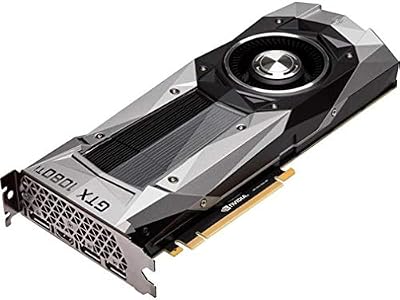


Comparing the GTX 1070 vs RTX 3060 remains a critical evaluation for budget-conscious gamers looking to modernize their PC builds without overspending. The classic Pascal architecture legendary status is tested against Ampere feature set. Below, we break down benchmarks, features, and value proposition to determine your best GPU upgrade path.
Architectural Evolution and Core Specifications Analysis
When evaluating legacy hardware against modern graphics processing units, architectural progress plays a far greater role than raw clock speeds alone. The leap from NVIDIA Pascal architecture introduced in 2016 to the Ampere generation launched in 2021 represents a massive paradigm shift in how rendering pipelines handle compute workloads. Understanding these foundational hardware changes highlights why older graphics cards struggle with modern game engines even when possessing seemingly respectable raw compute numbers.
As an Amazon Associate we earn from qualifying purchases at no extra cost to you.




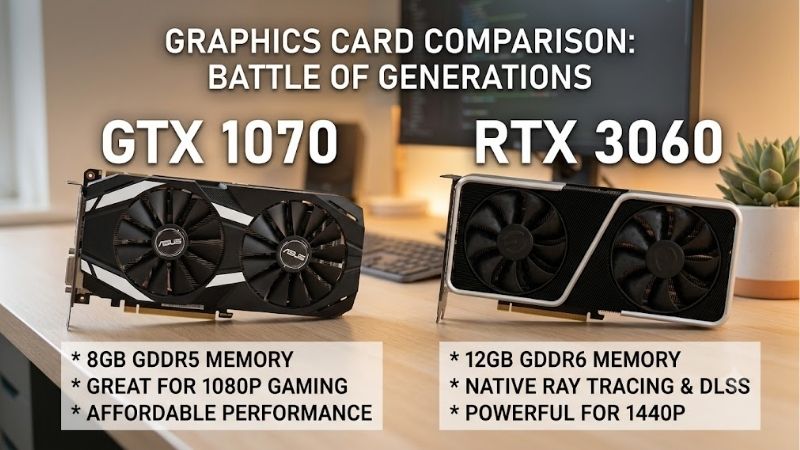
Pascal vs Ampere Architecture Differences
The GTX 1070 is constructed on the 16nm Pascal architecture utilizing the GP104 graphics processor. It features 1920 CUDA cores operating at a base clock of 1506 MHz and a boost clock of 1683 MHz. While this architecture was groundbreaking during its release, providing unprecedented power efficiency at the time, its pipeline is strictly optimized for legacy DirectX 11 and early DirectX 12 rasterization workloads. It lacks dedicated hardware units for modern real-time spatial calculations and machine learning acceleration.
In stark contrast, the RTX 3060 relies on the 8nm Ampere architecture powered by the GA106 graphics processor. It expands the core count significantly to 3584 CUDA cores, running at a base clock of 1320 MHz and boosting up to 1777 MHz. More importantly, Ampere introduces dedicated 2nd Generation Ray Tracing Cores and 3rd Generation Tensor Cores. These specialized silicon blocks handle concurrent execution of shading, ray tracing, and AI calculations, allowing the RTX 3060 to perform complex graphic algorithms that would completely paralyze older hardware.
Furthermore, Ampere benefits from revised streaming multiprocessors that offer double the FP32 throughput compared to Pascal. This structural overhaul ensures that instructions are processed with significantly reduced latency. As modern gaming engines rely heavily on asynchronous compute and complex shaders, the architectural superiority of Ampere guarantees far smoother frame delivery and fewer micro-stutters in demanding modern titles.
VRAM Buffer and Memory Bus Comparison
Memory subsystem capabilities represent another area where these two mid-range contenders diverge dramatically. The GTX 1070 comes equipped with 8GB of GDDR5 memory running across a 256-bit bus width. This configuration provides a total memory bandwidth of 256 GB/s. Back in 2016, an 8GB VRAM buffer was considered luxurious and future-proof, allowing players to run textures at maximum settings without encountering memory bottlenecks.
The standard desktop variant of the RTX 3060 upgrades this allocation significantly by featuring 12GB of GDDR6 memory paired with a 192-bit bus interface. Despite having a narrower bus width, the faster GDDR6 modules operate at 15 Gbps, yielding a superior memory bandwidth of 360 GB/s. The increased bandwidth allows rapid transfer of high-resolution asset files, while the generous 12GB VRAM buffer offers substantial protection against texture swapping stutter in memory-intensive modern games.
In contemporary gaming environments at 1080p and 1440p resolutions, high-definition texture packs and open-world asset streaming frequently exceed 8GB of video memory usage. Operating near the VRAM limit causes frame drops and texture pop-in on the GTX 1070. The 12GB buffer on the RTX 3060 ensures ample headroom for upcoming titles, rendering pipeline cache overhead, and content creation applications like 3D modeling or video editing.
Power Consumption and Thermal Requirements
Power dynamics and thermal design power ratings must be considered when upgrading components in an existing PC build. The GTX 1070 features a rated TDP of 150 watts and typically requires a single 8-pin PCIe power connector. Due to the efficiency of the Pascal architecture, cards from this generation operate relatively cool, with standard dual-fan cooling solutions comfortably keeping core temperatures under 75 degrees Celsius during heavy gaming sessions.
Conversely, the RTX 3060 possesses a higher rated TDP of 170 watts, necessitating slightly higher energy delivery. Most partner boards utilize a single 8-pin power connector, though premium factory-overclocked variants may employ an 8-pin plus 6-pin layout. The increased power draw generates additional heat output, requiring case airflow management to ensure optimal boost clock sustainability over prolonged sessions.
Despite the 20-watt increase in thermal output, the RTX 3060 delivers substantially higher performance per watt due to its advanced node process and architectural efficiency. Gamers upgrading from a GTX 1070 can usually retain their existing 500W or 550W power supply units without needing a power system overhaul, making the physical installation straightforward and cost-effective.
Real-World Gaming Performance and Ray Tracing Benchmark Face-Off
Transitioning from synthetic specifications to real-world performance reveals the tangible gap between these GPU generations. Synthetic scores provide a baseline, but actual framerates in popular titles demonstrate how games utilize modern graphics features. Below, we examine rasterization speeds, upscaling technologies, and global hardware supply trends affecting graphics card acquisition today.
1080p and 1440p Rasterization Benchmark Performance
In traditional rasterized gaming without ray tracing enabled, the RTX 3060 demonstrates a dominant lead across virtually all modern game titles at both 1080p Full HD and 1440p Quad HD resolutions. At 1080p high-to-ultra settings, the RTX 3060 delivers on average 40% to 60% higher frame rates than the GTX 1070. In fast-paced esports titles like Valorant, Counter-Strike 2, and Apex Legends, both cards easily push high refresh rates, but the RTX 3060 maintains higher 1% low framerates, ensuring smoother frametime consistency.
When shifting focus to graphics-heavy AAA titles such as Cyberpunk 2077, Red Dead Redemption 2, and Hogwarts Legacy, the performance gap becomes even more pronounced. The GTX 1070 struggles to maintain a steady 60 frames per second at 1080p medium-high settings in newer releases, often dipping into the 35 to 45 FPS range during chaotic scenes. The RTX 3060 comfortably stays above 65 to 80 FPS under identical conditions, providing a noticeably smoother gameplay experience.
At 1440p resolution, the age of the GTX 1070 becomes a severe limiting factor. Texture bandwidth constraints and reduced shader throughput force settings down to low or medium to maintain playable framerates. The RTX 3060 handles 1440p resolution far more effectively, maintaining playable frame rates across modern titles when paired with appropriate graphic preset adjustments and dynamic resolution scaling.
Check the latest price on Amazon:
- Rtx 3060 12gb Vs Rtx 4060 8gb
- Nvidia Windows 11 drivers
- 5080 vs 9070 XT benchmark
- Rtx 5050 Laptop Vs Rtx 4060 Laptop
DLSS Upscaling and Ray Tracing Capabilities
The most decisive advantage held by the RTX 3060 over its Pascal predecessor is native hardware support for NVIDIA Deep Learning Super Sampling and hardware-accelerated Ray Tracing. The GTX 1070 entirely lacks dedicated RT cores and Tensor cores. While NVIDIA unlocked software-based ray tracing for Pascal GPUs via driver updates, executing these ray calculations on standard CUDA cores results in unplayable single-digit or low double-digit frame rates.
DLSS technology utilizes deep learning neural networks processed on Tensor cores to upscale lower-resolution render targets into crisp, high-resolution outputs. In titles supporting DLSS, the RTX 3060 can boost framerates by 30% to 50% in Quality or Balanced modes with virtually no noticeable loss in visual clarity. This feature extends the longevity of the RTX 3060, allowing it to comfortably run modern titles that would otherwise overwhelm its hardware.
Check the latest price on Amazon
The GTX 1070 is restricted to spatial upscaling solutions like AMD FidelityFX Super Resolution or Intel XeSS in fallback modes. While these technologies help boost frame rates on older cards, they lack the temporal stability and image sharpness provided by hardware-accelerated AI reconstruction. The lack of DLSS support severely limits the flexibility of the GTX 1070 when attempting to run demanding current-gen releases.
Market Supply Dynamics and AI Hardware Shifts
Understanding current graphics card pricing and availability requires analyzing global hardware manufacturing priorities. Recent regulatory shifts, such as the United States government allowing NVIDIA to resume shipments of modified H200 AI accelerator chips to select international markets under strict compliance frameworks, have refocused global semiconductor manufacturing capacity. Enterprise AI hardware yields substantially higher profit margins than consumer desktop GPUs, leading wafer allocations at foundry facilities to prioritize high-margin enterprise silicon.
This prioritization directly impacts consumer graphics card production volumes across both current and previous generation architectures. As foundry allocation favors enterprise server chips, production of mid-range consumer GPUs experiences tighter inventory pipelines. Concurrently, board partners dedicate limited GDDR memory supplies toward higher-margin commercial products, preventing market oversupply and keeping retail GPU prices stable or slightly elevated.
For consumers comparing GPU options, these enterprise developments indicate that dramatic price cuts on mid-range retail cards are unlikely in the near future. Supply chain emphasis on AI hardware means consumer graphics inventories will remain tightly managed, making mid-range options like the RTX 3060 a pragmatic target before secondary market pricing reflects tight supply conditions.
| Feature / Metric | NVIDIA GeForce GTX 1070 | NVIDIA GeForce RTX 3060 |
|---|---|---|
| Architecture | Pascal (16nm) | Ampere (8nm) |
| CUDA Cores | 1920 | 3584 |
| VRAM Capacity | 8GB GDDR5 | 12GB GDDR6 |
| Memory Bus Width | 256-bit | 192-bit |
| Memory Bandwidth | 256 GB/s | 360 GB/s |
| Tensor Cores (AI) | None | 112 (3rd Gen) |
| RT Cores (Ray Tracing) | None | 28 (2nd Gen) |
| NVIDIA DLSS Support | No | Yes (DLSS 2) |
| Thermal Design Power | 150 Watts | 170 Watts |
| Recommended PSU | 500 Watts | 550 Watts |
Practical Buying Considerations, Pricing Trends, and Verdict
Navigating the PC hardware landscape requires evaluating both long-term market cost trajectories and personal performance requirements. Upgrading a graphics card is an investment that should account for upcoming game engine demands and overall system balance. Below, we analyze cost trends, pros and cons, alternative choices, and final purchasing guidance.
Component Price Inflation and Smart Buying Strategies
Broader macroeconomic factors continue to drive cost increases across the entire PC hardware ecosystem. Supply chain adjustments, rising raw material costs, and increased manufacturing expenses have pushed retail prices upward for desktop components, prebuilt gaming desktop PCs, and gaming laptops. Laptop manufacturers in particular have adjusted prices higher, driving many gamers toward desktop upgrades as a more cost-effective alternative.
These inflationary pressures mean that holding onto legacy hardware like the GTX 1070 carries an opportunity cost. As newer game releases raise minimum system requirements, older GPUs depreciate in functional utility while replacement graphics cards gradually increase in price. Upgrading to a modern feature-complete GPU provides protection against rapid software obsolescence.
Smart purchasing strategies involve timing upgrades before legacy components lose all secondary market resale value. Selling a functioning GTX 1070 on the used market can offset a meaningful portion of the purchase price for an RTX 3060. Securing a 12GB graphics card now locks in long-term 1080p and 1440p gaming capability before component prices adjust higher.
Check the latest price on Amazon
GTX 1070 vs RTX 3060 Pros and Cons Breakdown
Examining the strengths and weaknesses of each card highlights their respective value propositions for different user profiles and budgets.
NVIDIA GeForce GTX 1070 Pros:
- Proven reliability with extremely mature, stable graphics drivers.
- Lower total power draw at 150W, generating modest case thermals.
- Highly affordable on used secondary markets for extreme budget builds.
- 8GB VRAM buffer remains sufficient for basic 1080p esports titles.
NVIDIA GeForce GTX 1070 Cons:
- Complete lack of dedicated hardware for DLSS and Ray Tracing.
- Aging Pascal architecture struggles with modern DirectX 12 Ultimate titles.
- Limited GDDR5 memory bandwidth causes performance drops in new releases.
- Driver optimization priority from NVIDIA has shifted to newer architectures.
NVIDIA GeForce RTX 3060 Pros:
- Generous 12GB GDDR6 VRAM buffer offers high future-proofing value.
- Full hardware support for DLSS upscaling and real-time Ray Tracing.
- Excellent 1080p ultra and competent 1440p gaming performance.
- Modern Ampere architecture receives full driver optimization updates.
NVIDIA GeForce RTX 3060 Cons:
- Slightly higher power consumption rated at 170W TDP.
- Requires higher initial financial investment compared to used market legacy cards.
Alternative GPU Options and Final Purchase Recommendation
While comparing these two specific models is common, smart shoppers should consider market alternatives in similar price tiers. One notable candidate is the AMD Radeon RX 6600 XT or RX 6700 XT. The RX 6700 XT offers competitive rasterization speeds and 12GB VRAM, making it an attractive option for users who do not prioritize NVIDIA-specific features like CUDA acceleration or DLSS.
Another alternative within NVIDIA own lineup is the RTX 4060. Featuring the Ada Lovelace architecture, the RTX 4060 introduces Frame Generation capabilities and lower power consumption. However, it ships with an 8GB VRAM buffer on a 128-bit bus, making the older RTX 3060 12GB variant a preferred choice for buyers who prioritize VRAM capacity for texture-heavy modern games or productivity workloads.
For users currently gaming on a GTX 1070, upgrading to an RTX 3060 represents a massive quality-of-life improvement. The combination of a 50% average rasterization boost, access to DLSS feature sets, and a roomy 12GB frame buffer justifies the upgrade cost for anyone looking to play modern releases at high settings.
Check the latest price on Amazon
Conclusion
Deciding between the GTX 1070 vs RTX 3060 comes down to whether you want to continue compromising on graphical settings or unlock modern gaming experiences. The GTX 1070 remains a legendary GPU that served gamers admirably, but its lack of AI hardware upscaling and 8GB memory limits make it a bottleneck for contemporary AAA titles. Upgrading to the RTX 3060 delivers substantial performance gains, essential DLSS features, and a future-proof 12GB VRAM buffer. Given rising component pricing trends, making the leap to Ampere now ensures your rig stays capable for years to come.
Frequently Asked Questions
How much faster is the RTX 3060 than the GTX 1070?
In pure rasterization the RTX 3060 is typically around twenty-five to forty percent faster at 1080p and 1440p depending on the title, which is a solid but not enormous generational jump on its own. The far bigger practical difference comes from DLSS support and hardware ray tracing, neither of which the Pascal-based GTX 1070 can use at all.
Is the memory upgrade significant?
Yes. The GTX 1070 has 8GB of GDDR5 on a 256-bit bus, while the RTX 3060 has 12GB of GDDR6 on a 192-bit bus. The Ampere card gives up some bus width but gains four gigabytes of capacity and considerably more bandwidth, which matters increasingly in modern titles with large texture pools and at 1440p with high settings.
What do I gain from DLSS and ray tracing?
DLSS lets the RTX 3060 render internally at a lower resolution and reconstruct a sharp image, often gaining thirty to sixty percent frame rate at quality settings with little visible cost. It also reduces VRAM pressure. Hardware ray tracing enables realistic lighting and reflections in supported games, though at this performance tier you will usually combine RT with DLSS to stay playable.
Do I need a new power supply?
Almost certainly not. The GTX 1070 is rated at 150W and the RTX 3060 at roughly 170W, a small increase. Both use a single 8-pin PCIe connector on most models. A decent 550W supply covers either card in a typical build. If your existing unit is more than eight years old, however, replacement is worth considering regardless of the GPU.
Is the upgrade worth the used market price?
If you can find an RTX 3060 12GB at a fair used price, yes, particularly because the GTX 1070 is now a very old card with dried thermal pads and worn fans, and Pascal driver support is winding down. If your budget stretches slightly further, an RTX 4060 or RX 7600 delivers more performance per watt and newer feature support.

Write Your Review
No reviews yet. Be the first to share your experience!