
- Top Pick: SRhonyra GTX 1650 4GB Low Profile Graphics Card
- Best Value: XFX Speedster SWFT105 Radeon RX 6400 Gaming Graphics Card with 4GB GDDR6, AMD RDNA 2 RX-64XL4SFG2
- Premium Choice: ASRock Radeon RX 6400 Challenger ITX 4GB Graphics Card, 2321 MHz Boost Clock, AMD RDNA 2 Architecture, GDDR6, Low-Profile, Single Fan, PCIe 4.0, HDMI 2.1, DisplayPort 1.4
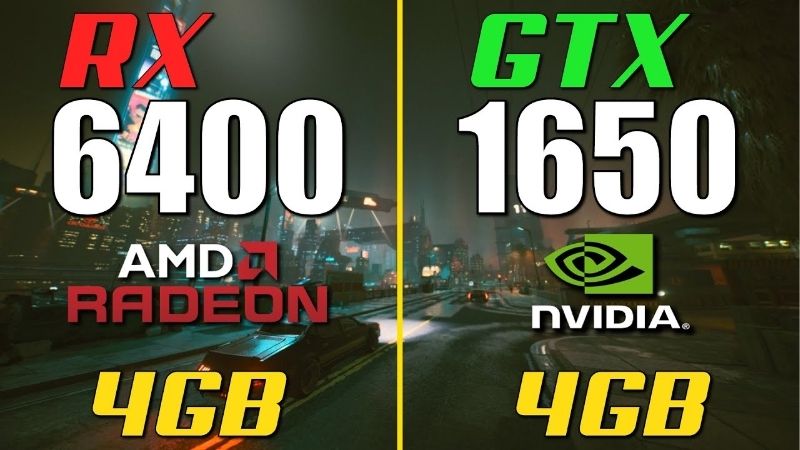
GTX 1650 vs RX 6400 is the matchup that matters most to anyone building a tiny, low-power PC with no spare power connector. Both cards run on slot power alone, both fit slim cases, and both target basic 1080p gaming. But their differences in ports, encoding, and PCIe behavior can make or break a build. This comparison lays out the specs, the real performance, and which of these two ultra-efficient GPUs is the right call in 2026.
The Quick Verdict and Full Spec Comparison
Before the details, here is the bottom line. These cards are aimed at the same niche—low-power, connector-free builds—but they reach it differently, and one carries hidden compatibility catches the other avoids. The table below shows the specs that decide whether each card is a smart fit or a frustrating one.
As an Amazon Associate we earn from qualifying purchases at no extra cost to you.




Quick Verdict: Who Wins at a Glance
For most builders, the GTX 1650 is the safer, more flexible choice. It runs at full speed on older PCIe 3.0 systems, includes a hardware video encoder, and offers more display outputs, making it the more predictable drop-in.
The RX 6400 wins on pure efficiency and size. At roughly 53W it is the lowest-power option here and ideal for the smallest, most thermally limited builds—but only if your system runs PCIe 4.0 and you do not need to record or stream.
Short version: pick the GTX 1650 for compatibility and features, and the RX 6400 only for the tiniest, lowest-power PCIe 4.0 builds.
Full Spec Comparison Table
Numbers first. These specs explain both the performance and the compatibility catches.
| Spec | GTX 1650 | RX 6400 |
|---|---|---|
| Architecture | Turing | RDNA 2 |
| VRAM | 4GB GDDR5 / GDDR6 | 4GB GDDR6 |
| PCIe interface | x16 | x4 |
| Board power | ~75W | ~53W |
| Power connector | None on most models | None |
| Hardware encoder | Yes (NVENC) | No encoder |
| Display outputs | Usually 3 | Often 1–2 |
| Typical used price | ~$100–$130 | ~$110–$140 |
The two catches to notice are the RX 6400’s x4 PCIe interface and its lack of a hardware encoder. Both are fine for some builds and dealbreakers for others, which is exactly what this comparison exists to sort out.
What the Raw Numbers Actually Mean
Raw performance between these two is close, often trading blows depending on the game. Neither is built for high settings in demanding titles; both are aimed at esports and lighter 1080p gaming on a strict power budget.
The RX 6400’s x4 PCIe interface is the key technical wrinkle. On a modern PCIe 4.0 motherboard it performs as intended, but on an older PCIe 3.0 system that x4 link is effectively halved, causing a measurable performance drop the GTX 1650 does not suffer.
The missing encoder on the RX 6400 is the other quiet factor. If you ever plan to stream or record gameplay, the GTX 1650’s NVENC support gives it a practical edge the RX 6400 simply cannot match.
Deep Dive Face-Off: Performance, Features, and Real-World Fit
With both cards this close on raw speed, the winner is decided by the details around performance—compatibility, features, and physical fit. This is where the GTX 1650 vs RX 6400 decision becomes less about frame rates and more about your specific system and needs.
Gaming Performance and PCIe Sensitivity
In esports titles at 1080p, both cards deliver playable frame rates, generally landing in a similar range on a modern platform. Differences from game to game are small enough that neither card holds a decisive raw-performance lead.
Because the two are so evenly matched on speed, small settings choices matter more than the badge on the box. Both cards prefer medium-to-high presets rather than ultra at 1080p, and both benefit from turning down memory-heavy options to stay within their 4GB buffers. Tuned sensibly, either delivers a smooth experience in popular competitive games—which is why the deciding factors end up being compatibility and features rather than a frame-rate gap.
The picture changes on older hardware. Pair the RX 6400 with a PCIe 3.0 motherboard and its narrow x4 link becomes a bottleneck, dragging frame rates down in a way that can leave the GTX 1650 clearly ahead in the exact budget systems these cards often go into.
So your motherboard generation matters as much as the GPU here. On PCIe 4.0 the two are close; on PCIe 3.0 the GTX 1650 is the safer performer.
It is worth putting numbers on that penalty. On a PCIe 3.0 board, the RX 6400’s x4 link runs at roughly half the bandwidth it gets on PCIe 4.0, and in VRAM-heavy moments that shortfall can shave a noticeable chunk off frame rates and introduce stutter. The GTX 1650’s full x16 interface sidesteps the problem entirely, which is why it is the more predictable choice for the older prebuilts these low-power cards so often land in.
Encoding, Outputs, and Feature Set
The GTX 1650 carries a hardware NVENC encoder, letting it record or stream gameplay without hammering the CPU. The RX 6400 lacks any hardware encoder, which is a genuine limitation for anyone who wants to capture footage.
Display connectivity also favors the 1650, which usually offers three outputs versus the RX 6400’s more limited one or two. For a multi-monitor budget setup, that difference is easy to overlook until it becomes a problem.
Neither card supports meaningful ray tracing or upscaling at this tier, so both are best judged on the practical features above rather than any advanced graphics tech.
The encoder gap deserves extra weight if content creation is anywhere in your plans. Streaming to Twitch, recording clips, or even smooth video calls all benefit from the GTX 1650’s dedicated encoder, which offloads that work from your processor. On the RX 6400, the same tasks fall back on the CPU or software, which is slower and can stutter on the modest processors these budget builds typically pair with.
Power, Size, and System Compatibility
Efficiency is the RX 6400’s strongest argument. At around 53W it is the lowest-power card here and often available in single-slot, low-profile form, making it perfect for the smallest and most thermally restricted builds.
The GTX 1650 is barely higher at roughly 75W and also comes in low-profile versions, so it fits most small cases too, just with slightly more heat and power draw.
Both run without a power connector, so the real physical question is how extreme your size and cooling limits are. For the absolute tiniest builds, the RX 6400 edges ahead; for everything else, the 1650’s small power premium buys useful flexibility.
Think about the exact chassis you are working with. In a slimline office desktop or a compact home-theater case with almost no airflow, the RX 6400’s roughly 53W and single-slot designs can be the difference between a card that fits and one that does not. In a normal small tower with even modest ventilation, the GTX 1650’s slightly higher draw is a non-issue, and its broader feature set becomes the deciding factor.
Value, Alternatives, and Final Verdict
With performance so close, value comes down to matching each card’s quirks to your build. Here are the honest trade-offs, an alternative if neither is ideal, and a clear recommendation based on your system.
Pros and Cons of Each Low-Power GPU
Both cards are built around tight constraints. Here is the direct breakdown.
GTX 1650
- Pros: Full-speed on PCIe 3.0, hardware encoder, more display outputs, no connector on most models, dependable compatibility.
- Cons: Slightly higher power than the RX 6400, only 4GB VRAM, no ray tracing or DLSS.
RX 6400
- Pros: Lowest power draw at ~53W, single-slot low-profile options, ideal for the tiniest builds.
- Cons: x4 PCIe penalty on older boards, no hardware encoder, fewer display outputs, 4GB VRAM.
The Alternative Pick
If neither card quite fits, there are options on both sides. For a bit more performance in a still-modest build, a used GTX 1660 or RX 6600 is a strong step up. For an even smaller, cheaper footprint, the GTX 1630 is a lower-tier alternative, though it is slower than both cards here.
For most low-power builders, the RX 6600 is the best upgrade target if your case and power supply can handle it, offering far more performance for a modest price increase.
Which alternative makes sense depends on whether you want more speed or an even tighter physical fit.
See More:
Final Verdict: Who Should Buy Which
Choose the GTX 1650 if you value compatibility and features: it runs at full speed on older systems, records and streams via NVENC, and drives more displays. For the majority of budget builders, it is the more dependable pick.
Choose the RX 6400 only for the smallest, lowest-power builds on a PCIe 4.0 platform where you do not need an encoder. In that narrow niche, its efficiency is genuinely useful.
The honest summary is that these cards serve overlapping needs but reward different systems. Match the RX 6400 to a modern, tiny, efficiency-first build, and match the GTX 1650 to older hardware or any setup where recording, extra monitors, and predictable performance matter. Get that pairing right and either card can anchor a tidy, low-power 1080p machine without surprises.
Prices on both cards move constantly, so compare live listings before you buy. You can check current deals on each option through the links on this page and grab the one that suits your system.
In the end, the GTX 1650 vs RX 6400 verdict hinges on your build’s details rather than raw speed. The GTX 1650 is the safer all-rounder thanks to full PCIe 3.0 support, an encoder, and more outputs, while the RX 6400 is the specialist pick for ultra-compact, ultra-efficient PCIe 4.0 systems. Match the card to your motherboard, your case, and your need to record, and you will avoid the compatibility traps that catch unprepared budget builders.
Top-Rated Picks


Best Seller
XFX Speedster SWFT105 Radeon RX 6400 Gaming Graphics Card with 4GB GDDR6, AMD RDNA 2 RX-64XL4SFG2
| Product | Brand | Rating | Reviews | Price |
|---|---|---|---|---|
| Cable Matters 8 Pin GPU Power Cable – 2ft, 8Pin PSU(E… | CableMatters | ★ 4.5 | 592 | $9.99 |
| Fasgear 16pin GPU Cable to 4X 8 Pin Pcie Extension – … | Fasgear | ★ 4.5 | 240 | $29.99 |
| PCIE 5.0 16Pin GPU Power 12VHPWR Extension Cable, 16P… | Bangfun | ★ 4.5 | 86 | $19.99 |
| YEZriler 8 Pin PCIe Cable for EVGA Power Supply, PCIe… | MoreOptionsForYou! | ★ 4.2 | 99 | $9.99 |
| (2-Pack) COMeap 12 Pin GPU Cable, Dual PCIe 8 Pin Fem… | COMeap | ★ 4.6 | 39 | $13.99 |
Frequently Asked Questions
Which no-connector card is faster overall?
The GTX 1650 is generally a little faster in rasterized 1080p gaming, especially the GDDR6 revision, though margins vary by title. The RX 6400 can close the gap in newer APIs on a PCIe 4.0 system but falls behind badly on PCIe 3.0 boards where its x4 link chokes.
How much power does each card draw from the slot?
The GTX 1650 has a 75W TDP, which is exactly the PCIe slot limit, so some partner models still add a 6-pin connector for headroom. The RX 6400 draws only about 53W, giving it more margin in older office prebuilts with weak power supplies and poor airflow.
Can either card be used for streaming or video encoding?
Only the GTX 1650. It includes NVENC hardware encoding, although the original TU117 revision uses the older Volta-generation encoder rather than the Turing one. The RX 6400 has no hardware encoder at all, forcing CPU encoding. For OBS streaming or video work, the GTX 1650 is the clear choice.
How many monitors can each drive?
The GTX 1650 typically offers three outputs such as HDMI, DisplayPort and DVI depending on the partner, supporting three displays. Most RX 6400 cards expose only two outputs, usually HDMI and DisplayPort. For multi-monitor office or trading setups this alone often decides the purchase.
Is 4GB of VRAM enough on either card?
For esports and older titles, yes. In modern AAA games 4GB forces low or medium textures on both cards, and the RX 6400 suffers more because its narrow PCIe x4 link makes spilling to system memory expensive. Neither card is suited to high texture settings.





Write Your Review
No reviews yet. Be the first to share your experience!