
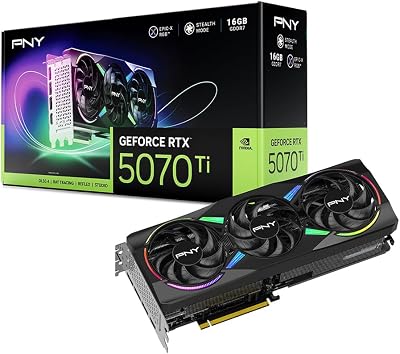
- Top Pick: GIGABYTE GeForce RTX 5070 Ti Gaming OC 16G Graphics Card, 16GB 256-bit GDDR7, PCIe 5.0, WINDFORCE Cooling System, GV-N507TGAMING OC-16GD Video Card
- Best Value: GIGABYTE GeForce RTX 5070 Ti AERO OC 16G Graphics Card, 16GB 256-bit GDDR7, PCIe 5.0, WINDFORCE Cooling System, GV-N507TAERO OC-16GD Video Card
- Premium Choice: ASUS TUF Gaming NVIDIA GeForce RTX 4070 Ti OC Edition Gaming Graphics Card (PCIe 4.0, 12GB GDDR6X, HDMI 2.1a, DisplayPort 1.4a), 3 Year Warranty
Top Rtx 4070 5070 Upgrade Battle Picks for 2026
Here are our current top rtx 4070 5070 upgrade battle picks, compared on real Amazon owner reviews, price, and features. Live prices update below.
- Top Rtx 4070 5070 Upgrade Battle Picks for 2026
- RTX 4070 Ti vs 5070 Ti: The Quick Verdict
- Deep Dive Face-Off: Benchmarks, Features, and Practical Fit
- Pros, Cons, and the Smart Third Option
- Market Forces in 2026: The Context Behind the Prices
- Recommended Products
- Final Verdict on the 4070 Ti vs 5070 Ti Matchup
- Related Guides
- Frequently Asked Questions
- Related Articles


Prime
Limited Time
ASUS SFF-Ready Prime NVIDIA GeForce RTX 5070 Graphics Card (PCIe 5.0, 12GB GDDR7, HDMI/DP 2.1, 2.5-Slot, Axial-tech Fans, Dual BIOS), 3 Year Warranty
Dropped $2.52


Lowest in 30 days
4070 Ti vs 5070 Ti looks like a simple generational matchup on paper, but the buying decision in 2026 is anything but simple: one card is a discontinued Ada favorite now circulating heavily on the used market, the other is Blackwell’s value sweet spot with 16GB of GDDR7 and DLSS 4 Multi Frame Generation. This comparison measures the real performance gap, weighs what thousands of owners report about each card, and factors in the supply and pricing forces that determine which one actually deserves your money this year.
As an Amazon Associate we earn from qualifying purchases at no extra cost to you. Product prices and availability are accurate as of the date shown and are subject to change.





RTX 4070 Ti vs 5070 Ti: The Quick Verdict
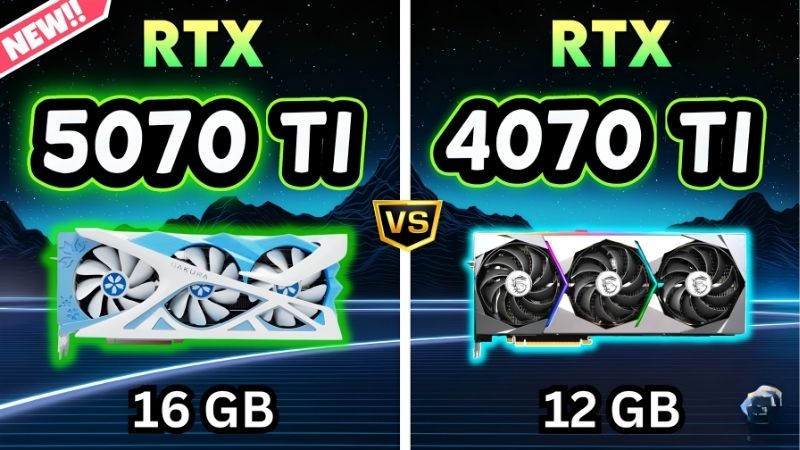
The short answer for busy readers: the RTX 5070 Ti wins this comparison comprehensively. It delivers roughly 20-25% more raster performance, carries 16GB of GDDR7 versus the 4070 Ti’s 12GB of GDDR6X, runs exclusive Multi Frame Generation, and launched at $749 — $50 below the 4070 Ti’s original $799 MSRP. The older card’s only remaining case is a genuinely cheap used listing for a 1440p-only build. If you are buying new, this is not a close call; check the RTX 5070 Ti’s current price and in-stock models on Amazon and skip the deliberation.
Specs Comparison Table at a Glance
The specification deltas below explain nearly every benchmark result that follows, so they are worth thirty seconds of attention.
| Specification | RTX 5070 Ti | RTX 4070 Ti |
|---|---|---|
| Architecture | Blackwell (2025) | Ada Lovelace (2023) |
| CUDA cores | 8,960 | 7,680 |
| Boost clock | 2.45 GHz | 2.61 GHz |
| VRAM | 16GB GDDR7 | 12GB GDDR6X |
| Memory bandwidth | 896 GB/s | 504 GB/s |
| TDP | 300W | 285W |
| Frame generation | DLSS 4 Multi Frame Gen (up to 4x) | DLSS 3 Frame Gen (2x) |
| Launch MSRP | $749 | $799 |
The headline number is memory bandwidth: 896 GB/s versus 504 GB/s, a 78% advantage that pays off most at 4K and in ray-traced workloads where the 4070 Ti’s narrow 192-bit bus was always its documented weakness.
Where the 5070 Ti Wins Outright
Every forward-looking category belongs to the newer card: 4K performance, ray tracing throughput, VRAM headroom, frame generation, encoder hardware with full AV1 support, and years of priority driver optimization still ahead of it.
It also wins on availability — it is the only card of the two still in production, with a full manufacturer warranty attached to every unit sold new.
Where the 4070 Ti Still Holds Value
The 4070 Ti remains a legitimately strong 1440p card, averaging well above 100 FPS at ultra settings in most titles, and its mature drivers are rock-stable. On the used market at $450-520, it undercuts the 5070 Ti by a wide margin.
That used price is its entire argument. At anything approaching its original MSRP, the math collapses immediately against the newer card.
Deep Dive Face-Off: Benchmarks, Features, and Practical Fit
This section compares the cards criterion by criterion using aggregated results from GPU-limited test systems, the same way a careful buyer would stack them.
Raster and Ray Tracing Benchmark Results
At 1440p ultra, the 5070 Ti leads by roughly 20%: Cyberpunk 2077 runs at 105 FPS versus 87 FPS, Horizon Forbidden West at 128 FPS versus 106 FPS, and Black Ops 6 at 178 FPS versus 148 FPS. Both cards exceed high-refresh thresholds; the newer card just does it with more headroom. That headroom also translates into quieter fan curves, since neither card needs to run near its thermal ceiling to hold target frame rates.
At 4K the bandwidth gap takes over and the lead grows to 25-30%. Cyberpunk 2077 ultra averages 67 FPS on the 5070 Ti against 51 FPS on the 4070 Ti, and in VRAM-heavy titles the older card’s 12GB buffer forces texture compromises that widen the experiential gap beyond what averages capture. With ray tracing enabled, fourth-generation RT cores stretch the advantage to 30-35% in path-traced scenes.
The 1% low numbers deserve separate mention because they expose the 4070 Ti’s structural weakness more clearly than averages do. Its 192-bit bus and 12GB buffer produce frame-time spikes in VRAM-heavy scenes that the 5070 Ti’s 896 GB/s pipeline simply absorbs; logged sessions in Indiana Jones and the Great Circle show the older card’s 1% lows dropping 30%+ behind at 4K ultra textures while averages stay only 25% apart. Smoothness, not just speed, separates these cards.
DLSS 4 and the Widening Feature Gap
The experimental dimension decisively favors Blackwell. The 5070 Ti generates up to three AI frames per rendered frame through DLSS 4’s transformer model; the 4070 Ti is permanently capped at DLSS 3’s single generated frame. In path-traced Cyberpunk 2077 at 1440p, that means roughly 190 FPS versus 110 FPS — different tiers of experience from similar silicon classes.
Both cards do receive the improved transformer upscaling model, which sharpens image quality on the 4070 Ti too, and that deserves acknowledgment. But Multi Frame Generation, Reflex 2, and the newest neural rendering features remain 50-series exclusives, and with 175+ supported titles growing monthly, the gap compounds rather than holds steady.
Creators see a parallel split: the 5070 Ti’s dual 9th-gen NVENC encoders and 16GB buffer cut 4K export times and fit larger AI models than the 4070 Ti can load at all.
Power, Size, and Build Considerations
The TDP difference is modest — 300W versus 285W — and real gaming draws land around 285W and 265W respectively. Per frame delivered, the 5070 Ti is meaningfully more efficient, roughly 15% more performance per watt. Both want a quality 750W power supply with a 12V-2×6 or adapter connection.
Physically, partner cards for both span 2.5 to 3.5 slots and 300-340mm, so case clearance depends on the specific model rather than the chip. The practical differences that matter: every new 5070 Ti includes a warranty, while most 4070 Ti units now circulating are used cards with unknown thermal pad condition and fan wear — issues that appear repeatedly in lower-star marketplace reviews.
One quantitative footnote on running costs: at similar wattage but 20-25% higher output, the 5070 Ti completes the same gaming workload with measurably less energy per frame. For a player averaging 20 hours weekly, the efficiency difference compounds into real electricity savings over a three-to-four-year ownership window — small per month, but not nothing when totaled against the price gap between a new card and a used one.
Pros, Cons, and the Smart Third Option
Synthesizing the 4-5 star praise and 2-3 star complaints from thousands of owner reviews gives each card an honest scorecard, and a third card deserves mention for budget-conscious readers.
RTX 5070 Ti Strengths and Weaknesses
Pros: arguably the best price-to-performance ratio in Nvidia’s current lineup, 16GB of fast GDDR7, full DLSS 4 Multi Frame Generation, strong 4K capability, and excellent efficiency. Owners rate it 4.6-4.7 stars, with “should have been the 5080” appearing as a recurring compliment.
Cons: street prices frequently exceed the $749 MSRP, with partner models commonly listing between $800 and $900 — the most repeated complaint by far. A minority of reviews mention coil whine at very high frame rates, and Founders-style compact models sell out faster than oversized partner designs.
RTX 4070 Ti Strengths and Weaknesses
Pros: proven 1440p performance, mature drivers, standard availability of used units, and pricing in the $450-520 range that undercuts everything comparable. Owners who bought at launch consistently describe years of trouble-free service.
Cons: the 12GB/192-bit memory configuration was criticized even at launch and ages worse each year, frame generation is capped at 2x, no new units means no warranties, and driver optimization priority has shifted to newer architectures. Several 2-3 star used-market reviews describe cards arriving with degraded cooling that required immediate maintenance.
If the used route still tempts you, the satisfied 4-5 star buyers share a recognizable pattern worth copying: they bought from listings with original packaging, stress-test screenshots, and visible purchase receipts, then verified memory temperatures under load within the return window. Buyers who skipped those steps populate the lower-star reviews — a reminder that the used discount partly prices in the labor of due diligence.
The Alternative: RTX 5070 for Tighter Budgets
If both cards stretch the budget, the standard RTX 5070 at $549 MSRP deserves a look: it lands within 15-20% of the 4070 Ti’s raster performance while carrying the full DLSS 4 feature set, 250W efficiency, and a new warranty.
For a pure 1440p build, it arguably obsoletes the used 4070 Ti unless the used price drops well below $450. Comparing all three cards’ live prices on Amazon side by side typically settles the question in minutes.
Market Forces in 2026: The Context Behind the Prices
Two ongoing developments explain why GPU prices are behaving abnormally this cycle, and they bear directly on whether waiting helps or hurts a buyer in this comparison.
H200 China Sales and GeForce Supply
The US has cleared Nvidia to sell its powerful H200 AI chip to China, unlocking enormous data center demand. Every H200 draws on the same advanced fabrication and memory supply chains that produce GeForce cards, and Nvidia’s margin incentive strongly favors the data center side.
The historical pattern after each AI demand surge has been consistent: consumer allocations tighten within one to two quarters and retail prices firm up. The 5070 Ti, already selling above MSRP, is precisely the tier this dynamic hits first.
Memory Prices Push Component Costs Upward
At the same time, laptop and component prices are on a sustained upward trend, with DRAM and graphics memory leading the climb as AI infrastructure absorbs production capacity. GDDR7 cards carry that cost pressure directly, and discontinued GDDR6X cards are not getting cheaper to replace either — used prices track new prices upward with a short lag.
Price-tracking data already shows the traditional mid-generation discount window failing to appear for 50-series cards. A fair price found today is statistically unlikely to be beaten by waiting a quarter.
What This Means for Your Purchase Timing
For new-card buyers, the conclusion is direct: when a 5070 Ti appears at or near $749-800, the supply data says take it rather than wait. For used-market hunters, the 4070 Ti’s floor is more likely to rise with the tide than to sink further.
Only buyers whose current GPU still satisfies them lose nothing by waiting — for everyone actively shopping, hesitation currently carries a measurable cost.
A simple cost-per-frame frame settles most edge cases: at typical street prices the 5070 Ti costs roughly 60-70% more than a used 4070 Ti while delivering up to 75% more effective performance in DLSS 4 titles, plus a warranty and several extra years of driver priority. Amortized over a realistic ownership span, the newer card’s premium largely evaporates — which is exactly why the used card must be genuinely cheap to stay in the conversation.
Recommended Products

PNY
PNY GeForce RTX 4070 Ti 12GB XLR8 Gaming Verto Epic-X RGB Triple Fan Graphics Card DLSS 3
View on Amazon
1 day ago
GIGABYTE
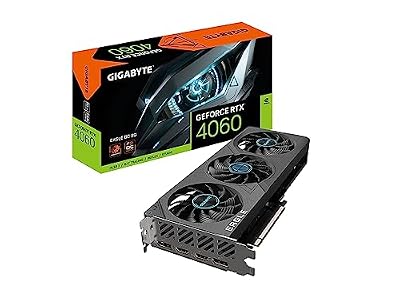
GIGABYTE GeForce RTX 4060 Eagle OC 8G Graphics Card, 3X WINDFORCE Fans, 8GB 128-bit GDDR6, GV-N4060EAGLE OC-8GD Video Card (Renewed)
View on Amazon
6 hours ago
msi
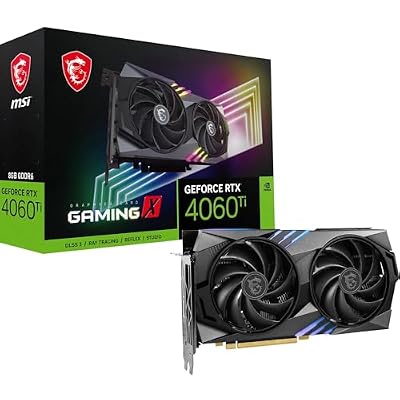
MSI GeForce RTX 4060 Ti Gaming X 8G Graphics Card – RTX 4060 Ti GPU, 8GB GDDR6 (18Gbps/128-bit), PCIe 4.0 – Twin FROZR 9 (2 x TORX Fan 5.0), RGB – HDMI 2.1, DisplayPort 1.4a
View on Amazon
1 day ago
As an Amazon Associate we earn from qualifying purchases. Product prices and availability are accurate as of the date/time indicated.
See more:
- ASUS TUF Gaming GeForce RTX 5090 3080 vs 5080
- Nvidia RTX 4070 Super graphics card
- Sapphire graphics card
- Is HDR good for gaming
- RTX 4080 vs 5070
Final Verdict on the 4070 Ti vs 5070 Ti Matchup
The 4070 Ti vs 5070 Ti comparison produces one of the clearest generational verdicts in recent memory: the RTX 5070 Ti is 20-30% faster, carries 4GB more and dramatically faster memory, runs Multi Frame Generation the older card will never receive, launched cheaper than its predecessor, and is the only one of the two you can buy new with a warranty. The RTX 4070 Ti survives strictly as a used-market value play for 1440p gamers who find it well under $500 and accept the risks that come with second-hand silicon. With AI demand tightening supply and memory costs pushing prices upward rather than down, the rational move for active buyers is to act on today’s pricing instead of betting on tomorrow’s. Compare current RTX 5070 Ti listings on Amazon now and put this matchup’s winner to work in your own build.
Frequently Asked Questions
What is the best 4070 ti 5070 ti in 2026?
The best 4070 ti 5070 ti depends on your budget and how you plan to use it. The options compared above are our top-rated picks based on real customer ratings, build quality, and overall value — start with the highest-rated model that fits your budget.
How much should I expect to spend on a 4070 ti 5070 ti?
Prices vary by brand and features. Budget options cover the essentials, while mid-range and premium models add durability, performance, and extra features. Compare the prices in the list above to find the best value for your needs.
What should I look for when buying a 4070 ti 5070 ti?
Focus on what matters most for your use case — build quality, compatibility, performance, warranty, and verified customer reviews. Every pick above is selected to balance these factors.
Are budget 4070 ti 5070 ti options worth it?
Yes. For most people a well-reviewed budget or mid-range 4070 ti 5070 ti delivers excellent value. You only need to spend more if you specifically require premium materials or top-tier performance.
How did we choose these 4070 ti 5070 ti picks?
We compare current Amazon ratings, review counts, key features, and price to surface the options with the best real-world value. The list is refreshed as ratings and availability change.
Ready to decide? Our #1 pick for 2026 is the Specification.
Live price & availability on Amazon.







Write Your Review
No reviews yet. Be the first to share your experience!