
Nvidia L40S has quietly become the card that cost-conscious AI teams reach for when an H100 is overkill but a small GPU will not cut it. It occupies a rare sweet spot: near data-center inference performance, a large 48 GB frame buffer, and a price and power profile that fit ordinary servers. If you run inference, fine-tune mid-sized models, or blend AI with graphics work, this review breaks down exactly what the L40S does well, where it falls short, and whether it belongs in your next server build.
As an Amazon Associate we earn from qualifying purchases at no extra cost to you.



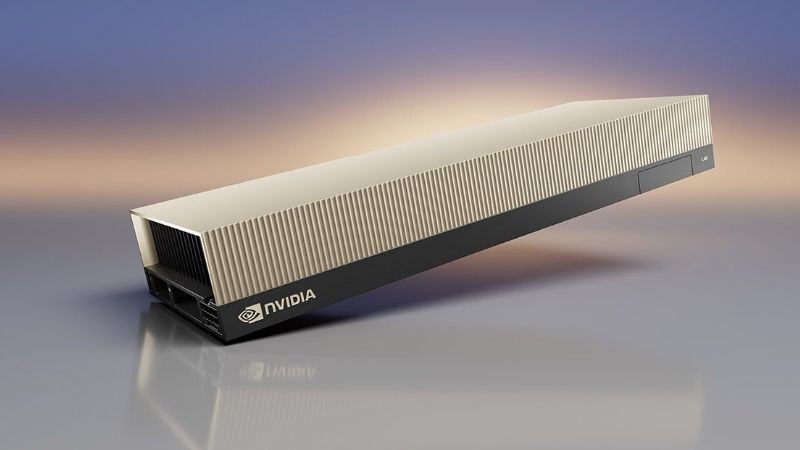
What the Nvidia L40S Brings to the Table
The L40S is built on Nvidia’s Ada Lovelace architecture, the same generation behind the RTX 40 series and professional RTX cards, but tuned for the data center. Understanding what that heritage gives you, and what it does not, is the key to judging whether the L40S fits your workload better than a Hopper card or a smaller L4.
Ada Architecture and FP8 Support
The L40S packs 18,176 CUDA cores, 568 fourth-generation Tensor cores, and 142 third-generation RT cores. Crucially, those Tensor cores support FP8 precision, which roughly doubles effective inference throughput on modern models compared to FP16, closing much of the gap to pricier accelerators.
That FP8 capability is the analytical heart of the L40S value story. It means a card built on gaming-class silicon can serve transformers efficiently, delivering a large share of an A100’s inference performance at a fraction of the cost.
The experimental upside is that as inference software matures around FP8, the L40S keeps gaining speed on the same hardware, extending its useful life well beyond its purchase date.
That matters for budgeting: a card whose real-world speed improves through driver and framework updates depreciates more slowly in usefulness, which strengthens the total-cost argument that already favors the L40S.
48 GB of Memory for Models and Graphics
The 48 GB of GDDR6 memory with ECC is the L40S headline. It comfortably holds mid-sized language models, diffusion models, and large scenes, letting a single card serve workloads that would not fit on a 24 GB board.
That headroom also future-proofs you: as models and scenes keep growing, 48 GB buys years of runway that a 24 GB card cannot, deferring the day you are forced to upgrade.
That capacity does double duty. For AI, it fits the model plus its key-value cache; for graphics and rendering, it holds complex scenes and high-resolution assets, which is why the L40S appeals to studios running both kinds of work on one platform.
The practical caveat is that this is GDDR6, not the HBM found on data-center training cards. Capacity is generous, but memory bandwidth trails HBM parts, which shapes where the L40S shines and where it does not.
In practice this means the L40S is memory-rich but bandwidth-moderate: it will happily hold a large model, but the rate it streams data limits the very largest, latency-critical serving jobs, which is exactly the boundary buyers need to understand.
Where the L40S Fits vs L4 and A100
Against the L4, the L40S offers far more compute and double the memory, making it the choice for larger models and heavier throughput, while the L4 wins on power efficiency for small-model serving. They are complementary, not competitors.
Against the A100, the L40S trades HBM bandwidth for a lower price and FP8 support. For inference it is often the smarter buy; for large-scale training, the A100’s bandwidth and interconnect still lead. Knowing which side of that line your workload sits on decides the purchase.
A useful shortcut: if your workload is inference or mixed AI-and-graphics, start with the L40S; if it is large-scale training, start with a Hopper card; and if it is high-volume small-model serving, start with the L4. The L40S owns the versatile middle.
That middle is also where most real budgets live, which is why the L40S has spread so quickly through inference clusters that cannot justify Hopper pricing but need more than an entry card delivers.
Nvidia L40S Performance in Real Deployments
Specifications set expectations; deployment shows what actually happens in your rack. Across the workloads the L40S targets, the pattern in operator feedback is consistent, and it clarifies exactly who should buy this card.
AI Inference and Fine-Tuning
For inference, the L40S is the card’s strongest suit. With FP8 and 48 GB, it serves mid-sized models with strong throughput per dollar, which is why it has become a default recommendation for cost-aware inference clusters.
For fine-tuning and smaller training runs, it is capable but not a training powerhouse; the lack of HBM bandwidth and NVLink means large distributed training is better served by Hopper or Ampere data-center cards. Match the tool to the task and the L40S rewards you.
Fine-tuning smaller models and running retrieval-augmented inference are both comfortable here, so teams building practical AI features rather than training foundation models tend to find the L40S covers most of their day-to-day needs.
Throughput scales well with batching too, so tuning batch size to your latency target is the single most effective way to squeeze more requests per second out of each L40S in production.
Operators frequently praise the balance of performance, memory, and cost, while the most common complaint is that people expected training-card behavior from an inference-and-graphics card and were surprised by the bandwidth ceiling.
Read that as guidance, not a warning: buyers who scoped the card to inference and graphics report strong satisfaction, and the disappointed minority almost always expected training-card bandwidth from a card never built to deliver it.
Graphics, Rendering, and Omniverse
Because it keeps full RT cores, the L40S is a genuine graphics and rendering card as well as an AI accelerator. It handles rendering, virtual workstations, and Omniverse workloads well, making it a flexible choice for organizations that need both AI and visualization.
This versatility is a real practical advantage. A single L40S deployment can serve inference during peak hours and rendering or virtual desktops otherwise, improving utilization and spreading the card’s cost across more kinds of work.
For universities, media companies, and enterprises with mixed needs, that flexibility is a procurement win, letting one standardized card serve several departments instead of buying specialized hardware for each.
Power, Cooling, and Server Compatibility
At around 350 W in a dual-slot, passively cooled data-center form factor, the L40S slots into standard servers without the exotic power and cooling an H100 demands. That is a large part of its total-cost appeal.
Before buying, confirm your server supports the L40S thermal and power profile, since it relies on chassis airflow rather than its own fans. Get that right and it drops into mainstream infrastructure cleanly, which lowers deployment cost and risk.
Because it needs no exotic power or liquid cooling, an L40S rollout rarely triggers a facilities project, which is a quiet but real saving compared with deploying 700 W accelerators that can force rack and cooling upgrades.
Buying the L40S in 2026: Value, Market, and Pros and Cons
The L40S makes the most sense when viewed as a value and versatility play rather than a raw-performance flagship. Two market realities in 2026 also shape whether now is a good time to buy, and both reward decisiveness over waiting.
Why the L40S Is a Value Sweet Spot
The core argument is efficiency of spend. For inference and mixed workloads, the L40S delivers most of the practical performance teams need at a meaningfully lower price and power draw than a Hopper card, which is exactly what a cost-per-request-minded buyer wants.
It also consolidates roles. Buying one card type that handles inference, rendering, and virtual workstations simplifies procurement and support, and that operational simplicity is worth real money over a deployment’s life.
Fewer part numbers to stock, one driver path to validate, and a single support relationship all reduce the hidden overhead that inflates the true cost of a fleet, and that is where the L40S quietly pulls ahead of a mixed-hardware estate.
Memory Prices and Buying Timing
The main external factor is the memory market. Component and memory prices spiked through late 2025 before leveling off, and while that plateau is welcome, it is a pause and not a price cut, so a 48 GB card like the L40S stays exposed to elevated memory costs.
New supply is on the way, with OEMs able to source DDR5 from vendors such as CXMT and Micron building two Idaho plants, but those fabs will not reach volume production until 2027 to 2028. The measured takeaway is that L40S pricing is unlikely to fall much soon, so if it fits your workload, buying now beats waiting on relief that is years out.
The broader trend of component prices drifting upward reinforces this: when the whole market is priced for scarcity, today’s L40S quote is likely close to the best you will see before new memory capacity comes online later in the decade.
For an L40S buyer weighing timing, the practical conclusion is simple: the memory market will not rescue your budget in the near term, so if the card fits your workload, the productivity you gain by deploying now outweighs speculative savings that may never arrive.
Nvidia L40S Pros and Cons
The ownership picture distilled for a quick decision.
Pros: 48 GB memory with ECC; FP8 support for efficient inference; strong performance per dollar and per watt; genuine graphics and rendering ability; drops into standard servers at around 350 W.
Cons: GDDR6 bandwidth trails HBM training cards; no NVLink for large distributed training; not ideal for the biggest training runs; pricing held up by an elevated memory market into 2027.
See More:
Final Verdict: Is the Nvidia L40S Worth It?
For teams that need efficient inference, mid-sized model serving, or a single card that spans AI and graphics, the Nvidia L40S is one of the smartest-value data-center GPUs available, delivering most of the performance that matters at a far friendlier cost than a flagship. If your priority is large-scale training that demands maximum memory bandwidth, a Hopper or Ampere card is the better tool.
For most organizations, though, the honest truth is that the workloads they actually run are inference and mixed AI-and-graphics, which is precisely the L40S sweet spot rather than the exception.
Buy it for what it is, an efficient and versatile inference and graphics card, and it consistently rates as one of the best-value data-center GPUs of its generation.
If the L40S fits your workload, a firm memory market means waiting is unlikely to reward you. Check the latest Nvidia L40S pricing, availability, and server compatibility through the link below and secure the value while supply lasts.
Top-Rated Picks


| Product | Brand | Rating | Reviews | Price |
|---|---|---|---|---|
| ARCTIC MX-4 (4 g) – Premium Performance Thermal Paste… | ARCTIC | ★ 4.8 | 104k | $4.99 |
| ARCTIC MX-4 (incl. Spatula, 4 g) – Premium Performanc… | ARCTIC | ★ 4.8 | 71.9k | under $10 |
| Crucial 8GB DDR4 RAM 3200MHz (PC4-25600), Downclockab… | Crucial | ★ 4.8 | 62.8k | under $80 |
| AMD Ryzen 5 5600X 6-core, 12-thread unlocked desktop … | — | ★ 4.8 | 30.2k | under $200 |
| NVIDIA Shield Remote; Voice Search, Motion-Activated,… | — | ★ 4.7 | 10.6k | under $30 |
Frequently Asked Questions
What are the L40S key specifications?
The L40S is an Ada Lovelace data center card with 48GB of GDDR6 with ECC, around 350W board power, and a dual-slot passive cooler. It combines strong RT cores, fourth-generation tensor cores with FP8, and AV1 encode and decode, making it a genuine mixed graphics and AI accelerator.
How does the L40S compare to an A100?
The A100 uses HBM2e with far higher memory bandwidth, supports MIG and NVLink, and remains stronger for large-scale training. The L40S uses GDDR6 with lower bandwidth but offers 48GB, better graphics and ray tracing, AV1 encoding, and usually a much lower price for inference and rendering.
Does the L40S support NVLink?
No. Like other Ada-generation cards it has no NVLink, so multiple L40S cards communicate over PCIe and keep separate memory pools. That limits model-parallel training efficiency, which is why it is positioned primarily for inference, fine-tuning and visualization rather than very large distributed training.
What cooling does the L40S require?
It is passively cooled and depends entirely on chassis airflow, so it must be installed in a server designed for 350W passive accelerators. Placing one in a standard workstation without directed high-pressure airflow will cause severe throttling or thermal shutdown regardless of ambient room temperature.
Is the L40S good value for AI inference?
Generally yes. The 48GB capacity accommodates large models on a single card, FP8 support improves throughput, and pricing is well below HBM-based accelerators. For memory-bandwidth-bound workloads an HBM card still wins, so benchmark your specific model before committing to a large deployment.
Ready to decide? Our #1 pick for 2026 is the ARCTIC MX-4 (4 g) – Premium Performance Thermal Paste….
Live price & availability on Amazon.

Write Your Review
No reviews yet. Be the first to share your experience!