
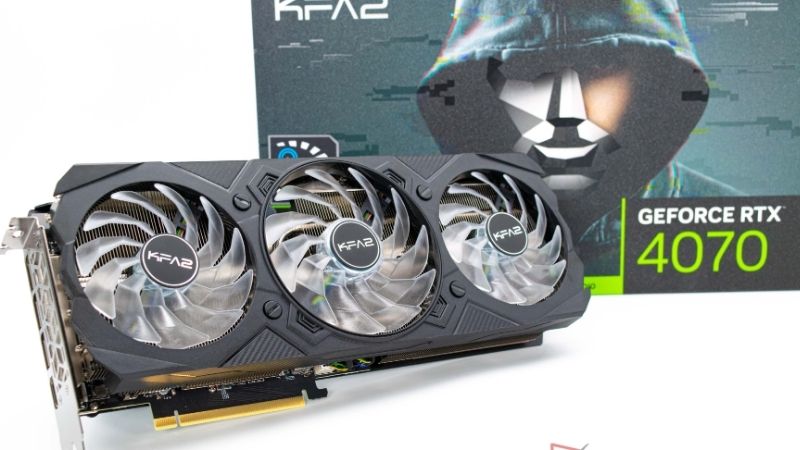
The GeForce RTX 4070 launched in April 2023, roughly six months after the RTX 4090 opened the Ada Lovelace generation. It was NVIDIA’s first 70-class card of that series, and it arrived after the RTX 4070 Ti, which meant the sequence of the lineup looked a little backward compared with earlier generations. If you want the exact day-level date for your region, check NVIDIA’s original announcement page, because retail availability could differ slightly by country.
- Where the RTX 4070 Fit in the Ada Lovelace Rollout
- What the RTX 4070 Replaced
- Key Launch Specs
- What Came After: The Super Refresh and the RTX 50 Series
- Is the RTX 4070 Still Relevant Today?
- Upgrade Paths From and To the RTX 4070
- Who Should Buy or Skip It
- Release Date Research Checklist
- Frequently Asked Questions
- Related Guides
This guide covers the launch timeline, the headline specs that defined the card, what NVIDIA released after it, and whether it still makes sense today. The short version: it was a power-efficient 1440p card on release, it has since been refreshed and then replaced, and it now matters mostly as a used or leftover-stock option.
Where the RTX 4070 Fit in the Ada Lovelace Rollout
NVIDIA did not release the 40 series all at once. It staggered the cards from the top down, and the order is the key to understanding why the 4070 felt like a later arrival.
| Card | Launch window | Role in the lineup |
|---|---|---|
| RTX 4090 | October 2022 | Flagship, first Ada card |
| RTX 4080 | November 2022 | High-end, 16GB |
| RTX 4070 Ti | January 2023 | Upper-mid, 12GB |
| RTX 4070 | April 2023 | Mid-range, 12GB |
| RTX 4060 Ti | May 2023 (8GB), July 2023 (16GB) | Mainstream |
| RTX 4060 | mid 2023 | Entry gaming |
The RTX 4070 Ti itself had a messy history: it began life as a 12GB model that NVIDIA first called an RTX 4080 and then withdrew from that name before relaunching it as the 4070 Ti. That is why the plain 4070 trailed it by a few months despite sitting below it in the stack.
What the RTX 4070 Replaced
The card was positioned as the successor to the RTX 3070, which had launched in the fall of 2020. NVIDIA’s pitch was that the 4070 could reach roughly the performance class of the older RTX 3080 in many games while using far less power, helped by the efficiency of the newer manufacturing process and the addition of DLSS 3 frame generation. Treat any exact percentage claim carefully, since results vary by game and settings, but the efficiency story was the real selling point.
Compared with the RTX 3070, the 4070 also moved from 8GB of memory to 12GB, which addressed one of the most common complaints about the older card as game memory demands grew.
Key Launch Specs
These are the main specifications buyers cared about. For board-specific details such as boost clocks, cooler size, and connector type, always check the individual manufacturer page.
- Architecture: Ada Lovelace, with fourth-generation Tensor cores and third-generation RT cores.
- CUDA cores: 5,888.
- Memory: 12GB of GDDR6X on a 192-bit bus.
- Board power: 200 watts for the reference specification, a notably low figure for a card of its class.
- Recommended power supply: a 650-watt unit is the class NVIDIA listed.
- Features: DLSS 3 with frame generation, AV1 hardware encoding, and support for the PCIe 4.0 interface.
- Outputs: typically three DisplayPort connectors and one HDMI port on reference-style boards.
The low power rating is the detail that aged best. A 200-watt card fits into compact cases and modest power supplies far more easily than the flagship cards of the same era, which is part of why it remains popular in small builds.
What Came After: The Super Refresh and the RTX 50 Series
NVIDIA followed the original card with the RTX 4070 Super in January 2024, which added more CUDA cores at a similar memory configuration and effectively took over the 4070’s slot. That made the original less attractive for new buyers once the Super variant was available at similar pricing, and it is the reason many retailers reduced the original’s visibility over time.
The next full generation arrived with the RTX 50 series. The RTX 5070 launched in March 2025 as the direct successor in naming, built on the Blackwell architecture with GDDR7 memory. For buyers shopping today, the practical question is no longer which 4070 to choose but whether a 4070 variant is cheaper than a 5070 in the same condition.
Is the RTX 4070 Still Relevant Today?
As of late 2026, the card remains a capable 1440p option, and 12GB of memory is still adequate for most current titles at high settings, though the most demanding games at maximum texture quality can push close to that limit. It also keeps DLSS 3 frame generation, though it does not support the multi-frame generation feature that NVIDIA reserved for the RTX 50 series.
Its strengths are efficiency and compatibility: low power draw, modest cooling needs, and broad driver support. Its weaknesses are the limited memory bus and the fact that newer cards give better features for the money when the price gap is small. The card makes the most sense when it is discounted, used, or already in your system.
Upgrade Paths From and To the RTX 4070
Knowing where the 4070 sits in time helps you decide whether to move to it or away from it. Owners of cards from the GTX 10 series, the RTX 20 series, or the RTX 3060 class see a large improvement, because those generations lack frame generation and have less efficient hardware. Owners of an RTX 3070 or RTX 3080 see a smaller change in raw speed, with the main gains being 12GB of memory (versus 8GB on the 3070), lower power draw, and the newer feature set.
Moving away from the 4070 is a different question. Someone who bought it at launch and plays at 1440p is unlikely to need a replacement unless a specific game demands more memory or the newer multi-frame generation technology. In that case, the RTX 5070 or the step above it is the logical route, and the original 4070 can find a second life in a secondary PC or be sold on the used market. Because the card draws so little power, it is also a popular choice for streaming or media machines that need strong encoding support without a large power supply.
One more detail worth remembering is the interface. The card uses a PCIe 4.0 connection, but it works in older PCIe 3.0 slots with only a small effect for most games, which makes it a practical drop-in upgrade for older platforms that still have a capable processor.
Who Should Buy or Skip It
The 1440p gamer on a budget
If you play at 1440p with a high refresh rate monitor and are willing to use DLSS in demanding titles, a used or discounted RTX 4070 is a sensible match. Check that the price sits clearly below an RTX 4070 Super, because the Super is the better card in the same family.
The small-form-factor builder
If your case is compact or your power supply is limited, the 4070’s low board power makes it one of the easiest cards in its performance class to cool and power. Look for short-length models designed for small cases.
The buyer who wants the newest features
If you want the latest frame generation technology and GDDR7 memory, skip the 4070 and look at the RTX 50 series. Paying for an older generation only makes sense when the savings are meaningful.
Release Date Research Checklist
- Confirm the exact launch date for your region on NVIDIA’s announcement page.
- Do not confuse the RTX 4070, the 4070 Super, and the 4070 Ti. They are three separate cards with different specs.
- Check the memory size and type on any listing before buying.
- Compare the original 4070 with the 4070 Super and the 5070 at similar condition.
- Verify your power supply wattage and connector type against the board maker’s requirements.
Frequently Asked Questions
When was the RTX 4070 released?
It launched in April 2023, after the RTX 4090, RTX 4080, and RTX 4070 Ti. Check NVIDIA’s official announcement for the precise day in your region.
Is the RTX 4070 the same as the 4070 Super?
No. The 4070 Super arrived in January 2024 with more CUDA cores and slightly higher board power. They share the same memory capacity and general design, but the Super is the faster card.
Did NVIDIA replace the RTX 4070?
Yes, first with the 4070 Super in the same generation and then with the RTX 5070 in the RTX 50 series. The original card remains supported with drivers and is still sold in some channels.
How much power does the RTX 4070 need?
The reference specification is 200 watts, and NVIDIA lists a 650-watt power supply as the recommended class. Check the manufacturer page for your specific model, since some partner boards differ.
Related Guides
- RTX 4070 Reviw: Is This the Ultimate Mid-Range Graphics Card?
- RTX 4070 8GB
- ITX RTX 4070 Review 2026: Best Short Cards for Small PCs
- Nvidia RTX 4070 Price: Is This GPU Still Worth Buying Today?

Write Your Review
No reviews yet. Be the first to share your experience!