
The Short Answer
For most people asking how much VRAM do AI models need, the practical answer is 12GB to 24GB. A 12GB graphics card can handle smaller language models, image generation, transcription, embeddings, and many everyday local AI tasks. A 16GB card offers more comfortable headroom for larger image sizes, longer prompts, and multitasking. A 24GB card is the sweet spot for serious home AI use, including many quantized 30B- to 34B-parameter language models and more demanding creative workflows.
VRAM is the fast memory built into a graphics card. It holds the AI model, the active prompt or image data, and temporary working data while the model runs. When there is not enough VRAM, software may slow down by moving data into regular system RAM, reduce the model size, shorten the context window, or refuse to load the model altogether.
As an Amazon Associate we earn from qualifying purchases at no extra cost to you. Product prices and availability are accurate as of the date shown and are subject to change.


For a first AI-focused desktop in 2026, plan around 16GB if your work is casual to intermediate and 24GB if you expect to run local models regularly. Larger capacities—48GB, 80GB, and beyond—are primarily for professional workstations, shared model servers, training, and very large models.
Standard Sizes
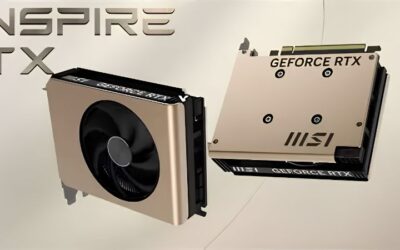
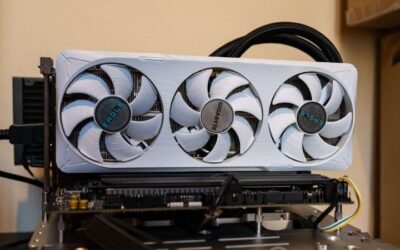
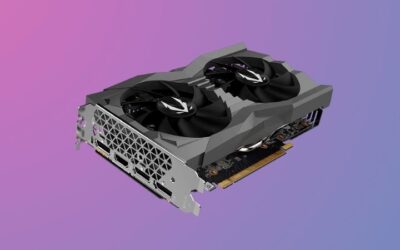
VRAM capacity is measured in gigabytes, but the physical size of the graphics card matters just as much when planning a desk setup, tower, cabinet, or media console. Most AI-capable cards use a full-height PCIe slot, yet their length and thickness vary dramatically. Measure both the card and the case clearance before buying.
| VRAM Tier | Typical AI Use | Typical Graphics Card Dimensions | Recommended Case Clearance | Typical Power Draw |
|---|---|---|---|---|
| 8GB to 12GB | Small models, image generation, transcription, coding assistants | 9 to 12 in. L × 4.4 to 5.4 in. H × 1.6 to 2.4 in. W 22.9 to 30.5 cm L × 11.2 to 13.7 cm H × 4.1 to 6.1 cm W |
12.5 in. / 31.8 cm length; 2.5-slot width | 160 to 250W |
| 16GB | Comfortable local image work, medium models, longer sessions | 10.5 to 13.5 in. L × 4.4 to 5.5 in. H × 2 to 2.8 in. W 26.7 to 34.3 cm L × 11.2 to 14 cm H × 5.1 to 7.1 cm W |
14 in. / 35.6 cm length; 3-slot width | 200 to 320W |
| 24GB | Advanced local AI, larger quantized language models, creative production | 11 to 14 in. L × 4.4 to 5.8 in. H × 2.4 to 3.5 in. W 27.9 to 35.6 cm L × 11.2 to 14.7 cm H × 6.1 to 8.9 cm W |
14.5 in. / 36.8 cm length; 4-slot width | 320 to 450W |
| 48GB and above | Professional models, multi-user service, fine-tuning, heavy research | 10.5 to 12.5 in. L × 4.4 to 5.5 in. H × 1.5 to 2.8 in. W 26.7 to 31.8 cm L × 11.2 to 14 cm H × 3.8 to 7.1 cm W |
13 in. / 33 cm length; airflow on all sides | 250 to 700W per card |
As a rough model-memory guide, a 7B- to 8B-parameter model often fits in 6GB to 10GB when heavily quantized, while a 13B- to 14B-parameter model commonly needs about 10GB to 16GB. A 30B- to 34B-parameter model can require roughly 20GB to 24GB in a compact quantized format. These figures are not fixed: model format, context length, software, and additional features all change the final requirement.
How to Measure Your Space
- Measure the desktop tower location. Allow at least 6 inches (15.2 cm) behind the case for cables and 3 inches (7.6 cm) at the intake and exhaust sides. A powerful AI workstation should not be pressed tightly into a bookcase cubby.
- Check internal GPU length clearance. Open the case or read its specifications. Measure from the rear expansion-slot bracket to the first obstruction, such as front fans, a radiator, or drive cage. Add 0.5 inch (1.3 cm) beyond the listed card length.
- Measure width, not only length. A thick 3.5- or 4-slot card can block adjacent PCIe slots. It can also sit close to the case side panel, leaving little room for power connectors. Reserve 1.5 inches (3.8 cm) above the card for a safe cable bend.
- Confirm desk load capacity. A complete AI desktop with a large GPU, cooling hardware, and power supply commonly weighs 30 to 55 pounds (13.6 to 24.9 kg). Choose a desk rated for at least 75 pounds (34 kg) if it will also support monitors and accessories.
- Plan the electrical load. A 750W power supply is a common starting point for a 12GB to 16GB card, while 850W to 1,000W is often appropriate for a high-power 24GB build. Use a grounded wall outlet and avoid overloading a crowded power strip.
- Leave room for heat. Put the tower on a hard floor or desktop rather than thick carpet. Avoid enclosed cabinets unless the enclosure has generous ventilation; a minimum 2-inch (5.1 cm) gap is better than no gap, but 3 to 6 inches (7.6 to 15.2 cm) is preferable.
By Room or Use Case
Small Home Office: 12GB to 16GB
For a compact office, a 12GB or 16GB card is usually the most sensible choice. It supports local chat models in smaller sizes, document summarization, voice transcription, image generation, and AI-assisted coding without demanding an oversized tower. Look for a case around 16 to 19 inches (40.6 to 48.3 cm) tall and 8 to 9 inches (20.3 to 22.9 cm) wide. A desk footprint of at least 48 × 24 inches (121.9 × 61 cm) leaves room for a monitor, keyboard, and adequate airflow.
Creative Studio: 16GB to 24GB
Designers, video editors, and frequent image-generation users benefit from 16GB at minimum, with 24GB providing a smoother margin for larger canvases, batch work, and other applications running at the same time. Expect a larger tower, often 19 to 22 inches (48.3 to 55.9 cm) tall. Place it beside the desk or on a sturdy lower shelf rather than in a shallow credenza. Budget roughly $450 to $900 for many 16GB graphics-card options and approximately $1,200 to $2,000 or more for common 24GB consumer options, depending on availability and the rest of the build.
Dedicated AI Desk: 24GB
A 24GB card is the practical enthusiast choice for someone who wants to experiment with larger local language models instead of relying entirely on cloud tools. It is also useful when multiple AI programs may be open at once. Give this setup a full-size case with at least 14.5 inches (36.8 cm) of graphics-card clearance, a quality 850W to 1,000W power supply, and a desk or side table that does not trap heat. Noise can rise during sustained generation, so keep the machine 3 to 6 feet (0.9 to 1.8 m) away from a primary seating position when possible.
Shared Studio, Lab, or Professional Workspace: 48GB and Up
Higher-capacity cards are appropriate for professional fine-tuning, larger models, or a system serving several users. These are not typically “under-desk and forget it” purchases. Plan for a large chassis, strong cooling, and possibly a dedicated circuit depending on the full system. A workstation with multiple cards can exceed 70 pounds (31.8 kg), so floor placement or a heavy-duty equipment stand is often safer than a standard writing desk.
Common Sizing Mistakes
The most common mistake is buying based only on parameter count. A model advertised as 30B does not have one universal VRAM requirement; precision level and quantization can change memory use substantially. Always check the model’s recommended memory for the exact file format you intend to run.
Another mistake is treating listed VRAM as entirely available. Your operating system, display output, AI interface, context window, and temporary processing buffers all consume memory. A 12GB card should not be planned as though every byte is free for the model. Leave several gigabytes of practical headroom whenever possible.
Buyers also overlook physical clearance. A card may technically fit by length but fail once front-mounted radiators, thick power cables, or a closed side panel are considered. Finally, do not buy an enormous 24GB card for a cramped entertainment cabinet without addressing airflow. More VRAM is valuable, but heat and noise can make an otherwise capable machine unpleasant to live with.
FAQ
Is 8GB of VRAM enough for AI?
Yes, for entry-level local AI tasks. An 8GB card can run small quantized language models, transcription tools, embeddings, and modest image-generation jobs. It is limiting for larger models, high-resolution image workflows, long prompts, and multitasking. If you are buying new specifically for AI, 12GB is a more flexible starting point.
Is 16GB VRAM enough for local language models?
For many people, yes. Sixteen gigabytes can run a broad selection of smaller and medium-size quantized models and provides useful breathing room beyond 12GB. It is a strong fit for local assistants, coding support, summarization, and moderate creative AI work. Very large models will still need more VRAM, lower quantization, or system-RAM offloading.
Why does context length increase VRAM use?
As a conversation or document context gets longer, the model must retain more working information while generating each new response. This additional memory, often called a cache, grows with the context window. A model that loads comfortably for short prompts may run out of room when asked to process a long report, large codebase, or extended chat history.
Should I choose more VRAM or a faster GPU?
Choose enough VRAM first. A faster card cannot load a model that does not fit in its memory. Once the model fits with reasonable headroom, greater processing speed improves response time and image-generation speed. For a buyer focused on local AI rather than gaming alone, 16GB or 24GB of VRAM is often more useful than a faster lower-memory alternative.


Write Your Review
No reviews yet. Be the first to share your experience!