
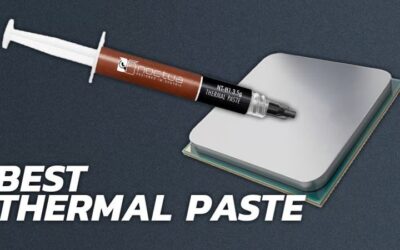
Best thermal compound paste choices matter far more than the price tag suggests. A syringe that costs less than a game can move sustained CPU temperatures by several degrees, and a bad one dries out within a year. This guide compares rated conductivity, handling, syringe value and real service life across the tubes actually worth buying today.
As an Amazon Associate we earn from qualifying purchases at no extra cost to you. Product prices and availability are accurate as of the date shown and are subject to change.
By Ryan Cole, PC hardware writer at NvidiaReview
How to Choose the Best Thermal Compound Paste
Paste is the cheapest part of any cooling system and the easiest one to get wrong. Choosing the best thermal compound paste comes down to three things: what the conductivity rating really tells you, how the compound behaves during application, and how long it lasts before pump-out sets in.
Thermal Conductivity Ratings and What They Actually Mean
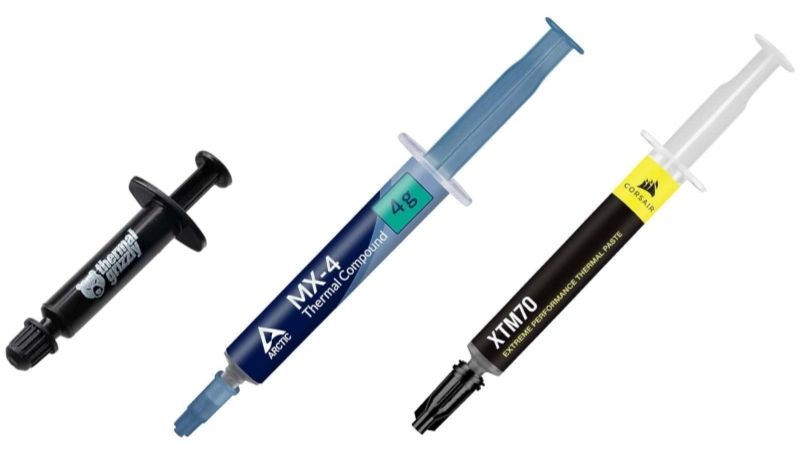
Manufacturers publish conductivity in W/mK and the numbers look dramatic. Arctic rates MX-4 at 8.5 W/mK, Thermal Grizzly rates Kryonaut at 12.5 W/mK. Those figures come from different test methods, so read them as a rough tier ranking rather than a promise of degrees saved on your chip.
The real gap between a mid-tier compound and a premium one is small on a mainstream 65W CPU and much wider on a dense, hot chip under a strong cooler. If your heatsink is already the limiting factor, no paste rescues it. If your CPU spikes hard on short loads, the better compound starts to earn its price.
Viscosity, Spread Method and Syringe Volume
Thick compounds hold their shape but fight you in a cold room. Warming the syringe in a pocket for a few minutes makes a real difference. A centre pea works on most square heat spreaders; a thin line down the long axis suits rectangular AM5 and Threadripper lids better than the classic dot.
A mainstream desktop application takes roughly a quarter of a gram, so a 1g syringe covers a few builds and an 8g tube covers a workshop. Larger tubes cost far less per gram, but only buy one if you build regularly, since an opened syringe does not last forever on the shelf.
Service Life and Pump-Out Resistance
Pump-out is the slow migration of compound out of the hot centre of the die as the metal expands and contracts. It is why temperatures creep up over two or three years without any hardware change. Thin, oily pastes suffer most; denser compounds and phase-change pads resist it best.
Noctua rates NT-H2 for up to five years in application and NT-H1 for around three, which is a useful yardstick for the category. Phase-change materials such as PTM7950 take a different route: they melt into place on the first heat cycles and then stay put for years without repumping.
Top Picks: Best Thermal Compound Paste for Every Build
These five picks for the best thermal compound paste cover the full range, from a first-time builder pairing a tower cooler with a mid-range chip to someone sealing up a long-uptime workstation. All figures are manufacturer-rated and were checked in August 2026, so treat pricing tiers as a guide.
| Product | Rated conductivity | Common sizes | Best for |
|---|---|---|---|
| Thermal Grizzly Kryonaut | 12.5 W/mK | 1g / 5.55g / 11.1g | All-round high performance |
| Arctic MX-6 | Not published as a single figure | 2g / 4g / 8g | Value across many builds |
| Noctua NT-H2 | Not published | 3.5g / 10g | First-time builders |
| Thermalright TF7 | 12.8 W/mK | 2g / 4g | Budget builds |
| Honeywell PTM7950 | 8.5 W/mK | Cut-to-size sheet | Long-term stability |
Thermal Grizzly Kryonaut – Best Overall Balance
Kryonaut has been the default enthusiast answer for years and still holds up. Thermal Grizzly rates it at 12.5 W/mK across an operating range of -250C to 350C, it is non-conductive, and the medium viscosity spreads under cooler pressure without needing a spatula or a warm room.
The catch is longevity: under constant high heat it dries faster than denser compounds, so heavy workstation users may reapply sooner than they would with a thicker paste. Cost per gram is high too. For a gaming rig reapplied every couple of years, it remains the easiest recommendation here.
Arctic MX-6 – Best Value Across Multiple Builds
MX-6 is the workshop tube. Arctic sells it in 2g, 4g and 8g syringes at a fraction of the per-gram cost of boutique compounds, and it is non-conductive and non-capacitive, so a slip near the socket is harmless. Arctic rates the MX line for a long service life without reapplication.
It is noticeably thicker than MX-4, which is the main complaint: in a cold room it fights the plunger and wants a minute of warming before it spreads evenly. Arctic also stopped headlining a single W/mK figure for it. Neither issue matters much once the cooler is torqued down.
Noctua NT-H2 – Best for First-Time Builders
NT-H2 is built around forgiveness rather than headline numbers. Noctua publishes no W/mK figure at all, instead rating it for up to five years in application, and it bundles NA-SCW1 cleaning wipes so a first attempt can be wiped off and redone without a separate trip for isopropyl.
The viscosity is middle-of-the-road and spreads predictably, which is exactly what you want when you have never mounted a cooler before. The downside is price: you pay Noctua rates for a compound whose peak performance sits below Kryonaut. Buy it for the peace of mind, not the leaderboard.
Thermalright TF7 – Best Budget Pick
Thermalright rates TF7 at 12.8 W/mK, non-conductive, and sells it in 2g and 4g syringes with a spatula in the box. For a budget build where the paste budget competes with a case fan, it delivers most of what a premium compound offers at a much lower price per application.
Quality control is the weak spot. Batch-to-batch consistency is less predictable than the German and Austrian brands, and support is thin if you get a bad tube. It is also stiff enough that the included spatula is not optional. As a spare tube in the toolbox, it is hard to argue with.
Honeywell PTM7950 – Best Long-Term Pump-Out Resistance
PTM7950 is a phase-change sheet rather than a paste. Rated around 8.5 W/mK, it softens once the die passes roughly 55C and then locks into the gap. That mechanism makes it exceptionally resistant to pump-out, which is why laptop repair shops and long-uptime builders swear by it.
The trade-offs are real. You cut it to size, peel two films, and accept that temperatures only settle after several heat cycles. It also underperforms on cold starts, and the market is full of counterfeits, so buy from a reputable seller. For a machine you will not open for years, it is the smart pick.
What the 2026 Market Means for Paste and Cooling Buyers
Cooling is one of the few corners of the PC market where 2026 pricing has not gone strange, which affects where the best thermal compound paste sits in your upgrade priorities. Memory and storage have gone the other way, so three market factors are worth knowing before you fill a basket.
Small Cooling Upgrades Still Deliver Real Gains
With graphics cards up sharply year on year, a full GPU swap is out of reach for a lot of builders right now. Fresh compound, a better tower cooler, a pair of case fans or a healthier power supply still produce measurable improvements on an existing machine for a tiny fraction of that cost.
This is the honest case for spending nine dollars on a syringe. If your three-year-old build throttles during long sessions, repasting and cleaning the radiator or heatsink fins is the first thing to try. It costs one evening, and it frequently recovers most of the performance you thought you had lost.
Entry-Level Pricing Is Under Pressure
Cooling components have crept up roughly 6 to 8 percent, power supplies a little more, as manufacturers concentrate on mid-range and premium lines. The promotional pricing policies that used to soften those numbers were withdrawn in February 2026, so the sticker you see now is closer to what you pay.
The practical response is not panic buying. Compound does not expire quickly and prices here are not moving in double digits. Buy the size you will actually use within a year or two, and skip the very cheapest unbranded tubes, since the saving is a couple of dollars on a part that lasts years.
Where Late-Year Deals Are Still Genuine
The usual advice to wait for the November sales does not hold for memory, SSDs or prebuilt systems this year, because that stock was built from expensive 2026 contract components. Cooling is different. Paste, air coolers, fans, cases and power supplies still see real discounts in that window.
So if you are only after compound, buying today is fine and the difference will be small either way. If a cooler or a set of fans is on the same list, holding until late November is defensible. Prices quoted anywhere in this guide reflect August 2026 and should be verified before you order.
Frequently Asked Questions
These are the questions that come up most often once someone has a syringe in hand and a cooler waiting on the desk: how much to apply, how often to redo it, and whether the best thermal compound paste changes anything at all on a stock cooler and a locked processor.
How often should thermal compound be replaced?
Every two to three years is plenty on a typical gaming machine, or whenever the cooler comes off for any reason. If temperatures have crept up five degrees over a year with clean fans, pump-out is the likely cause and even the best thermal compound paste will need redoing eventually.
Does applying more compound improve cooling?
No. The compound only fills microscopic gaps between two flat metal surfaces, and excess acts as insulation while squeezing out around the socket. A pea-sized dot for square heat spreaders or a thin line for rectangular ones is the right amount for almost every desktop CPU on the market.
Is liquid metal worth using instead?
Only under specific conditions. Liquid metal conducts electricity, corrodes bare aluminium coolers and needs careful containment, in exchange for a few degrees on already extreme setups. On a normal build with a copper-based cooler, a top ceramic compound gets you most of the way with none of the risk.
Can I use the paste pre-applied to a new cooler?
Yes, factory pre-applied compound from a reputable cooler brand is perfectly serviceable and saves a step. Clean it off and apply your own only if you have a better tube on hand, if the pad looks dry or damaged, or if you have already dry-fitted the cooler and disturbed the layer.
See More:
- Thermal paste at Best Buy
- Graphics card at Best Buy
- Best AM4 CPU for gaming
- Best motherboard for 9800x3d
Final Thoughts
The best thermal compound paste is whichever one you will apply correctly and then leave alone. Kryonaut for a strong all-rounder, MX-6 when you build often, NT-H2 for a first attempt, PTM7950 for a machine you plan to seal up. Any of them beats a dried-out layer from three years ago.
As an Amazon Associate we earn from qualifying purchases at no extra cost to you. Product prices and availability are accurate as of the date shown and are subject to change.







Write Your Review
No reviews yet. Be the first to share your experience!