
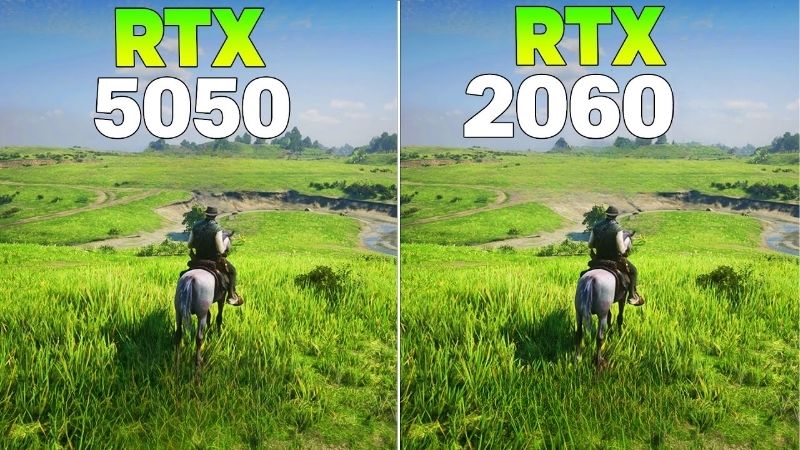
RTX 2060 vs 5050 is a comparison that looks obvious until you read the specification sheets side by side. Seven years and three architecture generations separate these cards, yet the 2019 model holds a higher memory bandwidth figure than the 2025 one. That single anomaly explains why this upgrade divides opinion, and why the answer depends far more on your motherboard and your monitor than on the generation number printed on the box.
Quick answer: Our top pick in 2026 is the Architecture — our #1 rated choice. See the full ranked comparison, alternatives and buying advice below.
The Quick Verdict: RTX 2060 vs 5050 in One Minute
If you want the answer without the analysis: the RTX 5050 is roughly 40 to 50 percent faster in raster at 1080p, adds 2 GB of VRAM, and draws 30 fewer watts. It is a real upgrade. It is also a modest one for a seven-year gap, and NVIDIA’s own positioning tells you why — this is an entry card built to a price, not a generational showcase.



Who Should Upgrade to the RTX 5050
Upgrade if your 6 GB frame buffer is the thing breaking your games. Modern titles at 1080p high settings routinely exceed 6 GB, and when VRAM runs out the result is not lower frames — it is stutter, texture pop-in, and hitching that no settings adjustment fully repairs.
Upgrade if DLSS 4 Multi Frame Generation matters to you. This is the one capability the RTX 2060 cannot access at any settings level, because the hardware to run it does not exist on Turing.
Upgrade if your PSU or your electricity bill is a constraint. Dropping from 160 W to 130 W in the same case is a measurable thermal and acoustic improvement.
Who Should Keep the RTX 2060
Keep it if you are on a PCIe 3.0 motherboard. This is the single most overlooked factor in this comparison and the next section explains the mechanism in detail — the short version is that the RTX 5050 uses a narrower PCIe link than you might assume, and an older board narrows it further.
Keep it if you play esports titles. Counter-Strike 2, Valorant, and Rocket League already run well past your monitor’s refresh rate on a 2060. Faster than “already fast enough” is not a benefit you can see.
Keep it if the money would be better spent elsewhere. A 2060 paired with 8 GB of system RAM or a mechanical hard drive is not GPU-limited, and swapping the GPU fixes nothing.
The Full Specification Comparison Table
| Specification | RTX 2060 (6 GB) | RTX 5050 |
|---|---|---|
| Architecture | Turing (TU106) | Blackwell (GB207) |
| Launch | January 2019 | July 2025 |
| Launch price | 349 | 249 |
| CUDA cores | 1,920 | 2,560 |
| VRAM | 6 GB GDDR6 | 8 GB GDDR6 |
| Memory bus | 192-bit | 128-bit |
| Bandwidth | 336 GB/s | 320 GB/s |
| FP32 compute | ~6.5 TFLOPS | ~13.2 TFLOPS |
| PCIe interface | 3.0 x16 | 5.0 x8 |
| TDP | 160 W | 130 W |
| Power connector | 8-pin | 8-pin |
| Recommended PSU | 500 W | 550 W |
| DLSS Super Resolution | Yes | Yes |
| DLSS Frame Generation | No | Yes |
| DLSS Multi Frame Gen | No | Yes |
| Compute capability | 7.5 | 12.0 |
Read row six and row seven together, because that is where this comparison stops being predictable. The 2019 card carries a wider memory bus and marginally higher bandwidth than the 2025 card. NVIDIA compensated with faster 20 Gbps GDDR6 on a narrower bus, and the net result is that the newer card moves slightly less data per second.
Deep Dive Face-Off: Where Each Card Wins
Comparing these cards feature by feature rather than one at a time exposes a pattern that a spec table alone conceals. The RTX 5050 wins decisively on compute and on software capability. It wins narrowly or not at all on memory subsystem. And on one specific dimension — interface width — it can actually lose to the older card depending on what you plug it into.
Raw Performance and 1080p Frame Rates
At native 1080p across modern titles the RTX 5050 averages roughly 66 fps. Individual results give a clearer shape than an average: Cyberpunk 2077 at the High preset lands near 72 fps, Hogwarts Legacy around 70 fps, and Marvel Rivals near 50 fps at demanding settings.
An RTX 2060 in the same titles typically sits 40 to 50 percent behind. The compute gap explains it — 13.2 TFLOPS against 6.5 is a doubling on paper, though real-world scaling never matches the theoretical figure.
The architectural detail behind that gap is worth stating precisely, because it is not simply higher clocks. A Blackwell SM partition processes up to 32 INT or FP32 operations per clock, against Turing’s split arrangement. Combined with a boost clock of 2,572 MHz versus the 2060’s far lower ceiling, the improvement is structural rather than incremental.
VRAM, Bandwidth and the PCIe 5.0 x8 Trap
Here is the finding that changes the recommendation for a large share of readers. The RTX 5050 runs on a PCIe 5.0 x8 link, not x16.
On a modern PCIe 5.0 board, x8 delivers ample bandwidth and nobody notices. On a PCIe 3.0 board — which is what most RTX 2060 owners actually have, because that is what was current in 2019 — the card negotiates PCIe 3.0 x8. That is roughly a quarter of the interface bandwidth it was designed around.
This matters specifically because the card has only 8 GB of VRAM. When a game exceeds the frame buffer, the GPU streams assets across the PCIe link, and a narrow link turns a manageable overflow into visible stutter. The two limitations compound rather than merely coexist.
The practical instruction is unambiguous: check your motherboard’s PCIe generation before buying. If it is 3.0, budget for a platform upgrade or accept that you will not see the reviewed performance.
DLSS 4 and Multi Frame Generation: The Real Gap
This is where the seven-year gap genuinely shows, and it is the strongest argument for the RTX 5050. The card carries 5th-generation Tensor Cores and delivers up to 421 TOPS of AI performance — approximately six times the RTX 3050’s figure, and far beyond anything Turing offers.
An important nuance that most comparisons get wrong: DLSS Super Resolution upscaling works on the RTX 2060. Turing has Tensor Cores and NVIDIA has continued extending upscaling support to older RTX cards. What the 2060 cannot do is Frame Generation or Multi Frame Generation, both of which require hardware the architecture lacks.
The forward-looking argument favours Blackwell for a reason beyond today’s frame rates. NVIDIA reports RTX 5050 cards running 60 percent faster in raster than an RTX 3050, and up to four times faster with the full DLSS 4 suite engaged. That multiplier grows as more titles adopt the technology, which means the card’s effective performance improves after purchase — something silicon alone never does.
Pros and Cons: The Honest Upgrade Maths
Reviewer consensus on the RTX 5050 is more mixed than its generation number implies, and the criticism comes from people who liked the previous entry cards. Understanding both sides matters more here than in most comparisons, because the upgrade is real but the value proposition is genuinely contested.
Where the RTX 5050 Genuinely Earns the Money
Efficiency is the clearest win. The lowest TDP in the entire RTX 50 desktop stack, a single 8-pin connector, and comfortable operation on a modest supply. In a compact build this is decisive rather than incidental.
Bandwidth per bus width is an engineering achievement worth naming. 320 GB/s from a 128-bit bus beats the RTX 4060’s 272 GB/s on the identical bus width, purely through faster 20 Gbps memory.
DLSS 4 access is the third, and over a multi-year ownership period it is likely the most valuable of the three.
The Complaints Reviewers and Owners Report
The recurring criticism is price against delivered performance. Tom’s Hardware concluded the card is overpriced for what it delivers at 249, and noted that 8 GB of VRAM prevents you from using Multi Frame Generation precisely in the demanding titles where you would most want it. That is a pointed objection: the headline feature is constrained by the memory the card ships with.
The GDDR6 decision draws consistent comment. Every other RTX 50 desktop card uses GDDR7. Had the 5050 received it, bandwidth would sit near 448 GB/s rather than 320.
Acoustics vary by partner. The 130 W TDP suggests a quiet card, but budget cooler designs have been measured near 38 dBA and 1,900 RPM under load — audible in a quiet room despite the modest power draw. Cooler quality varies more than the reference specification implies.
The Alternative: What to Buy If Neither Fits
If 8 GB is the sticking point — and after reading the VRAM section it should be — the Intel Arc B580 delivers comparable 1080p rasterisation with 12 GB of GDDR6. The extra 4 GB is exactly the headroom the 5050 lacks. The Arc B570 sits a step below on raw performance while carrying 10 GB.
If you want the 5050’s feature set without its constraints, the RTX 5060 steps up to GDDR7 at 448 GB/s and handles 1440p meaningfully better.
And on the red team, the RX 9060 XT averages higher 1080p frame rates than the RTX 5050 in the same test suite — worth weighing if DLSS 4 is not your priority.
GPU Prices in 2026: Upgrade Now or Wait?
Every specification above sits inside a market context that the numbers do not explain on their own. The RTX 5050’s most criticised design decisions — 8 GB of VRAM, GDDR6 instead of GDDR7 — are not arbitrary cost-cutting. They are downstream of a memory supply situation that also determines whether waiting for a better card is a sensible plan or an expensive one.
Why the 5050 Ships With GDDR6 and 8GB
Start with the mechanism rather than the complaint. NVIDIA allocates scarce GDDR7 supply to higher-margin cards and to notebooks, where power efficiency justifies the premium. The desktop 5050 gets GDDR6 because that is what remains. The laptop 5050, tellingly, does get GDDR7 — same chip, different memory, allocated by margin.
The demand pressure behind that scarcity has intensified. Washington has approved NVIDIA selling the H200, among its most capable AI accelerators, to China. Each H200 carries 141 GB of high-bandwidth memory, and expanded access to a market of that scale absorbs enormous memory volume upstream of anything allocated to consumer graphics.
The conclusion for an upgrader is uncomfortable but useful: the 8 GB frame buffer you are frustrated by is a symptom of demand that is strengthening, not easing. Waiting for NVIDIA to be generous with VRAM at this tier is betting against the industry’s strongest signal.
Memory Prices and the Cost of Waiting
Laptop and component prices have continued trending upward rather than reverting toward 2024 levels, with memory at the centre of the pressure. Street pricing reflects it — RTX 5050 cards have been listed from around 289.99 against a 249 MSRP.
The real good news deserves an honest hearing. The steep escalation through late 2025 has stopped. Framework has noted a spell of comparative stability while stating plainly that the volatility is not behind us. Stopping and reversing are not the same event.
For an RTX 2060 owner the arithmetic is straightforward. Waiting means running a 6 GB card through another year of releases designed around larger frame buffers, in exchange for a discount nobody has committed to delivering.
Relief Arrives in 2027-2028, Not Sooner
Supply is being added, and the calendar is worth knowing before you defer anything. Two Micron fabrication plants are under construction in Idaho. CXMT in China now sells DDR5 into the OEM channel, widening a supplier base that had thinned out.
Neither arrives this year. The Idaho plants are not scheduled to come online until 2027 to 2028 — the earliest realistic point at which supply expansion could move consumer pricing downward.
Two years is a long time to stutter through modern titles while waiting on a schedule that is already public and already distant.
Compare current street pricing on the RTX 5050 against the 12 GB alternatives before committing — the gap between an 8 GB card and a 12 GB one has been narrower than the frame buffer difference justifies.
See More:
- NVIDIA
- NVIDIA DeepStream
- NVIDIA GPU driver update
- NVIDIA GeForce NOW download
- NVIDIA RTX A2000 12GB driver
Final Verdict and Recommendation
RTX 2060 vs 5050 resolves differently depending on one question most buyers never ask: what PCIe generation is your motherboard? On a 4.0 or 5.0 board, the RTX 5050 is a straightforward 40 to 50 percent uplift with DLSS 4 access and 30 W less heat. Buy it. On a PCIe 3.0 board, the x8 link and the 8 GB frame buffer compound each other, and the upgrade underdelivers against every review you have read.
Buy the RTX 5050 if you are VRAM-limited today, run a modern platform, and want Multi Frame Generation. Keep the RTX 2060 if you play esports, sit on a PCIe 3.0 board, or have a system bottleneck that is not the GPU. Buy the Arc B580 or RTX 5060 instead if 8 GB is the constraint you are trying to escape — because the 5050 does not escape it either.
With memory demand strengthening and genuine supply relief sitting in the 2027-2028 window, this is not a market that rewards waiting. Buy the tier that fits your board and your frame buffer needs now, or keep what you have and spend the money where the actual bottleneck lives.
Frequently Asked Questions
How much faster is the RTX 5050 than an RTX 2060?
Expect roughly 30 to 45 percent more rasterized performance depending on the title, with a larger gap in ray traced workloads thanks to fourth generation RT cores. The bigger practical difference is the 8GB frame buffer against the 2060’s 6GB, which removes the texture stutter that increasingly affects Turing at 1080p.
Is the upgrade worth it if I only play at 1080p?
If your 2060 already delivers your monitor’s refresh rate in the games you play, the jump is modest and better money goes toward a 60 or 70 class card. The upgrade makes sense mainly for players hitting VRAM limits, wanting multi frame generation, or needing the newer AV1 encoder for streaming.
Does the 5050 support multi frame generation?
Yes, being a Blackwell part it gets DLSS 4 with 2x, 3x and 4x frame generation modes. On an entry level card the caveat matters more than usual: you need a base frame rate near 50fps before generation feels good, and the feature consumes extra VRAM from an already modest 8GB pool.
What are the power and connector differences?
The RTX 2060 is a 160W board needing a single 8-pin and a 500W system, while the 5050 sits near 130W with a single 8-pin and a 550W recommendation. Blackwell’s efficiency means lower temperatures and quieter operation in the same case, and no power supply upgrade is required for either.
Will my old system bottleneck the 5050?
Possibly. Many 2060 systems pair with a Ryzen 5 2600 or Core i5-8400 class CPU, which limits frame rates in modern CPU-heavy titles regardless of GPU. Also check that your board offers PCIe 4.0, since narrow bus entry cards lose measurable performance on PCIe 3.0 slots.
Ready to decide? Our #1 pick for 2026 is the Architecture.
Live price & availability on Amazon.




Write Your Review
No reviews yet. Be the first to share your experience!