
- Top Pick: GIGABYTE Radeon RX 9070 XT Gaming OC 16G Graphics Card, PCIe 5.0, 16GB GDDR6, GV-R9070XTGAMING OC-16GD Video Card
- Best Value: Sapphire 11348-03-20G Pulse AMD Radeon™ RX 9070 XT Gaming Graphics Card with 16GB GDDR6, AMD RDNA 4
- Premium Choice: ASUS Prime Radeon RX 9070 XT 16GB GDDR6 OC Edition Gaming Graphics Card


AMD Radeon RX 9070 XT vs NVIDIA GeForce RTX 5070 is the defining mid-range face-off of this generation, and if you are cross-shopping the two you want numbers and a verdict, not a highlight reel. Both target the same 1440p high-refresh buyer at similar money, but they win on different axes. This comparison lays out the specs side by side, breaks down each strength honestly, and tells you which card fits which person so you can decide in minutes.
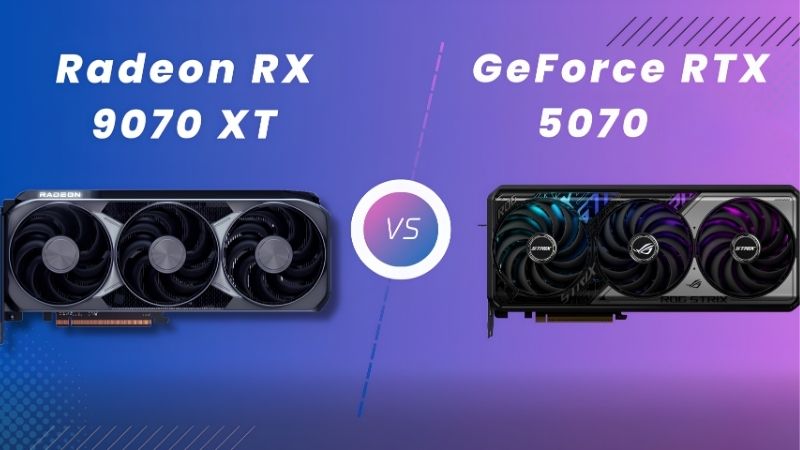
The Quick Verdict: AMD RX 9070 XT vs NVIDIA RTX 5070
For readers who want the answer immediately: the RX 9070 XT generally wins on raw rasterization and VRAM capacity, while the RTX 5070 wins on ray tracing, DLSS 4 frame generation, and the broader AI feature ecosystem. Pricing between them is close, so the decision hinges on what you value more, pure frames or feature depth. Below, each claim is backed by the specs and the reasoning behind it.
As an Amazon Associate we earn from qualifying purchases at no extra cost to you.


Who Wins on Raw Rasterization
In traditional rasterized rendering, the RX 9070 XT typically holds the edge. It carries more onboard memory and a wider memory configuration than the RTX 5070, and AMD’s RDNA 4 architecture is tuned to push high frame rates at 1440p in native, non-upscaled workloads.
For a competitive gamer chasing maximum native frames at 1440p without leaning on upscaling, the 9070 XT is the more direct answer. If your library is mostly esports and rasterized AAA titles, this is the axis that matters most to you.
The size of the lead varies by title, and that variance is important to understand rather than average away. Some engines favor RDNA 4 heavily, others land closer to parity, and a few even tilt toward Blackwell. So the honest framing is that the 9070 XT wins the rasterization category more often than not, but you should check benchmarks for the specific games you play rather than assuming a uniform gap.
Who Wins on Ray Tracing and DLSS
The RTX 5070 takes ray tracing decisively. NVIDIA’s fourth-generation RT cores and its more mature ray tracing pipeline mean that in path-traced and heavily ray-traced titles, the 5070 delivers a smoother experience than the 9070 XT even where AMD narrows the raster gap.
DLSS 4 with Multi Frame Generation widens the lead further in supported games. AMD’s FSR has improved substantially, but NVIDIA’s upscaling and frame-generation stack remains broader in game support and generally cleaner in image quality, which is a meaningful advantage for anyone playing modern single-player showcases.
Who Wins on Price and Value
Value is close enough that the market decides it. The RTX 5070 launched around $549, and the RX 9070 XT sits in a similar band, so neither wins on sticker price by a wide margin. The tiebreaker is which feature set you will actually use.
There is also a timing factor in 2026. GPU prices have trended upward and have not fully released that pressure, so the “cheaper” card on any given week can flip based on stock. We will return to whether you should buy now or wait later in this comparison.
Full Specs Comparison Table and What the Numbers Mean
Numbers cut through marketing, so here is the core specification face-off. Read the memory and architecture rows carefully, because those two categories explain almost every real-world difference between these cards.
| Spec | AMD Radeon RX 9070 XT | NVIDIA GeForce RTX 5070 |
|---|---|---|
| Architecture | RDNA 4 | Blackwell |
| VRAM | 16 GB GDDR6 | 12 GB GDDR7 |
| Memory Bus | 256-bit | 192-bit |
| Ray Tracing | 3rd-gen RT (improved) | 4th-gen RT cores |
| Upscaling | FSR | DLSS 4 + Multi Frame Gen |
| Target Resolution | 1440p high-refresh | 1440p high-refresh |
| Launch Price | ~$599 | ~$549 |
| Recommended PSU | ~700 W | ~650 W |
Core Specs, VRAM, and Memory Bandwidth
The headline difference is memory. The 9070 XT’s 16 GB on a 256-bit bus gives it more capacity and bandwidth than the 5070’s 12 GB on a 192-bit bus. For high-resolution textures and future titles that grow hungrier for VRAM, that extra headroom is a genuine longevity advantage.
The 5070 counters with GDDR7, which is faster per pin and partially offsets the narrower bus. In practice, the 5070 rarely feels bandwidth-starved at 1440p, but the 9070 XT’s larger buffer is the safer bet for buyers who keep a card for many years or push toward 4K textures.
This matters more every year as game texture budgets grow. A 12 GB card is comfortable at 1440p today, but the trajectory of AAA releases points toward heavier VRAM demands, and a 16 GB buffer gives you more runway before you are forced to lower texture settings. If you are the type who keeps a GPU for four or five years rather than upgrading each generation, weight this row heavily in your decision.
Power Draw, Cooling, and Case Compatibility
On the practical side, the RTX 5070 is the lower-power card, with NVIDIA recommending a 650 W supply versus roughly 700 W for the 9070 XT. If your current PSU is modest, the 5070 gives you more breathing room and runs cooler in cramped cases.
Both cards come in a range of partner designs, so length and slot thickness vary by model. Whichever you choose, measure your case’s maximum GPU length and confirm slot clearance before buying, since many partner boards in this class run 2.5 to 3 slots thick and past 300 mm long.
Pros and Cons of Each Card
The RX 9070 XT’s pros are its 16 GB buffer, strong native rasterization, and wide memory bus, making it excellent for high-frame 1440p and future-proofing. Its cons are weaker ray tracing than NVIDIA, an upscaling ecosystem that still trails DLSS in breadth, and higher power draw.
The RTX 5070’s pros are class-leading ray tracing, DLSS 4 with Multi Frame Generation, lower power consumption, and the deepest AI feature set with ongoing driver-based gains. Its cons are the smaller 12 GB buffer and narrower 192-bit bus, which cap its 4K ambitions and raise mild longevity questions.
Neither list contains a dealbreaker for the average 1440p gamer. The choice is about which strengths you will use and which weaknesses you can live with.
Deep Dive Face-Off: Performance, Features, and Timing
With the specs established, this section compares the cards on the criteria that actually shape daily use: real-world frame rates, the software and AI ecosystem, and the market timing that determines when you should pull the trigger.
Rasterization and Real-World Frame Rates
In native 1440p rasterized gaming, expect the 9070 XT to lead in many titles, sometimes by a modest margin and occasionally by more depending on how well a game maps to RDNA 4. For pure frames-per-dollar in non-upscaled workloads, AMD is the aggressor here.
The 5070 stays highly competitive and pulls ahead the moment ray tracing or DLSS enters the picture. So the “faster” card depends entirely on your settings: rasterization favors AMD, while ray tracing plus upscaling flips the result toward NVIDIA.
Ray Tracing, DLSS 4, and NVIDIA’s AI Edge
This is where the experimental, forward-looking case for the RTX 5070 lives. Blackwell’s ray tracing hardware and DLSS 4 Multi Frame Generation can transform demanding path-traced games from marginal to smooth, and the feature list keeps growing through driver updates rather than staying fixed at launch.
That ongoing optimization is a real consideration for a multi-year purchase. A 5070 bought today often gains frames in newly supported titles later, and NVIDIA’s AI tooling extends beyond gaming into creative and local AI workloads. If you value being on the leading edge of features, the 5070 is the more future-facing bet.
AMD has closed the gap meaningfully with newer FSR versions and its own frame-generation techniques, and for many players the difference is small enough to ignore. But when you tally supported game count, image stability, and the pace of feature rollout, NVIDIA’s ecosystem is still the deeper one. The question is not whether AMD’s features work, because they do, but whether the extra depth of NVIDIA’s stack is worth trading away some native rasterization performance to you.
Buy Now or Wait? The 2026 Price Reality
Timing deserves its own analysis because the market is unusual right now. Component prices have trended upward, but the steep climb of late 2025 has eased, and the market has entered a period of relative stability, even as analysts warn that volatility is not over. The panic phase has passed; a real discount has not arrived.
Anyone hoping to wait for a price collapse should temper expectations. New memory supply is opening up, with OEMs able to source DDR5 from suppliers like CXMT and Micron building two fabs in Idaho, but those plants are not expected to run until 2027 to 2028. For a card you need this year, waiting exposes you to volatility with little near-term upside, which nudges the practical buyer toward acting while pricing is stable.
The Alternative and Final Recommendation
If neither card lands cleanly for your budget or needs, there are sensible detours, and then a clear framework for who should buy which. This closes the loop on the AMD Radeon RX 9070 XT vs NVIDIA GeForce RTX 5070 decision.
A Third Option Worth Considering
If both cards stretch your budget, a standard RTX 5060 Ti in its 16 GB configuration delivers a large slice of the 1440p experience for less money while keeping DLSS 4 and a generous VRAM buffer. It is the value escape hatch when the 9070 XT and 5070 both feel like too much spend.
If your budget instead flexes upward and 4K is the real goal, stepping up to an RTX 5070 Ti with 16 GB of GDDR7 resolves the VRAM debate entirely and gives you a more comfortable 4K card, which may be the smarter long-term buy for high-resolution players. In a market where prices are firm, spending once on the right tier can be cheaper than upgrading again in two years.
Who Should Buy the RX 9070 XT
Choose the 9070 XT if you prioritize native rasterized frame rates, want the security of a 16 GB buffer, and mostly play titles where ray tracing is optional. Value-focused 1440p gamers who keep hardware for years get strong mileage from AMD’s memory advantage.
It is also the pick if you are indifferent to DLSS and simply want the most native performance your money can buy at this tier, provided your power supply can comfortably feed it.
Who Should Buy the RTX 5070
Choose the RTX 5070 if ray tracing, DLSS 4, lower power draw, and NVIDIA’s expanding AI ecosystem matter to you. Single-player enthusiasts who chase visual showcases and want ongoing feature gains through drivers will be happiest here.
It is also the better fit for compact or lower-wattage builds thanks to its efficiency, and for creators and hobbyists who lean on NVIDIA’s software stack beyond gaming. If your PSU is a modest 650 W unit or your case is tight on airflow, the 5070’s lower thermal footprint quietly removes a whole category of headaches.
See More:
- NVIDIA GeForce Game Ready Driver
- NVIDIA CUDA Toolkit Archive
- Gigabyte GeForce RTX 5070 Windforce OC
- PNY GeForce RTX 5070 Ti Triple Fan
Conclusion
The AMD Radeon RX 9070 XT vs NVIDIA GeForce RTX 5070 verdict is not a knockout but a values test: the 9070 XT wins on native rasterization and VRAM, while the RTX 5070 wins on ray tracing, DLSS 4, efficiency, and future-facing AI features. With 2026 pricing stable but unlikely to drop soon and real relief years away, the buyer who needs performance now is best served by picking the card whose strengths match their games and locking it in. Compare current prices for both cards through the links below and buy the one that fits how you actually play.
Frequently Asked Questions
Which card is faster in raw rasterized games?
The RX 9070 XT generally leads in traditional rasterization, often by a double digit percentage at 1440p and 4K, because it carries a wider 256-bit bus and 16GB of memory against the 5070’s 192-bit bus and 12GB. In pure native resolution gaming the Radeon is the stronger performer.
How different is ray tracing performance between them?
RDNA 4 dramatically narrowed the gap compared to previous Radeon generations, so the 9070 XT is competitive in most ray traced titles. NVIDIA still pulls ahead in path traced showcases like Cyberpunk overdrive mode, where the dedicated RT hardware and DLSS ray reconstruction do meaningful heavy lifting.
Does the 12GB versus 16GB VRAM difference matter?
It matters increasingly at 4K and with ultra texture packs. Several 2025 and 2026 releases already push past 12GB at 4K with ray tracing, forcing the 5070 to swap textures and stutter. If you plan to keep the card three or more years, the 16GB buffer is the safer bet.
What about upscaling and frame generation quality?
DLSS 4 with its transformer model still holds a visible image quality edge over FSR 4, particularly at lower internal resolutions and in fine detail like foliage and wires. FSR 4 closed most of the gap on RDNA 4 hardware, but DLSS has far wider game support.
Which needs more power and a bigger PSU?
The 9070 XT pulls around 300W and typically uses two 8-pin connectors, calling for an 750 to 850W supply. The RTX 5070 sits near 250W on a single 12V-2×6 connector and is happy on 650W. If you are reusing an older PSU, the NVIDIA card is easier to accommodate.
Ready to decide? Our #1 pick for 2026 is the Architecture.
Live price & availability on Amazon.

Write Your Review
No reviews yet. Be the first to share your experience!