
- Top Pick: ASUS TUF Gaming NVIDIA GeForce RTX 4080 Super OC Edition Gaming Graphics Card (PCIe 4.0, 16GB GDDR6X, HDMI 2.1a, DisplayPort 1.4a), 3 Year Warranty
- Best Value: ASUS ROG Astral LC GeForce RTX 5090 32GB GDDR7 OC Edition Gaming Graphics Card
- Premium Choice: ASUS ROG Astral GeForce RTX 5090 32GB GDDR7 OC Edition Gaming Graphics Card
Top Rtx 5090 4080 Super Flagship Picks for 2026
Here are our current top rtx 5090 4080 super flagship picks, compared on real Amazon owner reviews, price, and features. Live prices update below.

Dropped $349.01


Dropped $25.01


5090 vs 4080 Super pits Nvidia’s current Blackwell flagship against the previous generation’s high-end value champion, and the gap between them is enormous on paper. The RTX 5090 brings 32GB of memory, a massive core count, and DLSS 4 Multi Frame Generation, while the RTX 4080 Super delivers excellent 4K gaming for roughly half the price. The real question is not which card is faster, since that answer is obvious, but whether the 5090’s commanding lead justifies its premium for your use case. This comparison lays out the specs, performance, and value math to help you decide.
As an Amazon Associate we earn from qualifying purchases at no extra cost to you. Product prices and availability are accurate as of the date shown and are subject to change.


Quick Verdict and Specifications
Here is the fast take on this flagship-versus-value matchup, followed by the spec sheet that shows just how wide the hardware gap really is.
The Bottom Line Up Front
The RTX 5090 is dramatically faster and carries far more VRAM, making it the uncompromising choice for 4K, path tracing, and heavy creative work. The RTX 4080 Super offers most of what mainstream 4K gamers need at a much lower price.
For pure value, the 4080 Super wins comfortably. For those who demand the absolute peak of performance and have the budget for it, the 5090 stands alone with no real rival.
Availability also separates them: the 4080 Super is winding down to clearance and used stock, while the 5090 is the current halo product, often supply-constrained and priced accordingly. Both realities feed directly into the value discussion later.
Specifications Side by Side
The spec sheet makes the scale of the difference immediately clear.
| Spec | RTX 5090 | RTX 4080 Super |
|---|---|---|
| Architecture | Blackwell | Ada Lovelace |
| CUDA cores | 21760 | 10240 |
| VRAM | 32GB GDDR7 | 16GB GDDR6X |
| Memory bus | 512-bit | 256-bit |
| Total graphics power | 575W | 320W |
| Launch MSRP | $1999 | $999 |
| DLSS support | DLSS 4 (Multi Frame Gen) | DLSS 3 Frame Gen |
The 5090 roughly doubles the 4080 Super in cores, VRAM, and memory-bus width, but it also doubles the price and draws far more power.
As always, street prices stray from MSRP, and at the high end they tend to stray upward. The 5090 in particular can command more than its sticker, so treat these figures as a floor rather than a promise of what you will pay.
Reading the Spec Gap
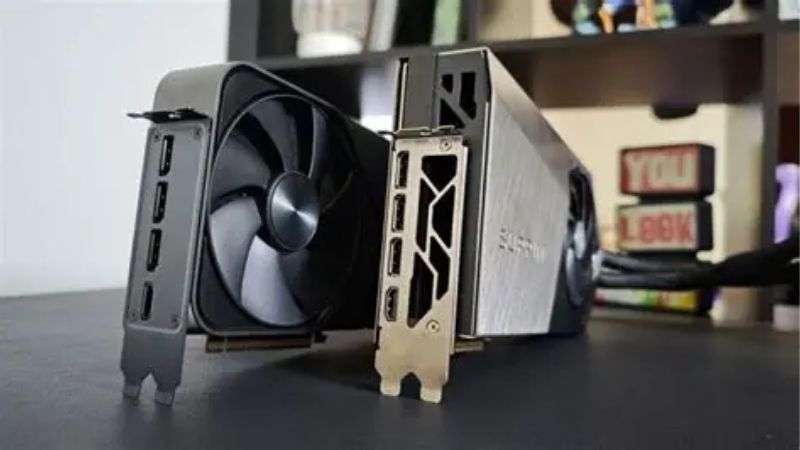
With 21760 cores against 10240 and a 512-bit bus against 256-bit, the 5090 is a true generational flagship with enormous raw throughput. The 32GB buffer further separates it for memory-intensive workloads.
The 4080 Super is no slouch, however. Its 10240 cores and 16GB buffer remain potent for 4K gaming, and its 320W draw is far more manageable. The gap is real, but the 4080 Super covers most gaming needs without the flagship’s extremes.
The honest summary is that the 5090 is built without compromise and priced to match, while the 4080 Super is engineered for balance. Which matters more depends entirely on whether you are chasing the ceiling or the sweet spot.
Performance Face-Off
The specs promise a one-sided raw contest, and real behavior confirms the 5090’s dominance while clarifying where the 4080 Super remains entirely sufficient.
4K Gaming Performance
At 4K the 5090 is in a class of its own, sustaining very high frame rates in demanding titles where the 4080 Super has to work harder. For maxed-out 4K with no compromises, the flagship is unmatched.
The 4080 Super, though, still delivers a strong 4K experience, comfortably playable at high settings in most games, often with the help of upscaling. For many 4K gamers it is genuinely enough, and the 5090’s surplus performance goes partly unused.
The key question is how much of the 5090’s surplus you will actually use. On a high-refresh 4K display with demanding titles, much of it is meaningful; on a standard 60Hz 4K panel, a large share of that extra power simply goes unrendered.
Ray Tracing, Path Tracing, and DLSS 4
Heavy ray tracing and path tracing are where the 5090 flexes hardest, combining raw power with DLSS 4 Multi Frame Generation to stay smooth in the most punishing scenarios.
The 4080 Super supports DLSS 3 Frame Generation but not the newest Multi Frame Generation, so in DLSS 4 titles the 5090 extends its lead further still. For cutting-edge ray-traced and path-traced gaming, the flagship’s feature set is decisive.
For creators, the 5090’s 32GB buffer and immense compute also accelerate rendering, AI, and video workloads far beyond what the 4080 Super can offer, making it a genuine workstation-class tool.
Power, Heat, and Practicality
The 5090’s 575W draw is demanding, requiring a robust power supply, serious cooling, and ample case space. It is a card that reshapes the rest of your build around it.
The 4080 Super’s 320W is far more practical for a typical high-end system, fitting more easily into standard cases with mainstream power supplies. For most builders, that practicality is a meaningful advantage.
This practical gap is easy to underestimate. The 5090 can require a power-supply upgrade, a larger case, and careful airflow planning, whereas the 4080 Super usually drops into an existing high-end build without drama.
Value, Alternatives, and Market Forces
Raw performance favors the 5090, but value and market conditions reframe the decision for most buyers.
Price and Value per Frame
At $1999 against $999, the 5090 costs twice as much as the 4080 Super but does not deliver twice the gaming frame rate, so on pure cost per frame the 4080 Super is the better value.
The 5090’s premium is justified only when you need its specific strengths: maxed 4K, path tracing, or heavy creative work. For gamers who do not, the 4080 Super, or even a mid-tier Blackwell card, is the smarter alternative that frees up budget for the rest of the build.
For pure gaming, then, the 4080 Super captures most of the experience for half the outlay. The 5090’s premium makes sense only when its specific strengths, rather than raw frame rates alone, are central to what you do.
Rising Prices and Buying Urgency
Laptop and PC-component prices are trending upward and are expected to keep rising. At the high end, that pressure makes both cards prone to price increases, so waiting can be costly.
For value buyers the trend reinforces choosing the 4080 Super and buying promptly, while those set on the 5090 should be aware that flagship pricing rarely softens and may climb further in this environment.
At this tier, waiting is especially risky, since halo products rarely get cheaper and supply pressure can push them higher. If a fair price appears for the card you want, acting promptly is usually the sounder play.
Nvidia’s AI Focus and Supply
The U.S. recently cleared Nvidia to sell its H200 AI chips to China. The H200 is a data-center accelerator, not a GeForce card, so it does not change how either gaming card performs.
The indirect effect matters most at the top end: strong AI demand keeps Nvidia’s capacity and attention focused on accelerators, which can constrain flagship GPU supply and keep prices firm. That makes a fairly priced high-end card worth securing when available.
That same AI demand is part of why the 5090 can be hard to find at sticker price. The components that make it a creative powerhouse are exactly the ones data centers covet, which keeps top-end supply tight and pricing firm.
Final Verdict: Which Should You Buy?
The performance winner is obvious, so the real verdict is about whether your needs and budget justify the flagship premium.
Buy the RTX 5090 if…
Choose the 5090 if you want uncompromising 4K and path-traced gaming, need 32GB of VRAM for creative or AI workloads, and have the budget, power, and cooling to support it.
It is the no-limits choice for enthusiasts and professionals who treat performance as the priority and price as secondary. Nothing else in the lineup matches it.
It is equally compelling for professionals whose time is money, where faster renders, simulations, or AI workloads quickly repay a premium that would be hard to justify for gaming alone.
Buy the RTX 4080 Super if…
Choose the 4080 Super if you want excellent 4K gaming at a far more sensible price, with manageable power draw and easier system requirements. It covers the vast majority of high-end gaming needs.
For most buyers, it is the value-smart high-end card, delivering a premium experience without the flagship’s extreme cost, power, and cooling demands.
It is also the wiser choice for a balanced system, since the money saved over a 5090 can fund a better CPU, display, or storage, often improving the overall experience more than raw GPU headroom would.
Pros and Cons Recap
Here is the concise trade-off summary for both cards.
RTX 5090 pros: unmatched performance, 32GB VRAM, DLSS 4 Multi Frame Generation, creator-grade power. Cons: very high price, 575W draw, demanding to cool and house. RTX 4080 Super pros: excellent 4K value, manageable 320W, easier to build around. Cons: half the raw performance of the 5090, 16GB buffer, no DLSS 4 Multi Frame Generation.
Frequently Asked Questions
Quick answers to the questions buyers most often ask when weighing the RTX 5090 against the RTX 4080 Super.
Is the RTX 5090 worth twice the price of the 4080 Super?
For pure gaming, usually not, since it does not deliver double the frame rate and the 4080 Super already handles 4K well.
For maxed 4K, path tracing, or heavy creative and AI work, the 5090’s strengths can justify the premium.
In short, the 5090 is a specialist tool for those who need its ceiling, while the 4080 Super is the value choice that satisfies the large majority of high-end gamers.
Can the RTX 4080 Super handle 4K gaming?
Yes. The 4080 Super is a capable 4K card, playable at high settings in most titles, often with upscaling assistance.
The 5090 simply extends that further with more headroom for the most demanding scenarios and highest refresh rates.
Most 4K gamers will find the 4080 Super entirely sufficient for a smooth, high-quality experience at high settings across today’s demanding titles.
How much power does the RTX 5090 need?
The 5090 draws around 575W, requiring a robust power supply, strong cooling, and ample case space.
The 4080 Super’s 320W is far easier to accommodate in a typical high-end build.
Plan your build around that figure from the start, since retrofitting cooling and power for a 5090 later is far more troublesome.
Conclusion
In the 5090 vs 4080 Super comparison, the 5090 is unquestionably the faster card, but faster is not the same as smarter for every buyer. The 4080 Super delivers the better value and covers most 4K gaming superbly, while the 5090 is reserved for those who demand the absolute peak and can justify its price, power, and cooling. With component prices trending upward, the practical move for most gamers is the 4080 Super bought at a fair price, leaving the 5090 as the deserving but costly choice for true no-compromise enthusiasts.










Write Your Review
No reviews yet. Be the first to share your experience!