
- Top Pick: Sapphire 11348-03-20G Pulse AMD Radeon™ RX 9070 XT Gaming Graphics Card with 16GB GDDR6, AMD RDNA 4
- Best Value: PowerColor Hellhound AMD Radeon RX 9070 XT 16GB GDDR6 Reva Edition
- Premium Choice: XFX Mercury AMD Radeon RX 9070XT OC Gaming Edition with RGB 16GB GDDR6, HDMI 3xDP, AMD RDNA 4 RX-97TRGBBBA


The Radeon RX 9070 vs RTX 5080 comparison is popular, but it hides a mismatch worth knowing up front: these two cards are not really direct rivals. AMD’s RX 9070 is a strong-value 1440p card, while NVIDIA’s RTX 5080 is a 4K flagship with top-tier ray tracing and DLSS 4. That gap shapes everything about which one is right for you and how much you should pay. This comparison breaks down the raw specifications, gaming at 1440p and 4K, ray tracing and upscaling, power and compatibility, and honest price-to-value math. We also point to a closer alternative and explain what today’s rising prices mean for buying now. Read the quick verdict first if you are short on time.
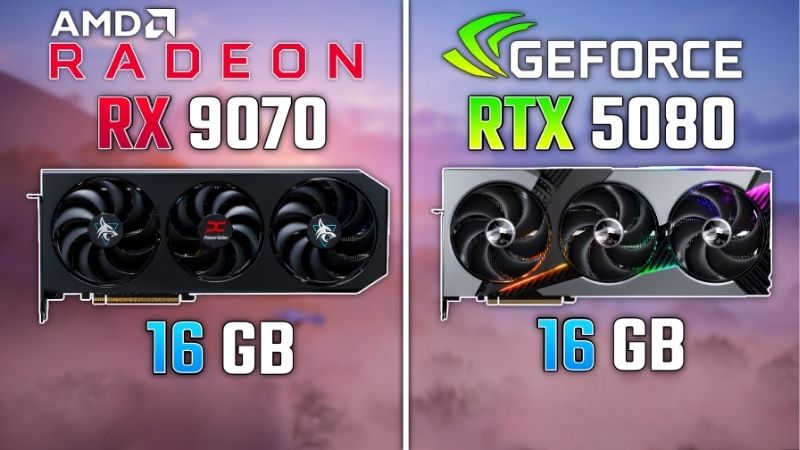
Radeon RX 9070 vs RTX 5080: The Quick Verdict
Because these cards sit in different tiers, the winner depends entirely on your goals and budget. The RTX 5080 is far more powerful and feature-rich, while the RX 9070 delivers excellent value for high-refresh 1440p gaming. The RTX 5080 wins on raw performance; the RX 9070 wins on price. Here is the fast answer, then who each card suits.
As an Amazon Associate we earn from qualifying purchases at no extra cost to you.


The One-Line Answer for Busy Buyers
The RTX 5080 wins clearly on performance, ray tracing, and features. The RX 9070 wins on value, delivering strong 1440p gaming for much less money.
So if you want a 4K flagship with maximum ray tracing and DLSS 4, the 5080 is the obvious pick. If you want great high-refresh 1440p gaming without paying flagship money, the RX 9070 is the value choice. These are simply built for different buyers.
Framing it as a tier gap rather than a head-to-head helps you decide quickly. If your instinct is to compare these two specifically, it is usually because you are weighing value against the flagship experience, not because they trade blows on a benchmark chart. Knowing which side of that line you fall on answers the question faster than any single number can.
Who Should Pick the Radeon RX 9070
Choose the RX 9070 if you game mainly at 1440p, want excellent value, and do not need the absolute top tier of ray tracing. Its strong raster performance and 16 GB of memory make it a superb high-refresh 1440p card for the money.
It is also the right call if NVIDIA’s flagship pricing is hard to justify. With RDNA 4’s improved ray tracing and FSR 4 upscaling, the RX 9070 covers modern features well while keeping your total build cost far lower.
Who Should Pick the RTX 5080
Choose the RTX 5080 if you want a genuine 4K flagship with class-leading ray tracing and the smoothest DLSS 4 experience. Its Blackwell architecture and GDDR7 memory deliver a large performance lead in demanding scenarios.
It is also the smarter buy if you do serious creative or AI work alongside gaming, where NVIDIA’s CUDA ecosystem shines. For a no-compromise, high-resolution experience, the 5080 is in a different class than the RX 9070.
Specifications and Performance Face-Off
The specs make the tier gap plain. The RTX 5080 brings faster memory, stronger ray tracing hardware, and 4K-focused power, while the RX 9070 counters with excellent raster efficiency and value at 1440p. The numbers explain the gaming results that follow.
Core Specs Side by Side
Here are the key specifications that shape performance:
| Spec | RX 9070 | RTX 5080 |
|---|---|---|
| Architecture | RDNA 4 | Blackwell |
| Memory | 16 GB GDDR6 | 16 GB GDDR7 |
| Ray tracing | Improved (RDNA 4) | Class-leading |
| Upscaling | FSR 4 | DLSS 4 + multi-frame gen |
| Typical power draw | ~220 W | ~360 W |
| Best resolution | 1440p | 4K |
Both carry 16 GB, but the 5080’s faster GDDR7, stronger ray tracing, and higher power target put it firmly in 4K flagship territory, while the efficient RX 9070 is tuned for value at 1440p.
Gaming Performance at 1440p and 4K
At 1440p, the RX 9070 is a strong performer and delivers high-refresh gameplay in most titles, offering a smooth experience that belies its lower price. For many players, it is all the card they need.
At 4K and in the most demanding, ray-traced games, the RTX 5080 pulls far ahead, holding framerates the RX 9070 cannot match. This is the tier gap in action: the 5080 is built to max out a 4K display, while the RX 9070 is happiest driving a high-refresh 1440p panel. Match the card to your monitor and the right choice becomes obvious.
Refresh rate factors in alongside resolution. A high-refresh 1440p display pairs beautifully with the RX 9070, which can push the high framerates such panels are built for. A 4K high-refresh monitor, by contrast, is exactly what justifies the 5080, since it has the muscle to keep those demanding pixels moving smoothly where the RX 9070 would have to compromise.
Ray Tracing, DLSS 4, and NVIDIA’s AI Features
Ray tracing is a clear win for the 5080. Its dedicated hardware handles heavy ray-traced and path-traced titles far more comfortably, and the lead is largest in the games that push these effects hardest.
Upscaling widens the divide further. DLSS 4 with multi-frame generation uses AI to boost smoothness dramatically, and this is where NVIDIA’s forward-looking technology stands out. AMD’s FSR 4 has improved a great deal and is genuinely good, but DLSS still enjoys broader support and a deeper feature set. For buyers who prize AI-driven performance and future optimization, the 5080’s software stack is a major advantage.
The productivity angle reinforces this. Beyond gaming, the RTX 5080’s CUDA support and stronger ray tracing make it far more capable for 3D rendering, video work, and AI tasks, which can justify its price for creators who also game. The RX 9070 is a fine gaming card but is not aimed at that professional crowd, so if your workload extends beyond play, the 5080 pulls further ahead.
Value, Power, and Real-World Fit
Comparing cards from different tiers makes value, power, and fit especially important. This section makes the RX 9070’s affordability and the 5080’s premium concrete, and lays out the honest pros and cons of each.
Price-to-Performance: What You Really Pay For
The RX 9070’s headline is value. It costs far less than the RTX 5080 while delivering excellent 1440p performance, so for a high-refresh 1440p gamer its frames-per-dollar figure is outstanding.
The RTX 5080 asks a large premium, and you pay it for 4K power, ray tracing, DLSS 4, and productivity strength. If you game at 1440p, that premium is hard to justify. If you target 4K or do creative and AI work, it becomes reasonable. Be honest about your resolution before spending, because the price gap here is substantial.
Total system cost is part of the picture too. The RX 9070’s lower power draw means you can pair it with a more modest power supply and cooling, trimming the overall build budget, while the 5080 often demands a stronger, pricier supply. For a value-focused build, those savings add up alongside the lower sticker price of the card itself.
Power Draw, PSU, and Case Compatibility
Power needs differ sharply. The efficient RX 9070 draws around 220 W and is happy on a quality 650 W to 700 W supply, making it easier to fit into mid-range builds. The RTX 5080 pulls closer to 360 W and wants a strong 750 W to 850 W unit with real headroom.
Check physical clearance too, as the 5080 is a large card, and confirm your power connectors, since high-end cards may use the 12VHPWR connector that must be seated fully. The RX 9070’s lower demands make it the simpler card to house, which is a genuine practical advantage for many builders.
Noise and heat follow from power. The efficient RX 9070 is generally easier to keep quiet and cool, which matters in a small room or a compact case, whereas the high-wattage 5080 can run warmer and louder unless paired with strong airflow. Neither is a dealbreaker, but the quieter, cooler experience is a real everyday perk of the lower-power AMD card.
Pros and Cons of Each Card
Here is the honest balance sheet for this RX 9070 vs RTX 5080 decision:
| RX 9070 | RTX 5080 | |
|---|---|---|
| Pros | Excellent 1440p value; efficient; 16 GB; easy to power | 4K flagship power; best ray tracing; DLSS 4; great for AI |
| Cons | Not a 4K flagship; weaker heavy ray tracing | Expensive; high power; overkill for 1440p-only gamers |
The pattern is clear. Pay less for outstanding 1440p value with the RX 9070, or pay much more for a complete 4K flagship experience with the RTX 5080.
The Smart Alternative and What Today’s Prices Mean
Because these cards target different buyers, a closer-matched alternative often makes more sense, and timing matters in the current market. If the gap between them feels awkward, a middle option may fit better before you spend.
A Closer-Matched Alternative Worth Considering
If you like AMD but want more power against the 5080, the RX 9070 XT is the closer rival, narrowing the raster gap significantly for a modest increase. On NVIDIA’s side, an RTX 5070 Ti sits between the two, offering much of the 5080’s feature set at a lower price.
These alternatives are worth pricing before you decide, because one may match your resolution and budget better than either card in this specific matchup. If that interests you, compare current GPU prices on Amazon alongside both cards here.
If you specifically want to compare AMD’s best against the 5080 on more even footing, our RX 9070 XT versus RTX 5080 breakdown is the closer contest, since the XT narrows the raster gap far more than the standard 9070 does. Pricing all of these together is the surest way to see where your money buys the most performance for the games you actually play.
Should You Buy Now or Wait?
Timing is a fair question in 2026 because component prices have trended upward and the memory shortage behind that rise has not fully cleared. There is cautious good news: prices have stopped climbing as steeply as they did in late 2025, and some hardware makers have reported a period of relative stability, though they still warn of volatility. Strong AI demand, underscored by the United States clearing NVIDIA to sell its powerful H200 chip to China, keeps pressure on the memory these cards depend on.
New supply is coming from Chinese memory makers and new Micron fabs in Idaho, but those plants are not expected to run until 2027 or 2028. So prices have leveled off rather than dropped, and meaningful relief remains years out. If you are ready to buy now, waiting is a risky bet in the near term.
Final Recommendation
Buy the RTX 5080 if you want a true 4K flagship with the best ray tracing and DLSS 4, or if you pair gaming with creative and AI work. Buy the RX 9070 if you game at 1440p, want excellent value, and are happy with strong-but-not-flagship ray tracing.
For value-focused 1440p gamers, the RX 9070 is the smarter spend, while the RTX 5080 is the clear choice for 4K enthusiasts who want every feature and the performance crown.
See More:
- Radeon drivers
- What is NVIDIA CUDA Toolkit
- 4080 Super vs 5060 Ti
- NVIDIA PhysX
- NVIDIA Game Ready Driver
Conclusion
The Radeon RX 9070 vs RTX 5080 decision is really a choice between a value 1440p card and a 4K flagship, so the right pick depends on your monitor, budget, and workload rather than raw benchmarks alone. The 5080 leads decisively on performance and features; the RX 9070 delivers outstanding 1440p value, with a 9070 XT or 5070 Ti bridging the gap. With prices only stabilizing rather than falling and AI demand keeping the market tight, there is little reason to wait if you are ready. Weigh resolution against budget, then check today’s prices to secure the GPU that fits you best.
Frequently Asked Questions
Is the RX 9070 anywhere near the RTX 5080 in raw performance?
No, and the pricing reflects that. The RX 9070 is a mainstream 1440p card built on RDNA 4, while the RTX 5080 is a 4K flagship with far more shader throughput and GDDR7 bandwidth. Expect the 5080 to be roughly 50 to 70 percent faster in demanding raster titles at 4K.
Do both cards have enough VRAM for modern games?
Both ship with 16GB, which is comfortable for 4K textures today. The difference is bandwidth: the 5080 uses GDDR7 on a 256-bit bus, while the 9070 uses slower GDDR6. At 1440p that gap matters less, so the 9070 rarely feels VRAM starved in normal gaming use.
What power supply does each card need?
The RX 9070 draws around 220 watts and is happy on a quality 650 to 750 watt unit with standard eight-pin connectors. The RTX 5080 pulls roughly 360 watts through a 12V-2×6 connector, so plan on 850 watts minimum, an ATX 3.x supply, and a fully seated cable to avoid connector heating.
How big is the ray tracing gap between them?
RDNA 4 closed much of AMD historic ray tracing deficit, so the 9070 is competitive per dollar. Against the 5080 specifically, NVIDIA still leads by a wide margin in path traced titles, and DLSS 4 with multi frame generation extends that lead further in games that support it.
Which one is the better buy for a 1440p gamer?
The RX 9070 makes far more sense. It delivers high refresh 1440p in nearly everything at roughly half the price, and the money saved covers a better monitor or CPU. Choose the 5080 only if you game at 4K, use heavy ray tracing, or need CUDA for creative and AI work.

Write Your Review
No reviews yet. Be the first to share your experience!