
RTX 4060 vs RTX 5060 is the budget-GPU decision millions of 1080p gamers are wrestling with right now, and the honest answer is more nuanced than the marketing suggests. On paper the RTX 5060 replaces the RTX 4060 at the same $299 launch price, yet it is not a night-and-day leap — it is a targeted upgrade built around faster GDDR7 memory and DLSS 4 Multi Frame Generation. If you are cross-shopping these two cards, you almost certainly want a fast, data-backed answer rather than a fifteen-minute video. This comparison strips out the hype, lines up the numbers side by side, and tells you in plain terms which card actually deserves your money in 2026.


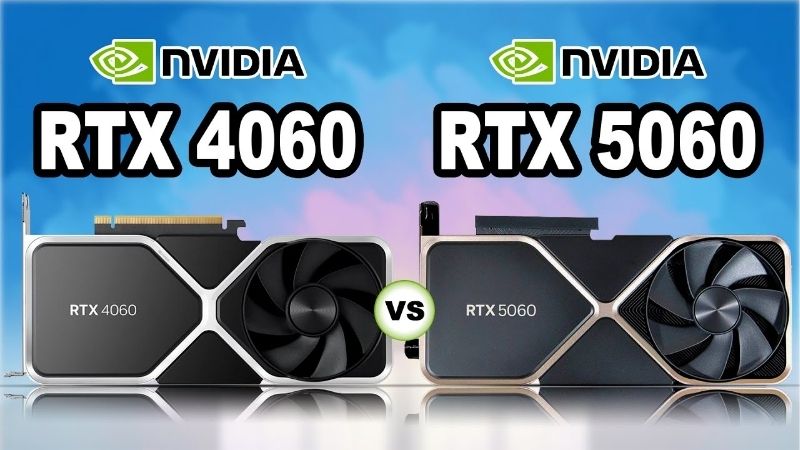
The Quick Verdict For The RTX 4060 vs RTX 5060 Buyer
If you only have thirty seconds, here is the compressed answer before the deep numbers below. At identical $299 pricing the RTX 5060 is the smarter buy for anyone building a new 1080p rig, because you get roughly 15–20% more raw rasterization performance plus a feature set the RTX 4060 physically cannot run. But “smarter buy at the same price” is not the same as “worth upgrading to,” and that distinction is exactly what decides the outcome for existing owners versus new builders. The two groups should read the verdict very differently.
As an Amazon Associate we earn from qualifying purchases at no extra cost to you.



Quick Verdict For Pure 1080p Gaming
For a brand-new 1080p build, the RTX 5060 wins cleanly. The generational gains in raw frames are modest, but price parity means there is simply no reason to choose the older card when both cost the same money.
The real tie-breaker is DLSS 4 with Multi Frame Generation, which is exclusive to the RTX 50-series. In supported titles it can generate up to three AI frames per rendered frame, pushing perceived frame rates far beyond anything the RTX 4060 can reach. That gap widens every month as more games add support.
If you already own an RTX 4060, do not upgrade. A 15–20% jump is not something you will feel in day-to-day play, and your money is far better saved toward a bigger leap in a future generation. Selling a working 4060 to fund a same-tier card is a losing trade.
Quick Verdict For Upgraders From A GTX 1660 Or RTX 2060
This is where the RTX 5060 becomes an easy recommendation. Coming from a GTX 1660 or RTX 2060, you are looking at a large performance jump layered on top of modern ray tracing, AV1 encoding, and the full DLSS 4 suite.
Owners of these older cards are exactly the audience Nvidia designed the RTX 5060 for. The card can double perceived performance in DLSS-supported games and transforms titles that felt sluggish on Turing-era hardware into smooth, high-refresh experiences.
Even the jump from an RTX 3060 is worth weighing, though there is a catch: you would trade 12GB of VRAM for 8GB. For pure 1080p that is a fair swap given the efficiency and feature gains, but it is a genuine consideration if you play texture-heavy games.
RTX 4060 vs RTX 5060 Specs And Price Snapshot
Before the feature-by-feature breakdown, here is the data both cards live and die by. Skim this table and most of the argument settles itself, then read the analysis underneath for the context the raw numbers hide.
| Specification | RTX 4060 | RTX 5060 |
|---|---|---|
| Architecture | Ada Lovelace | Blackwell |
| CUDA cores | 3,072 | 3,840 |
| VRAM | 8GB GDDR6 | 8GB GDDR7 |
| Memory bandwidth | ~272 GB/s | ~448 GB/s |
| Boost clock | ~2.46 GHz | ~2.50 GHz |
| TDP | 115W | 145W |
| DLSS 4 Multi Frame Gen | No | Yes |
| Launch MSRP | $299 | $299 |
The numbers that matter most are not the CUDA core counts, which differ by only about 25%. It is the memory bandwidth line and the DLSS 4 row that separate these cards in practice, and both favour the newer model decisively. Notice too that the shared 8GB VRAM figure is identical on both cards — a reminder that this generation’s improvements are about speed and features, not capacity. That single shared limitation is the thread running through the rest of this comparison, so keep it in mind as you read on.
Deep Dive Face-Off: RTX 4060 vs RTX 5060 By Criteria
A spec sheet only tells half the story. What matters is how those numbers translate into frames, heat, and real system requirements at your desk. Here is the head-to-head on the three things that genuinely change your experience: raw performance and features, power and physical fit, and the honest balance of strengths and weaknesses. Each of these areas rewards a different kind of buyer, so read the one that matches your situation most closely, then check the others for anything that might change your mind.
Raw Performance, Memory Bandwidth, And DLSS 4
In native rasterization, independent testing consistently places the RTX 5060 about 15–20% ahead of the RTX 4060. That is a real, measurable gain, but it is a single-tier step rather than a generational chasm, and you should ignore any claim of “double the performance” that quietly relies on frame generation to get there.
The more meaningful hardware change is bandwidth. Moving from GDDR6 to GDDR7 lifts memory throughput from roughly 272 GB/s to about 448 GB/s on the same 128-bit bus — close to a 65% increase. That extra bandwidth is why the RTX 5060 pulls further ahead in demanding, bandwidth-hungry scenes than the core-count difference alone would predict.
Then there is DLSS 4. Multi Frame Generation is locked to the Blackwell architecture, so the RTX 4060 cannot access it at all. In supported titles this is the single largest gap between the two cards, and with DLSS 4 support already live across a large and growing library of games, it is a feature you will actually use rather than a spec-sheet footnote.
Power Draw, Thermals, And PSU Compatibility
The RTX 5060 draws 145W versus the RTX 4060’s 115W. That 30W increase is modest, but it is worth checking against your power supply if you are running an older or low-wattage unit rather than assuming it will simply drop in.
A quality 500–550W PSU comfortably handles the RTX 5060 with most mainstream CPUs. Both cards stay physically compact: most dual-fan models fit small mini-ITX cases, making either a strong choice for a space-limited or small-form-factor build where a larger high-end card would never fit.
One practical detail to note is that some of these budget cards use a PCIe x8 electrical interface rather than the full x16, which has a small but measurable impact on older PCIe 3.0 motherboards. Thermals, meanwhile, are a non-issue for typical use — both run cool and quiet at 1080p, so your case airflow will matter more than any heat difference between them.
Pros And Cons Of Choosing The RTX 5060 Over The RTX 4060
No card is perfect, and the RTX 5060 carries one clear weakness that colours the entire decision. Here is the balanced view so you buy with eyes open.
Pros: faster GDDR7 bandwidth for a real edge in demanding scenes, 15–20% higher rasterization, exclusive DLSS 4 Multi Frame Generation, improved AV1 encoding for streamers and creators, better efficiency per frame, and identical launch pricing to the outgoing card.
Cons: still only 8GB of VRAM, which is the ceiling that limits texture headroom in the newest 1440p titles; the raw generational gain is small if you never touch DLSS; and street prices frequently sit above the $299 MSRP, eroding the value argument.
On balance the pros clearly outweigh the cons for a new build, but the 8GB ceiling is the one caveat serious 1440p players should weigh before committing.
Pricing Reality, Alternatives, And The Final Call
The technical winner is clear, but 2026 pricing pressure and a couple of strong alternatives can change what the right purchase looks like for you specifically. This is the part most spec comparisons skip, and it is the part most likely to affect what you actually pay at checkout. A card that wins on paper can still be the wrong buy if its street price has drifted far above MSRP, so treat this section as the practical counterweight to the benchmark numbers above.
How 2026 Memory Prices Reshape The RTX 4060 vs RTX 5060 Math
Graphics-card pricing is no longer set by gaming demand alone. Through late 2025, surging AI datacenter demand drove DDR5, SSD, and high-VRAM graphics-card prices up by roughly 20%, and that pressure has spilled into the wider component market, keeping street prices on many cards stubbornly above MSRP.
There is cautiously positive news, though. Prices have stopped climbing as steeply as they did at the very end of 2025, and some hardware makers have reported a period of relative stability — while still warning that further volatility is possible. New supply is opening up as well: manufacturers can source DDR5 from Chinese suppliers such as CXMT, and Micron is building two new plants in Idaho to add memory capacity.
The catch is timing. Those new facilities are not expected to ramp until 2027–2028, so real relief is still years away; prices have merely paused rather than fallen. For this specific matchup there is a silver lining: because both cards carry only 8GB, datacenters are far less interested in them than in 16GB parts, so they enjoy slightly more price breathing room than higher-VRAM cards. The practical takeaway is simple — if you need a card now, buying sooner is safer than betting on a near-term price drop that the supply calendar does not support.
The Alternative If Neither Card Feels Right
If the 8GB ceiling worries you, the AMD Radeon RX 9060 XT 16GB is the obvious alternative, trading DLSS 4 for double the VRAM and stronger native 1440p rasterization. For anyone planning to keep a card for four or five years, that memory buffer is compelling.
On a tighter budget, the Intel Arc B580 typically undercuts both Nvidia cards while offering 12GB of memory, making it a genuine value pick if you can live without the mature DLSS ecosystem. A used RTX 4070 is the last option worth watching — if you can find one near the price of a new RTX 5060, it delivers noticeably more raw horsepower for 1440p.
Weigh these alternatives against your own priorities rather than raw price alone. If you value the widest game support, the smoothest upscaling, and the best ray tracing, the Nvidia cards remain the safer long-term pick. If you simply want the most raw frames and VRAM per dollar and are comfortable tuning settings yourself, the AMD and Intel options genuinely earn a place on your shortlist.
See More:
Final Verdict And Recommendation
Buy the RTX 5060 if you are building fresh, gaming primarily at 1080p, and want the longest-supported feature set at the entry-price tier. It is the correct default for the vast majority of buyers in this bracket, and DLSS 4 alone justifies the choice over the older card.
Only consider the RTX 4060 if you find it heavily discounted well below $299, which is increasingly rare as stock dries up and Nvidia shifts focus to the 50-series. And if you already own the RTX 4060, keep it — the upgrade simply is not worth it this generation, and your budget is better banked for a larger future jump.
To sum up the RTX 4060 vs RTX 5060 debate: the RTX 5060 is the correct new-build choice thanks to GDDR7 bandwidth and DLSS 4, while the RTX 4060 only makes sense at a steep discount. With component prices merely stabilising rather than falling through 2026, locking in the right card sooner is the sensible move. Check the current price and availability through the link below before stock on the best-value models runs low.
Frequently Asked Questions
How much of an upgrade is the RTX 5060 over the RTX 4060?
The RTX 5060 adds around 25 percent more shader cores and switches from GDDR6 to GDDR7, lifting memory bandwidth from roughly 272GB/s to about 448GB/s. That bandwidth jump is the important part, since the 4060 was clearly starved on its narrow bus. Real world gains typically land between 20 and 30 percent at 1080p, with more in bandwidth sensitive scenes.
Do both cards still have only 8GB of VRAM?
Yes, and that remains the core criticism of both. Neither card gained capacity, so both can exhaust their buffer in titles using high resolution texture packs, path tracing or frame generation at 1440p. The 5060 hides the problem slightly better thanks to faster memory, but it does not solve it. Plan on high rather than ultra textures in heavy releases.
Is DLSS 4 multi frame generation worth upgrading for?
Multi frame generation is exclusive to Blackwell cards like the RTX 5060, and it can dramatically raise displayed frame rates on a high refresh monitor. It does not reduce input latency, though, since it inserts generated frames rather than shortening the render pipeline. It works best when your base frame rate is already around 60, which is exactly where this class of card sits.
Does the RTX 5060 need a bigger power supply?
Slightly. The 4060 sits near 115 watts while the 5060 moves up to around 145 watts, so a quality 450 to 550 watt unit still covers either card in a mainstream system. Both typically use a single 8-pin PCIe connector, and both remain easy fits for compact cases and prebuilt machines with modest power headroom.
Should an existing RTX 4060 owner upgrade?
Generally no. A 25 percent uplift within the same VRAM capacity is not a meaningful generational leap, and the money is better saved toward a 5060 Ti 16GB or higher tier card. The 5060 makes sense for people coming from a GTX 1060, 1650 or RTX 2060, where the combined performance and feature gain is genuinely transformative.
Ready to decide? Our #1 pick for 2026 is the Architecture.
Live price & availability on Amazon.

Write Your Review
No reviews yet. Be the first to share your experience!