
- Top Pick: Sapphire 11348-03-20G Pulse AMD Radeon™ RX 9070 XT Gaming Graphics Card with 16GB GDDR6, AMD RDNA 4
- Best Value: ASRock Radeon RX 9070 XT Taichi 16GB OC, RDNA 4, 3100MHz Boost, 16GB GDDR6 256-bit, PCIe 5.0, Taichi 3X Cooling, Dual BIOS, Polychrome SYNC
- Premium Choice: PowerColor Hellhound AMD Radeon RX 9070 XT 16GB GDDR6 Reva Edition


Best Seller
XFX Swift AMD Radeon RX 9070XT Triple Fan Gaming Edition with 16GB GDDR6 HDMI 3xDP, AMD RDNA 4 RX-97TSWF3BA

AMD 9070 XT vs Nvidia 5070 Ti is the matchup that defines the upper mid-range in 2026, and picking the wrong side can cost you real money or a real chunk of performance. Both cards target high-refresh 1440p and entry-level 4K, both carry 16 GB of memory, and both sit close enough in price to make the decision genuinely hard. This comparison cuts through the noise with a quick verdict, a full specs table, a feature-by-feature face-off, a cheaper alternative if both are out of reach, and a clear recommendation for each type of buyer.
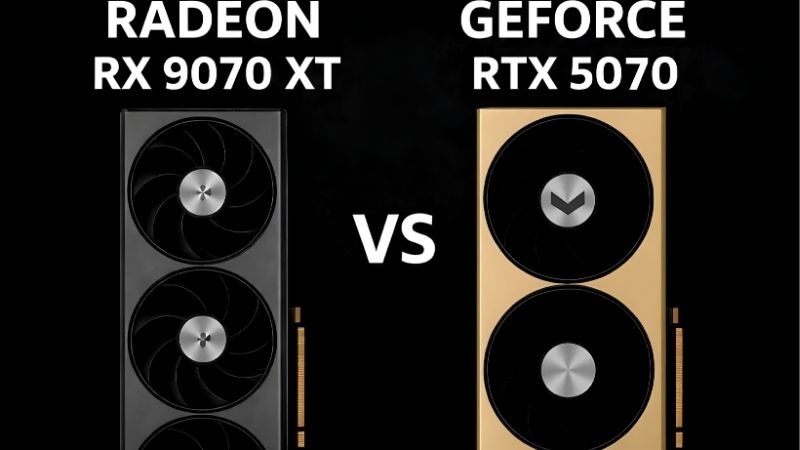
AMD 9070 XT vs Nvidia 5070 Ti: Quick Verdict and Specs
Before the deep analysis, most readers just want to know which card to buy, so this section front-loads the answer and lays out the raw numbers. The two cards are closer than the marketing on either side would have you believe, which is precisely why the specific details below decide the winner for your particular use case.
As an Amazon Associate we earn from qualifying purchases at no extra cost to you.



The Quick Verdict for Busy Buyers
If you want the fastest raw rasterization per dollar plus 16 GB for high-texture gaming, the RX 9070 XT usually wins on value. If you prioritize ray tracing, the best-in-class upscaling of DLSS 4, and the widest software and app support, the RTX 5070 Ti is the safer all-rounder.
The short version: AMD for raster value, Nvidia for ray tracing and features. Both are excellent 1440p cards, so there is no wrong answer here, only a better fit for how you actually play.
One more framing that helps buyers decide quickly: think about the split between your rasterized and ray-traced hours. If ninety percent of your playtime is competitive shooters, sims, and non-RT titles, the AMD card’s raw speed and lower price are hard to beat. If you regularly enable ray tracing in single-player showcases, the Nvidia card’s lead in exactly those scenarios is what you are paying the premium for.
Full Comparison Table
Numbers first. The table below lines up the core specifications so you can see exactly where each card leads before we get into real-world behavior. Skim it for the two or three figures that matter most to you, and the rest of this comparison will explain what those numbers actually mean once you are gaming.
| Spec | AMD RX 9070 XT | Nvidia RTX 5070 Ti |
|---|---|---|
| Architecture | RDNA 4 | Blackwell |
| Shading units | 4,096 stream processors | 8,960 CUDA cores |
| Memory | 16 GB GDDR6 | 16 GB GDDR7 |
| Memory bus | 256-bit | 256-bit |
| Total board power | ~304 W | 300 W |
| Launch MSRP | 599 | 749 |
| Upscaling | FSR (latest) | DLSS 4 + Multi Frame Gen |
| Recommended PSU | 750 W | 750 W |
Price and Value Snapshot
On paper the 9070 XT undercuts the 5070 Ti by roughly 150 at list price, though street prices vary with stock and region. That gap is the heart of the entire debate.
The question you have to answer is whether Nvidia’s ray tracing and DLSS 4 advantage is worth that premium for the games you actually play. If you rarely touch ray tracing, the AMD card’s lower price is hard to argue against; if you love it, the math shifts toward Nvidia quickly.
There is also a resale and longevity angle worth weighing. Nvidia cards historically hold their value slightly better on the used market, and the steadily growing library of DLSS 4 titles means the 5070 Ti’s feature advantage tends to widen rather than shrink over its lifetime. The 9070 XT counters with raw raster headroom that ages gracefully in the many games that never add ray tracing at all, so both cards have a defensible case for lasting well.
Deep Dive Face-Off: Performance, Ray Tracing, and Features
Headline specs only tell part of the story, so this section pits the two cards against each other on the criteria that decide a purchase: rasterization, ray tracing and upscaling, and the practical realities of VRAM and power. Reviewers broadly agree these are close cards, but they diverge in ways that map cleanly onto different buyer priorities.
Rasterization Performance Head-to-Head
In pure rasterization at 1440p, the two trade blows, and the 9070 XT often edges ahead in many titles thanks to RDNA 4’s strong raster throughput. For gamers who mostly play competitive or non-RT titles, that raw speed is exactly what they are paying for.
At 4K raster, both remain playable with high settings in most games, and the extra memory bandwidth of GDDR7 helps the Nvidia card in the most bandwidth-heavy scenes. For the high-refresh 1440p sweet spot that suits both cards best, expect triple-digit frame rates in most modern games.
Analytically, the picture is close enough that individual game engines decide the winner more than the hardware does. Titles that favor AMD’s architecture can hand the 9070 XT a meaningful lead, while a handful of Nvidia-optimized engines swing the other way. Averaged across a broad test suite, the two land within a small margin of each other in raster, which is why price and features, not raw frames, usually break the tie for buyers.
Ray Tracing and Upscaling: DLSS 4 vs FSR
Ray tracing is where Nvidia pulls clearly ahead. The RTX 5070 Ti handles heavy RT and path tracing far more gracefully than the 9070 XT, so if you chase maxed-out lighting, Nvidia is the stronger tool.
DLSS 4 with Multi Frame Generation is the forward-looking trump card: in supported titles it multiplies smoothness and extends the card’s useful life as more games adopt it over time. AMD’s FSR has improved substantially and has the advantage of being open and broadly compatible across hardware, but Nvidia’s upscaling still leads on image stability and adoption in the newest AAA releases.
The gap matters most in exactly the demanding scenarios where you need help. When you enable heavy ray tracing at 1440p or push toward 4K, the combination of stronger RT cores and DLSS 4 lets the 5070 Ti hold a comfortable frame rate while the 9070 XT works harder to keep up. If those are the settings you chase, this single factor can justify the price difference on its own; if they are not, the advantage is far less relevant to your day-to-day experience.
VRAM, Power, and Real-World Fit
Both cards offer 16 GB, which is the practical minimum you want for comfortable high-texture 1440p and 4K gaming into the future. This is a meaningful area where cheaper cards fall short, and it is a genuine strength shared by both.
Power draw is similar at around 300 W, and both suggest a 750 W PSU, so plan your case airflow and cabling accordingly. One practical note before checkout: confirm physical card length against your case and check that your monitor’s ports match, since both cards support modern DisplayPort and HDMI standards for high-refresh output.
There is a subtle difference worth knowing on the memory side. The 5070 Ti uses faster GDDR7, while the 9070 XT uses GDDR6; both total 16 GB, but the Nvidia card’s higher bandwidth can help in memory-intensive workloads and future titles. For most gamers this is a minor edge rather than a deciding factor, yet it reinforces why 16 GB on either card is the smart floor to buy at when you want a rig that stays comfortable for years rather than months.
Pricing Outlook, The Alternative, and Final Verdict
With the technical picture settled, the last decisions come down to timing, budget flexibility, and matching each card to the right buyer. The current market adds a wrinkle worth understanding before you spend, because when you buy can matter almost as much as which card you choose.
Pricing Outlook in a Shaky Market
Timing matters as much as the spec sheet right now. Component prices have been trending upward, largely because of rising memory costs, and both of these 16 GB cards are directly exposed to that pressure.
The better news is that the sharp increases of late 2025 have leveled off. Some makers, including Framework, have reported a period of relative stability, while still cautioning that things could move again. The market appears to have caught its breath rather than reversed course.
New supply is coming, but slowly. OEMs can now tap DDR5 from Chinese suppliers such as CXMT, and Micron is building two plants in Idaho, yet those come online around 2027-2028 and will not touch this year’s prices.
The bottom line for buyers is that prices have paused, not fallen, and meaningful relief is more than a year out. If either card hits a fair price and you need it now, buying beats waiting for a discount that may simply not arrive on your timeline.
The Alternative If Both Are Too Expensive
If the 5070 Ti stretches your budget and the 9070 XT is hard to find in stock, the standard Nvidia RTX 5070 at 549 is the natural step down for pure 1440p gaming. It keeps the modern feature set at a lower entry point.
Pros of dropping to the RTX 5070: lower price, still includes DLSS 4, and a very efficient 250 W design. Cons: only 12 GB of VRAM and less 4K headroom than either 16 GB card above.
A second alternative is AMD’s non-XT RX 9070, which trims performance and price while keeping the full 16 GB of memory, making it a smart pick for raster-focused 1440p gamers on a tighter budget.
The logic behind offering these alternatives is simple: the best card is the one that fits both your needs and your wallet without forcing a compromise you will regret. If stretching to a 5070 Ti means cutting corners elsewhere in the build, a slightly slower card paired with a better CPU, SSD, or monitor often delivers a more satisfying overall system. Keep the whole build in view rather than fixating on the GPU alone, and the right choice usually becomes obvious.
See More:
Final Verdict and Recommendation
Buy the RX 9070 XT if you want maximum rasterization performance per dollar, play mostly rasterized or competitive titles, and value having 16 GB at a lower price point. It is the value champion of this pairing.
Buy the RTX 5070 Ti if ray tracing, DLSS 4, and the broadest software and app ecosystem matter to you, and you can absorb the premium for a more future-flexible card. It is also the more comfortable pick if you dabble in creative or AI workloads, where Nvidia’s software support remains the industry default.
For everyone in between, let price be the referee. If the two cards land within a small margin of each other on any given week, the feature-rich 5070 Ti becomes easier to recommend; if the 9070 XT is meaningfully cheaper or the only one in stock at a fair price, its raster value wins. Whichever way you lean, prices shift weekly, so use the buttons on this page to check today’s live listings for both cards before you commit.
The AMD 9070 XT vs Nvidia 5070 Ti decision really comes down to two questions: how much you care about ray tracing and DLSS 4, and how much the price gap stings for your budget. For raster value, choose AMD; for features and ray tracing, choose Nvidia, and rest easy knowing both are genuinely great 1440p performers.
With the market paused rather than dropping, locking in a fair price on whichever card fits your priorities is the sensible move today. Compare the latest prices in the AMD 9070 XT vs Nvidia 5070 Ti battle and grab the one that matches how you actually play.
Frequently Asked Questions
Which card gives better value at typical street prices?
The RX 9070 XT launched at a lower price than the RTX 5070 Ti and usually keeps that gap at retail, so it delivers more raster frames per dollar. The NVIDIA card justifies its premium through stronger ray tracing, wider DLSS 4 support, and better creator application performance rather than raw price-to-frame ratio.
Will my current power supply handle either upgrade?
The RTX 5070 Ti draws 300W through a single 12V-2×6 connector with a 750W recommendation. The RX 9070 XT sits slightly higher near 304W and generally uses two 8-pin PCIe connectors, with AMD suggesting around 800W for a full system. An 850W ATX 3.1 unit comfortably covers both.
Is 16GB enough for 4K gaming over the next few years?
Yes for the vast majority of scenarios. Both cards carry 16GB on a 256-bit bus, which handles 4K ultra textures and ray tracing today. Path traced titles and heavily modded games are the exception, and upscaling from a lower internal resolution reduces VRAM demand in exactly those cases.
How do drivers and software compare between AMD and NVIDIA now?
Both are stable. AMD Adrenalin bundles tuning, recording, and per-game profiles in one polished interface, while the NVIDIA App has consolidated the old Control Panel and GeForce Experience. NVIDIA still tends to ship day-one profiles for more launches, which matters if you buy games at release.
Which should I pick for a 1440p high-refresh monitor?
Either delivers well over 100fps in most modern titles at 1440p maximum settings. Choose the 9070 XT if you want maximum raster performance per dollar and mostly play competitive or non-ray-traced games. Choose the 5070 Ti if ray tracing, DLSS 4 Multi Frame Generation, or CUDA-accelerated creative work is part of your workload.

Write Your Review
No reviews yet. Be the first to share your experience!