
Top Asus Tuf Gaming Geforce Rtx Picks for 2026
Here are our current top asus tuf gaming geforce rtx picks, compared on real Amazon owner reviews, price, and features. Live prices update below.
- Top Asus Tuf Gaming Geforce Rtx Picks for 2026
- Performance: What the TUF RTX 5090 Delivers
- Pros and Cons From Verified TUF 5090 Owners
- The Market Around the 5090 in 2026
- Recommended Products
- Conclusion: The Flagship in Its Toughest Suit
- Related Guides
- Frequently Asked Questions
- Related Articles
- Related Guides
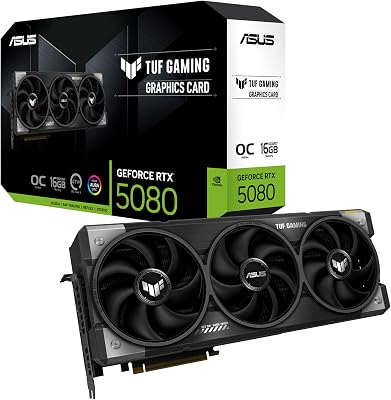


ASUS TUF Gaming GeForce RTX 5090 is what happens when Nvidia’s most powerful consumer GPU gets dressed in ASUS’s most durability-obsessed armor: a 575W flagship wrapped in a metal exoskeleton, military-grade components, and a cooler sized like a small appliance. It is also a four-figure purchase that deserves scrutiny beyond the spec sheet, because at this tier the partner model choice matters nearly as much as the silicon itself. This review measures what the TUF delivers in games and thermals, synthesizes what verified owners praise and complain about, weighs it against its own Founders Edition and partner rivals, and addresses the market conditions that make timing this purchase unusually consequential.
As an Amazon Associate we earn from qualifying purchases at no extra cost to you.


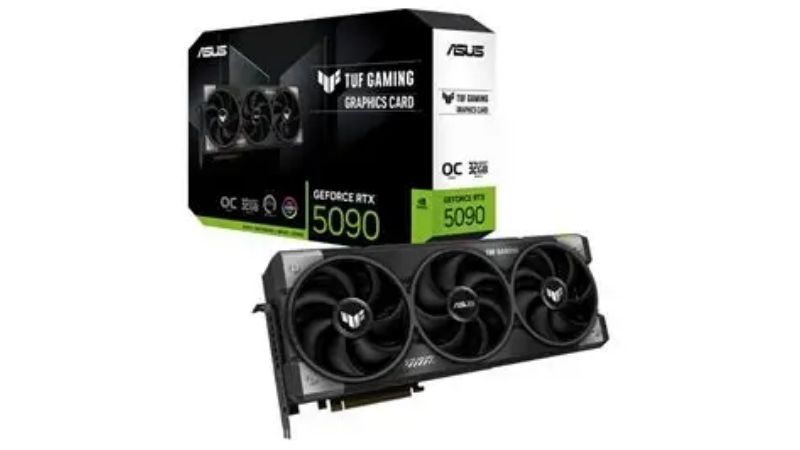
Performance: What the TUF RTX 5090 Delivers
The silicon underneath is Nvidia’s full Blackwell flagship: 21,760 CUDA cores, 32GB of GDDR7 at 1,792 GB/s, and a 575W TDP — the fastest consumer GPU in existence by a comfortable margin. The TUF’s job is feeding and cooling that chip without compromise, and the numbers say it succeeds.
4K and Beyond: The Benchmarks
At 4K ultra native, nothing else approaches it: Cyberpunk 2077 at 105 FPS, Horizon Forbidden West at 148 FPS, Black Ops 6 at 175 FPS — roughly 30-35% ahead of the RTX 5080 and 25-30% past the old RTX 4090. The TUF’s factory OC edition adds a measured 2-3% over reference clocks, sustained rather than burst, thanks to thermal headroom covered below.
This is also the first card where 8K gaming exits the stunt category: DLSS 4 Performance mode delivers playable 60+ FPS at 8K in supported titles, and triple-1440p surround setups — the traditional flagship-killer — run at high refresh without compromise. At 4K with Multi Frame Generation, path-traced showcases exceed 200 FPS, numbers that read like typos against any previous generation.
The CPU pairing deserves a sentence of caution drawn from owner experience: below 4K, this card is bottlenecked by every processor on the market, and reviews from 1440p buyers describe leaving measurable performance unused. The TUF 5090 is a 4K-and-up purchase by arithmetic, not by marketing — pairing it with anything less wastes exactly the premium that separates it from the 5080.
Ray Tracing, DLSS 4, and the Creator Case
Fourth-generation RT cores make full path tracing a default setting rather than a benchmark: Alan Wake 2 and Cyberpunk 2077 with every ray-traced option enabled hold 4K frame rates the previous flagship managed only at 1440p. Multi Frame Generation multiplies from a higher base than any other card, which is why the 5090’s effective-FPS charts embarrass everything below it.
The 32GB buffer quietly serves a second constituency: local AI models that overflow 24GB cards load entirely in VRAM, 8K video timelines scrub without proxies, and Blender scenes render without memory management. Creator reviews of this card read like the 4090’s — payback periods, not frame rates — with the ceiling moved up a tier.
Thermals and Noise: Where the TUF Earns Its Name
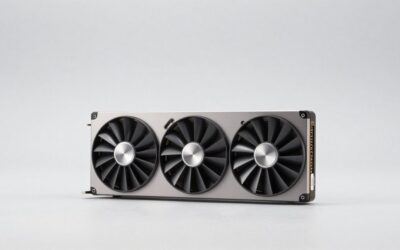
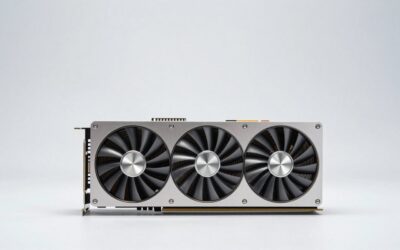
Pushing 575W through any cooler is the engineering test, and the TUF’s results are the card’s strongest argument: 68-72°C GPU temperatures under sustained 4K load, memory junctions in the low 80s, and noise at 36-39 dBA — quiet enough that owners consistently report case fans becoming the loudest component. The vapor chamber, phase-change thermal pad, and 3.6-slot fin stack do real measurable work.
The cost of that cooling is volume: 348mm long, 3.6 slots thick, and over 3kg hanging from the PCIe slot. The included anti-sag bracket is not decorative — it is structural, and reviews that skip it report the visible droop that explains why ASUS ships one in the box.
Power planning completes the installation picture: measured gaming draw sits around 540-570W with transient spikes past 700W, making a quality 1000W ATX 3.1 unit the realistic floor and 1200W the comfortable recommendation for overclocked systems. The native 12V-2×6 cable included in the box avoids adapter chains entirely — a detail owners praise after a generation of connector anxiety — and seating it with a confirmed click remains the one ritual no 5090 owner skips.
Pros and Cons From Verified TUF 5090 Owners
Aggregated owner reviews land at 4.6-4.8 stars — among the highest of any 5090 partner model — with the praise and complaints clustering in patterns worth reading before spending this much.
What 4-5 Star Reviews Consistently Celebrate
Thermal performance dominates the praise: owners migrating from older flagships describe disbelief at the temperature-to-noise ratio, and long-session gamers report sustained clocks without the throttling drama 575W implies. The phrase “overbuilt in the best way” recurs across review pools almost verbatim.
Build quality earns the second cluster: the metal frame and backplate, military-grade capacitors, and dual-BIOS switch (performance and quiet modes) read as durability insurance on a four-figure part. Owners also single out the included 12V-2×6 cable quality and the anti-sag bracket as details that respect the price tag.
The dual-BIOS switch earns specific testing notes in reviews: quiet mode trades roughly 1-2% performance for a 3-4 dBA noise reduction that owners in living-room builds call the better default, while performance mode holds the benchmark numbers above. Having both on a hardware switch — no software, no reflash — is the kind of redundancy the TUF line built its reputation on.
What 2-3 Star Reviews Warn About
Price leads every complaint: the TUF carries a premium over Nvidia’s $1,999 reference MSRP, with street listings commonly between $2,200 and $2,500 — and reviewers question the percentage math even while praising the hardware. Availability frustration follows closely: stock appears and vanishes within hours, a pattern that has defined the 5090 tier since launch.
The practical complaints are physical: the card rejects mid-towers that comfortably held previous flagships, demands a quality 1000-1200W ATX 3.1 power supply, and dumps 575W of heat into the room — owners in warm climates mention summer gaming sessions noticeably warming small spaces. A minority report coil whine at extreme frame rates, unit-dependent and usually tamed by frame caps.
TUF vs Founders Edition vs Other Partners
Against the Founders Edition, the TUF trades compactness for thermals: the FE’s 2-slot engineering marvel runs 5-8°C warmer and slightly louder, while the TUF’s bulk buys the quietest sustained operation in its class. Against premium rivals like the ROG Astral tier, the TUF undercuts on price while matching the cooling that matters, which is precisely the niche it has owned for generations.
The honest recommendation matrix: FE for small cases and aesthetics, TUF for the best thermals-per-dollar among premium models, and reference-priced partner cards for buyers who find one in stock at $1,999 — a genuine event worth acting on immediately.
The Market Around the 5090 in 2026
No GPU tier is more exposed to current industry forces than this one, and the timing question on a $2,200+ purchase deserves the same rigor as the hardware question.
H200 Sales to China and Flagship Supply
The United States has approved Nvidia selling the H200 — one of its most powerful AI accelerators — to China, reopening enormous data center demand. The 5090 sits closest to that fire of any consumer card: it shares the most advanced fabrication capacity and the same memory supply chains with data center products, and Nvidia’s margin incentive tilts allocation away from GeForce flagships first.
Every previous AI demand surge tightened consumer flagship availability within one to two quarters — and the 5090’s chronic stock volatility is that mechanism operating in real time. High-VRAM consumer cards also absorb overflow demand from buyers priced out of data center hardware, the same dynamic that froze 4090 depreciation.
Component Inflation and the Price Floor
Simultaneously, laptop and component prices are trending upward with memory leading the climb, as AI infrastructure absorbs DRAM production. The 5090’s 32GB of GDDR7 represents the largest memory bill of any consumer card — the most direct exposure to that inflation in the entire lineup — and memory contracts negotiated quarters ahead bake current increases into pricing through 2026.
Price tracking confirms the consequence: 5090-tier cards have spent the generation at or above MSRP with no discount window, and waiting for one has been a losing strategy every quarter so far. The realistic scenarios from here are stable-high or higher.
Buy Now or Wait: The Four-Figure Answer
For buyers whose budget and workload justify this tier, the read is unambiguous: a TUF 5090 found at or near its typical street price today is statistically unlikely to be beaten by waiting, and stock alerts matter more than patience. Set them, and act when one fires.
For buyers stretching to reach it, the RTX 5080 at half the price delivers 70-75% of the experience with the identical feature set — the comparison worth running honestly before committing. Checking both cards’ live availability on Amazon costs nothing and frequently makes the decision.
Recommended Products

Amazon Renewed
ASUS Dual GeForce RTX™ 4060 V2 OC Edition (PCIe 4.0, 8GB GDDR6, DLSS 3, HDMI 2.1a, DisplayPort 1.4a, 2-Slot Design, Axial-tech Fan Design, 0dB Technology, and More) (Renewed)

Sapphire&ref_=dp_csx_lgbl_s_premium-eligible
Prime
Sapphire Pulse 11324-01-20G Graphics Card AMD Radeon RX 7600 8 GB GDDR6

Gigabyte NVIDIA GeForce RTX 4060 Eagle OC Graphics Card – 8GB GDDR6, 128-bit, PCI-E 4.0, 2505MHz Core Clock, 2X DP 1.4, 2X HDMI 2.1a, NVIDIA DLSS 3 – GV-N4060EAGLE OC-8GD
As an Amazon Associate we earn from qualifying purchases. Product prices and availability are accurate as of the date/time indicated.
See more:
- ASUS TUF Gaming GeForce RTX 5090 3080 vs 5080
- Nvidia RTX 4070 Super graphics card
- Sapphire graphics card
- Is HDR good for gaming
- RTX 4080 vs 5070
Conclusion: The Flagship in Its Toughest Suit
The ASUS TUF Gaming GeForce RTX 5090 reviews as the rare four-figure product that over-delivers on its own premise: the fastest consumer GPU ever made, cooled so effectively that 575W runs quieter than last generation’s midrange, wrapped in build quality that treats the price tag as a durability contract. Its honest costs are size, heat into the room, a premium over reference pricing, and availability that tests patience — none of which the target buyer will find surprising. For 4K high-refresh gaming, 8K experiments, surround cockpits, and 32GB creator workloads, it is the answer without an asterisk. With AI demand squeezing flagship supply and memory inflation holding the price floor up, hesitation is the only expensive option left at this tier. Check the current ASUS TUF RTX 5090 stock and pricing on Amazon, set your alerts, and claim the top of the chart while it can still be claimed.
Frequently Asked Questions
What is the best asus tuf gaming geforce rtx 5090 in 2026?
The best asus tuf gaming geforce rtx 5090 depends on your budget and how you plan to use it. The options compared above are our top-rated picks based on real customer ratings, build quality, and overall value — start with the highest-rated model that fits your budget.
How much should I expect to spend on a asus tuf gaming geforce rtx 5090?
Prices vary by brand and features. Budget options cover the essentials, while mid-range and premium models add durability, performance, and extra features. Compare the prices in the list above to find the best value for your needs.
What should I look for when buying a asus tuf gaming geforce rtx 5090?
Focus on what matters most for your use case — build quality, compatibility, performance, warranty, and verified customer reviews. Every pick above is selected to balance these factors.
Are budget asus tuf gaming geforce rtx 5090 options worth it?
Yes. For most people a well-reviewed budget or mid-range asus tuf gaming geforce rtx 5090 delivers excellent value. You only need to spend more if you specifically require premium materials or top-tier performance.
How did we choose these asus tuf gaming geforce rtx 5090 picks?
We compare current Amazon ratings, review counts, key features, and price to surface the options with the best real-world value. The list is refreshed as ratings and availability change.

Write Your Review
No reviews yet. Be the first to share your experience!