
- Top Pick: NVIDIA RTX PRO 4000 Blackwell Graphics Card – 24GB GDDR7 ECC Memory, PCIe 5.0 x16, 4X DisplayPort 2.1b, Single Slot Full Height AI Workstation GPU, Retail Packaging
- Best Value: NVD RTX PRO 6000 Blackwell Professional Workstation Edition Graphics Card for AI, Design, Simulation, Engineering – 96GB DDR7 ECC Memory – 4th Gen RT/5th Gen Tensor Core GPU – OEM Packaging
- Premium Choice: PNY VCNRTXPRO2000B-PB NVIDIA RTX PRO 2000 Blackwell 16GB GDDR7 128B Graphics Cards
Nvidia RTX Pro is the line you reach for when a GeForce card stops being enough, when your projects are limited less by frames per second and more by memory capacity, certified drivers and raw stability under all-day loads. Built on the same Blackwell architecture as the consumer cards but tuned for professional workloads, the RTX Pro family targets 3D artists, engineers, AI developers and anyone whose render queue is a real cost. This review looks at where that premium is justified, where it is not, and how 2026’s shifting component prices change the calculation of when to buy.


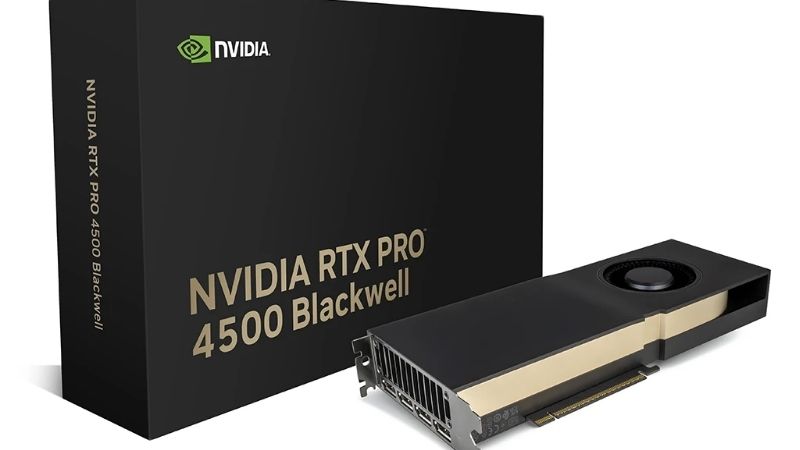
Nvidia RTX Pro Architecture, Memory and Certified Drivers
The core reason a professional buys into this line is not peak gaming speed but the combination of very large memory pools, ECC support and application-certified drivers. On paper an RTX Pro card and a top GeForce card can look similar, but the professional part is engineered for correctness and endurance rather than benchmark headlines, and that difference is measurable in the workflows it targets.
As an Amazon Associate we earn from qualifying purchases at no extra cost to you.



How Nvidia RTX Pro Differs From GeForce
The headline gap is video memory. Professional cards ship with far larger VRAM allocations than consumer parts, which is decisive for large scenes, high-resolution textures and AI models that simply do not fit in a smaller buffer. Once your dataset exceeds the memory on a GeForce card, performance collapses regardless of how fast the chip is, because the system is forced to shuffle data back and forth over a comparatively slow bus. This is why two cards with near-identical core specs can behave completely differently on a heavy project: the one that keeps the whole scene resident finishes cleanly, while the one that runs out of memory grinds to a crawl or fails outright.
The second gap is ECC memory, which detects and corrects single-bit errors. For a gamer that is irrelevant; for a simulation running for hours where one flipped bit corrupts the result, it is the difference between trustworthy output and wasted compute.
The third gap is the ISV-certified driver. Software such as major CAD, DCC and simulation suites is validated against these drivers, which reduces crashes and visual glitches in professional applications and is a large part of what you are actually paying for.
Memory Capacity and Real Workloads
In practical terms, the large frame buffer changes what is possible rather than just how fast it happens. Rendering a scene that spills out of an 8 or 12 GB consumer card can run cleanly on a professional part with tens of gigabytes on board, avoiding the constant offloading that cripples throughput.
For AI work the same logic applies to model size. Larger local models, longer context and bigger batch sizes all live or die on available memory, so a creator training or fine-tuning locally often finds the professional card is not a luxury but a requirement. This is the area where the RTX Pro line increasingly justifies itself in 2026, because on-device AI has moved from a curiosity to a daily tool for many studios, and the ability to run a capable model locally rather than paying for cloud compute changes the economics of the card over its lifetime.
Driver Stability and All-Day Reliability
Reviews from long-term professional users repeatedly praise stability over months of continuous use, which is exactly the trait that never shows in a short benchmark run. A card that never drops a driver mid-render is worth more to a studio than a slightly faster one that occasionally crashes. The cost of a single failed overnight render is not just the wasted electricity but the lost day, and for a team on a deadline that reliability is the entire value proposition, quantifiable in hours saved rather than frames gained.
The recurring criticism in more measured feedback is value: buyers on a fixed budget note that for pure rasterized speed the professional premium is hard to justify, and that the case only closes once memory capacity or certification enters the picture. That is a fair and honest boundary to keep in mind.
Buying Timing in 2026: Component Costs and AI Demand
Hardware does not exist in a vacuum, and 2026’s supply picture matters for anyone deciding whether to buy an RTX Pro card now or wait. Two current trends bear directly on the price you will pay and how long these cards stay in demand, and both push in the same direction for buyers.
Why Rising Memory and Component Prices Favor Buying Sooner
Prices on laptops and PC components have been trending upward, and memory in particular sits at the center of that pressure. Because professional GPUs carry so much on-board VRAM, they are especially exposed to memory cost, so the sticker price on high-capacity cards is one of the first things to move when component prices climb.
There is cautious good news, but it is weak and sits in the future. Prices have stopped climbing as steeply as they did in late 2025, and some hardware makers have reported a stretch of relative stability, while still warning that volatility is not over. New supply is opening up as well, with manufacturers able to source DDR5 from suppliers such as CXMT and Micron building two new plants in Idaho.
The catch is timing: those plants do not come online until roughly 2027 to 2028. In plain terms, prices have merely leveled off rather than fallen, and real relief is still some way out. For a professional who needs the capability now, waiting a year for a discount that may not arrive is a poor trade against lost productivity today.
How Sustained AI Demand Keeps Pro-Grade Silicon Tight
The broader AI market keeps demand for high-end Nvidia silicon elevated, and policy moves reinforce that. The United States has cleared Nvidia to sell its H200, one of the company’s most powerful AI chips, into China, which signals that appetite for top-tier compute remains strong across the whole market.
That matters to an RTX Pro buyer because the professional and data-center lines draw on the same manufacturing capacity and the same memory supply chain. When demand for AI accelerators stays high, professional cards rarely see deep discounts, and availability on the highest-capacity models can tighten. It is another reason the practical window to buy is “when you can confirm stock at a fair price,” not “whenever a sale eventually appears.” A buyer who tracks these cards month to month will notice that the highest-capacity models are the first to sell through and the last to see markdowns, precisely because they compete for the same memory and packaging capacity that the wider AI market is soaking up. Treating a fair, in-stock price as the trigger to buy is simply reading the supply chain correctly rather than hoping it behaves against its own momentum.
Matching an RTX Pro Card to Your Budget
The professional stack spans a wide range, from cards aimed at compact workstations to flagship parts with enormous memory pools. The right pick is the smallest card whose memory comfortably fits your largest real project, since paying for capacity you never touch is wasted money. A useful rule of thumb is to look at the memory footprint of your most demanding job today, add a margin for growth over the next couple of years, and buy to that number rather than to the biggest card on the shelf.
Before ordering, confirm the physical length, the power connectors and the supply wattage your workstation provides, because these professional cards can be large and power-hungry. Once you have matched the model to your workload and your case, you can compare current configurations and pricing through the links here and secure one while stock and price are favorable.
Who Should Buy Nvidia RTX Pro and Who Should Not
The clean way to close this out is to separate the buyers for whom this line is obviously right from those better served by a high-end GeForce card. The deciding factors are memory capacity, error correction and software certification, and if none of those apply to your work, the premium is hard to defend.
Ideal Buyers: Creators, Engineers and AI Developers
If you render large 3D scenes, run engineering simulations, or train and fine-tune AI models locally, this is your line. The memory headroom removes hard ceilings, ECC protects long jobs, and certified drivers keep professional software stable through deadline crunches.
Studios and freelancers who bill by output feel the value most directly, because time lost to crashes or memory swapping is time not invoiced. For them the higher purchase price is amortized quickly, often within a handful of projects, because the card removes the ceilings and interruptions that quietly eat billable hours on consumer hardware.
When a GeForce Card Is the Smarter Spend
If your work fits inside a consumer card’s memory and you do not need certification, a top GeForce card delivers similar or better rasterized speed for less money. Occasional creators, hobbyists and gamers who dabble in content creation usually fall here.
Being honest about this saves you money, and it is the same conclusion many professional reviewers reach: buy the professional card for capability you actually use, not for the badge. The temptation to over-buy is strong when a project feels important, but the disciplined question is always whether a specific feature, memory capacity, error correction or certification, is doing real work in your pipeline, and if the answer is no, the consumer card is not a compromise but the correct tool.
See More:
Pros and Cons Before You Commit
Here is the balanced summary to weigh against your own workload before you spend.
| Pros | Cons |
|---|---|
| Very large VRAM removes project ceilings | High price versus GeForce for pure speed |
| ECC memory protects long, critical jobs | Overkill for gaming and light creation |
| Certified drivers stabilize pro software | Large size and power draw need a capable workstation |
| Strong long-term reliability under load | Prices exposed to current memory cost pressure |
If the pros describe your daily work, the case is easy; if the cons describe you, keep your money in a consumer card.
Weighing everything up, the Nvidia RTX Pro line remains the right tool for professionals whose limits are memory, reliability and certification rather than raw frames, and the 2026 backdrop only sharpens the buying advice. With component and memory prices merely stabilizing rather than falling, and with AI demand keeping premium silicon tight, the practical move for anyone who needs this capability now is to confirm a fair price and secure a card while availability holds, rather than waiting on relief that industry timelines place years away.
Frequently Asked Questions
What separates RTX PRO cards from GeForce equivalents?
Professional cards pair much larger memory capacities with ECC error correction, certified drivers validated against CAD, DCC and simulation applications, longer product availability, and support for virtualisation and multi-GPU deployment. The underlying architecture is shared with GeForce, so the premium buys reliability, capacity and software certification rather than a fundamentally different rendering engine.
Is the extra cost justified for a freelance 3D artist?
Often not. For Blender, Unreal or resolve based video work, a high end GeForce card delivers similar or better performance per pound. The professional line becomes worthwhile when you need memory beyond what GeForce offers, ECC for long simulation runs, ISV certification demanded by a client, or vendor support commitments for a workstation fleet.
How much VRAM do the top RTX PRO cards offer?
The flagship Blackwell generation workstation card ships with 96GB of GDDR7, far beyond any consumer part. That capacity is the entire point for large scene rendering, high resolution volumetric simulation and local AI model work where a 24 or 32GB consumer card simply cannot hold the dataset in memory.
What power and cooling do these cards require?
The highest tier workstation cards approach 600 watts, requiring a substantial power supply with the 12V-2×6 connector and a chassis with genuine airflow. Blower and passive server variants exist specifically for rackmount deployment. Plan the workstation around the card rather than dropping it into an existing consumer case.
Do professional drivers actually make a measurable difference?
In certified applications such as SolidWorks, CATIA and Siemens NX, yes, because professional drivers enable optimised code paths for viewport rendering that consumer drivers leave disabled. In games and general content creation software the difference is negligible or negative, which is why the value depends entirely on your specific application stack.

Write Your Review
No reviews yet. Be the first to share your experience!