
Blackwell is an NVIDIA GPU architecture, not a single chip: it covers the data center accelerators such as B200 and GB200 that power AI clusters, and the consumer GeForce RTX 50 series for gaming PCs. They share a name and some design ideas, but they are different silicon aimed at completely different buyers, and the “blackwell chip” people search for depends on which world they mean.
- What Blackwell Is and Where the Name Comes From
- Consumer Blackwell: GeForce RTX 50 Series
- Data Center Blackwell: B200, GB200 and Beyond
- Side-by-Side Comparison
- Workstation Blackwell: The RTX PRO Line
- How Blackwell Differs From Its Predecessors
- Why the Split Matters for Buyers
- Is Blackwell Worth Choosing Right Now?
- Unannounced Products and Rumors
- Who Should Care About Which Blackwell
- Quick Reference Checklist
- Frequently Asked Questions
- Related Guides
This guide sorts out the two branches. It explains what Blackwell brought to GeForce, what it brought to the data center, how the product families map onto each other, and what the architecture means for a buyer as of late 2026. For exact specifications, core counts and prices, rely on NVIDIA’s own product pages, because the lineup includes many variants and details change.
What Blackwell Is and Where the Name Comes From
NVIDIA names its architectures after scientists and mathematicians, and Blackwell honors the statistician David Blackwell. It follows Hopper in the data center and Ada Lovelace in consumer graphics. NVIDIA introduced the data center parts first, at its GTC conference in March 2024, and then the GeForce RTX 50 series at CES in January 2025. A workstation line, branded RTX PRO, extends the architecture to professional desktops and servers.
Because one architecture name covers so many products, “Blackwell chip” can refer to a data center processor built for AI clusters or to a graphics card in a gaming PC. They are built on related technology, but nobody should compare them directly.
Consumer Blackwell: GeForce RTX 50 Series
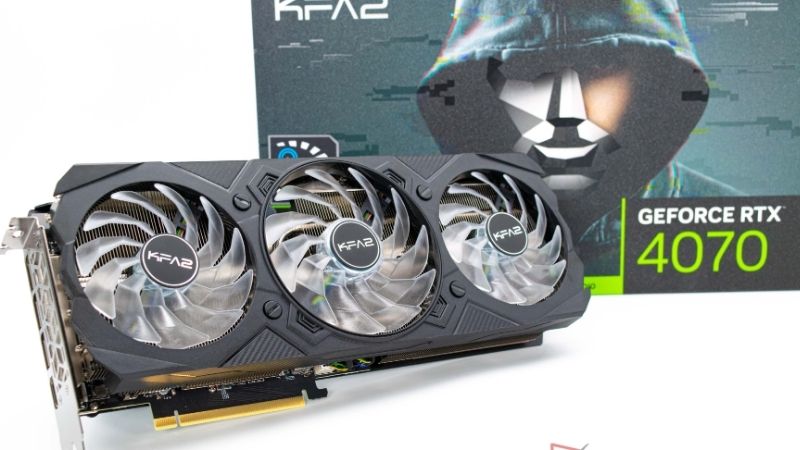
The GeForce RTX 50 series includes cards from the RTX 5050 up through the RTX 5090. Defining features include:
- GDDR7 memory, a newer memory standard than the GDDR6 and GDDR6X used by earlier generations.
- Fifth-generation Tensor cores and fourth-generation ray tracing cores.
- DLSS 4, including multi frame generation, which can generate more than one extra frame per rendered frame on supported games.
- PCIe 5.0 support on the consumer boards.
- Updated media engines with expanded video encoding and decoding capabilities.
The flagship RTX 5090 carries 32 GB of GDDR7 on a very wide bus, while the RTX 5080 has 16 GB, and lower cards in the stack scale down from there. Check NVIDIA’s pages for the exact memory on each model, because some cards in the family come in more than one memory configuration.
Data Center Blackwell: B200, GB200 and Beyond
On the data center side, Blackwell is built for training and running large AI models. The B200 GPU combines two large dies into one package, connected so that software sees them as one device, and uses high-bandwidth HBM3e memory rather than the GDDR chips on consumer cards. The GB200 pairs Blackwell GPUs with NVIDIA’s Grace processor, and these are sold in rack-scale systems with high-speed NVLink interconnects rather than as individual cards you could slot into a desktop.
Features aimed at AI include support for lower-precision number formats that speed up inference, a second-generation Transformer Engine, and large-scale networking. An enhanced line, Blackwell Ultra, followed with more memory and performance. As with everything at this level, exact figures belong on NVIDIA’s data sheets.
Side-by-Side Comparison
| Aspect | Consumer GeForce RTX 50 | Data center Blackwell |
|---|---|---|
| Main purpose | Gaming, creation, local AI | Training and serving large AI models |
| Memory type | GDDR7 | HBM3e (high-bandwidth stacked memory) |
| Form factor | PCIe graphics card with display outputs | Server modules and rack-scale systems; typically no display outputs |
| Key software feature | DLSS 4 and ray tracing | Transformer Engine and NVLink scale-out |
| Who buys it | Gamers, creators, enthusiasts | Cloud providers and large enterprises |
| Where to learn the specs | NVIDIA GeForce product pages | NVIDIA data center product pages |
Workstation Blackwell: The RTX PRO Line
Between the two sits the RTX PRO line, which brings the architecture to professional workstations and servers. These cards offer large memory pools, certified drivers and features for design, simulation and AI development. They suit users who need more memory or reliability features than GeForce provides but do not need rack-scale hardware. They are priced and supported differently from gaming cards, so verify requirements before choosing one.
How Blackwell Differs From Its Predecessors
Compared with Ada Lovelace on the consumer side, Blackwell shifts the emphasis from raw rasterization toward AI-driven features. The newer Tensor cores and software stack aim to generate more of each frame through neural rendering and frame generation, while the memory system moves to GDDR7 for higher bandwidth. In the data center, the change from Hopper centers on scale: two dies in one package, a faster interconnect between GPUs and support for smaller number formats that make large model inference cheaper per query. In both cases the company is leaning on software and AI rather than only adding shader units.
That has a practical effect on how to read performance claims. A feature that depends on game support, such as multi frame generation, helps only in the titles that implement it, and headline gains quoted with those features enabled do not describe raw performance. Always check what is being compared and whether it is the same image quality and settings.
Why the Split Matters for Buyers
Two practical points follow. First, you cannot buy a data center Blackwell part as a home upgrade: it uses server interfaces and cooling, often with no video output. Second, a gaming RTX 50 card’s strength in local AI comes from its Tensor cores and memory capacity, not from sharing a chip with the data center parts. For running models at home, the amount of video memory usually matters more than the generation.
Is Blackwell Worth Choosing Right Now?
For a new gaming PC, the RTX 50 series is NVIDIA’s current consumer generation as far as NVIDIA’s lineup shows, and it includes the newest DLSS technology. The benefit of buying it is access to multi frame generation and newer media features, while the trade-off is that games must support DLSS 4 to use them, and raw gains between tiers vary. Anyone considering a refresh or successor product should rely on NVIDIA’s official announcements, not rumors.
Unannounced Products and Rumors
Whenever a new architecture lands, speculation about mid-cycle refreshes follows. Treat any claim about unannounced Blackwell variants, specifications or release dates as unconfirmed unless it comes from NVIDIA directly. This article describes only products that NVIDIA has announced, and it deliberately avoids guessing at core counts or timing for anything else. If you are planning a purchase around a rumored card, the safer approach is to buy against the products that exist and are documented on NVIDIA’s product pages.
Who Should Care About Which Blackwell
The Gamer Building a New PC
Focus on the GeForce RTX 50 series, matching memory capacity to your resolution and your games. Ignore data center news except as background.
The Local AI Hobbyist
Look at memory capacity first, then Tensor core features. A high-memory GeForce card or a workstation RTX PRO card may fit, depending on the models you run.
The Business or Researcher
If you need scale, the data center products or cloud instances built on them are the relevant choice. They are bought as systems or rented, not slotted into a desktop.
Quick Reference Checklist
- Blackwell is an architecture, not one chip.
- GeForce RTX 50 is the consumer branch and uses GDDR7.
- B200 and GB200 are data center products using HBM3e.
- RTX PRO is the workstation branch.
- DLSS 4 and multi frame generation are consumer features.
- Confirm exact specs on NVIDIA’s own product pages.
Frequently Asked Questions
Is the Blackwell chip in the RTX 5090 the same as in the B200?
No. Both use the Blackwell architecture, but they are different chips with different memory types, interconnects and purposes.
Can I buy a B200 for a home PC?
Not in any practical way. It is a server-class module with data center interfaces and cooling, normally sold within systems to large customers.
Which Blackwell GPUs support DLSS 4?
The GeForce RTX 50 series was introduced with DLSS 4, and NVIDIA states which features work on which cards. Some DLSS 4 improvements also reach older RTX cards, but multi frame generation is tied to the new generation.
What came before Blackwell?
Hopper preceded it in the data center and Ada Lovelace in consumer graphics. Ampere came before both of those.
Related Guides
- NVIDIA Data Center Guide: GPUs Powering the AI Boom
- Nvidia Data Center Revenue: What's Driving the AI Boom?
- Nvidia Chips Explained: From GeForce to AI Powerhouses
- Blackwell GPU Review: Nvidia's Architecture Explained 2026

Write Your Review
No reviews yet. Be the first to share your experience!