
- Top Pick: ASUS Dual GeForce RTX 4060 Ti EVO OC Edition 8GB GDDR6 (PCIe 4.0, 8GB GDDR6, DLSS 3, HDMI 2.1a, DisplayPort 1.4a, Axial-tech Fan Design, Auto-Extreme Technology), 3 Year Warranty
- Best Value: Gigabyte GeForce RTX 4060 WINDFORCE OC 8G Graphics Card, 2X WINDFORCE Fans, 8GB 128-bit GDDR6, GV-N4060WF2OC-8GD Video Card
- Premium Choice: ASUS Dual GeForce RTX 4060 V2 OC Edition (PCIe 4.0, 8GB GDDR6, DLSS 3, HDMI 2.1a, DisplayPort 1.4a, 2-Slot Design, Axial-tech Fan Design, 0dB Technology), 3 Year Warranty


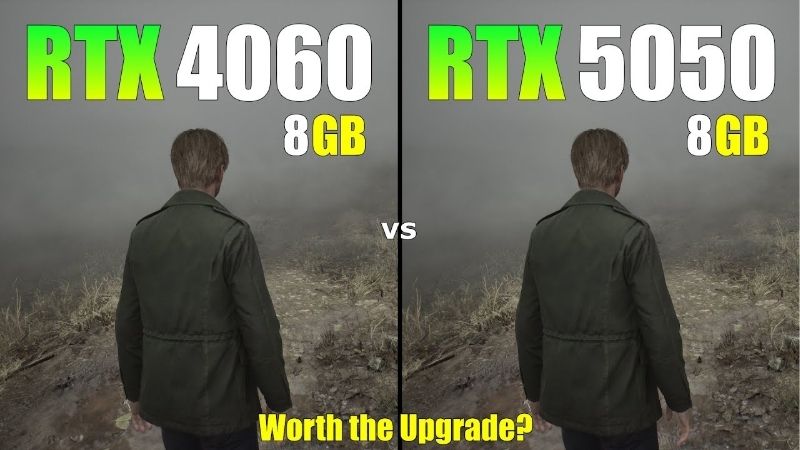
The rtx 5050 vs rtx 4060 battle is a rare case where the newer card is not automatically the faster one. In native gaming the two-year-old RTX 4060 still edges out Nvidia’s fresh entry-level Blackwell card, yet the RTX 5050 fights back with a lower price, DLSS 4 Multi Frame Generation, and modern efficiency features. Both stick to 8GB of GDDR6 on a 128-bit bus for 1080p play, so the winner depends on whether you value raw frames or newer software. This breakdown makes the call clear.
Quick Verdict: RTX 5050 vs RTX 4060 at a Glance
Here is the answer up front. The RTX 4060 is the stronger native performer, leading by roughly 15% in raw gaming, while the RTX 5050 is the better value at $249 and the only one of the two with DLSS 4 Multi Frame Generation. For most new buyers the 5050 makes more sense, mainly because the 4060 is a 2023 card that is increasingly hard to find new. The table and mini-verdicts below sort it for your situation.
As an Amazon Associate we earn from qualifying purchases at no extra cost to you.




Who Wins the RTX 5050 vs RTX 4060 Value Race
On raw frames, the older card wins. Across aggregate benchmarks the RTX 4060 outperforms the RTX 5050 by about 15%, helped by its 3,072 CUDA cores against the 5050’s 2,560. In native gaming without frame generation, the 4060 is simply the faster chip.
Price and features flip the value equation. The RTX 5050 launched at $249 versus the 4060’s original $299, and it adds DLSS 4 Multi Frame Generation, which the older card cannot run. So the 5050 gives you a lower entry price and newer software in exchange for a modest raw-performance deficit.
The shortest answer: choose the RTX 4060 if you can find one at a fair price and want the most native frames, and choose the RTX 5050 if you want the lowest price of entry, DLSS 4, and a card that is actually in stock as a new purchase. For a first-time builder or someone upgrading from a much older GTX 10-series or 16-series card, that in-stock, low-cost, feature-current combination usually outweighs the 4060’s slim native lead.
The Full RTX 5050 vs RTX 4060 Comparison Table
Specs settle the argument faster than prose, so here is the core sheet side by side. Use it to sanity-check any deal before you click through to a store.
| Spec | RTX 5050 | RTX 4060 |
|---|---|---|
| Architecture | Blackwell (GB207) | Ada Lovelace (AD107) |
| CUDA cores | 2,560 | 3,072 |
| Memory | 8GB GDDR6 | 8GB GDDR6 |
| Bus width | 128-bit | 128-bit |
| Boost clock | ~2.57 GHz | ~2.5 GHz |
| Upscaling | DLSS 4 + Multi Frame Gen | DLSS 3 + Frame Gen |
| Board power | ~130W | ~115W |
| Interface | PCIe 5.0 x8 | PCIe 4.0 x8 |
| Launch MSRP | $249 | $299 |
Two details matter beyond the core count. The 4060 is actually the more efficient card at 115W versus 130W, while the 5050’s headline advantage is software: DLSS 4 Multi Frame Generation is exclusive to the newer Blackwell card. That software split, rather than the modest core-count difference, is the real line in the sand between these two cards and the main reason to consider the newer one at all.
Why 2026 Prices and Stock Reshape the Decision
Here is the part spec sheets skip: the RTX 4060 is a 2023 product being phased out, so finding one new at a sensible price is getting harder, and a tight 2026 memory market has pushed budget GPU prices up rather than down. That scarcity is often the real deciding factor, because a 4060 you cannot buy at a fair price loses to a 5050 you can.
There is cautious good news, but it is weak and in the future. Prices have stopped climbing as steeply as they did in late 2025, and some hardware makers have reported a stretch of relative stability, while still warning that volatility is not over. For a budget buyer, the free-fall has paused rather than reversed.
Fresh supply is coming but is years out. New memory capacity, including DDR5 from Chinese suppliers and two Micron plants in Idaho, is not expected to run until 2027-2028. The practical takeaway: at the entry level, a new-in-stock RTX 5050 near $249 with a warranty is often the smarter real-world buy than hunting a discontinued 4060, and waiting for a price crash is a weak plan. At this budget tier every dollar counts, so the smart discipline is to buy the best in-stock card near its intended price today rather than gambling on relief that the memory supply timeline simply does not promise before 2027.
Deep Dive Face-Off: Performance, Features and Efficiency
The native-frame gap is only part of the story, because DLSS 4, power, and the realities of an 8GB budget build all shape the experience. This section walks those three battlegrounds with measured behavior rather than adjectives.
Raw Rasterization and 1080p Frame Rates
At 1080p, the resolution both cards are built for, the RTX 4060 leads in native rendering. Testing shows it ahead across most games, with the aggregate gap sitting around 15% and individual titles ranging from a few percent to just over twenty.
The RTX 5050 stays within striking distance rather than being outclassed. In several 3DMark tests it actually matches or beats the 4060, and its game deficit is modest enough that many players would not notice it without a frame counter running.
The analytical read is that the 4060 is the faster native card, but not by a generation-defining margin. For a 1080p gamer choosing between them, raw frames favor the 4060 while the difference remains small enough for price and features to override it. Put in real terms, you are looking at a handful of frames in most 1080p titles, the kind of gap that vanishes the moment you nudge a single graphics setting, so it rarely deserves to be the deciding factor on its own.
DLSS 4 Multi Frame Generation and AI Features
DLSS 4 is the RTX 5050’s trump card. Its Multi Frame Generation can insert additional AI-generated frames in supported titles, and with the higher multiplier modes the 5050 can post frame-rate numbers that exceed the 4060 on paper.
The experimental caveat is honesty about image quality. Frame generation at higher multipliers can introduce latency and visual artifacts, so those inflated numbers do not reflect raw rendering power and are best treated as a bonus in supported games rather than a core performance claim.
Looking forward, the 5050’s fifth-generation Tensor cores and DLSS 4 support mean it stands to gain more from future driver and game updates than the older 4060, whose DLSS 3 feature set is now a generation behind. For longevity of features, the newer card has the edge. As game developers continue to build around DLSS 4 and Nvidia’s newest AI features, the 5050 is positioned to keep improving through updates while the 4060’s older stack gradually falls further behind.
Power, 8GB VRAM and Real-World Build Fit
On efficiency the 4060 quietly wins, drawing about 115W against the 5050’s 130W. Both are easy to power, and a quality 450W to 550W supply comfortably runs either card in a typical budget build.
One practical detail favors the older card on older systems: the RTX 5050 uses a PCIe 5.0 x8 interface, so on a PCIe 3.0 motherboard it runs at reduced bandwidth that can trim a little performance, while the 4060 on PCIe 4.0 is more forgiving. Budget upgraders on older boards should factor this in.
The shared limitation is the 8GB frame buffer. It is adequate for 1080p today, but the most demanding modern titles at high textures can brush against it, so both cards are best treated as strong 1080p performers rather than 1440p machines. Pushing either card to 1440p with high textures is where that 8GB ceiling bites hardest, producing stutter rather than a clean frame-rate drop, so setting realistic 1080p expectations keeps the experience smooth.
Pros, Cons, Alternatives and Final Buying Advice
With frames, features, and efficiency on the table, the recommendation gets simple once you weigh the honest scorecard against stock and price. This section covers the pros and cons, a stronger alternative if your budget can flex, and a clear verdict.
RTX 5050 vs RTX 4060: Pros and Cons Breakdown
The RTX 5050’s strengths are its lower $249 price, DLSS 4 Multi Frame Generation, newer Blackwell features, and ready new-stock availability. Its cons are a roughly 15% native-performance deficit, higher 130W draw, and a PCIe 5.0 x8 link that can bottleneck on older boards.
The RTX 4060’s strengths are stronger native 1080p frames, better 115W efficiency, and a mature, well-supported driver history. Its cons are the older DLSS 3 feature set, a higher original price, and shrinking availability as a 2023 card nears end of life.
Put plainly: the 4060 wins on raw native performance and efficiency, the 5050 wins on price, modern features, and simply being buyable new. Neither is a bad card at the right price; the wrong move is overpaying for a scarce 4060 when a new 5050 sits in stock. Availability has quietly become the loudest factor in this matchup, and a card you can buy today at a fair price beats a marginally faster one you can only find at inflated resale prices.
A Smart Alternative If Your Budget Can Stretch
If you can add a little to your budget, the RX 9060 XT is the standout step up, available not far above $300 and offering significantly stronger performance plus a 16GB memory option that ages far better than 8GB.
For those set on Nvidia, the RTX 5060 at $299 adds faster GDDR7 memory and more CUDA cores while keeping DLSS 4, making it a sensible middle rung above the 5050 for not much more money.
Given the 2026 market, spending slightly more for a card with more VRAM and headroom is often the better long-term value than saving every dollar at the 8GB entry tier. Real price relief is years away, so a modest step up now pays off over the card’s life. Stretching from $249 to around $300 buys a disproportionate jump in both performance and VRAM headroom, which at the very bottom of the market is often the most cost-effective upgrade you can make.
Final Verdict: Which Budget GPU Should You Buy
Buy the RTX 4060 if you can find one at or below its old price and you want the most native 1080p frames with proven efficiency. It remains a capable budget card where stock and pricing allow.
Buy the RTX 5050 if you want the lowest entry price, DLSS 4 Multi Frame Generation, and a card you can actually purchase new today. For most fresh budget builds in 2026, that combination makes it the more practical pick.
Whichever you choose, timing and stock matter most at this tier. Compare live prices and availability on both cards before you commit, and grab the one that offers the best real deal in your region. Follow the link to check current prices and lock in the better buy.
See more:
- amd driver auto-detect tool
- nvidia geforce rtx 5080 best buy
- TechPowerUp GPU-Z
- nvidia china
- nvidia etf price
Conclusion
The rtx 5050 vs rtx 4060 decision defies the usual newer-is-better rule: the RTX 4060 is the faster native 1080p card, while the RTX 5050 counters with a lower price, DLSS 4 Multi Frame Generation, and real new-stock availability. In a 2026 market where budget GPU prices have merely flattened and the 4060 is fading from shelves, the smart move for most new buyers is a well-priced, in-stock 5050, or a small step up to a 16GB card if the budget allows. Compare current prices through the link above and secure the budget GPU that fits your build today.
Frequently Asked Questions
Is the RTX 5050 actually faster than the RTX 4060?
Not by much in raw rendering. The RTX 4060 has 3072 CUDA cores against 2560 on the RTX 5050, and the two trade places depending on title. The 5050 wins on ray tracing efficiency and gains the DLSS 4 multi frame generation the 4060 cannot use, so the newer card wins on features more than raw throughput.
How do the memory configurations compare?
Both are 8GB cards on a 128-bit bus. The RTX 4060 uses GDDR6 at 17Gbps while the 5050 uses GDDR6 at 20Gbps, giving the newer card slightly more bandwidth. Notably the 5050 does not use GDDR7, unlike the RTX 5060 and above. Neither card gives you any additional VRAM headroom over the other.
What are the power draw and PSU differences?
The RTX 4060 is the more efficient card at 115W total board power with a 550W recommendation. The RTX 5050 sits at 130W with the same 550W recommendation. Both use a single 8-pin connector and both fit easily into compact builds and older prebuilts without any power supply upgrade.
Which supports better frame generation?
The RTX 5050 supports DLSS 4 multi frame generation, inserting up to three generated frames per rendered frame, which is exclusive to the 50-series. The RTX 4060 supports single frame generation from DLSS 3 plus DLSS 4 super resolution and ray reconstruction. In supported titles the 5050 can show far higher on-screen frame rates.
Should I upgrade from an RTX 4060 to an RTX 5050?
No. The performance difference is too small to justify the cost and you gain no extra VRAM. The comparison matters only for someone buying new, where street price decides. If you already own a 4060 and want a meaningful jump, look at the RTX 5060 Ti 16GB or higher instead.
Ready to decide? Our #1 pick for 2026 is the Architecture.
Live price & availability on Amazon.


Write Your Review
No reviews yet. Be the first to share your experience!