
- Top Pick: 5cm 90Degree PCI-e 4.0 X16 Riser Cable for PCIe GeForce RTX30/40 GPU Card
- Best Value: ASUS Hyper M.2 x16 Gen5 Card (PCIe 5.0/4.0) Supports Four NVMe M.2 (2242/2260/2280/22110) Devices up to 512 Gbps for AMD and Intel® Platform RAID Functions.
- Premium Choice: Quad NVMe PCIe 5.0 Adapter with Heatsink, RIITOP PCIe 5.0 x16 to 4X NVMe Card for 2280/2260/2242/2230 M.2 (M Key) SSD (PCI-e Bifurcation Required)
PCIe 5.0 vs PCIe 4.0 GPU is the comparison on every upgrader’s mind in 2026, because new platforms advertise PCIe 5.0 support and it is easy to assume newer must mean faster. The honest reality is more nuanced, and getting it right can save you from spending money where it makes no difference. This comparison gives you the quick verdict for impatient readers, a clear specification table, a detailed face-off across the criteria that matter, and a final recommendation on which to actually care about.
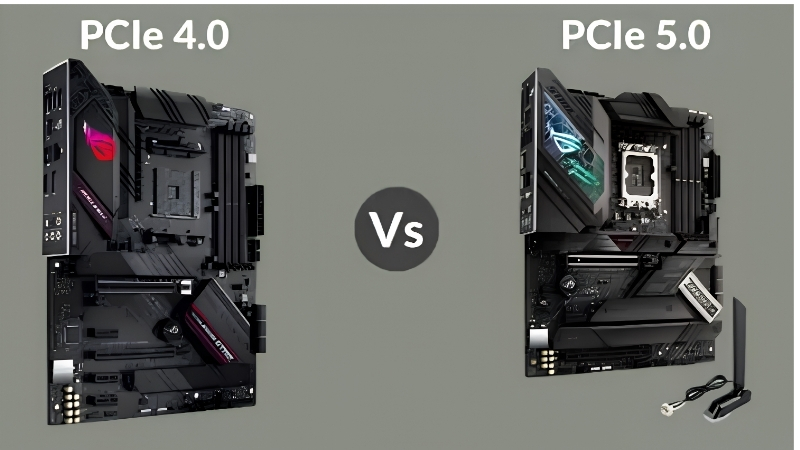
PCIe 5.0 vs PCIe 4.0 GPU: The Quick Verdict
The quick verdict: for the vast majority of gamers, PCIe 5.0 and PCIe 4.0 make essentially no difference to graphics card performance in 2026. Current GPUs do not saturate even PCIe 4.0, so a 5.0 slot delivers at most a low single-digit gain in niche cases. Choose your platform for other reasons and put the saved money toward a better GPU or a faster SSD instead.
As an Amazon Associate we earn from qualifying purchases at no extra cost to you.


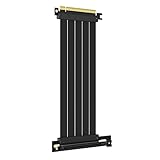
![EZDIY-FAB PCIE Gen 4 16x Extreme Flexible, High Speed Riser Cable PCI Express 4.0 Port GPU Extension Card-Right Angle Connector [11.8in/30cm]](https://m.media-amazon.com/images/I/41O7+NL6L0L._SL160_.jpg)


It is one of those rare cases where the simplest advice is also the most accurate. Save the premium, buy the card you actually want, and let the slot standard look after itself.
That single shift in priorities tends to leave gamers happier with both their build and their budget, which is the whole point of getting the comparison right.
The Short Answer for Most Gamers
If you are buying or upgrading a graphics card, you do not need to chase PCIe 5.0 for the GPU itself. Today’s cards run at full speed on a PCIe 4.0 slot, and benchmarks show the difference against 5.0 is usually within the margin of error.
That means you should not pay a premium for a motherboard purely to get PCIe 5.0 graphics support. The money is far better spent on a higher GPU tier, which delivers a real, visible improvement.
This is a common and expensive misconception worth dispelling early. Plenty of buyers spend extra on a 5.0-capable board expecting smoother gaming, only to find the frame counter looks identical to a 4.0 setup with the same card.
Comparison Table
Here are the two standards side by side on the figures that get quoted most.
| Feature | PCIe 4.0 | PCIe 5.0 |
|---|---|---|
| Bandwidth (x16) | ~32 GB/s | ~64 GB/s |
| Real gaming gain | Baseline | ~0-3% on current GPUs |
| Backward compatible | Yes | Yes |
| Matters most for | Current GPUs | SSDs, future GPUs, x8 cards |
The table makes the point clearly: PCIe 5.0 doubles the theoretical bandwidth, yet that headroom goes almost entirely unused by today’s graphics cards.
It is the classic gap between a specification and an experience. The number on the box doubles, but the thing you actually feel, your frame rate, does not move, because the card was never waiting on the slot in the first place.
This is exactly why specifications can mislead. A figure that doubles looks like a major upgrade on a spec sheet, yet means nothing to a component that was never constrained by it, which is the trap PCIe 5.0 marketing sets for graphics buyers.
What PCIe 5.0 and 4.0 Actually Are
PCIe is the interface that connects your graphics card to the rest of the system, and each generation roughly doubles the available bandwidth. PCIe 5.0 offers about twice the throughput of PCIe 4.0 on the same number of lanes.
That extra bandwidth sounds significant, and for some uses it is. The key question is whether your graphics card can actually use it, and for current cards the answer is mostly no, which is the heart of this comparison.
Understanding that distinction is what saves you money. Once you accept that a current GPU cannot fill even a 4.0 slot, the case for paying more for 5.0 graphics support quietly falls apart.
Deep Dive Face-Off: PCIe 5.0 vs PCIe 4.0
Beyond the headline numbers, the two standards deserve a closer look across the criteria that decide real-world value: raw bandwidth, actual gaming performance, and compatibility with future hardware. This is where the gap between the specification and your experience becomes clear.
Bandwidth on Paper
On paper, PCIe 5.0 is a decisive win, roughly doubling the data rate of PCIe 4.0. A full x16 PCIe 5.0 slot offers around 64 gigabytes per second against roughly 32 for PCIe 4.0.
This is a genuine technical advance with real uses elsewhere in the system. The question for a GPU buyer is simply whether a graphics card generates enough traffic to fill that pipe, and that is where the paper advantage meets reality.
Bandwidth, after all, only matters if something needs it. A pipe twice as wide carries no more water if the tap feeding it is the same size, and a current graphics card is very much that same-sized tap.
Real Gaming Performance
In actual games, current graphics cards barely register a difference between PCIe 4.0 and 5.0. Independent testing repeatedly shows gains of zero to a few percent, often small enough to fall within run-to-run variation.
The reason is simple: today’s cards do not move enough data to saturate even PCIe 4.0, so the extra headroom of 5.0 sits idle. The exception is a card limited to fewer lanes, such as an x8 budget model, where 5.0 can claw back a little lost bandwidth.
Even in that x8 case, the difference is usually small and only appears in specific, demanding scenarios. For a full x16 card, which is what most gamers run, the gap between 4.0 and 5.0 is effectively invisible in normal play.
Compatibility and Future-Proofing
Both standards are fully backward and forward compatible. A PCIe 5.0 card runs in a 4.0 slot and a 4.0 card runs in a 5.0 slot, in each case at the lower standard’s speed, with no loss for current GPUs.
Future-proofing is the one area where 5.0 has a mild edge, since cards may eventually use the extra bandwidth. But that day is not here for gaming, so buying a platform today purely for tomorrow’s hypothetical GPU is a weak reason to spend more.
By the time a graphics card genuinely needs PCIe 5.0, you will likely be upgrading your whole platform anyway. Paying a premium now to future-proof a slot is rarely the efficient way to spend an upgrade budget.
Which Should You Choose?
With the face-off settled, the practical question is what to prioritise with your money. This section weighs the trade-offs, points to what actually delivers a bigger upgrade, and gives a clear final recommendation rather than a vague “it depends”.
Pros and Cons of Each
Here is the honest balance for a GPU buyer:
- PCIe 4.0 – Pros: runs every current card at full speed, cheaper platforms, zero meaningful performance loss. Cons: less theoretical headroom for future cards.
- PCIe 5.0 – Pros: double the bandwidth, better for SSDs and x8 cards, mild future-proofing. Cons: no real gaming gain today, often a pricier platform.
For the graphics card alone, neither choice changes your frame rates in any way you will notice, which is the conclusion the data keeps pointing to.
That consistency across independent tests is what makes the verdict trustworthy. This is not one reviewer’s opinion but a repeated finding: for current cards, the PCIe generation simply does not show up in the results.
For a buyer, that means the safest assumption is the simplest one: treat the two standards as equal for your graphics card and move on to decisions that actually affect performance.
The Alternative: What Actually Matters More
Instead of agonising over PCIe generation, put your attention where it pays off. Stepping up one GPU tier, or adding more VRAM, delivers a far larger and more visible improvement than any slot standard.
PCIe 5.0 does shine for storage, where high-end SSDs genuinely use the bandwidth. So if your platform has PCIe 5.0, enjoy it for a fast drive, and choose your graphics card on its own merits rather than the slot it plugs into.
This is the most useful way to reframe the whole question. Treat PCIe 5.0 as a storage feature you may or may not use, and treat your graphics card as a separate decision driven by its tier, memory, and price.
Decoupling the two decisions is genuinely liberating. You stop paying a slot tax on your graphics upgrade and start spending every dollar where it changes what you see on screen.
Final Verdict and Recommendation
For gaming in 2026, PCIe 4.0 and 5.0 are effectively equal for the graphics card, so do not pay extra for 5.0 on the GPU’s account. Buy the platform that suits your budget and other needs, and spend the difference on a better card.
If you already have PCIe 5.0, you lose nothing and gain a little future headroom and SSD speed. Either way, the graphics card you choose matters far more than the PCIe generation behind it.
The takeaway is freeing: you can stop worrying about PCIe generation and focus on the card itself. Whether you are choosing a new GPU or a platform to run it on, take a look at the recommended graphics cards and components linked throughout this comparison and put your money where it actually improves performance.
See More:
- How to clean a GPU heatsink
- GPU vertical mount thermals
- GPU thermal throttle temp
- What PSU for RTX 4090
- What PSU for RTX 5080
Conclusion
In the PCIe 5.0 vs PCIe 4.0 GPU debate, the verdict for 2026 is clear: for graphics performance, the two are effectively identical, because current cards do not saturate even PCIe 4.0. PCIe 5.0’s doubled bandwidth benefits SSDs and may help future cards, but it changes nothing you will notice in today’s games. Choose your platform on price and features, and spend the savings on a stronger GPU. Check the recommended cards and components above to invest where it truly counts.
Top-Rated Picks


| Product | Brand | Rating | Reviews | Price |
|---|---|---|---|---|
| ARCTIC MX-4 (4 g) – Premium Performance Thermal Paste… | ARCTIC | ★ 4.8 | 104k | $4.99 |
| ARCTIC MX-4 (incl. Spatula, 4 g) – Premium Performanc… | ARCTIC | ★ 4.8 | 71.9k | $5.49 |
| Crucial 8GB DDR4 RAM 3200MHz (PC4-25600), Downclockab… | Crucial | ★ 4.8 | 62.8k | $74.99 |
| AMD Ryzen 5 5600X 6-core, 12-thread unlocked desktop … | — | ★ 4.8 | 30.2k | $177.60 |
| NVIDIA Shield Remote; Voice Search, Motion-Activated,… | — | ★ 4.7 | 10.6k | $25.99 |
Frequently Asked Questions
Does a PCIe 5.0 slot make my graphics card faster?
For a full x16 card, almost never. PCIe 4.0 x16 provides about 32GB/s in each direction and current games rarely saturate it, so the measured difference between 4.0 and 5.0 typically sits within one or two percent. The bandwidth matters far more for NVMe storage and for cards that use a narrow x8 or x4 link.
Will a PCIe 5.0 card work in a PCIe 4.0 motherboard?
Yes. The interface is backward and forward compatible, so the card simply negotiates the highest common speed and runs normally. You lose nothing meaningful in gaming performance. The only practical caution is that older boards may need a BIOS update to recognise very recent cards, particularly for Resizable BAR support.
When does the difference between 4.0 and 5.0 actually show up?
It shows when the link is narrow or the card runs out of VRAM. An entry card wired for x8 on a 3.0 board loses noticeable frame rate, and once a game spills textures into system memory the link becomes a bottleneck and one percent lows collapse. More VRAM fixes that problem better than a faster slot does.
Does splitting lanes with an NVMe drive hurt my GPU?
On many consumer boards the top M.2 slot shares lanes with the primary graphics slot, dropping it from x16 to x8. At PCIe 4.0 or 5.0 speeds that costs very little in games. On older PCIe 3.0 platforms the same drop is more visible, so check your motherboard manual before populating that particular slot.
Should I upgrade my platform just to get PCIe 5.0 for a GPU?
No. Buy a new platform for the CPU, memory speed, and storage capability you want, and treat the slot version as a bonus. Spending the upgrade budget on a faster graphics card or more VRAM delivers a far larger and more consistent improvement in frame rate than the interface generation does.






Write Your Review
No reviews yet. Be the first to share your experience!