
- Top Pick: ASUS Prime Radeon RX 9070 XT 16GB GDDR6 OC Edition Gaming Graphics Card
- Best Value: ASUS Prime Radeon™ RX 9070 GRE EVO OC Edition Graphics Card (PCIe 5.0, HDMI/DP 2.1, 2.5-Slot Design, axial-tech Fans, Dual Ball Fan Bearings, Dual BIOS, GPU Guard)
- Premium Choice: ASUS Prime Radeon RX 9070 EVO 16GB GDDR6 OC Edition Gaming Graphics Card
How to flash GPU BIOS is the most advanced firmware operation most PC owners will ever attempt on a graphics card, and it carries real risk if done carelessly. A BIOS flash rewrites the firmware that controls your card’s power limits, clock speeds, fan behavior, and feature set, and a bad flash can leave the card unbootable. That said, the process itself is straightforward when you follow each step exactly, back up the original BIOS first, and use the correct file for your specific card. This guide walks you through the full procedure with the safety checks that prevent mistakes, explains when flashing makes sense, and covers recovery options so you can flash with confidence rather than anxiety.
What You Will Need to Flash GPU BIOS
Flashing requires a few free tools, the correct BIOS file, and a reliable power source. Preparation is everything here: gathering the right materials before you start is what separates a clean flash from a bricked card. Do not skip any item on this list.
As an Amazon Associate we earn from qualifying purchases at no extra cost to you.




Backup and Flashing Tools
Download GPU-Z to read your current BIOS version and save a backup of the existing firmware to a file. This backup is your safety net: if anything goes wrong, you can restore the original. Never flash without saving the current BIOS first.
Download nvflash, the Nvidia command-line flashing utility, from a trusted source. This is the tool that writes the new firmware to the card. Make sure the version matches your GPU generation, as older nvflash releases may not recognize newer cards.
The Correct BIOS File
The BIOS file must match your exact card model, variant, and board revision. Flashing a file intended for a different variant of the same model can cause fan, power, or display output problems. Source the file from TechPowerUp’s BIOS collection or your card manufacturer’s support page, and cross-check the GPU chip, device ID, and subsystem ID against your card in GPU-Z.
If you are flashing to change power limits or unlock features, confirm the target BIOS is compatible with your specific hardware before proceeding. An incompatible file is the number-one cause of flash failures.
A Stable Environment
Use a UPS or ensure your power supply is on a stable circuit. A power loss mid-flash is the worst-case scenario and can corrupt the firmware beyond easy recovery. Close all unnecessary programs and disable sleep and screen savers so nothing interrupts the process.
If your card has a physical dual-BIOS switch, make sure you know which position is the primary BIOS and which is the secondary before you start. The secondary BIOS can be your emergency recovery path: if a flash goes wrong on the primary, flipping the switch boots the card on the untouched backup so you can reflash from a working state.
Work from a wired connection if downloading anything during the session, and do not rush. The actual flash takes seconds, but the preparation around it is what keeps the card safe.
One more detail: check that your card is the only GPU in the system, or that nvflash is targeting the correct device index. Flashing the wrong GPU in a multi-card setup is a rare but real mistake that careful users avoid by confirming the device before writing.
Step-by-Step Guide to Flashing GPU BIOS
Follow these steps exactly, in order, with no shortcuts. The numbered process includes the safety checks that protect you at each stage. Take your time: a careful flash is a safe flash.
Step 1 to 3: Back Up and Verify
Step 1: Read and note your current BIOS version. Open GPU-Z and record the BIOS Version, Device ID, and Subsystem ID. Screenshot or write them down.
Step 2: Save a backup of the current BIOS. In GPU-Z, click the arrow next to the BIOS Version field and select Save to file. Store this backup somewhere safe, such as a USB drive. This file lets you restore the original firmware if anything goes wrong.
Step 3: Verify the target BIOS file. Compare the Device ID and Subsystem ID of your target file against your card’s IDs in GPU-Z. They should match. If they do not, stop and find the correct file. Flashing a mismatched BIOS is the most common preventable error.
Step 4 to 6: Flash the BIOS
Step 4: Open an elevated command prompt. Run Command Prompt as Administrator. Navigate to the folder containing nvflash and your target BIOS file.
Step 5: Disable the BIOS protection. Run the nvflash command to override the board ID check if required. The exact flag depends on your nvflash version, so consult its documentation. This step is needed because Nvidia cards have a safety check that prevents flashing a mismatched file, which you should only override when you are certain the file is correct.
Step 6: Flash the BIOS. Run the flash command with the target file. nvflash will display the current and target BIOS details and ask for confirmation. Read the confirmation carefully, verify the details match, and confirm. The flash itself takes a few seconds. Do not touch anything until it reports success.
After confirmation, the card’s firmware is rewritten in a single pass. Any interruption during this window, whether a power loss, an accidental keystroke, or a system sleep event, can leave the firmware in a partially written state. This is the moment all the preparation protects: a stable power source, a clean environment, and closed programs ensure nothing interferes with those critical seconds.
After the flash completes successfully, restart the system. The card will boot with the new firmware.
Step 7 to 9: Verify and Recover
Step 7: Verify the new BIOS. After restarting, open GPU-Z and confirm the BIOS Version now shows the new firmware. Check that clocks, fan behavior, and display output are normal.
Step 8: Stress test. Run a game or stress tool and monitor temperatures, clocks, and stability. A successful flash produces normal behavior under load. Any anomaly, such as missing fan control or unusual power draw, suggests a BIOS mismatch.
Step 9: Recover if needed. If the card does not display after the flash, try booting from integrated graphics or a second GPU and reflashing the saved backup using nvflash. On some cards a dual-BIOS switch lets you boot from the unflashed secondary BIOS to recover the primary. If neither option works, contact the manufacturer for recovery guidance.
Recovery is almost always possible when you have a backup file. The saved BIOS from Step 2 is the file that restores your card to its exact pre-flash state, and having it on a separate USB drive means it survives even if the main system drive is inaccessible. Treat that backup as insurance: the five seconds it takes to save is worth more than any other step in the process.
Pro Tips, Mistakes, and When Flashing Makes Sense
Flashing is a powerful tool but a narrow one. Most owners never need to do it, and understanding when it makes sense prevents you from taking risk for no gain. This section covers the habits that keep a flash safe, the mistakes that cause problems, and the honest trade-offs.
Pro Tips for a Safe Flash
Always flash from a backup you made yourself, not just a file downloaded from the internet. Your own backup is guaranteed compatible with your exact board revision, and it is the fastest recovery path if anything goes wrong.
Double-check the Device ID and Subsystem ID match one more time at the confirmation prompt. This final verify is the last chance to catch a mismatched file before the write begins.
Common Mistakes to Avoid
Do not flash a BIOS from a different variant of the same GPU model. Two RTX 4070 cards from different manufacturers have different board designs, power stages, and fan configurations, and a mismatched BIOS can disable fan control or change power limits unsafely.
Do not interrupt the flash. A partial write leaves the firmware in a corrupted state that may require a second GPU or integrated graphics to recover. Let the process complete fully before touching anything.
Pros and Cons of Flashing GPU BIOS
On the plus side, a flash can unlock higher power limits, restore fan profiles, fix firmware bugs, and adapt the card to a new cooler. For the right use case, it is the only way to achieve the goal.
On the downside, a bad flash can render the card unbootable, voiding warranty in the process, and the process demands exact file matching and careful execution. The risk-to-reward ratio only favors flashing when you have a specific, justified reason.
For most owners, the card’s stock BIOS is perfectly fine. Flash only when you have a clear goal, the correct file, and a tested backup.
Flashing GPU BIOS is a precise operation that rewards preparation and punishes shortcuts. Back up first, verify the file, and follow every step.
Recovery is almost always possible when you have a backup. The saved BIOS from Step 2 is the file that restores your card to its exact pre-flash state, and storing it on a separate USB drive means it survives even if the main system is inaccessible. As a final recommendation, only flash when you have a concrete goal and a confirmed-compatible file. Flashing out of curiosity for marginal gains rarely justifies the risk, while a targeted flash to fix a known firmware issue or unlock a needed feature is the scenario where the process earns its place.
Flash Safety Checklist (verify before writing)
- Current BIOS backed up to a separate USB drive?
- Target file Device ID and Subsystem ID match your card?
- UPS or stable power source confirmed?
- All unnecessary programs closed, sleep disabled?
- Dual-BIOS switch position noted (if applicable)?
- nvflash version matches your GPU generation?
- Recovery plan clear (backup file, second GPU, or dual-BIOS)?
See More:
- How to lower GPU temperature
- How to lower GPU hotspot temp
- How to increase GPU performance
- How to enable G-Sync
Conclusion
Knowing how to flash GPU BIOS gives you the ability to unlock power limits, fix firmware bugs, or adapt your card to a new cooler, but only when done with exact preparation. Back up the current BIOS in GPU-Z before anything else, verify the target file against your card’s IDs, flash with nvflash in a stable environment, and stress-test after. Keep your backup on a safe drive and know your recovery options. Flash only when you have a justified reason, and use the tools linked above to maintain your card for the long run.
Top-Rated Picks

Best Seller
How To Safely Overclock Your GPU to Games or Crypto-Mining: BIOS Flashing For Crypto-Mining Or Games


| Product | Brand | Rating | Reviews | Price |
|---|---|---|---|---|
| ARCTIC MX-4 (4 g) – Premium Performance Thermal Paste… | ARCTIC | ★ 4.8 | 104k | $4.99 |
| ARCTIC MX-4 (incl. Spatula, 4 g) – Premium Performanc… | ARCTIC | ★ 4.8 | 71.9k | $5.49 |
| Crucial 8GB DDR4 RAM 3200MHz (PC4-25600), Downclockab… | Crucial | ★ 4.8 | 62.8k | $74.99 |
| AMD Ryzen 5 5600X 6-core, 12-thread unlocked desktop … | — | ★ 4.8 | 30.2k | $177.60 |
| NVIDIA Shield Remote; Voice Search, Motion-Activated,… | — | ★ 4.7 | 10.6k | $25.99 |
Frequently Asked Questions
Is flashing a GPU BIOS risky?
Yes, more so than a motherboard update. A failed flash can leave the card unable to output video, and recovery usually requires a second graphics card or integrated graphics to boot and reflash blind. It also voids the warranty on most cards. Only proceed when there is a specific problem the new firmware demonstrably fixes.
What do I need before starting?
Back up the existing firmware with GPU-Z, download the exact replacement file matched to your specific board model and memory vendor, have a second display path available such as integrated graphics, and use a machine on a stable power source. Never flash during a storm or on a system that has been unstable.
Can I flash a different card’s BIOS onto mine?
Cross-flashing between board partners or between similar chips sometimes works but frequently does not, because power delivery, fan control and memory configuration differ. A mismatched firmware can leave fans permanently at full speed or the card unable to initialise. The safe rule is to use only firmware published for your exact model.
How do I recover from a failed flash?
Boot using integrated graphics or a spare card, leaving the failed card installed in a secondary slot, then use nvflash with the appropriate index parameter to write your backup firmware back. Some enthusiast cards include a dual-BIOS switch, which makes recovery as simple as flipping the switch and reflashing the failed side.
Are there safer alternatives to flashing?
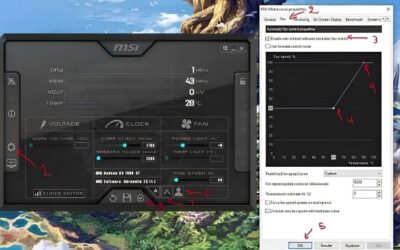
Usually. Power limits, fan curves and clocks can be adjusted in software through MSI Afterburner without touching firmware, and those changes are fully reversible. If your goal is more power headroom or a better fan profile, exhaust the software route first and treat flashing as a last resort for genuine firmware defects.






Write Your Review
No reviews yet. Be the first to share your experience!