
AIB GPU is the kind of graphics card most people actually end up buying, even if they have never heard the term, because it covers every model from Asus, MSI, Gigabyte, and the other big names you see on store shelves. AIB stands for “add-in board” partner, and these companies take Nvidia’s chip and build their own cards around it. This guide explains what an AIB GPU is, how partner cards differ from Nvidia’s own Founders Edition, and how to choose the right one in today’s pricey, fast-moving market.
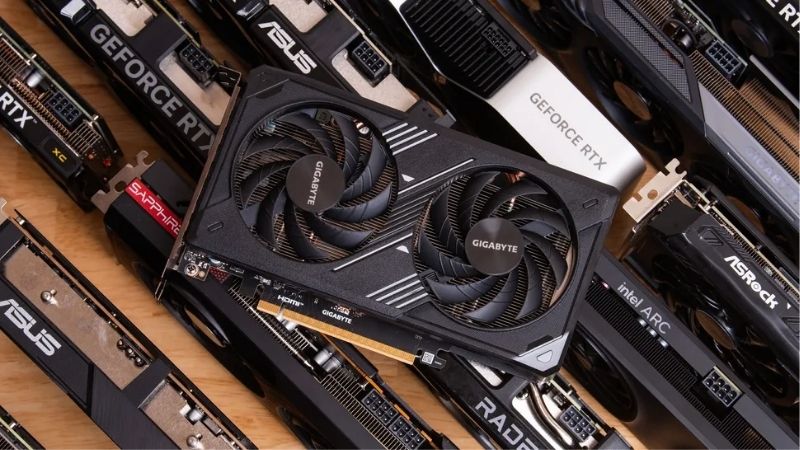
Understanding AIB GPUs and the Partner Ecosystem
When Nvidia designs a new graphics chip, it does not build most of the cards that reach customers. Instead it supplies that chip to a network of trusted manufacturers who design their own coolers, circuit boards, and branding around it. Those manufacturers are the add-in board partners, and the cards they sell are AIB GPUs, which together make up the vast majority of the market. Understanding that relationship is the first step to shopping smartly, because it means your real choice is usually between competing partner designs of the very same Nvidia chip.
What an AIB GPU Actually Is
An AIB GPU is a graphics card built by a third-party partner using Nvidia’s GPU chip but the partner’s own design for everything else. The core silicon is identical to what Nvidia specifies, while the cooler, power delivery, fan setup, size, lighting, and warranty are all chosen by the partner.
This is why you can find a dozen different versions of the same Nvidia card, ranging from small and affordable to enormous and feature-packed. They all share the same fundamental performance ceiling because the chip is the same, but they differ in how cool, quiet, fast, and large they are.
In short, when you shop for a specific Nvidia model, you are almost always choosing between competing AIB interpretations of it rather than buying a single fixed product. Recognising this also explains why two cards with the same Nvidia model name can carry very different prices: you are paying for the partner’s cooler and build, not for a faster chip.
AIB vs Founders Edition: The Core Difference
Nvidia’s own version of a card is the Founders Edition, made and sold directly by Nvidia at its official reference price. AIB cards are the partner alternatives, and they come in a spectrum of designs rather than one fixed configuration.
The practical contrast is choice versus consistency. The Founders Edition offers a single, predictable, premium option, while AIB cards offer variety: budget models that hit the lowest price, mid-range cards with better cooling, and flagship versions with huge heatsinks, factory overclocks, and premium build quality.
Because partner cards span such a wide range, they let you match a card precisely to your budget, your case size, and your noise tolerance, which is a flexibility the single Founders Edition cannot offer. For a buyer on a tight budget or with an unusual case, that range of options is often the deciding factor in favour of a partner card.
The Major AIB Brands and How They Differ
The best-known partners include Asus, MSI, Gigabyte, Zotac, PNY, and Palit, among others. Each runs several product lines, typically a premium tier with the strongest cooling and build, a mainstream tier that balances cost and quality, and a value tier aimed at the lowest price.
Differences between brands tend to come down to cooler performance and noise, build quality, warranty length and service, physical size, and extras like lighting or a dual-BIOS switch. No single brand is best at everything, so the smarter habit is to compare specific models in your budget rather than assuming one badge is always superior. A brand that makes the best flagship does not necessarily make the best budget card, so it pays to judge each specific model on its own cooling, noise, and price rather than on reputation alone.
How to Choose the Right AIB GPU
Picking the right partner card is mostly about matching its cooling, size, and price to your build and your priorities, since the raw chip performance is fixed. A little attention to a few specifications, and to the current state of the market, helps you avoid both overpaying and buying a card that does not fit.
What to Look for in an AIB Card
The most important factors are cooling and noise, physical size, factory clock speeds, and warranty. A larger, well-designed cooler usually runs quieter and may hold slightly higher boost clocks, while a compact model fits smaller cases at the cost of a little thermal headroom.
Factory overclocks on premium cards typically add only a low single-digit percentage of performance, so they are a minor factor rather than a major one. Warranty length and the brand’s reputation for honoring it can matter more over the life of the card, especially for an expensive purchase you intend to keep for years.
For the strongest, quietest options worth shortlisting, it is well worth comparing current premium AIB models from the major brands against each other before you commit. Reviews and thermal tests for the exact model you are considering will tell you far more than the brand name on the box.
Price, Availability, and the Current Market
This is where today’s headlines genuinely change the decision, so it is worth analysing how recent developments affect an AIB purchase specifically. The graphics card market in 2026 remains tight and changeable, and that shapes both what you pay and what you can find in stock at any given moment.
Two forces are keeping prices elevated. The broad trend across laptops and PC components has been one of rising prices, so the deep discounts buyers once waited for are far less common. On top of that, with the United States now allowing Nvidia to sell its powerful H200 AI chips to China, a large share of Nvidia’s manufacturing and wafer capacity continues to flow toward extremely profitable AI accelerators, which keeps the supply of consumer gaming chips, and therefore the AIB cards built on them, relatively thin and firmly priced.
There is some cautious good news, but it is weak and not immediate. Prices have at least stopped climbing as steeply as they did at the end of 2025, and parts of the industry have noted a period of relative stability, even while warning that the market is still volatile and could move again. For a buyer the realistic takeaway is practical rather than hopeful: do not assume a big price drop is around the corner, and when you find a well-cooled AIB card at a fair price relative to its tier, that is often a genuinely good time to buy rather than waiting for relief that may be far off.
Pros and Cons of AIB Cards
On the plus side, AIB cards give you enormous choice, with options for every budget, case size, and noise preference, and the premium models often cool better and run quieter than the reference design. Strong warranties and brand support are further advantages of buying from an established partner.
On the downside, the sheer variety can be overwhelming, the biggest flagship cards can be very large and heavy, and premium models carry a price premium for cooling and overclocks that add only modest real performance. In a tight market, both budget and flagship AIB cards can also be marked up well beyond their intended price.
For most buyers the verdict is that a mid-range or premium AIB card at a sensible price is the practical sweet spot, delivering the cooling and quiet they want without paying flagship prices for tiny performance gains.
Buying Tips and Final Recommendation
With prices firm and stock uneven, a little buying discipline pays off. Knowing how to match a card to your build and which mistakes to sidestep helps you land a great AIB GPU at a fair price instead of overspending or buying something that will not fit.
How to Match an AIB Card to Your Build
Start with physical fit, since AIB cards vary dramatically in length, width, and thickness. Measure your case clearance and confirm the card will not block other components or foul the side panel, because the largest flagship models simply will not fit many compact builds.
Next, check power requirements and connectors, making sure your power supply has the right cables and enough wattage with some headroom. Given that big AIB cards are heavy, planning for a support bracket is also a sensible part of matching the card to your build.
Mistakes to Avoid When Buying an AIB GPU
The biggest mistake is overpaying for a flagship purely for its factory overclock, since that overclock usually adds only a sliver of real performance. A well-cooled mid-range card at a lower price is frequently the smarter buy for almost identical gaming results.
Another mistake is buying the largest card available without checking it fits, then discovering it crowds the case or starves other parts of airflow. In today’s market, a further error is waiting indefinitely for prices to collapse; with AI-driven demand keeping supply tight, that drop may be a long way off, and a fairly priced card available now is often the wiser choice.
A subtler mistake is fixating on lighting and looks while overlooking the cooler and the warranty, which are what you will actually live with for years. A quieter, better-cooled card from a solid brand will please you long after the novelty of the styling has faded, so weigh substance over appearance when two cards are close in price.
See More:
Who Should Buy an AIB GPU
An AIB GPU suits almost everyone, because the range is so wide that there is a partner card for every budget, case, and priority. Buyers who want the quietest cooling, a specific size, a long warranty, or particular aesthetics will find their best match among partner models rather than the single Founders Edition.
If you simply want the best cooling and quiet for your money, a mid-range or premium AIB card at a fair price is the obvious pick. To see the strongest current options across the major brands, it is worth comparing today’s recommended AIB graphics cards linked below before you buy.
To wrap up, an AIB GPU is a partner-built version of an Nvidia card, offering the same core performance with a huge choice of cooling, size, price, and warranty, and in a volatile, AI-driven market, picking a sensibly priced model that fits your build is the smartest approach. Compare partner brands on cooling and value, plan for fit and power, and buy decisively when the price is right. To shortlist the best current options, take a look at the recommended AIB graphics cards linked below.
Top-Rated Picks


Editor's Pick
GIGABYTE GeForce RTX 3060 Gaming OC 12G (REV2.0) Graphics Card, 3X WINDFORCE Fans, 12GB 192-bit GDDR6, GV-N3060 Video Card


| Product | Brand | Rating | Reviews | Price |
|---|---|---|---|---|
| MSI GeForce RTX 3060 Ventus 2X 12G OC, Gaming Graphic… | — | ★ 4.7 | 4.5k | $635.00 |
| GIGABYTE GeForce RTX 3060 Gaming OC 12G (REV2.0) Grap… | — | ★ 4.7 | 3.2k | $479.00 |
| EVGA GeForce GTX 1060 3GB GAMING, ACX 2.0 (Single Fan… | EVGA | ★ 4.6 | 3.4k | $247.79 |
| MSI Gaming GeForce GTX 1660 Super 192-bit HDMI/DP 6GB… | — | ★ 4.7 | 2.2k | $232.60 |
| MSI GeForce RTX 4060 Ti Ventus 3X 8G OC (8GB GDDR6/PC… | — | ★ 4.7 | 1.3k | $998.00 |
Frequently Asked Questions
What does AIB actually stand for?
Add-in board. AIB partners such as ASUS, MSI, Gigabyte, Zotac and Sapphire buy GPU dies and memory from Nvidia or AMD, then design their own PCB, cooler, power delivery and BIOS around them. The result is many variants of the same chip at different prices and noise levels.
Are partner cards faster than reference models?
Usually by a small margin. Factory overclocked models add roughly two to five percent through higher boost clocks and raised power limits, and their larger coolers sustain those clocks better. The difference rarely justifies a large price premium unless you specifically want quieter operation.
Do partner cards need more power or a bigger case?
Often yes. Overclocked variants can raise board power by thirty to sixty watts and frequently use three or even four expansion slots with lengths beyond 330mm. Check your case clearance and add headroom to your power supply calculation compared with the reference specification.
How does the warranty differ?
The AIB partner handles the warranty, not the chip vendor, and terms vary from two to five years depending on brand and region. Some partners honour transfers to a second owner while others do not, which matters when buying used. Registration is required for extended coverage from certain brands.
Which partner should I buy from?
Judge each model on measured thermals, noise and coil whine reports rather than brand loyalty, since quality varies between tiers within the same manufacturer. A mid-range model from a good line often beats an entry model from a premium brand on both temperature and acoustics.




Write Your Review
No reviews yet. Be the first to share your experience!