
- Top Pick: PNY NVIDIA GeForce RTX™ 5080 OC Triple-Fan Graphics Card
- Best Value: GIGABYTE GeForce RTX 5080 Gaming OC 16G Graphics Card, WINDFORCE Cooling System, 16GB 256-bit GDDR7, GV-N5080GAMING OC-16GD Video Card
- Premium Choice: PNY NVIDIA GeForce RTX™ 5080 OC Triple Fan, Graphics Card (16GB GDDR7, 256-bit, Boost Speed: 2730 MHz, PCIe® 5.0, HDMI®/DP 2.1, 2.99-Slot, Blackwell Architecture, DLSS 4)


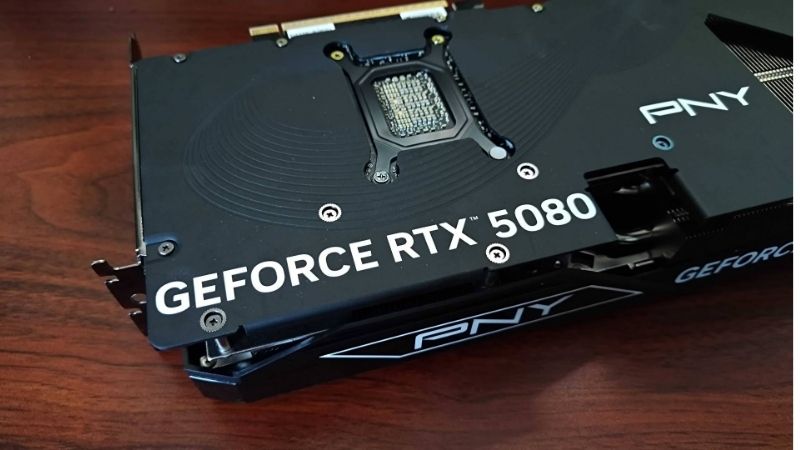
pny rtx 5080 oc review is what you search when the price looks too good and you want permission to trust it. The card is $60 to $100 below the badges you recognise, the specs read identical, and the part of your brain that has been burned before is asking what the catch is. That is a reasonable instinct on a four-figure purchase. So this review answers two questions directly: is PNY a company you can rely on for a $1,000 card, and is the factory overclock worth a single cent. One of those answers will reassure you. The other will save you money.
Is PNY Actually a Second-Tier Brand?
No, and the evidence is not a marketing claim — it is who buys from them. PNY is a long-standing official Nvidia partner and the primary distributor of Nvidia’s professional workstation graphics across North America and Europe. When an engineering firm or a studio buys a $5,000 professional GPU through a channel reseller, PNY is frequently the company on the other end of that transaction.
As an Amazon Associate we earn from qualifying purchases at no extra cost to you.




What the Professional Distribution Business Tells You
This matters because of what it implies about the relationship. Nvidia does not hand its enterprise channel to a company with quality control problems. Workstation customers have support contracts, procurement departments, and no tolerance for failure rates — the scrutiny in that business is an order of magnitude above consumer gaming.
PNY has also been an Nvidia partner for decades rather than years. Board partners that cut corners do not survive that long in a market where Nvidia can end the relationship at will.
None of this means every PNY card is perfect. It means the specific fear driving your search — that this is a fly-by-night operation selling questionable hardware at a suspicious discount — does not hold up. The discount is a positioning decision, not a warning sign.
Why Every RTX 5080 Performs the Same
Here is the part that reframes the price gap. Every RTX 5080 uses the same GB203 die, the same 10,752 CUDA cores, the same 16 GB of GDDR7 on a 256-bit bus, and the same roughly 960 GB/s of bandwidth. Nvidia sets the specification and the boost algorithm.
Board partners differentiate on the cooler, the power delivery, the lighting, the warranty, and the badge. Across a broad review sample, partner cards at the same tier land within roughly 1% to 3% of each other — which is inside run-to-run variance. You cannot feel it, and no benchmark you run at home will reliably detect it.
So the $60 to $100 you save is not coming out of performance. It is coming out of brand premium and, potentially, out of cooler quality — which at 360W is the thing genuinely worth checking rather than the frame rate.
Is the Factory OC Worth Paying For?
Short answer: no. A factory overclock on a modern Nvidia card typically raises the boost clock by a small margin worth roughly 1% to 3% in real frames. On a card producing 100 fps, that is one to three frames. You will not perceive it.
Modern GPUs are power-limited long before they are clock-limited. Nvidia’s boost algorithm already pushes the card to its thermal and power ceiling automatically. A factory OC mostly raises a number on the box that the card was going to approach anyway when conditions allowed.
The OC variant is sometimes still the one to buy — but for a different reason. OC models occasionally ship with a better cooler or a metal backplate rather than plastic, and at 360W the cooler is the component that determines whether your clocks hold through a two-hour session. Compare the cooler specifications and the photos, not the megahertz. If the OC model and the standard model share a cooler, take the cheaper one.
Thermals, Noise and Owner Reports
Aggregating four and five star feedback against the two and three star complaints tells you more about a specific board than any synthetic test, and the pattern for PNY’s 5080 line is consistent.
Handling 360W
The recurring positive theme is that PNY’s triple-fan 5080 designs handle 360W adequately — owners report load temperatures in the low-to-mid 70s Celsius in cases with real airflow, fans audible but not intrusive. That is a normal, unremarkable result for a card at this power, which is exactly what you want to hear.
Check hotspot temperature rather than core temperature in your first week. A core in the low 70s alongside a hotspot above 95°C indicates uneven die contact, and on a new card that is a warranty case rather than something to accept. Do this while the retailer’s return window is still open — it is a far easier conversation than a manufacturer claim in month fourteen.
Complaints about heat almost always trace to the case. 360W in a sealed tempered-glass enclosure with one exhaust fan will throttle this card and raise your CPU temperatures alongside it. If your front panel is solid, that is the variable to fix before you blame the board partner.
The Coil Whine Reports
Coil whine complaints appear against PNY cards. They also appear against every other brand, and it would be dishonest to frame this as a PNY-specific defect while equally dishonest to leave it out of a review you are reading for reassurance.
Two things worth knowing. Coil whine is a physical property of inductors under load, not a manufacturing fault, and manufacturers across the industry generally will not accept a return for it alone. And it is largely fixable at your end — capping frame rate in the driver or enabling V-Sync removes the extreme frame rates in menus and light scenes that provoke it. Most reports resolve once a cap is applied.
If silence matters enormously at this price, buy from a retailer with a straightforward return policy rather than a marketplace seller. That gives you a route that does not depend on how the manufacturer classifies whine.
Power, Connector and PSU Requirements
The 5080 uses the 16-pin 12V-2×6 connector and draws roughly 360W with transient spikes considerably higher. Nvidia recommends 850W, and with a high-end CPU that is the correct spec rather than a cautious one.
On an older ATX 2.x supply you will run the bundled adapter off three or four 8-pin cables. It works — but the connector must be fully seated, because partial seating is the documented root cause of the melting reports, and that is an installation failure rather than a manufacturing one. Push until it clicks, then verify there is no gap.
If your current unit is 750W or below, that is a purchase to make alongside the card rather than afterwards. An 850W ATX 3.1 supply with a native 12V-2×6 cable removes the adapter from the equation entirely — worth pricing into the same order, because it eliminates the single most talked-about failure mode on this card.
Pros, Cons and the Warranty Question
Here is the plain ledger, plus the part that only matters once and matters enormously when it does.
PNY RTX 5080 OC: Pros
Pros: Typically $60 to $100 below premium-badged 5080s for performance within 1% to 3% — you are not paying for frames you lose. PNY is a decades-long official Nvidia partner and the primary distributor of Nvidia’s professional workstation cards across North America and Europe, which settles the brand-trust question with evidence rather than assurance. Triple-fan designs handle 360W with owners reporting low-to-mid 70s under load. Full DLSS 4 stack including Multi Frame Generation. Ninth-generation NVENC with dual AV1 encoders. Widely stocked, which matters in a tight 5080 market.
The most common unprompted praise is exactly the reassurance you came for: buyers describe performance as indistinguishable from cards costing meaningfully more, and note that the only difference they can identify is the logo.
PNY RTX 5080 OC: Cons
Cons: The factory OC is worth roughly 1% to 3% — do not pay a premium for it. Coil whine reports exist, as with every brand. VelocityX software is dated; most owners use MSI Afterburner instead. Lower-tier models use plastic backplates. RMA turnaround reports are mixed — some smooth, some slow. Large card requiring case measurement and likely a support bracket. 12V-2×6 connector needs careful seating and probably a PSU upgrade. 16 GB at a four-figure price is a fair criticism, though that is Nvidia’s call rather than PNY’s.
Warranty Terms and Your Real Hedge
PNY’s XLR8 Gaming cards commonly carry a three-year limited warranty in the United States, with terms varying by region — verify what applies where you are buying rather than assuming the headline figure travels across borders. Keep the invoice, and register the product if registration is offered in your region.
RMA feedback in the two and three star reviews is mixed. That is unremarkable across the entire industry, but if downtime genuinely matters to you it is worth weighing. The practical hedge is straightforward: buy from a retailer with its own returns process. That gives you a second route that does not depend on the manufacturer, and it costs nothing.
Then use your first fortnight properly. Check hotspot temperature under sustained load, listen for coil whine at uncapped frame rates, and confirm the card is holding its boost through a long session rather than decaying. All three are trivially resolved inside a return window and painful outside one.
Why the Price Is What It Is
Before you decide whether to wait for better, it is worth knowing what is actually setting the number in front of you.
The H200 Decision and GeForce Supply
The United States has cleared Nvidia to sell the H200 — among its most capable AI accelerators — into China. This reaches your listing directly. Nvidia allocates finite TSMC wafer capacity and finite GDDR7 and HBM supply across its lines, and data centre margins dwarf GeForce margins by a wide multiple.
The 5080 is among the consumer cards most exposed, because it uses a large die and 16 GB of the same GDDR7 that professional parts compete for. Every prior surge in data centre demand has tightened high-tier consumer supply and pushed street prices above MSRP — that is a pattern with a decade of precedent, not a prediction.
The practical read: PNY’s competitive pricing and wide availability are an advantage in a market that tightens rather than a discount you can wait out. A 5080 at or near MSRP is a buy signal.
Component Prices Are Still Trending Up
The broad direction for laptops and PC components remains upward, and memory is the driver. AI infrastructure is consuming DRAM and GDDR at a scale consumer graphics cannot outbid, and that cost lands in every board partner’s bill of materials — including PNY’s, which is part of why their pricing discipline matters.
It also explains 16 GB on a $999 card. That was a cost decision under current memory economics, not an oversight. And it applies to the PSU you may need alongside the card, since power supplies are not exempt from component inflation either.
Budget the whole purchase rather than the sticker: card plus 850W ATX 3.1 supply plus support bracket. None of those three are trending down.
The Good News Is Real, But Weak
Prices have at least stopped climbing at the pace they set through late 2025. Framework, which publishes unusually candid supply commentary, has reported a stretch of relative stability while still warning that volatility has not ended. The steep climb flattened. Nothing reversed.
A plateau is not a discount. Planning a four-figure purchase around a correction the supply picture does not support means paying roughly the same money later, from thinner stock, with less warranty runway.
Which simplifies things considerably. The question was never whether to wait. It was whether PNY is safe — and it is.
See More:
Conclusion: Should You Buy It?
The honest verdict from this pny rtx 5080 oc review is that your instinct to check was sound and the answer is reassuring. PNY is not a second-tier operation trading on a suspicious discount — it is a decades-long official Nvidia partner and the primary distributor of Nvidia’s professional workstation cards across North America and Europe, which is not a relationship Nvidia extends to companies with quality problems. Every RTX 5080 runs the same GB203 silicon and lands within 1% to 3% of every other, so the $60 to $100 you save comes out of the badge, not out of your frame rate.
Two things to act on. Do not pay a premium for the OC — it is worth one to three frames out of a hundred, which is inside run-to-run variance. Choose the OC variant only if it ships with a better cooler or a metal backplate, because at 360W the cooler is what decides whether your clocks hold through a long session; compare the photos and the fin stack, not the megahertz. Then check your PSU: 850W is the floor, and an ATX 3.1 unit with a native 12V-2×6 cable removes the adapter and the seating risk entirely. Use your first fortnight to verify hotspot temperature under load and listen for coil whine at uncapped frame rates — both are easy to resolve inside a retailer’s return window. With H200 demand pulling on the same GDDR7 and prices flat but high, a 5080 at MSRP is not something to sleep on. Check the current listing, price an 850W ATX 3.1 supply and a support bracket alongside it, and buy the set.
Frequently Asked Questions
Is the cheaper 5080 electrically safe?
Yes, provided the power connector is properly seated. All 5080 cards use the 12V-2×6 connector at roughly 360W, and the reported connector failures across this generation have overwhelmingly involved partially inserted plugs or heavily bent cables. Push until it clicks, keep the cable straight for at least 35mm, and inspect it periodically.
What power supply does an RTX 5080 need?
Nvidia recommends 850W. Use a modern ATX 3.0 or 3.1 unit with a native 12V-2×6 cable rather than daisy-chained adapters, because this card produces sharp transient spikes well above its rated draw. Older high-wattage units without ATX 3.0 transient handling can trip protection despite appearing to have ample headroom.
Does a budget cooler hold back performance?
Slightly. All 5080 cards run the same silicon and similar power limits, so the difference is sustained boost clock under heat, usually worth two to four percent, plus noticeably more fan noise. If your case has good front intake and exhaust, a value model performs close to a premium one.
Is 16GB of VRAM enough for a card this fast?
For 4K gaming today, yes. Sixteen gigabytes of GDDR7 on a 256-bit bus handles 4K ultra textures with ray tracing, DLSS and frame generation without exhausting the buffer. The tighter cases are heavy path tracing with mods, and local AI models where capacity rather than speed sets the ceiling.
Will it fit and how much heat will it add?
Expect roughly 330mm length and close to three slots, so check clearance against front radiators and drive cages. At 360W the card dumps meaningful heat into the case, so plan at least two intake fans and one exhaust, and expect the room to warm noticeably during long sessions.

Write Your Review
No reviews yet. Be the first to share your experience!