
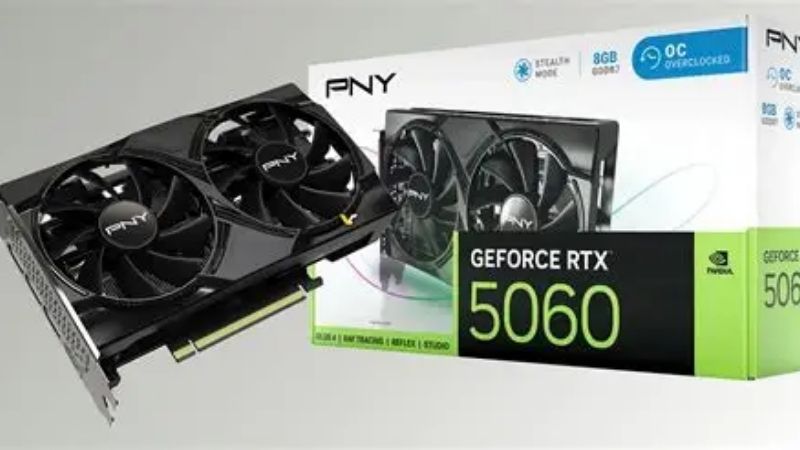
PNY GeForce RTX 5060 8GB searches almost always carry two worries at once. You have found the PNY listed at or below everything else on the shelf, and you want to know whether the cheap brand is a compromise. And you have read a great deal about 8GB being inadequate in 2026, and you want to know whether you are about to buy a card that will be obsolete next year. Both worries have clear answers, and one of them is counterintuitive: the 8GB you are nervous about is the reason this card is still on the shelf at all.
Worry One: Is PNY a Compromise?
This is the easier of the two questions and the answer is unambiguous, but it is worth understanding why rather than just being told no.
Board Partners Do Not Get Different Chips
Nvidia designs the GPU and ships identical silicon to every partner. PNY, ASUS, MSI, Gigabyte, and Zotac all receive the same die at the same specification — 3,840 CUDA cores, with 8GB of GDDR7 on a 128-bit bus at 448 GB/s and a 145W total board power.
What partners choose is the cooler, the factory clock, the aesthetics, the warranty, and the price. Nothing in that list makes frames.
So a PNY RTX 5060 and an ASUS RTX 5060 run the same chip at effectively the same speed. The driver is identical too — Nvidia writes it, and it does not know or care which cooler is bolted to the board.
| Spec | PNY RTX 5060 OC |
|---|---|
| GPU | Blackwell, 4N process |
| CUDA cores | 3,840 |
| Memory | 8GB GDDR7, 128-bit, 448 GB/s |
| TBP | 145W |
| Interface | PCIe 5.0 x8 |
| PSU recommended | 550W |
| MSRP | $299 |
| Street, July 2026 | ~$339 |
What You Actually Give Up
Three things, and they are worth naming honestly rather than dismissing.
Aesthetics. PNY’s designs are plain against RGB-heavy competition. If the card sits behind a tempered glass panel and that matters to you, this is a real cost.
Software. PNY ships nothing with the polish of MSI Afterburner or ASUS GPU Tweak. This one is easily solved — Afterburner is free, works on any card regardless of brand, and version 4.6.6 added official RTX 50 support. You are not missing anything you cannot download.
RMA reputation. PNY’s support has a thinner reputation than the larger partners’. On a $339 card that matters less than on a $1,000 one, but register the card and keep the receipt rather than treating the discount as free money.
What Owner Reports Actually Say
The most useful signal for a brand buyers are nervous about is the absence of a pattern. Reading across 4–5 star and 2–3 star feedback on PNY’s RTX 50 cards produces no coil whine complaints dominating the reviews, no PNY-specific driver quirks, and no dead-on-arrival cluster.
For a card like this, unremarkable is the review. The recurring positives are value and the fact that it simply works.
The recurring negatives are expectation rather than defect — people who expected RGB, or who did not check their PSU. Both are avoidable before you order.
Worry Two: Is 8GB Enough?
This one deserves a longer answer, because the internet consensus is louder than it is precise. The honest response is “yes, at 1080p, and it is the specification aging worst” — and both halves of that matter.
At 1080p, Yes
At 1080p high settings, 8GB is workable in the large majority of current titles. The card is genuinely strong here — 3,840 Blackwell cores handle high and ultra with ray tracing enabled, and the 128-bit bus keeps up at that pixel load.
Where 8GB starts filling is ray tracing plus Ultra texture packs, and the symptom is specific: not a lower average frame rate, but stutter in 1% lows as assets swap over the PCIe bus. If you see that, dropping textures one notch usually resolves it entirely.
DLSS 4.5 helps here in a way people underestimate. Rendering at a lower internal resolution means a smaller framebuffer, so upscaling reduces VRAM pressure as well as raising frame rates. Nvidia’s figure is that DLSS 4.5 now draws 23 of every 24 pixels on screen.
At 1440p, Less So
Be straightforward about this. The RTX 5060 is a 1080p card. Not because of the 8GB alone, but because 448 GB/s on a 128-bit bus is the constraint at higher pixel loads.
If you game at 1440p and expect Ultra, this is the wrong card and no amount of VRAM would fix it — which is exactly why the RTX 5060 Ti 16GB, carrying twice the memory on the same 128-bit bus, is also a 1080p card. Read the bandwidth column before the VRAM column.
For 1440p the honest answer is the RTX 5070: 6,144 cores, 12GB on a 192-bit bus at 672 GB/s, and it remains in normal supply.
The Counterintuitive Part
Here is the thing nobody puts in a review. The 8GB that reviewers criticise is why you can buy this card.
Component pricing has continued trending upward, with memory the dominant pressure and GDDR7 the tightest link. A 16GB card consumes twice the memory modules of an 8GB one, and when modules are the scarce input, the 16GB product is where a rational allocator cuts first.
The results are on the record. At CES 2026, board partners reported the RTX 5070 Ti and RTX 5060 Ti 16GB as end of life; Nvidia disputed the characterisation, and ASUS later called the reports incomplete. What is not disputed is that Nvidia’s allocation shifted visibly toward 8GB parts.
The RTX 5060 is an 8GB part. It stayed in normal supply and has held nearest to list of anything in the lineup — $299 MSRP trading around $339 as of July 2026, roughly 13% over, in a generation where the tier above ran 30–40% over and periodically vanished.
The Practical Checks Before You Order
Two things cause nearly all of the regret at this tier, and both are checkable in two minutes.
Your Motherboard’s PCIe Generation
This card runs a PCIe 5.0 x8 link rather than x16. On a modern board that is fine. On a PCIe 3.0 motherboard — which describes a great many of the prebuilts this card is bought to upgrade — the narrower link costs measurable performance.
Check before ordering. Wider cards do not have this problem, and it is the most common unpleasant surprise in this bracket.
Your Power Supply
145W and around 550W of quality supply, plus a proper 8-pin connector. That is undemanding by modern standards and it still stops upgrades on the bench.
Slim OEM prebuilts frequently ship 300W supplies with no PCIe power at all, and many use proprietary form factors where replacement is not straightforward. If you are upgrading a machine like that, confirm the connector exists before the card arrives.
Which Card You Are Actually Buying
PNY builds several cards across this family and the listing titles run to fifteen words. The RTX 5060 8GB, the RTX 5060 Ti 8GB, and the RTX 5060 Ti 16GB sit next to each other in search results and differ by a couple of characters.
Read the capacity and the Ti in the listing body rather than the title. And if you are looking at the 5060 Ti 16GB specifically, know that board partners have reported it end of life — availability rather than price is the constraint there.
What the Market Means for Buying It
Almost every card article this year comes with an urgency warning. This one does not, and the reason is worth stating plainly.
Relief Is Real, Weak, and Distant
The positive news exists. The steep climb through late 2025 has flattened, and Framework has reported a stretch of relative stability while still warning that volatility has not gone. New supply is opening — OEMs can source DDR5 from Chinese suppliers such as CXMT, and Micron is building two fabrication plants in Idaho.
Neither helps soon. Those fabs do not produce until 2027–2028. Prices stopped rising steeply; they have not fallen.
Translated: this card is not going to get cheaper, and it is also not going to disappear. That is an unusual combination in this market and it means you can take your time.
Who Should Buy It
Buy it if you game at 1080p, are upgrading a prebuilt or a compact build, and have or can fit a 550W supply. You are getting the same silicon as everyone else for the lowest price on the shelf, and this is the tier Nvidia is clearly still making.
Skip it if you game at 1440p and expect Ultra — the RTX 5070 is what you want. Skip it also if you run local AI or Stable Diffusion, where 8GB genuinely restricts you and capacity rather than bandwidth is the binding constraint.
And if your budget stretches, the RTX 5060 Ti 8GB at $379 MSRP adds 20% more cores on the same bus. Whether that is worth $80 depends on how close to list you can find each — it is worth comparing current listings across both before deciding, since the gap moves week to week.
What the OC Badge Is Worth
Little, and worth being specific since PNY’s model carries it. Board partners cannot change the silicon — an OC model is a stock card with a higher boost target written into its firmware and a cooler validated to sustain it.
A few tens of MHz on a card frequently limited by its 448 GB/s rather than its cores yields low single digits. Measure your own variance first: run a fixed benchmark twice and compare. Most systems show 2–4% between identical runs, which means an OC worth 2% is undetectable on your machine.
Afterburner does more for free. Undervolting typically drops 10–20°C, which raises sustained clocks rather than peak ones — and sustained is what you play on.
See More:
- Nvidia beta
- Nvidia CUDA 11.8
- Check CUDA version
- Nvidia GPU for gaming
- PNY GeForce RTX 5080 16GB OC review
Final Verdict on the PNY GeForce RTX 5060 8GB
Both worries resolve cleanly. PNY is not a compromise — it is the same Blackwell silicon, the same 3,840 cores, the same 8GB of GDDR7 at 448 GB/s, and the same Nvidia driver as any other partner. What you decline to pay for is RGB and marketing, and Afterburner is free.
And 8GB is enough at 1080p, which is what this card is for. It is the specification aging worst and it is also, in a market where GDDR7 supply strangled Nvidia’s 16GB tier into end-of-life reports, the reason this card sits on a shelf at 13% over list while the tier above ran 30–40% over and vanished periodically.
Check your motherboard’s PCIe generation and your PSU connector before ordering — those two turn an easy upgrade into a return. Beyond that, this is the least complicated purchase in the current lineup, and after a year of articles that all end with a warning about availability, that is worth something.
Frequently Asked Questions
Is 8GB of VRAM a real problem on the RTX 5060?
It is a real limit at 1440p ultra with high resolution texture packs, where frame time spikes appear once the buffer fills. At 1080p, which is what this card is built for, 8GB is still workable in the large majority of titles provided you use high rather than ultra textures. If you plan to game at 1440p long term, the 16GB 5060 Ti is the safer buy.
Does the PCIe 5.0 x8 interface hurt me on an older motherboard?
The 5060 uses only eight lanes. On a PCIe 4.0 board that is equivalent to PCIe 4.0 x8, which costs you almost nothing. On an older PCIe 3.0 board the effective bandwidth halves again, and in VRAM-limited scenes that can turn a small stutter into a noticeable one. It is a valid reason to prefer a 16GB card on older platforms.
What power supply does the PNY RTX 5060 need?
Board power is around 145W and Nvidia suggests a 550W supply for a typical system. A good quality 550W to 650W unit with a single 8-pin PCIe connector is plenty. There is no 12V-2×6 connector on mainstream 5060 designs, so you do not need an adapter or an ATX 3.1 supply to run one.
Will it physically fit a small case?
PNY dual-fan 5060 cards are compact, generally around 250mm or shorter and two slots thick, which suits most mini-tower and mATX builds. Always measure your case maximum GPU length and check clearance against front radiators or drive cages before ordering, since triple-fan variants from other brands can be substantially longer.
What does DLSS 4 multi frame generation change here?
Blackwell adds multi frame generation, which can insert more than one generated frame per rendered frame, and that lifts displayed frame rates substantially in supported games. It does not reduce input latency the way real frames do, and it needs a reasonable base frame rate to feel good, so treat it as a smoothness feature rather than a fix for a card running out of VRAM.
As an Amazon Associate we earn from qualifying purchases at no extra cost to you.


Ready to decide? Our #1 pick for 2026 is the GPU.
Live price & availability on Amazon.









Write Your Review
No reviews yet. Be the first to share your experience!