- Top Pick: GIGABYTE GeForce RTX 4070 Ti Super Eagle OC 16G Graphics Card, 3X WINDFORCE Fans, 16GB 256-bit GDDR6X, GV-N407TSEAGLE OC-16GD Video Card
- Best Value: ZOTAC Gaming GeForce RTX 4070 Ti Super Solid OC DLSS 3 16GB GDDR6X 256-bit 21 Gbps PCIE 4.0 Gaming Graphics Card, IceStorm 2.0 Advanced Cooling, ZT-D40730RC-10P
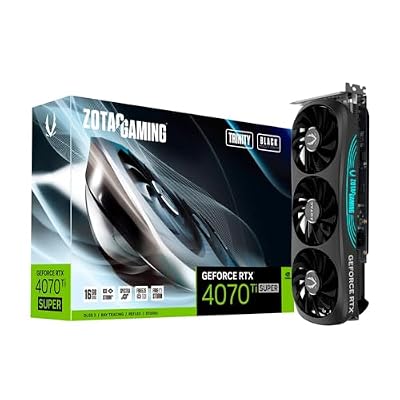
- Premium Choice: ZOTAC GAMING GeForce RTX 4070 Ti SUPER Trinity Black Edition 16GB GDDR6X
Top Rtx 4070 Super Amd Equivalent Picks for 2026
Here are our current top rtx 4070 super amd equivalent picks, compared on real Amazon owner reviews, price, and features. Live prices update below.


Save $420.00
RTX 4070 Ti Super AMD equivalent is a question thousands of buyers type before pulling the trigger in 2026, and it deserves a precise answer rather than a vague “get a Radeon.” The 4070 Ti Super is a 16GB, 1440p-dominant card, so its true AMD counterpart depends on whether you weigh raw raster, ray tracing, or price most heavily. This review breaks down exactly what the card delivers, what owners actually say after months of use, and which Radeon model lines up against it best.
As an Amazon Associate we earn from qualifying purchases at no extra cost to you. Product prices and availability are accurate as of the date shown and are subject to change.


What the RTX 4070 Ti Super Actually Delivers
Before naming a rival, it helps to pin down where the RTX 4070 Ti Super sits. This is a card built on the AD103 die with 8,448 CUDA cores and 16GB of GDDR6X on a 256-bit bus, launched at $799. On paper that places it firmly in the upper-midrange tier — a step below the 4080 Super and squarely aimed at high-refresh 1440p with capable 4K performance when paired with upscaling.
Specs and Where It Sits in the Stack
The headline number is the 16GB frame buffer. That capacity is the single biggest reason this card ages well: modern titles at 1440p with high textures rarely exceed it, so you are not buying into a VRAM wall the way 8GB and 12GB cards do.
Bandwidth lands around 672 GB/s, and board power sits at 285W with a 700W PSU recommendation. Those are practical numbers — the card slots into mainstream builds without forcing a power-supply upgrade for most owners.
Real-World 1440p and 4K Performance
At 1440p the 4070 Ti Super is comfortably a max-settings card across current AAA titles, typically landing well above 100 FPS in optimised games and holding 60+ in the heaviest ray-traced scenes once DLSS is engaged.
At 4K it is capable rather than effortless. Native 2160p with full ray tracing pushes it hard, but DLSS 3 with Frame Generation reliably restores smooth frame rates. In short, it is a 1440p flagship that moonlights as a competent 4K card — context that matters when we line up the AMD equivalent.
That upscaling advantage is also a forward-looking one: DLSS and Frame Generation keep improving through driver updates, so the card’s effective 4K headroom tends to grow after purchase rather than shrink.
What Owners Say: 4-5 Star Praise vs 2-3 Star Gripes
Aggregating buyer feedback paints a consistent picture. The 4-5 star reviews repeatedly highlight three things: cool and quiet operation on triple-fan partner cards, the reassurance of 16GB of VRAM for “future-proofing,” and how effortlessly the card maxes out 1440p titles. Many owners also single out DLSS Frame Generation as a genuine surprise upgrade over older cards.
The 2-3 star complaints are just as consistent and worth weighing honestly. The most common is physical size — several reviewers report the card not fitting smaller mid-tower cases without tight clearance. A recurring second gripe is price creep, with buyers feeling the card drifted above its launch value over time. A smaller cluster mentions coil whine on specific units and lingering caution around the 12VHPWR power connector.
Read together, the verdict from real owners is strongly positive on performance and acoustics, with the friction points being case fit, connector handling, and value timing rather than the silicon itself.
One pattern worth flagging for shoppers cross-comparing with Radeon: owners who came from older or weaker cards almost uniformly rate the upgrade five stars, while the more critical reviews tend to come from buyers comparing it directly against cheaper AMD options on a pure cost-per-frame basis. That context matters when you read star ratings — the card’s lower scores are usually about price-to-value judgments, not reliability or performance problems, which is exactly the calculus this AMD-equivalent comparison is built to help you settle.
Finding the True AMD Equivalent
“Equivalent” is not a single answer, because AMD competes with the 4070 Ti Super differently depending on the metric. In pure 1440p rasterisation, several Radeon cards match or beat it; in ray tracing and upscaling quality, the comparison tightens or flips toward Nvidia. Below are the three Radeon cards that genuinely belong in the conversation.
RX 7900 GRE: The Closest Price-and-Raster Match
The RX 7900 GRE is the most direct rival on a dollar-for-frames basis. It carries 16GB of GDDR6 and trades blows with the 4070 Ti Super in 1440p raster, frequently landing within a handful of percent either way depending on the title.
Where it falls behind is ray tracing and upscaling: FSR has closed ground but DLSS still holds a quality edge, and heavy RT scenes favour the Nvidia card. For raster-first 1440p gamers chasing value, though, the 7900 GRE is the textbook “4070 Ti Super AMD equivalent.”
RX 7900 XT and RX 9070 XT: Stepping Up
If you want the AMD card that out-muscles the 4070 Ti Super in raster, the RX 7900 XT is it — more shaders and 20GB of VRAM push it ahead in pure rasterised performance, though it again concedes ground in ray tracing.
The more modern answer is the RDNA 4-based RX 9070 XT. It narrows AMD’s long-standing ray-tracing deficit significantly and brings the newer FSR 4 feature set, making it arguably the closest “complete package” equivalent in 2026 rather than a raster-only match.
So the honest mapping is: 7900 GRE for price-matched raster, 7900 XT for a raster step-up, and 9070 XT for the most balanced modern equivalent.
Pros and Cons vs the AMD Alternatives
The RTX 4070 Ti Super’s pros against its AMD equivalents: superior ray tracing, the more mature DLSS upscaling and Frame Generation stack, strong driver stability, and lower power draw than the larger Radeon cards. Its cons: a higher price than the 7900 GRE for similar raster, less VRAM than the 7900 XT’s 20GB, and a physically large footprint that some buyers struggle to fit.
The AMD side’s pros: more raw raster per dollar (especially the 7900 GRE and 7900 XT) and, on the 9070 XT, a much-improved RT story with FSR 4. The cons: historically weaker ray tracing on the 7900 series and an upscaling experience that, while improving fast, many reviewers still rate a notch below DLSS.
Weighing these pros and cons, the right RTX 4070 Ti Super AMD equivalent comes down to your priorities — raster value points to Radeon, while RT and upscaling polish keep the Nvidia card ahead.
Should You Buy in 2026? Price, Supply, and Value
Choosing between the 4070 Ti Super and its Radeon rivals is no longer a simple spec exercise, because the 2026 market is actively distorting prices and stock on both sides. Understanding those forces is the difference between a good buy and an overpay.
How the H200 News and 2026 Price Hikes Hit This Tier
Two macro stories are reshaping this segment. First, a severe memory shortage: GDDR7, GDDR6 and high-bandwidth memory are in such short supply that VRAM now drives more than 80% of the bill of materials on some high-end GPUs, and trackers have logged current-gen price increases of roughly 15–23%. Crucially, the 4070 Ti Super itself is end-of-life, so its stock is thinning and street prices have firmed up rather than fallen.
Second, Nvidia’s AI business is pulling supply away from gaming. In January 2026 the U.S. approved exports of Nvidia’s H200 AI chip to China, with Chinese firms reportedly ordering over two million units at around $27,000 each. Capacity directed at those lucrative orders is capacity not building consumer GeForce cards — which keeps cards in this 16GB tier tight and pricey.
The effect cuts both ways: AMD’s Radeon cards face the same memory-driven pressure, so the value gap between the 4070 Ti Super and its AMD equivalent is unlikely to widen in your favour by waiting. If a card you want appears at a fair price, that is the signal to act.
Who the 4070 Ti Super Is Right For
This card is the right call if you game primarily at 1440p, value ray-tracing quality and DLSS, and want driver stability with minimal fuss. Creators who dabble in rendering or local AI also benefit from the 16GB buffer and Nvidia’s software ecosystem.
If you are a raster-only 1440p gamer on a tighter budget who does not care about ray tracing, an AMD equivalent like the 7900 GRE will stretch your money further — and that is a perfectly rational choice, not a downgrade.
Where to Buy and What to Check First
Before you buy, confirm three things: that the card physically fits your case (measure length and slot clearance), that your PSU comfortably covers 285W with the right connector, and — most importantly in 2026 — that the price is fair against current street rates rather than inflated.
You can compare live pricing on the RTX 4070 Ti Super and its AMD equivalents through the links on this page, then pick whichever lands the best deal for your build today.
See More:
Conclusion
The honest answer to the RTX 4070 Ti Super AMD equivalent question is “it depends on what you value” — the RX 7900 GRE matches it on price and 1440p raster, the RX 7900 XT beats it in raw rasterisation, and the RX 9070 XT is the most balanced modern rival once ray tracing and FSR 4 enter the picture. The Nvidia card keeps the edge in ray tracing, DLSS, and driver polish, while Radeon counters with stronger raster value. With 2026 memory shortages and Nvidia’s H200-driven supply squeeze keeping this whole tier expensive, the smart move is to compare the RTX 4070 Ti Super against its AMD equivalent at today’s prices and secure the better deal before stock tightens further. Use the links on this page to check current pricing and buy with confidence.
Frequently Asked Questions
What is the best rtx 4070 ti super amd equivalent in 2026?
The best rtx 4070 ti super amd equivalent depends on your budget and how you plan to use it. The options compared above are our top-rated picks based on real customer ratings, build quality, and overall value — start with the highest-rated model that fits your budget.
How much should I expect to spend on a rtx 4070 ti super amd equivalent?
Prices vary by brand and features. Budget options cover the essentials, while mid-range and premium models add durability, performance, and extra features. Compare the prices in the list above to find the best value for your needs.
What should I look for when buying a rtx 4070 ti super amd equivalent?
Focus on what matters most for your use case — build quality, compatibility, performance, warranty, and verified customer reviews. Every pick above is selected to balance these factors.
Are budget rtx 4070 ti super amd equivalent options worth it?
Yes. For most people a well-reviewed budget or mid-range rtx 4070 ti super amd equivalent delivers excellent value. You only need to spend more if you specifically require premium materials or top-tier performance.
How did we choose these rtx 4070 ti super amd equivalent picks?
We compare current Amazon ratings, review counts, key features, and price to surface the options with the best real-world value. The list is refreshed as ratings and availability change.