
- Top Pick: Beamo Ubuntu Desktop 24.04.3 LTS 64-bit Bootable USB Flash Drive – Live USB for Installing and Repairing Ubuntu Desktop
- Best Value: Ubuntu Linux Bootable USB for PC Desktop & Server | Run live or install Ubuntu from USB Flash Drive, includes amd64 and arm64 editions for beginners and IT users
- Premium Choice: The Definitive Ubuntu LTS Handbook: An Independent 2026 Guide to Installing, Mastering, and Securing 24.04 & 26.04 — From Desktop to Server
Remove Nvidia drivers Ubuntu is rarely a goal in itself — it is a step toward fixing something specific. Maybe you are switching to an AMD card, chasing a Wayland or suspend bug, recovering from a kernel update that broke your display, or just returning to the open-source driver for a quieter life. The right way to remove the driver depends entirely on which of those situations you are in, and treating them all the same is how people end up at a black screen. This review is organized around your reason for removing, so you can follow the path that fits your case, confirm the removal actually worked, and keep a working display the whole way through.
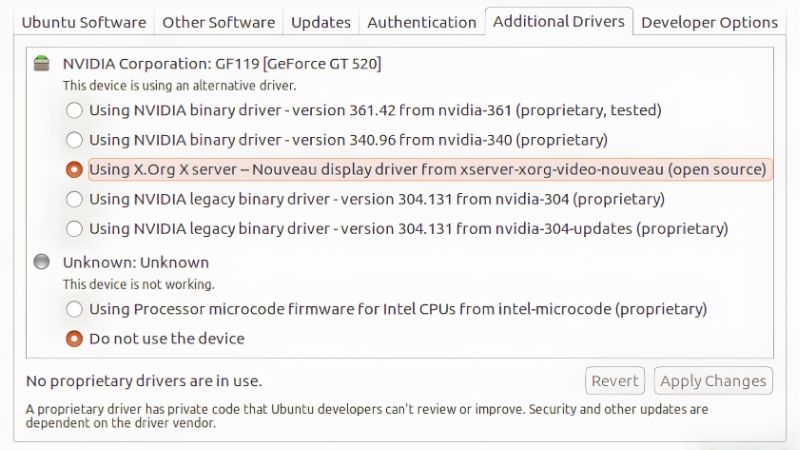
Reasons people remove Nvidia drivers on Ubuntu
Your motivation shapes the method, so it is worth naming it before touching a terminal. Removing the driver to switch to a different GPU is a different job from removing it to fix a display glitch, and each ends at a different place — one with a new driver, one with the open-source fallback. Identifying your scenario first is the single best way to avoid unnecessary steps and nasty surprises.
Switching GPUs or going back to nouveau
If you are replacing an Nvidia card with an AMD one, or simply want to run the built-in open-source nouveau driver, your goal is a full, permanent removal of the proprietary driver. Here the priority is completeness: you want no proprietary packages, kernel modules, or configuration left to conflict with the new setup.
The analytical point is that this scenario ends without an Nvidia driver at all, which means the open-source fallback must be ready to take over. Confirming that nouveau is free to load is more important here than in any other case, because you are not going to reinstall anything to paper over a mistake.
There is a hardware wrinkle specific to switching brands. If you are physically swapping in an AMD card, it is cleanest to remove the Nvidia driver while the old card is still installed and working, then power down and change the hardware. Doing it in that order means you always have a functioning display to work from, and you avoid the awkward situation of trying to fix driver configuration on a system whose new card has no suitable driver yet. A little sequencing here prevents a lot of console-only troubleshooting later.
Fixing display, Wayland, or suspend issues
A large share of removals are really troubleshooting. The proprietary driver can interact awkwardly with certain desktop sessions, external monitors, or sleep and resume, and removing it is a way to test whether it is the cause. In this case, removal is a diagnostic step, not necessarily a permanent decision.
Because the goal is to isolate a problem, the smart approach is to remove cleanly, boot on the fallback, and check whether the issue disappears. If it does, you have learned the driver was at fault and can reinstall a different version; if it does not, you have ruled the driver out and saved yourself further guesswork.
Recovering from a kernel or update break
Sometimes the trigger is a kernel upgrade that left the Nvidia module unbuilt, dropping you to a text prompt or a broken desktop. Here removal is part of recovery: clearing the mismatched driver so the system can boot normally, then rebuilding from a known-good state.
The practical mindset for this scenario is stabilize first, optimize later. Get back to a working desktop on the fallback driver, confirm the system is healthy, and only then decide whether to reinstall the proprietary driver that matches your current kernel. Trying to perfect performance while the machine is still unstable only adds variables; a calm, working baseline is the foundation every other fix builds on.
Doing the removal the right way for your case
Whatever your reason, a safe removal follows the same spine: know what is installed, remove it thoroughly, and make sure a working display driver remains. The details differ by scenario, but skipping any of these three steps is what turns a routine task into a recovery mission.
Confirm what is actually installed
Before removing anything, check which driver you are running and which packages are present. Knowing whether you are on a proprietary branch and which version tells you exactly what to remove and whether a blacklist is currently disabling the open-source fallback.
This step prevents the most common error: removing packages blindly and discovering afterward that a leftover configuration file is still blocking nouveau. A minute of inspection up front saves an hour of confused troubleshooting later, and it tells you whether your case needs a simple purge or also a configuration cleanup.
Remove thoroughly and verify it is gone
A proper removal purges the proprietary packages and clears the dependencies that came with them, not just the one obvious package. After removing, verify that the proprietary driver is truly absent rather than assuming the command did everything — a quick check that no Nvidia module is loaded confirms the job is complete.
Verification is the step most guides omit and the one that separates a clean result from a lingering problem. If any proprietary component survives, it can conflict with either the fallback or a future install, so confirming a genuinely empty state is worth the extra moment.
There is a laptop-specific reason to be thorough here. On hybrid machines that pair Nvidia graphics with an integrated GPU, the switching layer that manages which chip drives the display can leave its own leftovers, and those fragments sometimes keep an external monitor or power feature half-broken even after the main driver is gone. If your machine is a laptop, verify not just that the driver is absent but that display output, external ports, and suspend behave correctly on the fallback before you consider the job done.
Keeping the fallback display working
The safety of the whole process rests on the open-source driver being able to take over once the proprietary one is gone. If installation had disabled nouveau, that block must be lifted and the boot image rebuilt so the fallback loads on the next start. This is what stands between a smooth reboot and a black screen.
Treat this as non-negotiable regardless of your scenario. Even when you plan to reinstall a proprietary driver later, ensuring a working fallback in the meantime means a mistake leaves you with a usable desktop rather than a stranded machine.
After removal: stability and hardware fit
Once the driver is gone and your display is working, the final questions are whether to stay on the fallback, reinstall, or rethink the hardware entirely. This is where a removal that started as a quick fix sometimes reveals a bigger truth about how well your card and Linux get along.
Pros and cons of running on nouveau
Because this is a review, here is the honest trade-off of removing the proprietary driver and living on the open-source fallback.
| Pros | Cons |
|---|---|
| Built-in, no extra install, very stable for desktop use | Much weaker 3D and gaming performance |
| Sidesteps proprietary-driver display and suspend bugs | Limited support for the newest features |
| Great safe state while troubleshooting or switching cards | Not ideal for demanding games or GPU compute |
| No kernel-update breakage to manage | May underuse a powerful Nvidia card |
The verdict is that nouveau is an excellent fallback and a fine choice for light desktop use, but it leaves performance on the table for anyone who actually needs their GPU. If gaming or heavy graphics work is the point of your machine, staying on the fallback is a stopgap, not a destination.
When Nvidia on Linux keeps fighting you
If you find yourself removing and reinstalling drivers repeatedly just to keep a stable display, that pattern is a signal worth heeding. Some older cards drift out of good proprietary support, and certain configurations simply clash with modern desktop sessions no matter how carefully you install. Constant driver surgery is a symptom, not a solution.
Recognizing this early saves real frustration. Once you have confirmed the driver software is not the fixable cause, the question shifts from “which driver” to “which hardware,” and that reframing is often the start of a genuinely quieter Linux experience. Chasing driver versions endlessly feels productive, but when the root cause is the card’s fit with your system, every reinstall is effort spent on a problem that removal alone can never close.
Choosing Linux-friendly hardware
For a Linux user who wants graphics that just work, hardware with strong, current driver support is the durable answer. A card that your distribution handles smoothly ends the cycle of purge-and-reinstall and lets you spend your time using the machine rather than nursing it.
If your current card is aging out of support or fighting your setup at every kernel update, it is worth comparing well-supported, current GPUs on Amazon. Pairing your clean Ubuntu install with hardware that Linux handles gracefully is the upgrade that finally stops the driver battles for good.
See More:
- Nvidia CEO LinkedIn
- Nvidia driver rollback
- Nvidia roll back driver
- RX 9070 XT vs 5060 Ti
- Nvidia driver uninstaller
Conclusion
To remove Nvidia drivers Ubuntu without drama, start by naming your reason — switching cards, troubleshooting a display bug, or recovering from a broken update — because that decides your path. Then follow the same safe spine every time: confirm what is installed, remove it thoroughly and verify it is gone, and keep the open-source fallback ready so a reboot never leaves you dark. If you keep repeating this just to stay stable, listen to what that is telling you about your hardware. When the driver is not the fixable problem, compare Linux-friendly GPUs on Amazon and pair your clean setup with a card that behaves the way you expect.
Frequently Asked Questions
How do I remove Nvidia drivers installed from the Ubuntu repositories?
Run sudo apt-get remove –purge on the nvidia package pattern, then sudo apt autoremove, and finally rebuild the initramfs with sudo update-initramfs -u before rebooting. This removes the DKMS modules and configuration. If you installed the CUDA toolkit separately, decide whether you also want to purge the cuda packages or keep them.
What if I installed the driver with the .run file from Nvidia?
Packages and the .run installer are removed differently. For a .run installation, execute the installer again with the –uninstall flag, or run nvidia-uninstall if it is on your path. Mixing the two methods is the classic cause of a broken graphics stack, so clean up whichever one you actually used.
How do I get nouveau back after removing the driver?
The proprietary install writes a blacklist file, typically under /etc/modprobe.d, that disables nouveau. Delete or comment out that file, run sudo update-initramfs -u, and reboot. Without this step you will boot to a black screen or a very low resolution framebuffer because no display driver is loaded at all.
What do I do if I am stuck at a black screen already?
Boot with the nomodeset kernel parameter from the GRUB edit menu, or switch to a text console with Ctrl plus Alt plus F3. From there you can run the purge commands, fix the blacklist, rebuild the initramfs and reboot. Recovery mode with networking enabled is another reliable route into a usable shell.
Does Secure Boot complicate removal?
Removal itself is unaffected, but if you enrolled a Machine Owner Key to sign the DKMS modules, that key remains enrolled. It is harmless to leave, though you can remove it with mokutil if you are decommissioning the machine. Reinstalling later will prompt for a new key enrollment and a password at the next boot.
As an Amazon Associate we earn from qualifying purchases at no extra cost to you.



Write Your Review
No reviews yet. Be the first to share your experience!