
GPU for Valorant 240fps shoppers usually fall into one trap: paying for a 4K monster when Valorant is a light, CPU-friendly esports title that rarely touches the limits of a midrange card. The real goal is narrow and measurable, lock a stable 240 frames per second on a 240Hz panel without buying headroom you will never use. This review pulls together the average frame rates that look good on paper, the 1% lows that actually decide how a duel feels, and the practical details, PSU wattage, CPU pairing, and case clearance, that turn a spec sheet into a smooth ranked session.
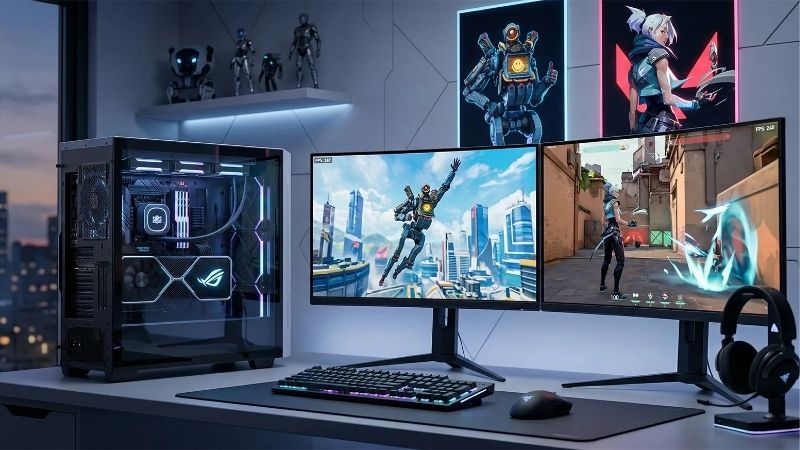
By the end you will know which card matches your budget and your monitor, and where the current GPU market makes buying now the smart move.
What It Takes to Hit 240 FPS in Valorant
Valorant is built on Unreal Engine 4 with a deliberately clean art style, so it is one of the least demanding competitive shooters you can run. That changes the math: the bottleneck for a steady 240 fps is far more often your CPU and monitor than your graphics card. Understanding where the load actually lands is the difference between overspending and buying exactly the right card.
CPU, Resolution, and the 240Hz Target
At 1080p, Valorant leans heavily on single-thread CPU performance. Even a modest modern GPU pushes 300 to 400 average fps at 1080p on High, which means the card is rarely the limiting factor. To hold 240 fps as a minimum rather than an average, you want a current 6-core or better CPU such as a Ryzen 5 7600 or Core i5-13400.
Resolution shifts the balance. Moving to 1440p adds some GPU load, but Valorant still clears 240 fps comfortably on midrange hardware. The practical takeaway: a 240Hz monitor and a capable CPU matter as much as the GPU itself, so budget for the whole chain, not just the card.
Why Valorant Is Easier Than AAA Games
Valorant uses simple geometry, no ray tracing, and modest textures, so VRAM use typically stays under 4 GB at 1080p. A card built for Cyberpunk path tracing is wasted here. This is precisely why an 8 GB, 115W class GPU is enough to saturate a 240Hz panel.
That efficiency is also why buyers on Amazon repeatedly note that their “esports build” runs cool and quiet, often without the card spinning up its fans aggressively. For a Valorant-first rig, restraint is the smart play.
It also frees budget for the parts that actually gate frame rate. A faster CPU, a 240Hz or 360Hz monitor, and a single stick swap to dual-channel memory will each lift your real 240 fps consistency more than jumping two GPU tiers ever would in this specific title.
Reading 1% Lows, Not Just Averages
Averages flatter almost every card. What you feel in a clutch is the 1% low, the frame time consistency when a smoke deploys or an ability floods the screen. A card with a little headroom keeps those 1% lows close to your cap instead of dipping into stutter.
Nvidia Reflex is the lever that matters most here. It trims system latency end to end, so even at the same fps the game feels more responsive. Cap your frame rate slightly below the refresh ceiling, around 237 fps on a 240Hz display, to keep frame pacing tight and avoid tearing.
In practice, the cards that disappoint at 240Hz are not the ones with low averages, they are the ones that spike. Background recording, an overloaded CPU, or thermal throttling will widen frame times far more than a one-tier GPU difference. Monitor your 1% lows with an overlay for a few matches before blaming the card.
Top GPUs for Valorant 240fps, Tested and Compared
For a 240 fps Valorant target there are two cards that make sense for most builders: the RTX 4060 as the value pick and the RTX 4070 Super as the do-everything option. The quick comparison below frames the trade-off, and the breakdowns that follow draw on what Amazon buyers actually report after weeks of use.
| Spec | RTX 4060 | RTX 4070 Super |
|---|---|---|
| CUDA cores | 3072 | 7168 |
| VRAM | 8 GB GDDR6 | 12 GB GDDR6X |
| TDP | 115W | 220W |
| Recommended PSU | 550W | 650W |
| Valorant 1080p (typical) | 300+ fps | 360+ fps |
| Street price | around 299 | around 599 |
RTX 4060 – The Budget 240 FPS Workhorse
On paper the RTX 4060 is modest, 3072 CUDA cores, 8 GB of GDDR6, and a 115W TDP fed by a single 8-pin connector. In Valorant that is more than enough: 1080p runs comfortably past 300 fps on average and holds 240 minimums when paired with a decent CPU. Its low power draw also means a compact dual-fan model fits small cases and runs on a 550W PSU.
Amazon feedback is consistent. Four and five star buyers praise the quiet operation, low temperatures, and how easily it drives a 240Hz esports monitor. The recurring two and three star complaint is the 8 GB of VRAM, which limits high-texture AAA gaming at 1440p, a non-issue for Valorant but worth knowing if you also play heavier titles.
If your priority is the cheapest reliable route to 240 fps, this is the card to watch. Check the current price before it climbs back above 299.
RTX 4070 Super – Headroom for the Future
The RTX 4070 Super is overkill for Valorant alone, often clearing 360 fps at 1080p. Its value is everything else: 7168 CUDA cores, 12 GB of GDDR6X, and DLSS 3 with Frame Generation that pays off in demanding games. The trade-offs are practical, a 220W TDP that wants a 650W PSU, a triple-fan cooler, and real length, so measure your case clearance first.
Buyers describe it as the “play everything” card. Five star reviews highlight quiet 1440p AAA performance and strong NVENC encoding for streamers. The common pushback is size and the roughly 599 price, fair criticisms if Valorant is genuinely all you play.
The experimental upside is real: DLSS, Frame Generation, and Nvidia’s steady driver optimization extend this card’s useful life well beyond today’s titles. If you want one GPU for several years, see the current deal.
Pros and Cons for 240 FPS Competitive Play
Stripping away the marketing, here is the honest balance sheet for hitting a stable 240 fps in Valorant on these Nvidia cards. The picture is strongly positive, with a few caveats that come down to the rest of your system rather than the GPU.
Pros
- Midrange cards already saturate a 240Hz panel, so you do not need to overspend.
- Low power draw and quiet thermals on the 4060 class.
- Nvidia Reflex meaningfully lowers latency for competitive play.
- Strong NVENC encoder if you also stream or record clips.
Cons
- Your CPU or 240Hz monitor may bottleneck before the GPU does.
- 8 GB cards limit future AAA headroom at higher resolutions.
- You must cap and tune fps to keep 1% lows close to the target.
Should You Buy Now? GPU Prices and the Nvidia Outlook
Picking the right card is only half the decision; timing is the other half. The current hardware market sends mixed signals, and a Valorant-focused buyer should read them differently than someone chasing a 4K flagship. Here is what is moving prices and what it means for your purchase.
Why GPU and Component Prices Are Still Elevated
Laptop and PC-component prices have continued to trend upward, and that pressure shows up in street prices for midrange cards sitting above their official launch figures. For a 240 fps Valorant build the lesson is simple: the value cards are the ones holding their proposition best, so wait for an RTX 4060 to dip back toward 299 rather than overpaying in a spike.
Memory cost is the quiet driver here. As long as DRAM and GDDR remain tight, even efficient cards carry that cost forward, which is another reason the lean esports build is the financially sane choice.
There is a tactical angle too. Midrange cards see frequent short sales tied to new launches and seasonal promotions, so a buyer who is patient by a week or two, rather than a year, often catches a 4060 at or below its target price without gambling on a market shift that may not arrive.
The H200-to-China Headline and What It Means for Gamers
One development worth understanding is that the US is now allowing Nvidia to sell the H200, one of its most powerful AI chips, to China. That is a data center story, not a gaming one, but the ripple matters: it confirms where Nvidia’s highest-margin demand and memory allocation are going.
For a Valorant player, the practical read is that consumer GPU supply and pricing are unlikely to loosen dramatically in the short term while AI demand stays this hot. That strengthens the case for buying a sensible midrange card now instead of waiting for a price collapse that the AI boom keeps postponing.
Timing Your Purchase: Buy Now or Wait?
There is genuine but distant good news. Prices have stopped climbing as steeply as they did in late 2025, and the market has entered a calmer, more stable stretch, though volatility has not disappeared. New supply is also coming, with Micron building two fabs in Idaho, but those plants do not come online until 2027 to 2028.
In plain terms, prices have plateaued rather than fallen, and real relief is still years away. Because Valorant does not need a top-tier card, there is little reason to wait: a 4060 or 4070 class GPU bought today delivers a full year of 240Hz play for a modest outlay. When you spot a fair price, check today’s deal and lock it in.
See More:
Final Verdict and Recommendation
For most players, the best gpu for valorant 240fps is the RTX 4060, it reaches the 240 fps target cheaply, runs cool and quiet, and pairs well with a mid-tier CPU and a 240Hz monitor. Step up to the RTX 4070 Super only if you also want strong 1440p AAA performance, DLSS 3, and several years of headroom. Either way, remember the chain matters: a fast card with a weak CPU or a 144Hz panel will not unlock 240 fps. With elevated prices likely to persist while AI demand stays high, buying a sensible Nvidia card now beats waiting for relief that is still years out. Whatever you choose, set a frame cap, enable Reflex, and confirm your monitor is actually running at 240Hz in Windows before you judge the result. Check the current price on the card that fits your build and start climbing ranked at full refresh.
Top-Rated Picks


| Product | Brand | Rating | Reviews | Price |
|---|---|---|---|---|
| ARCTIC MX-4 (4 g) – Premium Performance Thermal Paste… | ARCTIC | ★ 4.8 | 104k | $4.99 |
| ARCTIC MX-4 (incl. Spatula, 4 g) – Premium Performanc… | ARCTIC | ★ 4.8 | 71.9k | $5.49 |
| Crucial 8GB DDR4 RAM 3200MHz (PC4-25600), Downclockab… | Crucial | ★ 4.8 | 62.8k | $74.99 |
| AMD Ryzen 5 5600X 6-core, 12-thread unlocked desktop … | — | ★ 4.8 | 30.2k | $177.60 |
| NVIDIA Shield Remote; Voice Search, Motion-Activated,… | — | ★ 4.7 | 10.6k | $25.99 |
Frequently Asked Questions
What GPU do I need for 240 FPS in Valorant?
Valorant is extremely light. An RTX 5060, RX 7600 or Intel Arc B580 comfortably clears 300 FPS at 1080p low, and even older cards like a GTX 1660 Super can hold 240. At 1440p high an RTX 5060 Ti or RX 7700 XT is plenty, so spend your budget on CPU and monitor instead.
Is Valorant CPU bound at high refresh rates?
Almost entirely. Above roughly 200 FPS the processor determines your ceiling, and one percent lows during spike plants or multi-utility executes track CPU cache and clock speed. A Ryzen 5 7600, Core i5-14600K or better keeps frame times flat, while an old quad core will cap you regardless of graphics card.
How much VRAM does Valorant use?
Typically 2-3GB at 1080p and under 4GB at 1440p with maximum settings. VRAM is a non-issue for this title, so an 8GB card is generous. Any memory-capacity worries you read about apply to AAA titles, not to Valorant, which was deliberately built to run on low-end office hardware.
Which settings should I change for maximum FPS?
Set material, texture and detail quality to low, turn off vignette, bloom, distortion and cast shadows, and leave anisotropic filtering at 8x since it costs almost nothing. Use multithreaded rendering on and run exclusive fullscreen. Enhanced gun skin visuals off also gives a small but free gain on weaker systems.
Does NVIDIA Reflex work in Valorant?
Yes, Valorant supports Reflex Low Latency and it is worth enabling on any GeForce card. Radeon users should enable Anti-Lag 2 where available. Pair it with an FPS cap a few frames under your monitor refresh rate to keep the render queue short and input latency consistently low.





Write Your Review
No reviews yet. Be the first to share your experience!