
Understanding elden ring gpu requirements is refreshingly straightforward, since FromSoftware’s masterpiece runs well on modest hardware but caps frame rate at 60 and rewards stable frametimes over raw power. This guide breaks the requirements into clear tiers, shows you how to check whether your PC measures up, and recommends the best card for a smooth, stutter-free run including the demanding Shadow of the Erdtree expansion. Because the game is locked to 60 frames per second, the goal is consistency rather than chasing huge numbers, and matching your GPU to your resolution is what delivers it. A few quick checks will tell you exactly where your system stands and whether you even need to spend a thing.
As an Amazon Associate we earn from qualifying purchases at no extra cost to you.



Elden Ring GPU Requirements by Tier
The game is far less demanding than many modern titles, but its 60 fps cap and occasional traversal stutter mean the right card depends on your resolution and your desire for rock-solid frametimes, as the tiers below make clear. Knowing your target before you shop saves both money and disappointment, and it keeps you from paying for performance you will never use.
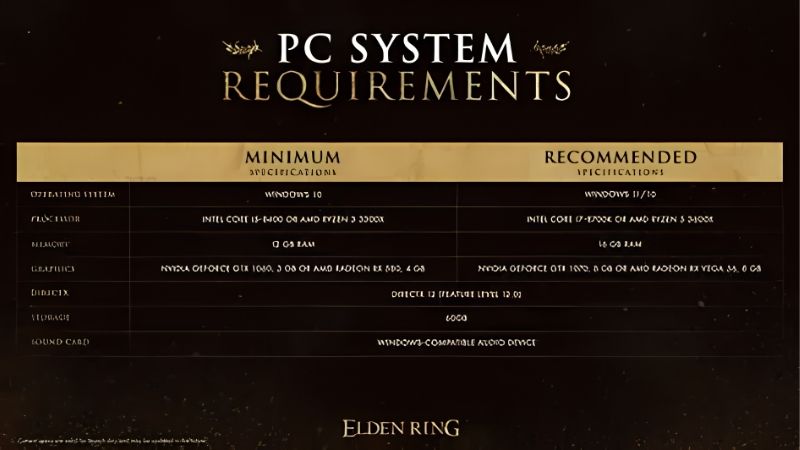
The Minimum Specs for 1080p
At the entry level, a card such as the GTX 1060 or RX 580 will run the game at 1080p medium to high settings. This is genuinely playable and looks good, which is part of Elden Ring’s broad appeal.
You should still pair it with an SSD to reduce the traversal hitches the game is known for. It is enough to enjoy the Lands Between, though the expansion pushes a little harder.
If you sit here, modest settings tweaks keep things smooth. For a steadier 60 fps, especially in the DLC, the recommended tier helps.
The Recommended Specs for a Stable 60 FPS
For a locked, stutter-free 60 frames per second at 1080p and 1440p high settings, a card like the RTX 4060 or RTX 5060 is more than enough. These cards hold the cap effortlessly with headroom to spare.
This headroom matters most during the busy combat and dense areas of Shadow of the Erdtree, where weaker cards can dip. The 8GB of VRAM on these cards handles the game comfortably.
Most players will be happiest here, enjoying a rock-solid experience without overspending. It is the practical target for the majority of systems, delivering a flawless capped experience with comfortable room to spare.
The Specs for 4K 60 FPS
To run the game at 4K high settings while holding a steady 60 frames per second, a card like the RTX 5060 Ti or RTX 5070 is the sensible choice. They have ample power for the cap at high resolution.
Because the frame rate is capped, there is no benefit to a flagship card here, so spending big would be wasteful. A mid-range card is the smart, balanced pick for 4K.
At this level the game looks sharp and runs flawlessly, with the cap held even in demanding scenes. It is the comfortable configuration for 4K players who want sharp visuals without paying for power the cap will never let them use.
How to Check If Your PC Can Run Elden Ring
Before you buy or upgrade, a few quick checks tell you exactly where your PC stands against the game’s modest demands, so you can set realistic expectations or plan a sensible upgrade rather than overspending on power a capped game cannot use. A few minutes spent here saves both money and disappointment later.
What You Will Need to Check
To assess your readiness, you will want to know your current GPU model and its VRAM, your monitor’s resolution, and whether you have a fast SSD to reduce stutter. A capable graphics card, enough VRAM and a solid-state drive are the core pieces, and all are widely available from major retailers if you need to upgrade.
Having these details on hand makes it easy to match your system against the tiers above. It also helps you decide whether a settings change or a modest GPU upgrade is the right move, rather than guessing and overspending.
If you are not sure how to find these details, free system-information tools display your GPU, memory and storage type in seconds, making this a quick and painless first step.
The Steps to Verify Your Setup
Follow these steps in order to know exactly where you stand:
- Identify your current GPU and its VRAM in your system settings or a free monitoring tool.
- Confirm you are running the game from a fast SSD to minimize traversal stutter.
- Note your monitor’s resolution, since the game targets a 60 fps cap.
- Compare your GPU to the tiers above to find your realistic settings level.
- If you fall short, identify the modest upgrade tier that matches your resolution.
Working through these steps gives you a clear, honest picture of your readiness. It turns a vague worry into a concrete plan, whether that means happily keeping your current card or budgeting for a modest upgrade.
Pros and Cons of Your Current Hardware
Pros: If your card matches the recommended tier, you can enjoy a locked 60 fps at high settings and avoid spending anything. Elden Ring’s modest demands mean many existing cards are already enough.
Cons: If your GPU is quite old or you lack an SSD, you may see dips and traversal stutter, especially in the expansion. In that case, a modest upgrade smooths things out.
If you land in that second group, the upgrade picks below are matched to exactly this game’s needs, so you can buy sensibly rather than overspending.
Best GPU Upgrades for Elden Ring in 2026
If your current card falls short of a stable 60 fps, a modest upgrade gets you a smooth run, and these three sensible picks cover the most common resolutions without overspending on a capped game, so your money goes toward a smooth experience rather than unused power.
Best Budget Upgrade for 1080p
For a locked 60 fps at 1080p, the Intel Arc B580 at $249 or the RTX 5060 at $299 are excellent value. Both hold the cap easily and leave plenty of budget for an SSD if you need one.
These cards are widely available and represent the most affordable path to a smooth run. For budget-conscious players, they are the sensible entry point.
Whichever you pick, installing the latest drivers ensures you get the smooth, stable performance the card is built to deliver.
Best 1440p Upgrade
For a rock-solid 60 fps at 1440p including the demanding DLC, the RTX 5060 at $299 or the RTX 5060 Ti at $379 are the standouts. Their headroom keeps frametimes stable in busy scenes.
This is the sweet spot for most players who want a flawless experience without overspending. The cards have ample power for the capped frame rate.
It is also a strong all-round choice, handling other modern games at this resolution just as comfortably.
Best 4K Upgrade
For a steady 60 fps at 4K, the RTX 5060 Ti at $379 or the RTX 5070 at $549 are sensible picks. They deliver the cap at high settings without the waste of a flagship.
This is the smart choice for 4K players, since the frame cap means extra power goes unused. It offers comfortable headroom for the resolution while keeping your spending sensible for a frame-capped game.
Pairing the card with a fast SSD does more for stutter than raw power, so prioritize storage alongside the GPU.
Pro Tips and Common Mistakes to Avoid
A few smart choices and a couple of common pitfalls make a big difference to how Elden Ring runs, so keep these practical pointers in mind as you tune your settings or plan an upgrade. A few minutes of setup can save you from frustration or an unnecessary purchase.
Do Not Overspend on a Capped Game
The biggest mistake is buying a flagship card for a game locked to 60 frames per second, since the extra power simply goes unused. A capable mid-range card delivers the same locked experience for far less.
Spending wisely here frees up budget for a better monitor or SSD. Matching the card to the cap is the smart move. Small adjustments like this often deliver a bigger real-world improvement than players expect, so they are well worth the few minutes they take.
Prioritize an SSD for Smoothness
Elden Ring’s occasional traversal stutter is often tied to storage, so installing the game on a fast SSD does more for smoothness than raw GPU power. It is one of the cheapest improvements available.
Many players blame their GPU when storage is the real culprit. An SSD is a habit that keeps your system running its best long after setup. Spending a little time here pays off across your whole library, not just this one game.
See More:
Focus on Stable Frametimes
With a 60 fps cap, consistency matters more than peak numbers, so aim for settings that hold a steady frame rate rather than maxing everything. Smooth frametimes feel better than occasional spikes.
Chasing maxed settings that cause dips is a common error. Tuning for stability gives the best feel in this game.
In short, meeting the elden ring gpu requirements is easy and affordable: an RTX 5060 delivers a locked 60 fps at 1440p, while an RTX 5060 Ti or RTX 5070 handles 4K without overspending. Check your hardware against the tiers, prioritize a fast SSD, and tune for stable, consistent frametimes rather than chasing raw power you cannot use. If you do need an upgrade, you can find the recommended cards through the links above, all chosen to deliver a smooth, stable 60 fps. As an Amazon Associate we may earn from qualifying purchases.
Top-Rated Picks


| Product | Brand | Rating | Reviews | Price |
|---|---|---|---|---|
| ARCTIC MX-4 (4 g) – Premium Performance Thermal Paste… | ARCTIC | ★ 4.8 | 104k | $4.99 |
| ARCTIC MX-4 (incl. Spatula, 4 g) – Premium Performanc… | ARCTIC | ★ 4.8 | 71.9k | $5.49 |
| Crucial 8GB DDR4 RAM 3200MHz (PC4-25600), Downclockab… | Crucial | ★ 4.8 | 62.8k | $74.99 |
| AMD Ryzen 5 5600X 6-core, 12-thread unlocked desktop … | — | ★ 4.8 | 30.2k | $177.60 |
| NVIDIA Shield Remote; Voice Search, Motion-Activated,… | — | ★ 4.7 | 10.6k | $25.99 |
Frequently Asked Questions
What GPU do I need for a locked 60 FPS in Elden Ring?
Elden Ring is capped at 60 FPS, so the target is consistency rather than raw speed. An RTX 5060, RX 7600 or Arc B580 holds 60 at 1080p maximum settings. For 1440p maximum with ray tracing enabled, an RTX 5070 or RX 9070 provides the headroom needed in Leyndell and the Shadow of the Erdtree areas.
Why does Elden Ring stutter even on powerful hardware?
The stutter is largely engine-side traversal and shader compilation rather than a GPU limitation. Riding quickly through open regions triggers asset streaming hitches on any hardware. Installing on an NVMe SSD, keeping drivers current and disabling ray tracing all reduce the frequency, but the engine behaviour cannot be fully eliminated.
How much VRAM does Elden Ring use?
Roughly 5-6GB at 1080p maximum and 7-8GB at 1440p with ray tracing on. An 8GB card is workable but sits close to the limit with ray tracing, so 12GB or more gives comfortable headroom at 1440p and 4K, especially with the higher fidelity DLC environments.
Is ray tracing worth enabling in Elden Ring?
It adds subtle ambient occlusion and shadow improvements but costs roughly 20-30 percent frame rate and increases stutter. Given the hard 60 FPS cap, most players get a better experience with ray tracing off, since maintaining a locked frame time matters far more than the modest visual upgrade during combat.
Does the CPU matter for Elden Ring?
Yes, more than people expect. The game is poorly multithreaded and leans on single thread performance, so weak or older processors cause dips below 60 in dense areas regardless of the graphics card. A Ryzen 5 7600 or Core i5-13400 class chip or better is recommended for stable frame pacing.





Write Your Review
No reviews yet. Be the first to share your experience!