
- Top Pick: Nvidia RTX 2000 ADA 16GB Graphics Card
- Best Value: NVIDIA Quadro RTX 6000
- Premium Choice: Geforce Nvidia RTX 3060ti Founders Edition 8GB
To download latest Nvidia drivers sounds like a one-click chore, but the way you do it decides whether you gain frames or inherit a stuttering mess. This review breaks down every download method, weighs the real pros and cons that owners report after doing it hundreds of times, and shows you the clean-install routine that avoids the classic post-update problems. Whether you just built a new PC, fixed a black-screen bug, or simply want the newest game-ready package, you will finish this guide knowing exactly which route to take and how to avoid the mistakes that force a reinstall.
Why Keeping Your Nvidia Drivers Updated Matters
Drivers are the translation layer between your games and your graphics card, and a stale one leaves measurable performance on the table. Nvidia ships game-ready packages alongside major titles, and the difference between an outdated driver and the newest one can be double-digit frame gains in freshly launched games. Beyond raw speed, updates carry the security patches, bug fixes, and feature unlocks that keep a modern card behaving the way it should, which is why serious users treat the update as routine maintenance rather than an optional extra.
As an Amazon Associate we earn from qualifying purchases at no extra cost to you.







Performance Gains in New Games
The headline reason to update is speed in the latest releases. When a big title launches, Nvidia frequently publishes a driver tuned for it, and the uplift is real, often in the range of ten to twenty percent in the first optimized build compared with a generic older package.
These gains are not uniform across your library, though. Older games rarely change, so if you only play established titles you will notice little difference. The practical rule is simple: update before you jump into a brand-new, demanding game, because that is where the optimization work is concentrated and where you feel it most. It also helps to know that the biggest gains usually land in the first one or two drivers after a game ships, then taper off. Waiting six months to update means missing the exact window where the tuning matters, so the habit that pays best is checking for a fresh package the week a title you want lands, not once a year when something breaks.
Bug Fixes and Stability Improvements
Updates quietly resolve the crashes, flickering, and black-screen issues that plague specific hardware and game combinations. A large share of the frustrated forum posts about instability trace back to a driver that was several versions behind, and a clean update fixes them outright.
Stability cuts both ways, which is the catch experienced users respect. A brand-new driver occasionally introduces a fresh bug even as it fixes an old one. That is why many long-time owners wait a few days after a release, skim community feedback, and only then download, letting early adopters surface any teething problems first.
New Feature Unlocks and Future-Proofing
Feature access is the underrated benefit. Frame-generation improvements, capture tools, and display options frequently arrive through the driver package rather than a hardware change, so a card can gain genuinely new abilities from a download alone.
This is where staying current pays off over the life of the card. The proprietary upscaling and AI features that make a mid-range GPU punch above its weight are refined in these releases. Skip updates for a year and you are effectively leaving purchased capability switched off, which is the opposite of protecting your investment.
How to Download Latest Nvidia Drivers the Right Way
There is more than one route to the newest package, and each suits a different type of user. The built-in app is fastest for casual updates, the website is best for control and clean installs, and knowing the difference between an express and a custom install decides whether leftover files follow you into the new version. Picking the method that matches your situation is the single biggest factor in a trouble-free update.
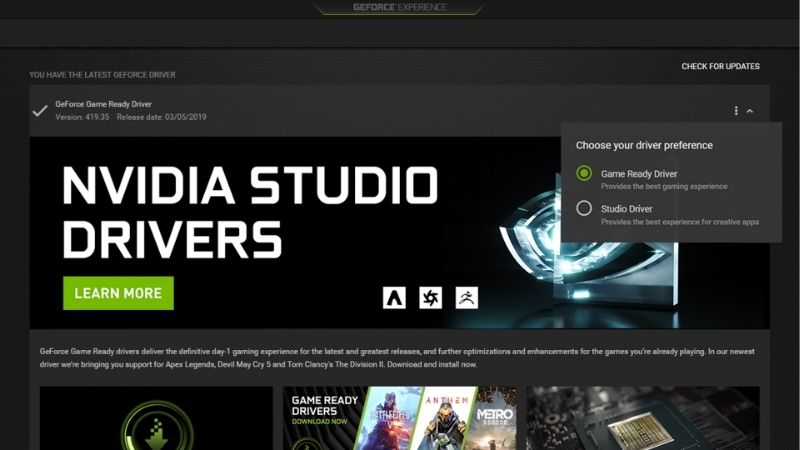
Using the GeForce Experience App
The companion app is the simplest path. It detects your card, notifies you when a game-ready driver is available, and installs it in a couple of clicks, which is ideal for users who just want current drivers without thinking about it.
The convenience comes with mild trade-offs. The app runs in the background, wants an account login, and bundles optional overlays some users would rather skip. For most people the tidy automation outweighs the overhead, but power users often prefer the manual route below for a leaner system with fewer background processes.
Manual Download from the Official Website
The manual method gives you full control. You select your exact card model, operating system, and driver branch, then download the standalone installer directly, which is the approach to use when you want a specific version or a fresh start.
This route is also the one to trust when an automatic update has failed or corrupted. Because you are grabbing the complete package rather than a delta update, you sidestep the partial-install problems that cause a surprising number of black-screen complaints. Bookmarking the correct product page for your card turns this into a fast, repeatable habit. One detail trips up newcomers: the site offers two driver branches, a game-ready line updated frequently for the latest titles and a studio line tuned for creative stability. Gamers should pick the game-ready branch, while video editors and 3D artists benefit from the studio branch that prioritizes reliability over day-one game support. Choosing the wrong branch will not break anything, but matching it to how you use the machine gets you the behavior you actually want.
Clean Install vs Express Install
The installer offers a custom path with a clean-install checkbox, and choosing it wipes old driver files before laying down the new ones. Express keeps existing settings and installs on top, which is quicker but carries over any accumulated clutter.
Owners who chase every last bit of stability swear by the clean install, especially when upgrading across several versions or switching cards. It resets profiles and clears conflicting remnants, at the small cost of reconfiguring your preferences afterward. When in doubt, and particularly if you have had glitches, the clean install is the safer choice.
Driver Update Pros, Cons, and Real User Experiences
Aggregating what owners actually report, from glowing five-star endorsements to frustrated two-star warnings, gives a balanced picture that a feature list cannot. The community consensus is overwhelmingly that updating is worth it, yet the same voices are candid about the situations where a new driver caused more trouble than it solved. Understanding both sides lets you download with confidence and a clear rollback plan.
The Upside Owners Consistently Report
The most common praise is smoother performance in current games and the disappearance of stubborn bugs. Users describe crashes that vanished, stutters that smoothed out, and features that suddenly worked after a long-overdue update.
A second frequent compliment is the ease of the process once you settle on a method. People who adopt a routine, either the app for convenience or the website for control, report that keeping current becomes a five-minute task they barely think about, which is exactly the low-friction maintenance a good driver program should deliver.
Common Complaints and Risks to Manage
The recurring complaint is the occasional bad release that introduces a regression, from higher idle power to a specific game running worse than before. These reports are a minority, but they are real, and they are why the wait-and-watch approach exists.
The good news is that the risk is manageable. The installer keeps the ability to roll back to a previous version, so a problem driver is a quick fix rather than a disaster. Savvy owners note the version number that worked well for them, so if a new one misbehaves they can revert in minutes without hunting for the file.
What the Community Recommends
The seasoned advice distills to a short checklist. Update before new game launches, use a clean install after any glitch or card change, and give major releases a few days unless a driver specifically fixes a problem you are having right now.
The final piece of wisdom is knowing when software cannot help. If you have the newest package, done a clean install, and your frame rates still fall short in the games you care about, the bottleneck is the hardware, not the driver. At that point the smartest move is not another download but a look at a more capable card. A helpful diagnostic is to watch your GPU usage while gaming: if the card is already pinned near one hundred percent and frames are still low, no driver will conjure headroom that the silicon does not have. That single check separates a software problem you can patch from a hardware ceiling you can only solve by upgrading, and it saves hours of chasing settings that were never the real limit.
See More:
Final Verdict and Next Steps
Learning to download latest Nvidia drivers correctly is one of the highest-value habits a PC owner can build, because it unlocks free performance, fixes stability issues, and switches on features you already paid for. The method you choose matters: the app for effortless updates, the website for control, and a clean install whenever something has gone wrong. The risks are minor and reversible, so there is little reason to run outdated software. That said, a driver can only optimize the silicon you own. If a fully updated, clean-installed system still stutters in the titles you love, that is the honest signal that a graphics upgrade will do what no download can, and you can compare current cards through the link in this guide to see what fits your setup and budget.
Frequently Asked Questions
Where should I download NVIDIA drivers from?
Use the official driver search page on nvidia.com or the NVIDIA App, and nothing else. Third-party driver packs and updater utilities frequently bundle adware or serve outdated packages. Select your exact GPU series, model, operating system and download type, then verify the version number on the download page before installing.
What is the difference between DCH and Standard packages?
DCH is the modern Microsoft driver model that Windows 10 and 11 use, with the Control Panel delivered separately through the Microsoft Store. Standard was the legacy format for older Windows installs. Modern systems get DCH automatically, and you cannot mix the two, so keep using whichever type is already installed.
Do I need to uninstall the old driver first?
For routine updates the installer handles it, and choosing Custom then Perform a clean installation is usually enough. If you are switching brands, chasing black screens or recovering from a failed update, boot into safe mode and run Display Driver Uninstaller for a genuinely clean slate before installing.
Should I always install the newest driver?
Update when a new game you play gets a Game Ready release, when you buy a new card, or when a fix addresses a bug you have. Otherwise there is no harm in waiting a week for feedback, since occasional releases introduce regressions in specific titles or with specific display and capture hardware.
Why does my driver install keep failing?
The usual causes are a stalled NVIDIA service, leftover files from a partial install, antivirus interference or a Windows Update driver installing at the same time. Pause Windows Update, disable antivirus briefly, run DDU in safe mode, then install the freshly downloaded package with the network disconnected.




Write Your Review
No reviews yet. Be the first to share your experience!