
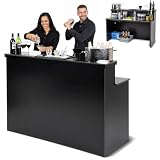
- Top Pick: GoBar Portable Double Bar Table Set – Mobile Bartender Station for Events – Includes Carrying Case – Standard or LED
- Best Value: ONBRILL 61" Foldable Bar Table, Mobile Party Bar Station on Lockable Wheel
- Premium Choice: GoBar Elite Heavy-Duty Portable Bar Table for Events – Foldable Commercial Grade Wood – Pop Up Mobile Bartending Station – Black
The best outdoor bar stations for entertaining are usually modular stainless-steel or powder-coated aluminum units with at least 48 inches of usable counter space, enclosed storage, and a layout that keeps guests out of the cooking and serving path.
- Quick comparison: which bar-station format fits your patio?
- 1. Choose counter space before features
- 2. Compare weather-resistant materials
- 3. Decide how much storage you actually need
- 4. Treat plumbing as a layout decision
- 5. Match assembly effort to how permanent the station will be
- 6. Use this decision matrix before buying
- Best overall approach for most patios
- Final buying checklist
As an Amazon Associate we earn from qualifying purchases at no extra cost to you.



Quick comparison: which bar-station format fits your patio?
| Station type | Typical footprint | Usable counter space | Storage | Plumbing | Best for |
|---|---|---|---|---|---|
| Compact rolling cart | 24–36 in. wide by 20–28 in. deep | 3–6 sq. ft. | Open shelf or small cabinet | Not required | Small patios, balconies, occasional hosting |
| Freestanding cabinet station | 36–60 in. wide by 24–30 in. deep | 8–12 sq. ft. | 1–3 cabinets plus drawers | Optional drain or water connection | Most patios and regular entertaining |
| Modular outdoor kitchen bar | 72–120 in. wide by 24–36 in. deep | 14–25 sq. ft. | Multiple cabinets, drawers, and appliance bays | Often needed for sink or ice maker | Large patios and permanent layouts |
| Built-in island bar | 96–144 in. wide by 36–48 in. deep | 20–35 sq. ft. | Highest capacity | Usually planned during installation | Dedicated entertaining areas and remodels |
Allow at least 36 inches of clear passage behind the working side of a station. If stools face the counter, reserve roughly 24 inches of width per seated guest and 36 inches from the counter edge to the nearest wall or furniture. These clearances matter more than the advertised width because a station that blocks a door or forces guests into the work zone will feel cramped during a party.
1. Choose counter space before features
Counter space is the most difficult feature to add later. A compact station may look adequate until it must hold a cutting board, bottles, an ice bucket, glasses, garnishes, and a tray of finished drinks.
For a practical estimate, assign about 2 square feet of active work surface per bartender. A 48-inch-wide counter that is 24 inches deep provides 8 square feet, but the rear 6–8 inches may be occupied by a backsplash, bottles, or a rail. That leaves approximately 6 square feet of genuinely flexible space: enough for one person to mix drinks comfortably, or two people working without much separation.
For four to six guests, target 6–10 square feet of usable counter area. For larger gatherings, a 72–96-inch modular station is more comfortable, particularly if one section is used for serving while another holds a sink, grill, refrigerator, or ice maker.
2. Compare weather-resistant materials
304 stainless steel
304 stainless steel is a strong choice for exposed counters, sinks, and appliance surrounds. It resists corrosion better than ordinary painted steel and is easy to clean, but it can show fingerprints, water spots, and scratches. In coastal regions, rinse salt residue regularly; even stainless steel benefits from maintenance.
Powder-coated aluminum
Aluminum is lightweight, naturally corrosion-resistant, and easier to move than steel. A quality powder coat protects the surface and expands color options. Inspect edges, fasteners, and cutouts carefully, because damage to the coating can become a maintenance point.
HDPE and resin panels
High-density polyethylene and outdoor resin are useful for budget-friendly carts and cabinet bodies. They do not rust and are often easy to wipe clean. Their limitations are lower heat tolerance, possible fading, and less rigid construction than metal. Do not place a hot pan directly on a resin counter unless the manufacturer explicitly permits it.
Wood and composite counters
Teak and other outdoor-rated woods can look excellent, but they require periodic cleaning and oiling or sealing, depending on the finish. Composite tops are low-maintenance, though some can stain or discolor under prolonged heat and sunlight. For minimum upkeep, choose a metal or nonporous composite worktop and use a fitted cover.
3. Decide how much storage you actually need
Open shelving is convenient for towels, trays, and frequently used items, but it exposes supplies to dust, rain, insects, and sunlight. Enclosed cabinets are better for glassware, cocktail tools, napkins, and unopened beverages. Drawers are especially useful for small tools because they prevent a deep cabinet from becoming a pile of miscellaneous equipment.
- Occasional entertaining: one cabinet or two shelves are usually sufficient.
- Weekly use: choose at least one full-width cabinet and one drawer for tools.
- Large gatherings: look for bottle-height storage, a bin for recycling, and a dedicated space for an ice chest or compact refrigerator.
- Cold-weather storage: removable shelves and portable modules are easier to empty and protect than a fully built-in island.
Check internal dimensions rather than cabinet count. A cabinet advertised as storage may not fit tall bottles, a countertop appliance, or a standard beverage cooler. Also check whether the doors open into a walkway or collide with adjacent modules.
4. Treat plumbing as a layout decision
A station with a sink is more convenient, but it creates installation requirements. A permanent sink normally needs a potable-water supply, a drain route, and protection from freezing temperatures. If the patio is far from the house plumbing, installation cost and complexity can exceed the price of the station itself.
For a simpler setup, choose a self-contained water system with a removable reservoir and waste tank, or use a portable hand-washing unit beside a dry bar. This avoids cutting concrete and makes winter storage easier. A drain that empties directly onto the patio is usually a poor solution: it can leave standing water, create stains, and violate local drainage requirements.
Ice makers and refrigerators also need a suitable electrical circuit. A typical compact refrigerator may draw about 1–3 amps while running but can briefly draw more during compressor startup. An ice maker adds another intermittent load. Avoid assuming that an outdoor-rated extension cord makes an overloaded circuit safe; use a weather-protected, code-compliant outlet and consult an electrician for permanent installations.
5. Match assembly effort to how permanent the station will be
| Assembly level | Typical time | What to expect | Trade-off |
|---|---|---|---|
| Ready-assembled cart | 15–45 minutes | Attach handles, wheels, shelves, or accessories | Fastest setup, least customization |
| Flat-packed cabinet | 2–5 hours | Leveling panels, doors, hardware, and countertop | Lower shipping cost, more adjustment required |
| Modular kitchen system | 1–2 days | Join cabinets, fit appliances, level modules, and manage utilities | Better layout flexibility, more installation work |
| Built-in island | Several days to weeks | Base construction, countertop fitting, electrical, plumbing, and permits where required | Most durable appearance, least movable |
Leveling is not cosmetic. An uneven station can make doors swing open, cause liquids to pool on the counter, and prevent modular cabinets from aligning. For a freestanding unit, install adjustable feet or use outdoor shims designed for the surface. For a movable cart, lockable casters are preferable to ordinary wheels.
6. Use this decision matrix before buying
| Your situation | Recommended configuration | Why |
|---|---|---|
| Balcony or patio under 100 sq. ft. | 24–36-inch cart, no plumbing | Preserves circulation and avoids permanent utility work |
| Covered patio with 4–6 guests | 48–60-inch cabinet station, 6–10 sq. ft. counter | Balances storage and workspace without dominating the room |
| Uncovered, rainy location | Powder-coated aluminum or stainless steel with cover | Reduces rust risk and protects stored supplies |
| Frequent parties and meal service | 72–96-inch modular system with separate prep and serving zones | Prevents drinks, food, and dirty items from competing for one surface |
| Rental home or frequent moves | Rolling cart or unplumbed modular cabinets | Can be relocated without damaging the patio |
| Coastal climate | 304 stainless hardware, aluminum cabinet body, sealed storage | Better resistance to salt air and moisture |
Best overall approach for most patios
For most households, the best outdoor bar station is a 48–60-inch freestanding cabinet with a weather-resistant metal frame, a nonporous counter, one enclosed cabinet, at least one drawer, and no permanent plumbing. Add a portable ice chest or removable water system first. Upgrade to a sink, refrigerator, or built-in island only after confirming the electrical, drainage, winterization, and clearance requirements.
Budget roughly $200–$500 for a basic cart, $500–$1,500 for a sturdier freestanding cabinet station, and $1,500–$5,000 or more for a modular outdoor kitchen bar before professional utility work. The cheapest suitable unit is not always the smallest one; it is the station that provides enough working surface and storage without forcing a costly patio redesign.
Final buying checklist
- Measure the full footprint, including doors, handles, casters, and counter overhangs.
- Reserve 36 inches of working clearance and about 24 inches of counter width per seated guest.
- Calculate usable counter area rather than relying on outside dimensions.
- Choose materials appropriate to rain, sun, salt air, and winter temperatures.
- Confirm whether cabinets are sealed, ventilated, lockable, and large enough for your bottles and equipment.
- Plan water, drainage, and electrical connections before choosing a sink or appliance module.
- Prefer modular or wheeled construction when the patio layout may change.
Ready to decide? Our #1 pick for 2026 is the Compact rolling cart.
Live price & availability on Amazon.




Write Your Review
No reviews yet. Be the first to share your experience!