
The best fireproof document bags for home use are the ones with a clearly stated fire rating, a genuine water-resistant closure, enough depth for your papers and drives, and a design you can carry quickly—not simply the thickest bag or the one using the word “fireproof.”
- Quick comparison: which type suits your documents?
- What “fireproof” actually tells you
- Water resistance is a separate requirement
- Capacity: choose by contents, not exterior dimensions
- Closure quality and portability
- Decision matrix for common home setups
- How to organize a fire-resistant document bag
- Bottom line
As an Amazon Associate we earn from qualifying purchases at no extra cost to you.


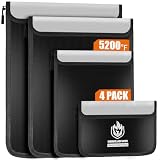
Quick comparison: which type suits your documents?
| Bag or container type | Fire-rating evidence to look for | Typical water protection | Useful capacity | Best fit |
|---|---|---|---|---|
| Compact zippered document pouch | Manufacturer time-and-temperature test; certification often absent | Short exposure to splashes or light spray | About 2–5 L | Passports, certificates, small USB drives |
| Layered fire-resistant briefcase | Prefer an independently verified test, such as a stated UL 72 or equivalent result | Usually better, especially with a folded flap and sealed zipper | About 5–12 L | Folders, deeds, insurance records, several drives |
| Fire-resistant box placed inside a bag | Often stronger certification than soft bags; verify the exact model | May include tested water resistance, but not always | About 8–25 L | Large paper archives and backup media |
| Fire-rated safe | Look for a recognized fire-test standard and a stated duration | Model-dependent; flood protection is separate from fire protection | About 15 L or more | Permanent storage rather than grab-and-go evacuation |
For most households, a layered briefcase-style bag is the best compromise. A compact pouch is easier to carry but quickly becomes too small, while a safe provides stronger protection but may be difficult to move during an emergency.
What “fireproof” actually tells you
Soft document bags are frequently described as fireproof even when the manufacturer has only tested the material or has not published a recognized certification. A credible listing should state the test temperature, test duration, and what remained protected. “Withstands 2,000°F” is incomplete unless it also says for how long and whether the interior stayed below a safe temperature.
For paper, the important result is usually an interior temperature below roughly 350°F, because paper begins to char and ignite at much lower temperatures than the outside of a fire. Digital media needs more caution: USB flash drives, external SSDs, memory cards, and optical discs can be damaged by heat, moisture, or magnetic exposure before paper is visibly affected.
UL 72 is a useful certification reference for record-protection equipment, but not every soft bag carries it. If a bag does not have an independently verified rating, treat its advertised temperature as a comparison figure rather than a guarantee. A certified fire-resistant box inside a carrying bag is generally a safer choice for irreplaceable records than an uncertified fabric pouch with impressive marketing numbers.
Water resistance is a separate requirement
Firefighting water, burst pipes, sprinklers, and rain can destroy documents even when the bag survives the heat. Check the closure rather than judging water protection from the outer fabric.
- Best: a roll-top or folded flap combined with a water-resistant zipper or gasket.
- Acceptable: a tightly sewn zipper with an overlying flap and sealed lining.
- Weak: a normal exposed zipper, hook-and-loop closure, or open handles that allow water to enter.
Do not confuse “water-resistant fabric” with waterproof construction. Seams, zipper ends, and handle attachment points are often the first places for water to enter. For especially important papers, place them in resealable plastic sleeves inside the fire bag. The sleeve is not a substitute for the bag’s fire protection; it adds a second barrier against water and soot.
Capacity: choose by contents, not exterior dimensions
Manufacturers commonly quote external measurements, but insulation and folded walls reduce usable space. A bag advertised as 12 inches wide may accept only a letter-size folder if the interior width is closer to 10 inches.
Use this quick capacity calculation before buying. A standard letter-size stack measuring 11 × 9 inches and 2 inches thick occupies:
11 × 9 × 2 = 198 cubic inches, or about 3.2 liters.
Add a passport wallet, two small drives, and room for protective sleeves, and a practical target becomes about 5 liters. If you have three such folders, the paper alone requires approximately 9.6 liters, so a nominal 10-liter bag will be tightly packed and difficult to close. Choose at least 12–15 liters instead.
| Contents | Recommended usable capacity | Useful internal features |
|---|---|---|
| Two to four passports, birth certificates, and a few drives | 2–4 L | Small pockets, padded drive sleeve, wide opening |
| One household folder plus passports and insurance papers | 4–7 L | Flat document compartment and compression strap |
| Several folders, property records, and backup media | 8–15 L | Rigid base, reinforced handles, dividers |
| Paper archive for a whole household | 15 L or more | Box structure or multiple smaller containers |
Closure quality and portability
A good closure should remain shut when the bag is dropped, dragged, or carried by one handle. Two opposed zippers with a locking loop are more useful than a single zipper without a way to secure it. A roll-top closure can resist water well, but it consumes internal height and is less convenient for flat folders.
Inspect the handles as carefully as the fabric. Handles stitched only to the outer shell may tear when the bag is full. Look for webbing that runs beneath or around the base, reinforced stitching, and a handle length that permits gloved or hurried carrying. A shoulder strap helps with larger bags, but it should be removable or firmly anchored so it does not catch during evacuation.
Portability also affects the right size. A 15-liter bag may protect more records, but it can become awkward once filled with paper. For many homes, two smaller bags are more practical: one grab-and-go bag for identity documents and one larger archive bag for less urgent records.
Decision matrix for common home setups
| Your situation | Recommended choice | Why | What to avoid |
|---|---|---|---|
| Apartment, limited storage, passports only | 2–4 L compact pouch with a sealed or covered zipper | Easy to keep near an exit and unlikely to be overfilled | Oversized bag that stays buried in a closet |
| Family with property and medical records | 5–10 L layered briefcase with verified fire-test details | Balances folder capacity with manageable weight | Thin single-layer fabric pouches |
| Large paper archive | Certified fire-resistant box, optionally carried in a bag | Rigid construction and stronger record protection | Relying on a soft bag for long-duration storage |
| Important digital backups | Fire-rated inner container plus separate water-resistant sleeve | Provides more protection against heat and firefighting water | Assuming a paper-rated bag protects SSDs equally |
| Frequent relocation or evacuation concern | 4–7 L bag with reinforced handles and moderate loading | Fast to lift and less likely to be left behind | Heavy bags filled to their stated maximum |
How to organize a fire-resistant document bag
- Separate originals from working copies. Keep passports, certificates, titles, and legal originals in sleeves so they can be removed quickly.
- Put flat papers in the center. Avoid placing sharp drive edges, keys, or binders against the lining.
- Use labeled pouches. Group identity, property, insurance, medical, and financial documents so you do not have to empty the bag during an emergency.
- Keep digital backups isolated. Place drives in padded, water-resistant sleeves inside the main container; do not let them rattle against metal hardware.
- Leave closing space. A bag packed to the zipper makes the closure weaker and can create gaps at the corners.
- Store it where it can be reached. Protection is of limited value if the bag is under heavy furniture, in a basement likely to flood, or behind locked storage that cannot be opened quickly.
Bottom line
The best fireproof document bags are not selected by temperature claims alone. Prioritize a published, independently verified fire test; then check water-resistant closure design, usable internal dimensions, reinforced carrying points, and the specific vulnerability of your drives. Choose a compact 2–4-liter pouch for identity documents, a 5–10-liter layered bag for ordinary household records, and a certified rigid container for larger archives or irreplaceable digital media.
Ready to decide? Our #1 pick for 2026 is the Compact zippered document pouch.
Live price & availability on Amazon.






Write Your Review
No reviews yet. Be the first to share your experience!