


Checking the nvidia etf price is how many investors track exposure to NVIDIA without buying the stock directly, but there is an important catch: there is no single fund that simply holds NVIDIA alone. Instead, the term covers semiconductor funds that hold NVIDIA heavily and leveraged single-stock ETFs that amplify its daily moves. This guide explains the main options, what actually drives their prices, the risks that make some unsuitable for long-term holding, and how to choose the right approach in 2026.
Understanding NVIDIA ETF Options
Because NVIDIA is a single company, no traditional ETF holds only its stock, so an NVIDIA ETF really means one of two things: a diversified fund that includes NVIDIA as a large holding, or a leveraged single-stock ETF that tracks a multiple of NVIDIA’s daily return. Knowing which type you are looking at is the first and most important step, since their prices behave very differently.
As an Amazon Associate we earn from qualifying purchases at no extra cost to you.



Why There Is No Pure NVIDIA ETF
ETFs are designed to hold baskets of securities, so a fund cannot simply hold one stock and still be a conventional ETF. This is why searching for an NVIDIA ETF returns funds that either include NVIDIA among many holdings or use derivatives to track it.
For direct ownership of NVIDIA, investors buy the stock itself. The ETF route is chosen instead for diversification, through a semiconductor basket, or for amplified short-term exposure, through a leveraged product.
Understanding this distinction avoids a common confusion. When someone refers to the NVIDIA ETF price, they are almost always talking about one of these related funds rather than a pure single-holding NVIDIA fund, which does not exist. Recognizing this upfront saves confusion and helps you choose the vehicle that actually matches your intent, whether that is diversification or a concentrated bet.
Broad Semiconductor ETFs Holding NVIDIA
The most popular way to get NVIDIA exposure with diversification is through semiconductor ETFs. The VanEck Semiconductor ETF, known as SMH, holds NVIDIA at roughly a 15% to 17% weighting alongside peers like TSMC, Broadcom, and AMD, making it the heaviest mainstream NVIDIA vehicle. Its size and liquidity have made it a default choice for investors wanting concentrated chip exposure.
The iShares Semiconductor ETF, or SOXX, offers a more balanced approach, holding NVIDIA at around 7% with broader exposure across 30 chip stocks. Both charge about 0.35% in fees, and SOXX has a lower-cost sibling in SOXQ.
These funds let investors benefit from NVIDIA’s growth while spreading risk across the wider chip sector. Their prices track the semiconductor industry broadly, so they rise and fall with the whole group rather than with NVIDIA alone. This makes them a way to ride the AI and chip theme broadly, accepting that on any given day a rival’s move can offset or amplify what NVIDIA’s stock is doing.
Single-Stock Leveraged and Inverse ETFs
For concentrated bets, single-stock ETFs track a multiple of NVIDIA’s daily move. The GraniteShares 2x Long NVDA ETF, ticker NVDL, aims to deliver twice NVIDIA’s daily return, while Direxion’s NVDU offers a similar 2x bull exposure.
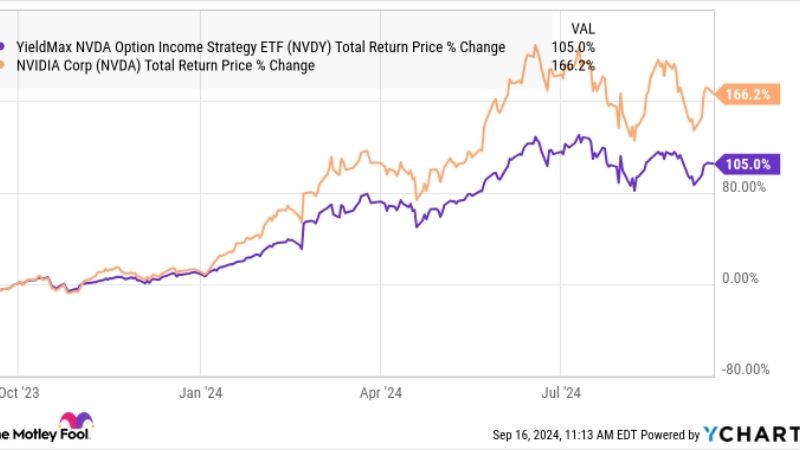
There are also inverse products, such as Direxion’s NVDD, which profits when NVIDIA falls, and income-focused options like the YieldMax NVDY, which uses an options strategy to generate yield from NVIDIA’s volatility. Each serves a different, specialized purpose.
These are powerful but risky tools aimed at active traders, not long-term investors. Their prices can swing dramatically, delivering outsized gains in a rally and severe losses in a downturn, which makes understanding their mechanics essential before use. These products are best understood as trading instruments rather than investments, engineered for precise short-term exposure rather than patient, long-term wealth building.
What Drives NVIDIA ETF Prices
Knowing the options is only useful alongside understanding what moves their prices. Here is how NVIDIA’s own performance, the mechanics of leverage, and fees and concentration all shape what you pay and earn.
NVIDIA’s Performance and AI Demand
At the core, every NVIDIA-linked ETF price is driven by NVIDIA’s own share performance, which in turn tracks the AI boom. Record data center revenue and surging demand for AI chips have propelled NVIDIA’s stock, lifting the funds tied to it.
Broader factors matter too. News on AI spending, export policy toward China, and competition all move NVIDIA’s stock and ripple through to the ETFs, so their prices reflect the same forces that drive the underlying company.
For semiconductor baskets, the wider sector’s health also counts, since strength or weakness in peers like TSMC and Broadcom affects the fund. This diversification can cushion or dilute NVIDIA’s individual moves depending on the day. For that reason, a semiconductor ETF’s price will rarely match NVIDIA’s exactly, tracking the fortunes of the whole sector instead of a single name.
Leverage and Volatility Decay
Leveraged single-stock ETFs introduce a crucial wrinkle: they reset daily, aiming to deliver their multiple of NVIDIA’s return each day rather than over longer periods. This daily reset causes a phenomenon called volatility decay.
In practice, this means a 2x fund does not simply double NVIDIA’s return over weeks or months. In choppy, sideways markets, the compounding of daily resets can erode value, so a leveraged fund can lag twice the underlying’s longer-term performance.
This is why leveraged NVIDIA ETFs are designed for short-term trading, not buy-and-hold investing. Their prices can behave unexpectedly over time, and holding them for long periods carries risks that catch many investors off guard. The mismatch between a leveraged fund’s daily objective and an investor’s longer holding period is the single most misunderstood feature of these products, and the source of most disappointment.
Fees and Concentration
Costs and composition also shape returns. Broad semiconductor ETFs charge modest fees around 0.35%, while leveraged single-stock funds typically carry higher expense ratios reflecting their complexity and active management.
Concentration is the other key factor. SMH’s heavy NVIDIA weighting has been both its greatest strength during NVIDIA rallies and its biggest risk during pullbacks, while SOXX’s lighter weighting offers a smoother, more diversified ride.
Choosing between them means balancing potential reward against risk. A more concentrated fund amplifies NVIDIA’s influence on your returns, while a broader one spreads exposure across the sector for stability. There is no universally correct answer here, only a trade-off between chasing NVIDIA’s upside and protecting yourself from its sharpest declines.
Choosing an NVIDIA ETF
With the options and price drivers clear, the decision comes down to your goals and risk tolerance. This section weighs the pros and cons, matches each approach to the right investor, and covers how to track prices responsibly.
Pros and Cons of Each Approach
Broad semiconductor ETFs offer diversification, lower risk, and reasonable fees, giving NVIDIA exposure without betting everything on one stock. The trade-off is diluted upside, since NVIDIA is only part of the fund.
Leveraged single-stock ETFs offer amplified gains and a concentrated NVIDIA bet, which appeals to traders. The cons are severe: high risk, volatility decay, higher fees, and the potential for catastrophic losses on a bad day.
Net assessment: for most people, a diversified semiconductor ETF is the sensible way to gain NVIDIA exposure, while leveraged products are specialized tools best left to experienced, active traders who understand the risks. The gap in suitability between the two approaches is wide, which is why matching the product to your experience and time horizon matters more than chasing the highest potential return.
Which Suits Which Investor
Long-term investors seeking NVIDIA exposure with less risk are best served by SMH or SOXX, gaining from the chip sector’s growth while spreading their bets. These funds suit a buy-and-hold approach far better than leveraged options.
Active traders comfortable with high risk and short holding periods may use leveraged single-stock ETFs for tactical bets, provided they understand daily resets and volatility decay. These are instruments for trading, not investing.
Those wanting the purest NVIDIA exposure of all should simply buy the stock, avoiding both dilution and leverage risk. The right choice depends entirely on your goals, time horizon, and tolerance for risk. Being honest about which of those describes you is the surest way to pick a vehicle you will be comfortable holding through the sector’s inevitable swings.
How to Check Prices and a Disclaimer
To track an NVIDIA ETF price, use the fund’s ticker, such as SMH, SOXX, or NVDL, on any brokerage or financial site for real-time quotes, holdings, and fees. Always confirm the current expense ratio and composition before buying. Holdings and weights shift at each rebalance, so the figures you saw last quarter may already be out of date.
This overview is educational and not financial advice. ETFs, especially leveraged ones, carry real risks, so anyone considering an investment should do their own research and consider consulting a qualified financial professional rather than relying on a single summary.
If your interest in NVIDIA also extends to its products, the same AI leadership driving these funds powers its consumer graphics cards. Gamers and builders can use the link to explore current NVIDIA GPUs directly. Whichever fund you track, the underlying driver is the same technology powering those consumer cards, so following NVIDIA’s products offers real insight into what moves the price.
See more:
Conclusion
Tracking the nvidia etf price means understanding that no pure single-holding NVIDIA fund exists, only diversified semiconductor ETFs like SMH and SOXX that hold it heavily, and leveraged single-stock products like NVDL that amplify its daily moves. Broad funds suit long-term investors, while leveraged ones are risky tools for active traders, and volatility decay makes them unsuitable for holding. Match the approach to your goals, and remember this is analysis, not financial advice. If you follow NVIDIA’s products too, use the link above to explore its current graphics cards.
Frequently Asked Questions
Is there an ETF that holds only NVIDIA?
Not a conventional diversified one, because standard ETFs must hold multiple securities. What exists are single-stock leveraged and inverse products that use derivatives to track a multiple of NVIDIA daily performance. These reset daily, decay in volatile markets, and are designed for short-term trading rather than buy and hold exposure.
Which broad ETFs give the most NVIDIA exposure?
Semiconductor funds such as SMH and SOXX carry the heaviest weightings, often in the double-digit percentage range. Broader technology funds like VGT and XLK hold meaningful positions, and index funds tracking the Nasdaq-100 or S&P 500 include NVIDIA at a smaller weight. Always check the current holdings page, since weights shift with price.
Why does a leveraged NVIDIA ETF not track two times the annual return?
Because leverage resets daily. Compounding over multiple days means the product tracks two times the daily return, not two times the period return. In a choppy sideways market this volatility decay erodes value even if the underlying stock ends flat. The effect worsens with higher volatility, and NVIDIA is a volatile stock.
What fees should I expect?
Broad index funds are cheap, often under 0.10 percent annually. Sector funds like SMH and SOXX typically sit in the 0.35 to 0.45 percent range. Single-stock leveraged products are far more expensive, commonly around 1 percent or more, plus embedded financing costs from the swaps they use. Fees compound, so they matter over long holding periods.
Is buying an ETF safer than buying NVIDIA directly?
A diversified semiconductor or technology ETF reduces single-company risk while keeping sector exposure, which is a reasonable trade-off. But concentration is still high, and semiconductors are cyclical. This article is general information, not personalised advice, and nothing here should be treated as a recommendation to buy or sell any security.





Write Your Review
No reviews yet. Be the first to share your experience!