


If you are shopping for a graphics card and confused about the difference between RTX and GTX, here is the short answer: RTX cards are Nvidia’s newer, more powerful line with ray tracing and DLSS, while GTX cards are older and simpler. Not sure which badge actually matters for your games and budget? This guide clears it up completely, so in a few minutes you will know exactly what separates them and which one is right for you.
As an Amazon Associate we earn from qualifying purchases at no extra cost to you.




What Really Separates RTX From GTX
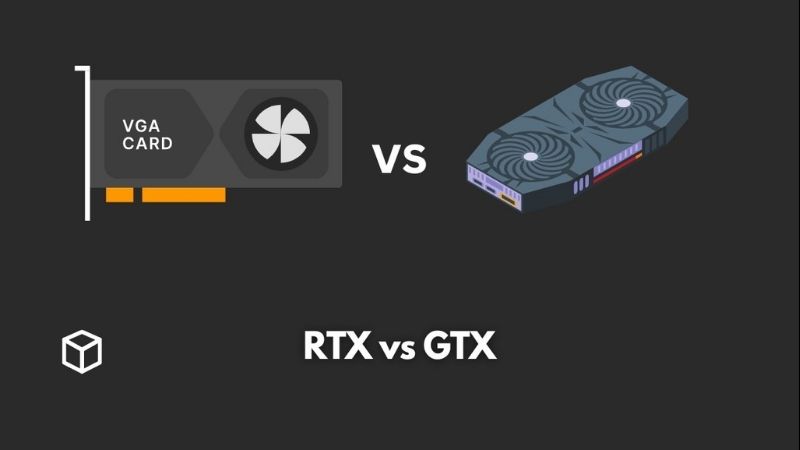
RTX and GTX are two generations of Nvidia graphics cards, and the difference is about more than just a name. Understanding the key features each brings is the foundation for choosing the right card without overpaying or missing out.
RTX Adds Ray Tracing and DLSS
The headline difference is that RTX cards support ray tracing and DLSS, while GTX cards do not. Ray tracing produces far more realistic lighting and reflections, giving supported games a noticeably richer look.
DLSS is arguably even more important for everyday gaming. It uses artificial intelligence to boost frame rates with little loss of image quality, which can dramatically improve performance in supported titles.
These features are exclusive to RTX for a reason. They rely on dedicated hardware built into RTX cards that GTX cards simply do not have, which is the core technical divide between the two lines.
It is worth understanding why DLSS in particular has become such a big deal. As games grow more demanding, running them at high settings and resolutions can push even strong cards to their limits, and DLSS lets an RTX card render at a lower internal resolution then intelligently sharpen the image back up. The result is a large frame-rate boost with image quality that is often hard to tell apart from native rendering. Because so many new games now support it, DLSS effectively stretches the useful life of an RTX card far beyond what its raw power alone would suggest, which is a benefit no GTX card can offer at any price.
GTX Is Older but Still Capable
GTX cards are the older generation, but that does not make them useless. For 1080p gaming in less demanding titles, a GTX card can still deliver a perfectly smooth experience at a lower price.
Their strength is value at the budget end. A GTX card often costs less than an RTX card, making it a sensible choice for casual gamers or older games that do not need modern features.
The trade-off is a lack of future-proofing. Without ray tracing or DLSS, GTX cards miss out on features that more and more new games are built around, which limits their long-term appeal.
It is also worth being aware of where the GTX line stands today. Because it is the older generation, GTX cards are increasingly found on the used market or as leftover new stock rather than as fresh releases, and the range does not extend into the high-performance tiers that modern RTX cards reach. This means a GTX card is best understood as a budget or entry-level solution rather than a serious gaming powerhouse. For the right buyer that is perfectly fine, but it is important to go in with realistic expectations rather than hoping a GTX card will keep pace with demanding new titles for years to come.
RTX Versus GTX at a Glance
Seeing the differences side by side makes the choice clearer. The table below summarises what each line offers so you can weigh them quickly:
| Feature | RTX | GTX |
|---|---|---|
| Ray tracing | Yes | No |
| DLSS upscaling | Yes | No |
| Generation | Newer | Older |
| Best for | Modern gaming, longevity | Budget 1080p, older games |
In short, RTX is the modern, feature-rich choice, while GTX is the budget-friendly option for simpler needs.
Which One Should You Actually Buy?
Knowing the differences is only useful if it guides your purchase. The right choice depends on how you play, your budget, and the current state of graphics card pricing, so let us break it down.
When RTX Is the Clear Choice
RTX is the smart pick for most modern gamers. If you play recent titles, want the best visuals, or care about staying current, DLSS alone often justifies choosing RTX for the performance it unlocks.
It is also the better long-term investment. Because new games increasingly rely on DLSS and ray tracing, an RTX card is far more likely to stay comfortable and relevant over the coming years.
For anyone gaming above 1080p, RTX is almost essential. Higher resolutions lean heavily on DLSS to maintain smooth frame rates, which GTX cards cannot provide.
The value equation has also shifted over time in RTX’s favour. As DLSS has matured and spread to a huge library of games, the practical performance advantage of an RTX card over a GTX card of similar raw power has widened considerably. In supported titles, DLSS can be the difference between a game that stutters and one that runs beautifully, which effectively means an RTX card often punches above its weight. For the majority of buyers building a system they want to enjoy for several years, this steadily growing advantage makes RTX the sensible default unless a very tight budget forces the decision.
When a GTX Card Still Makes Sense
GTX can still be the right call on a tight budget. If you play older or less demanding games at 1080p and want to spend as little as possible, a GTX card may cover your needs cheaply.
It also suits simple, secondary builds. For a basic gaming PC, a media machine that plays the odd game, or a child’s first computer, a GTX card offers enough performance without paying for features you will not use.
Just be realistic about the trade-off. Choosing GTX to save money today means missing modern features, so weigh that against how long you expect to keep the card.
There is also a smart middle path many buyers overlook: a lower-tier RTX card rather than a GTX one. Because the RTX range now reaches down into affordable territory, an entry-level RTX card can sometimes cost only a little more than a GTX card while unlocking DLSS and ray tracing support. For anyone torn between saving money and future-proofing, checking whether a budget RTX option sits within reach is often the wisest move, since it can deliver the best of both worlds. Only when even that stretch is impossible does a GTX card become the clear budget choice, which is worth confirming with current prices before you decide.
Prices, Timing and Buying in 2026
Graphics card prices shape this decision, and they have trended upward, driven largely by memory costs feeding through the supply chain. The encouraging news is that the sharp climb of late 2025 has flattened into a stretch of relative stability, even as makers warn prices could move again.
A real drop is not close. New memory supply is coming, including Chinese DDR5 sources and two Micron plants under construction in Idaho, but those plants are not expected to run until 2027 or 2028. With prices plateaued rather than falling, waiting for a cheaper card is unlikely to pay off.
Given that, buying the right card now beats waiting. Whether you lean RTX or GTX, compare current prices through the links on this page and secure the card that fits your goals before prices shift again.
How to Make the Right Choice for Your Build
With the differences and value clear, choosing between RTX and GTX comes down to a simple process. A few honest checks lead you to the card that fits your games and budget.
Match the Card to Your Games
Start with the games you actually play. If they support ray tracing or DLSS, or if they are demanding modern titles, RTX will noticeably improve your experience and is worth prioritising.
For older or lighter games, the calculation changes. A GTX card can run them smoothly at 1080p, so if that describes your library, you may not need to pay for RTX features.
Be honest about your future plans too. If you expect to play upcoming releases, an RTX card protects you against games increasingly built around its features.
A helpful way to decide is to look at the games you are most excited to play next, not just the ones you play now. Game developers are steadily building their titles around modern features, and a growing number of major releases either rely on DLSS to run well or showcase ray tracing as a headline feature. If your wishlist is full of recent and upcoming blockbusters, an RTX card ensures you can actually enjoy them as intended. If instead you mostly return to older favourites and lighter games, that pressure eases considerably, and a GTX card may serve you perfectly well without the extra outlay.
Weigh Features Against Your Budget
Compare the real prices before deciding. If an RTX card is only a little more than a GTX option, the extra features usually make it the smarter buy for the money.
If budget is truly tight, a GTX card frees up cash for other parts. Just make sure you are comfortable giving up modern features in exchange for the saving.
Ready to compare and choose? Use the links on this page to check current prices on both RTX and GTX cards, and pick the one that offers the best value for how you actually game.
Remember the Rest of Your System
A capable card needs a capable system. Ensure your processor and power supply can support your chosen card, since a strong card in a weak build will not reach its full potential.
Cooling matters as well. A more powerful RTX card can run warmer, so good case airflow helps it perform at its best throughout long sessions.
Plan the whole build. Confirming your system supports your chosen card is the final step to turning a smart choice into a genuinely great gaming experience.
See More:
Conclusion
The difference between RTX and GTX comes down to modern features versus budget simplicity: RTX brings ray tracing and DLSS for the best and most future-proof experience, while GTX offers cheaper 1080p gaming for older or lighter titles. Match your choice to the games you play and how long you plan to keep the card, and check whether an affordable RTX card is within reach before settling for GTX. With prices flat rather than falling, there is little reason to wait, so use the links above to compare RTX and GTX cards and secure the best value for your next build.
Frequently Asked Questions
Can a GTX card run ray tracing at all?
Some can technically. Nvidia enabled DirectX Raytracing fallback on GTX 1060 6GB and above, but those cards have no dedicated RT cores, so the work runs on shaders. Frame rates collapse to unplayable levels in any real game, which makes the feature a curiosity rather than something you would use for actual gaming.
Does DLSS work on GTX cards?
No. DLSS upscaling and frame generation require tensor cores, which only exist on RTX hardware from Turing onwards. GTX owners are limited to non-AI options such as AMD FSR, Intel XeSS in its DP4a path, or Nvidia Image Scaling, all of which give lower image quality than DLSS at the same internal render resolution.
Is an old GTX 1080 Ti still competitive?
In pure rasterisation it still trades blows with modern budget cards around the RTX 3060 or 4060 class, helped by its 11GB frame buffer. However it loses badly once ray tracing, DLSS or AV1 encoding matter, and it draws far more power for that performance, so it is a stopgap rather than a sensible new purchase.
Are GTX cards still supported by drivers?
Pascal and Maxwell GTX cards have been moved onto a legacy support branch that provides security fixes rather than new game optimisations or feature updates. They continue to work, but expect fewer day-one profiles for new releases and no access to modern software features that Nvidia gates behind RTX hardware.
Should I buy a used GTX card in 2026?
Only at very low prices for esports, emulation, media playback or a secondary build. For anything modern, a used RTX 2060 Super or 3060 gives you DLSS, hardware ray tracing and better encoders for a similar outlay, which stretches the useful life of the machine considerably further than another GTX purchase.
Ready to decide? Our #1 pick for 2026 is the Ray tracing.
Live price & availability on Amazon.



Write Your Review
No reviews yet. Be the first to share your experience!