
DGX Spark vs Strix Halo vs Mac Studio comes down to one trade-off: NVIDIA’s DGX Spark reads prompts fastest and runs CUDA, AMD’s Strix Halo mini PCs give you the most flexible x86 box running Windows or Linux, and Apple’s Mac Studio generates tokens fastest because it has by far the most memory bandwidth. For gpt-oss-120b, published llama.cpp numbers put the Spark around 59 tokens per second, Strix Halo around 49 to 55, while the new M5 Ultra Mac Studio has 1.2 TB/s of bandwidth, more than four times either PC. Here is the full comparison, including what changed in October 2026 with the new 64GB DGX Spark and the 192GB Gorgon Halo chips.
- Verdict at a glance
- Spec comparison
- Performance comparison
- NVIDIA DGX Spark
- AMD Strix Halo and Gorgon Halo
- Apple Mac Studio (M5 Max and M5 Ultra)
- Software ecosystem
- Pricing in the 2026 memory shortage
- Size, power and noise
- Setup tips for each platform
- Which one should you buy?
- Common mistakes
- Products Mentioned in This Guide
- How we compared
- Sources
- Frequently Asked Questions
Quick answer: Our top pick in 2026 is the CUDA and NVIDIA's AI software stack — our #1 rated choice. See the full ranked comparison, alternatives and buying advice below.
Verdict at a glance
| If you want… | Pick | Why |
|---|---|---|
| CUDA and NVIDIA’s AI software stack | DGX Spark | Same CUDA, NIM and DGX OS tools as NVIDIA’s data center systems |
| Fastest prompt processing among the three PCs | DGX Spark | Blackwell tensor cores; about 2,444 tok/s prefill on gpt-oss-120b in llama.cpp |
| Fastest token generation | Mac Studio (M5 Max or M5 Ultra) | 614 GB/s to 1.2 TB/s versus 256 to 273 GB/s |
| The most memory in one box | Mac Studio M5 Ultra | Up to 512GB unified memory |
| Windows plus Linux on x86 | Strix Halo mini PC | Runs both; doubles as a compact gaming PC |
| Lowest entry tier for 128GB | Strix Halo mini PC | Several vendors compete; some 128GB models undercut the Spark |
| Clustering for bigger models | DGX Spark | Built-in ConnectX-7 200Gb networking and NVIDIA Sync cluster setup |
| Quiet everyday computer that also runs AI | Mac Studio | Full desktop OS, near-silent, excellent general performance |
Spec comparison
| Spec | NVIDIA DGX Spark | AMD Strix Halo (Ryzen AI Max+ 395) | AMD Gorgon Halo (Ryzen AI Max+ PRO 495) | Mac Studio M5 Max | Mac Studio M5 Ultra |
|---|---|---|---|---|---|
| CPU | 20-core Arm (Grace) | 16-core Zen 5 | 16-core Zen 5 | 18-core (6 super, 12 performance) | Up to 36-core |
| GPU | Blackwell, 5th-gen tensor cores | Radeon 8060S, 40 CUs (RDNA 3.5) | Radeon 8065S, 40 CUs (RDNA 3.5) | Up to 40-core with Neural Accelerators | Up to 80-core |
| Memory | 128GB or 64GB LPDDR5X | Up to 128GB LPDDR5X-8000 | Up to 192GB LPDDR5X-8533 | 36GB to 128GB | 96GB to 512GB |
| Bandwidth | 273 GB/s | 256 GB/s | About 273 GB/s (256-bit bus) | Up to 614 GB/s | 1.2 TB/s |
| GPU-usable memory | Shared, unified | 96GB via BIOS; about 120GB via Linux setting | Up to 160GB, per AMD | Unified | Unified |
| AI compute claim | Up to 1 petaflop FP4 | XDNA 2 NPU rated up to 50 TOPS | 61 FP16 TFLOPS GPU, per AMD’s Ryzen AI Halo page | Not directly comparable | Not directly comparable |
| OS | DGX OS (Linux) | Windows or Linux | Windows or Linux | macOS | macOS |
| Networking for clustering | ConnectX-7, 200Gb | USB4 or 10GbE on some models | Varies by system | Thunderbolt 5 | Thunderbolt 5 |
| Price tier | Premium | Upper mid-range to premium | Ultra-premium | Premium | Premium to ultra-premium |
Gorgon Halo bandwidth is our own arithmetic from the published memory speed and bus width. Vendor AI compute figures use different precisions and units, so they are not directly comparable with each other.
Performance comparison
All three platforms are limited by memory bandwidth when generating tokens, which is why the two PCs land close together and the Mac Studio pulls ahead. Prompt processing is compute-bound, which favors NVIDIA. The table collects published numbers; software versions differ, so treat them as directional.
| Workload | DGX Spark | Strix Halo | Mac Studio | Source |
|---|---|---|---|---|
| gpt-oss-120b generation, llama.cpp | 58.7 tok/s (Feb 2026 build) | 49 (ROCm) to 54.5 (Vulkan) tok/s | See MacStories MoE result below | llama.cpp discussion #16578; community results compiled by AIMultiple |
| gpt-oss-120b prefill, llama.cpp | About 2,444 tok/s | About 459 tok/s (Vulkan, pp512) | Not directly comparable | Same as above |
| Same-run head-to-head, gpt-oss-120b generation | 38.6 tok/s | 34.1 tok/s | Not included | Hardware Corner via IntuitionLabs (earlier software) |
| MoE model generation, MLX | Not applicable | Not applicable | M5 Ultra: median 108 tok/s, 54% above M3 Ultra | MacStories |
| Long-context prefill, MLX | Not applicable | Not applicable | M5 Ultra: about 2,000 to 2,800 tok/s from 4K to 256K tokens | MacStories |
| Dense 27B at 4-bit | Slow on 273 GB/s | Slow on 256 GB/s | M5 Ultra: just over 50 tok/s in LM Studio | Ars Technica |
| Dense Llama 3.1 70B FP8, SGLang | 2.7 tok/s decode | Not measured | Not measured | LMSYS |
Two caveats matter. First, software keeps moving these numbers: the Spark’s gpt-oss-120b result climbed from 38.6 to 58.7 tokens per second between October 2025 and February 2026 in the llama.cpp maintainer’s runs. Second, AMD’s own figures claim Strix Halo-based Ryzen AI Halo systems lead the Spark by 4 to 14 percent on several MoE models, while independent same-run results showed the Spark about 13 percent ahead. Expect the two PCs to trade blows on generation, with the Spark far ahead on prefill.
NVIDIA DGX Spark
The DGX Spark is a small developer appliance built around NVIDIA’s GB10 Grace Blackwell chip. It launched in October 2025 with 128GB of LPDDR5X, and on October 2, 2026, NVIDIA announced a 64GB version sold through Acer, ASUS, Dell, Gigabyte, HP and MSI from October 23. ServeTheHome and VideoCardz report that 128GB pricing has also climbed because of the memory shortage, so the 64GB model is cheaper than today’s 128GB Spark but not cheaper than the original launch price.
Its strengths are software and prefill. It runs the same CUDA stack as NVIDIA’s data center hardware, so code moves to cloud GPUs without changes. LMSYS found it batches well with SGLang, scaling to 368 tokens per second aggregate at batch 32 on its test model, and it supports speculative decoding for further gains. Two units link over ConnectX-7; StorageReview measured roughly 464 to 505 tokens per second peak aggregate output on gpt-oss-120b at batch 64 across Dell, Gigabyte and HP cluster pairs.
Reasons to pick: CUDA compatibility; fastest prefill of the three PCs; clustering is built in and supported by NVIDIA Sync; good for fine-tuning experiments.
Reasons to skip: 273 GB/s limits single-user decode, especially on dense models; Linux only; not a general-purpose desktop.
The catch: clustering mostly adds capacity and multi-user throughput, not single-user speed; Classmethod found two linked Sparks gave the same decode speed on a dense 123B model as one.
AMD Strix Halo and Gorgon Halo
Strix Halo, sold as the Ryzen AI Max+ 395, puts 16 Zen 5 cores, a 40-CU Radeon 8060S and up to 128GB of LPDDR5X-8000 on one package. It ships in mini PCs such as the Framework Desktop, GMKtec EVO-X2, Minisforum MS-S1 Max, Beelink GTR9 Pro and AMD’s own Ryzen AI Halo developer box. Up to 96GB can be set as VRAM in BIOS, and AMD documents a Linux kernel parameter that raises it to about 120GB on a 128GB system.
In May 2026 AMD announced the Ryzen AI Max 400 refresh, called Gorgon Halo. Tom’s Hardware describes it as a minor refresh whose big change is support for 192GB, with up to 160GB assignable to the GPU according to AMD’s slides. Systems including the Minisforum MS-S1 MAX-P495, GMKtec Evo-X5 and a 192GB Framework Desktop are on sale at the top of the mini PC price range.
Reasons to pick: Windows and Linux; works as a normal PC and a capable compact gaming machine; widest choice of vendors and form factors; Gorgon Halo offers the most memory of any PC in this comparison.
Reasons to skip: slowest prefill of the three; ROCm support for gfx1151 is still listed as preview, and Vulkan is often faster for generation; 128GB systems have roughly doubled in price since launch, per ComputingForGeeks.
The catch: Gorgon Halo adds memory but barely any bandwidth, so bigger models fit but run at Strix Halo speeds.
Apple Mac Studio (M5 Max and M5 Ultra)
Apple announced the M5 Max and M5 Ultra Mac Studio on August 25, 2026. The M5 Max reaches up to 614 GB/s with up to 128GB, and the M5 Ultra reaches 1.2 TB/s with up to 512GB, the latter arriving in late October. Every GPU core now has a Neural Accelerator, which Apple says sharply speeds up the time to first token.
MacStories measured the M5 Ultra at a median of 108 tokens per second on a MoE model in MLX, versus 70 on the M3 Ultra, with prompt processing of roughly 2,000 to 2,800 tokens per second across very long contexts. MindStudio found a 256GB M5 Ultra and a cluster of two DGX Sparks produced nearly the same single-user speed on a large MoE model, both around 34 to 38 tokens per second, though the Spark pair scaled better with more simultaneous users.
Reasons to pick: by far the highest bandwidth; up to 512GB; quiet, efficient and a great everyday computer; MLX and LM Studio make it easy to start.
Reasons to skip: no CUDA; memory cannot be upgraded; top configurations are very expensive.
The catch: an RTX 5090 still reads prompts faster; MacStories found the 5090 well ahead on a 6,000-token prompt, so agent-heavy work may still favor NVIDIA hardware.
Software ecosystem
- DGX Spark: CUDA, TensorRT-LLM, vLLM, SGLang, Ollama, llama.cpp, NVIDIA NIM and AI Workbench. Best compatibility with research code and training frameworks.
- Strix Halo: llama.cpp (Vulkan and ROCm), Ollama, LM Studio, AMD’s Lemonade SDK with ROCm 7 builds. Good for inference, less mature for training.
- Mac Studio: MLX, LM Studio, Ollama, llama.cpp (Metal). Excellent for inference; MindStudio measured MLX about 34 percent faster than llama.cpp on one large model.
Pricing in the 2026 memory shortage
All three platforms depend on large amounts of LPDDR5X, which has made 2026 an unusual year for pricing. Memory makers have shifted capacity toward high-bandwidth memory for data center accelerators, and the effect shows up clearly in this category.
- DGX Spark: the 128GB model has had more than one price increase since launch, and the new 64GB version arrives at a higher price than the original 128GB launch price, per VideoCardz and ServeTheHome. StorageReview notes that two 64GB units cost more than one 128GB unit, so clustering is not a money-saving path.
- Strix Halo: ComputingForGeeks’ price tracking shows 128GB mini PCs from Framework and GMKtec roughly doubling in price between launch and autumn 2026, with stock often limited. The 64GB versions have risen far less, so the memory upgrade itself is now the expensive part.
- Mac Studio: Apple cut large memory options during the shortage, then brought back a 512GB ceiling with the M5 Ultra. A 128GB M5 Max and the base 96GB M5 Ultra sit close together in Apple’s lineup, which forces a choice between more memory and roughly double the bandwidth.
The practical advice: price out the exact memory configuration you need on all three platforms on the day you buy. The ranking by value can flip within weeks.
Size, power and noise
All three are compact next to a multi-GPU tower. The DGX Spark is the smallest, roughly the footprint of a thick hardcover book, and draws far less power than a desktop RTX card. Strix Halo mini PCs vary by vendor: some use internal power supplies and larger chassis for better cooling, while others are tiny boxes that can get loud under sustained AI load. AMD lets system makers configure the chip from 45W to 120W, so two Strix Halo machines can perform differently.
The Mac Studio is the quietest of the group in typical use and also the easiest to live with as a daily computer. For a home office where the machine sits on the desk, that can matter as much as raw speed.
Setup tips for each platform
- DGX Spark: update DGX OS and firmware before benchmarking or clustering. Dataiku and Petronella both documented ConnectX-7 links running far below rated speed until firmware updates were applied.
- Strix Halo: raise the GPU memory allocation in BIOS, then on Linux use the kernel parameters in AMD’s guide to reach about 120GB. Try both the Vulkan and ROCm builds of llama.cpp; Vulkan is often faster for generation.
- Mac Studio: use MLX-format models where available, since they often run faster than GGUF on Apple silicon. LM Studio supports both.
Which one should you buy?
- You are a developer who will deploy to NVIDIA cloud GPUs: DGX Spark. The CUDA match is worth more than raw generation speed.
- You want to chat with the largest models as fast as possible: Mac Studio M5 Ultra.
- You want 70B to 120B models plus an everyday Mac: Mac Studio M5 Max with 128GB.
- You want a Windows PC that also runs big MoE models: a Strix Halo mini PC.
- You need more than 128GB in a PC: Gorgon Halo, or two clustered DGX Sparks.
- Your models fit in 32GB: skip all three and buy a desktop with an RTX 5090, which LMSYS found roughly four times faster than the Spark at decode on gpt-oss-20b.
Common mistakes
- Comparing capacity without bandwidth. A 192GB box at 273 GB/s is not faster than a 128GB Mac at 614 GB/s; it just fits bigger models.
- Using launch-day benchmarks. ServeTheHome’s early Spark result of 14.5 tokens per second on gpt-oss-120b was about a quarter of later llama.cpp results.
- Buying for dense 70B models. On 256 to 273 GB/s systems, dense 70B models run slowly; these boxes shine on MoE models.
- Expecting clustering to double speed. It doubles capacity and throughput for many users, not single-user decode.
Products Mentioned in This Guide
These are specific systems built on the three platforms compared above: NVIDIA’s DGX Spark design, AMD’s Strix Halo mini PCs and Apple’s Mac Studio.
MSI EdgeXpert AI Mini Desktop (DGX Spark platform, 128GB)
As an Amazon Associate we earn from qualifying purchases at no extra cost to you.
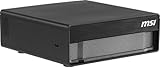
MSI’s version of the DGX Spark design with the GB10 Grace Blackwell chip and 128GB of unified memory, the pick for CUDA developers, fast prefill and built-in clustering.
Apple Mac Studio with M5 Max

Offers up to 614 GB/s of bandwidth for faster token generation than either PC; the 128GB configuration is the one we suggest for 70B to 120B models plus an everyday Mac.
GMKtec EVO-X2 AI Mini PC (Ryzen AI Max+ 395, 128GB)

One of the Strix Halo mini PCs named above, running Windows or Linux and doubling as a compact gaming PC while holding large MoE models.
MINISFORUM MS-S1 MAX (Ryzen AI Max+ 395, 128GB)

Another Strix Halo option with 128GB of LPDDR5X, for buyers who want an x86 box that runs big models and works as a normal PC.
Beelink GTR9 Pro (Ryzen AI Max+ 395)

A further Strix Halo mini PC from the vendor list above; check cooling and noise, since Strix Halo boxes vary by vendor under sustained AI load.
AMD Ryzen AI Halo Developer Platform (Linux)

AMD’s own Strix Halo developer box, the system behind AMD’s claimed small leads over the Spark on several MoE models.
How we compared
We compared these using manufacturer specifications, independent lab measurements from the sources named above, and owner reports. We did not bench-test these units ourselves. Because each platform uses different software backends, we treated cross-platform numbers as directional and highlighted same-run comparisons where they exist.
Sources
- llama.cpp GitHub discussion #16578, performance of llama.cpp on NVIDIA DGX Spark
- LMSYS Org, NVIDIA DGX Spark in-depth review
- StorageReview, NVIDIA DGX Spark cluster review and 64GB launch coverage
- ServeTheHome, DGX Spark 64GB launch and Ryzen AI Halo developer system review
- VideoCardz, DGX Spark 64GB and Gorgon Halo system coverage
- Classmethod, two-node DGX Spark clustering
- Dataiku and Petronella Technology Group, DGX Spark clustering write-ups
- AIMultiple, DGX Spark alternatives
- IntuitionLabs, compiling Hardware Corner’s DGX Spark vs Ryzen AI Max+ 395 results
- AMD, Ryzen AI Max+ 395 technical articles, Ryzen AI Halo product page and blog
- Tom’s Hardware, Ryzen AI Max 400 Gorgon Halo announcement
- ComputingForGeeks, Ryzen AI Max+ 395 mini PC comparison
- Apple Newsroom, Mac Studio with M5 Max and M5 Ultra
- MacStories, M5 Ultra Mac Studio review
- Ars Technica, Mac Studio M5 Ultra coverage
- MindStudio, M5 Ultra vs dual DGX Spark
Check your own setup: our LLM VRAM calculator estimates how much memory a model needs at each quantization and context length, and shows which GPUs and Macs it fits.
Frequently Asked Questions
Is the DGX Spark faster than Strix Halo?
At prompt processing, yes, by a wide margin. At token generation they are close: independent results show the Spark slightly ahead on gpt-oss-120b, while AMD’s own figures show small leads for its Ryzen AI Halo systems on several MoE models.
Is the Mac Studio better than the DGX Spark for local AI?
For generating text with large models, the Mac Studio is faster because of its much higher bandwidth. For CUDA development, prefill-heavy work and clustering, the Spark is the better tool.
Should I buy the 64GB or 128GB DGX Spark?
The 128GB model fits gpt-oss-120b-class models on one unit. The 64GB model suits smaller models or clustering in pairs, though two 64GB units cost more than one 128GB unit at current pricing, per StorageReview’s coverage.
Can Strix Halo run Windows?
Yes. Unlike the DGX Spark, Strix Halo systems run Windows or Linux, and they double as capable compact PCs.
Is Gorgon Halo worth waiting for?
It is already shipping in several systems. It adds memory, up to 192GB, but little bandwidth, so it is worth it only if you need models that do not fit in 128GB.
Which is best for 70B models?
The Mac Studio M5 Max or M5 Ultra, because dense 70B models need bandwidth. On the Spark and Strix Halo, dense 70B runs slowly.
Can I cluster Mac Studios like DGX Sparks?
Thunderbolt 5 links and tools such as llama.cpp RPC allow multi-machine setups, but NVIDIA’s ConnectX-7 networking and NVIDIA Sync make clustering far more turnkey on the Spark.
Ready to decide? Our #1 pick for 2026 is the CUDA and NVIDIA's AI software stack.
Live price & availability on Amazon.



Write Your Review
No reviews yet. Be the first to share your experience!