
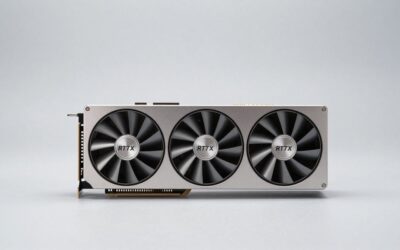
- Top Pick: ASUS Dual GeForce RTX 3050 6GB GDDR6 OC Edition Gaming Graphics Card
- Best Value: msi Gaming RTX 3050 Ventus 2X 6G OC Graphics Card (NVIDIA RTX 3050, 96-Bit, Boost Clock: 1492 MHz, 6GB GDDR6 14 Gbps, HDMI/DP, Ampere Architecture)
- Premium Choice: MOUGOL AMD Radeon RX 580 8GB GDDR5 Gaming Graphics Card HDMI/DP/DVI – Black


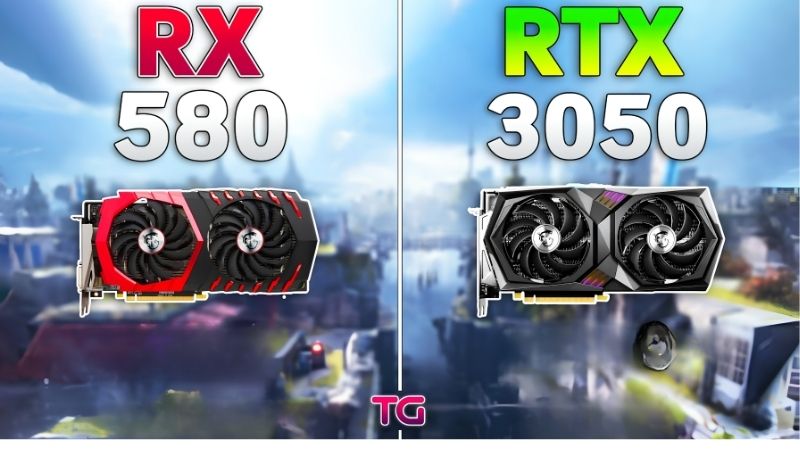
RX 580 vs RTX 3050 is a used-market question, and used-market questions have different rules. Nobody is buying either card new. You are choosing between a 2017 Polaris card that still sells for real money and a 2022 Ampere card that costs a bit more, and the interesting part is that the spec sheet points one way while the answer goes the other. The RX 580 has a wider bus and more bandwidth. It loses anyway, and the reason has almost nothing to do with the silicon.
The Quick Verdict
The RTX 3050 wins, and the margin is wider than the specs suggest. It is roughly 15–25% faster in modern titles, draws 55W less, and — decisively — it still receives full Game Ready driver support while the RX 580 has been on legacy drivers for years. It also runs DLSS 4.5, which the RX 580 has no equivalent for.
As an Amazon Associate we earn from qualifying purchases at no extra cost to you.


When the RX 580 Still Makes Sense
If the price gap is large. An RX 580 for $60 against an RTX 3050 for $150 is a different question from $110 against $150. At the bottom of the used market, the 580 is still a functional 1080p card for older titles.
The Thing Neither Spec Sheet Shows
The RX 580 is Polaris, and AMD moved that architecture to legacy driver status years ago. The RTX 3050 is Ampere, still on the supported branch. Nvidia ended Game Ready support for Maxwell, Pascal, and Volta in October 2025 — Ampere was not included. That gap compounds every year and it does not reverse.
Comparison Table
Five years and two vendors separate these cards. Cross-architecture spec comparisons mislead in both directions, so read the table as context rather than conclusion.
| Spec | RX 580 8GB (2017) | RTX 3050 8GB (2022) | Note |
|---|---|---|---|
| Architecture | Polaris (GCN 4) | Ampere | Five years apart |
| Shaders | 2,304 | 2,560 CUDA | Not comparable directly |
| RT cores | None | Yes (2nd gen) | Nvidia only |
| Tensor cores | None | Yes (3rd gen) | Nvidia only |
| VRAM | 8GB GDDR5 | 8GB GDDR6 | Same capacity |
| Bus width | 256-bit | 128-bit | AMD, 2x wider |
| Bandwidth | 256 GB/s | 224 GB/s | AMD wins |
| TDP | 185W | 130W | Nvidia, −55W |
| Upscaling | FSR 1/2/3 only | DLSS 4.5 | Nvidia |
| Frame generation | No | No | Neither |
| Driver status 2026 | Legacy | Full support | Decisive |
| Launch MSRP | $229 | $249 | — |
The Bandwidth Result That Goes Nowhere
The RX 580 has a 256-bit bus against the RTX 3050’s 128-bit — twice the width — and delivers 256 GB/s against 224. On paper AMD wins the memory subsystem outright.
It does not translate. The 3050’s Ampere shader cores do substantially more work per clock than Polaris cores, its memory compression is generations ahead, and bandwidth stopped being the 580’s constraint long before 2026. The card is shader-bound, not memory-bound.
This is a useful corrective to the habit — correct in most other comparisons — of reading the bandwidth column first. Bandwidth decides things when the shaders can consume it. Feeding a 2017 architecture faster does not make it a 2022 one.
Deep Dive Face-Off
Four criteria, from where the cards are closest to where the gap is unbridgeable.
Rasterization: A Real but Modest Gap
In pure rasterization the RTX 3050 leads the RX 580 by roughly 15–25% depending on the title. That is a real gap and a smaller one than five years of progress should have produced — the RTX 3050 was a weak entry in its own generation, criticised at launch for its price.
The 580 holds up better in older titles built around GCN, and DirectX 11 games in particular flatter it. In modern DirectX 12 and Vulkan engines the gap widens.
Both are 1080p cards and neither is a 1440p card. The choice is not between resolutions; it is between settings at the same resolution.
Drivers: Where the Comparison Stops Being Close
This is the criterion that settles it, and it is invisible on every spec sheet.
The RX 580 is Polaris, which AMD moved to legacy status years ago. No new game optimisations, no day-zero profiles. AMD’s more recent maintenance-mode changes cover the RX 5000 and 6000 series — the 500 series is well behind even that line.
The RTX 3050 is Ampere. When Nvidia ended Game Ready support for Maxwell, Pascal, and Volta in October 2025 — moving those cards to quarterly security updates through October 2028 — Ampere was untouched. The 3050 still receives day-zero profiles today.
For a card you are buying to run new games, that difference is worth more than 15% of frame rate. A new release on a current driver against one on a legacy branch frequently differs by double digits before you count anything else.
Upscaling: The Gap That Keeps Growing
The RTX 3050 launched with DLSS 2 and now runs the DLSS 4.5 model, which Nvidia says draws 23 of every 24 pixels on screen. On a card this size, that is not a nice extra — it is the difference between playable and not.
It does not have Multi Frame Generation, which is RTX 40 and 50 territory. So the 3050 gets the upscaling half of the modern stack and not the frame generation half.
The RX 580 gets FSR 1, 2, and 3 — hardware-agnostic and useful, but a clear step behind DLSS on image quality. FSR 4 requires RDNA 4, and when AMD brought FSR 4.1 to older cards in May 2026 it reached the RX 6000 and 7000 series. Polaris was not included and will not be.
Power and Practical Fit
The RX 580 draws 185W and typically needs an 8-pin connector. The RTX 3050 draws 130W and many models run on a single 8-pin, with some low-profile variants slot-powered.
That 55W matters more than it looks on the used market, because the machines these cards go into are usually old prebuilts with modest supplies. A 3050 drops into a 400–450W office machine that would struggle with a 580.
The 580 also runs hot and loud by modern standards, and a 2017 card has had nine years for its thermal paste and fan bearings to age. Factor a repaste into any 580 purchase.
The Detail That Catches Used Buyers Out
Two RX 580 variants exist and the listings rarely distinguish them. The 4GB model was the $199 card; the 8GB was $229. In 2026 the difference is not subtle — 4GB is genuinely restrictive at 1080p in current titles, where 8GB is workable.
The same applies on the Nvidia side. There is a 6GB RTX 3050 alongside the 8GB, and it is not simply the same card with less memory: the 6GB version runs fewer cores and a narrower bus. If a 3050 listing looks unusually cheap, check which one it is before assuming you found a deal.
The Alternative: What $200 Actually Buys Now
Both of these cards are compromises. Before committing to either, two alternatives deserve a look — and one of them is doing nothing.
The RTX 5050: New, Supported, and Not Much More
At $249 MSRP the RTX 5050 brings 2,560 Blackwell CUDA cores, 8GB of GDDR6 at 320 GB/s, a 130W TDP on a single 8-pin, and full DLSS 4.5 with Multi Frame Generation — the first xx50-class desktop card to get MFG.
Partner models have run $269–$310. Against a $150 used RTX 3050 with no warranty, that is roughly $120–$160 for a new card with a warranty, a supported driver branch, and the frame generation the 3050 lacks.
Reviewers were lukewarm on the 5050 at its price, and fairly — the RTX 5060 offers 50% more cores for $50 more. But against a five-year-old used card, the comparison flatters it.
The RTX 5060: The $50 That Matters
If the budget stretches to $299–$339, the RTX 5060 is where the money works hardest: 3,840 CUDA cores, 8GB of GDDR7 at 448 GB/s, 145W. It has also stayed closer to MSRP than any other RTX 50 card.
Against either card in this comparison it is not an upgrade so much as a different class of machine.
Keeping the Card You Have
Worth stating plainly. If you own an RX 580 and play older titles or esports at 1080p, it still works and spending $150 on a used RTX 3050 buys a modest gain with no warranty.
The honest counter is the driver branch. You are on legacy, permanently, and every new release is tuned for hardware you do not have. That gap only widens.
What the 2026 Market Does to This Decision
Used prices do not float free of new prices, and the new market has been unusual enough to change what a used card is worth.
Why Used Prices Have Not Fallen Either
Component pricing has continued trending upward, memory foremost. The good news is real but weak: the steep late-2025 climb has flattened, and Framework has reported a stretch of relative stability while still warning that volatility persists. New supply is opening — OEMs can source DDR5 from Chinese suppliers such as CXMT, and Micron is building two Idaho fabs — but neither produces until 2027–2028.
Used prices track new prices. With new entry-level cards holding above list and Nvidia’s 16GB models reported end of life at CES 2026, the pressure that would normally push a 2017 card toward worthlessness is not there. That is why an RX 580 still commands money it arguably should not.
The practical read: waiting for used prices to collapse is not a plan. They are tied to a new market where relief is three years out.
What This Means for a Budget Buyer
The gap between a used RTX 3050 at roughly $150 and a new RTX 5050 at $269–$310 is smaller than it looks once you account for warranty, driver lifetime, and Multi Frame Generation. On a card this size, MFG is the feature that decides whether recent titles are playable.
If your budget is genuinely fixed at $100–$150, take the RTX 3050 over the RX 580 — supported drivers and DLSS 4.5 outweigh the 580’s bandwidth advantage comfortably. If it can reach $270, the calculation changes and the used market stops being the right place to shop.
It is worth comparing what the RTX 5050 and 5060 actually cost today before committing to a used purchase. The 5060 class has held nearest to list of anything in the current lineup, and that is not true of the tiers above it.
See More:
- Nvidia beta
- Nvidia CUDA 11.8
- Check CUDA version
- Nvidia GPU for gaming
- PNY GeForce RTX 5080 16GB OC review
Final Verdict and Recommendation
The RX 580 vs RTX 3050 verdict inverts the spec sheet. The RX 580 has a 256-bit bus and more bandwidth and still loses, because bandwidth only helps when the shaders can use it — and Polaris cannot. The RTX 3050 is 15–25% faster, draws 55W less, runs DLSS 4.5, and sits on a driver branch that still receives day-zero profiles while the 580 has been legacy for years.
Buy the RTX 3050 if you are choosing between these two at similar prices. The driver support alone justifies it. Keep the RX 580 if you already own one, play older titles, and the alternative is $150 you would rather not spend. Buy the RTX 5050 or 5060 instead if you can find $120–$160 more — a new card with a warranty, a supported branch, and Multi Frame Generation is a different proposition from a five-year-old used one.
The general lesson worth carrying: on used cards, check the driver branch before the spec sheet. A card that is 15% slower but still supported ages better than a faster one the vendor has stopped optimising for, and that gap compounds every year rather than holding steady.
Frequently Asked Questions
Why do drivers decide this comparison?
The RX 580 uses the Polaris architecture, which AMD moved to maintenance support years ago, meaning security and critical fixes only with no new game optimisations. The RTX 3050 is Ampere and receives current drivers with full game support. For a card you intend to use with new releases, that difference outweighs a small raw performance gap.
Which is faster in games?
The RTX 3050 8GB is generally ten to twenty percent ahead at 1080p in modern titles, and much further ahead once DLSS is enabled. The RX 580 remains respectable in older DirectX 11 games where it was well optimised, but it falls behind sharply in newer engines that lean on features it lacks.
Does the RX 580 8GB VRAM advantage matter?
Both the RX 580 8GB and the RTX 3050 8GB carry the same capacity, so there is no advantage. Against the 4GB RX 580 variant the 3050 wins clearly. Memory capacity is not the differentiator here; upscaling support, ray tracing hardware, and driver longevity are.
What about power draw and PSU requirements?
The RX 580 is rated around 185W and often draws more under load, needing a single 8-pin and a solid 500W supply. The RTX 3050 draws about 130W on a single 8-pin and is happy on a good 450W unit. In a prebuilt with an OEM supply, the 3050 is the far safer drop-in.
Is there any reason to still buy an RX 580?
Only price. If you find one very cheap for a secondary machine or a retro and older game build, it still delivers solid 1080p in titles from its era. For anything you expect to play in the coming years, the 3050 or a modern entry card such as the RTX 5050 is the better investment.

Write Your Review
No reviews yet. Be the first to share your experience!