
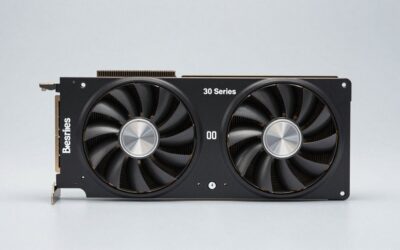
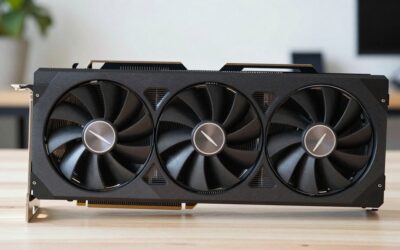
- Top Pick: Sapphire 11348-03-20G Pulse AMD Radeon™ RX 9070 XT Gaming Graphics Card with 16GB GDDR6, AMD RDNA 4
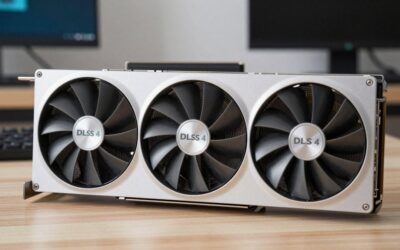
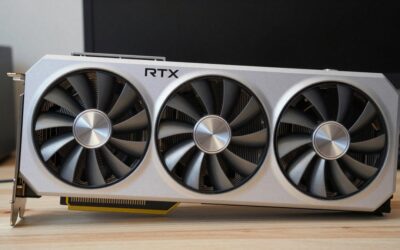
- Best Value: XFX Swift AMD Radeon RX 9070XT Triple Fan White Gaming Edition with 16GB GDDR6 HDMI 3xDP, AMD RDNA 4 RX-97TSWF3W9
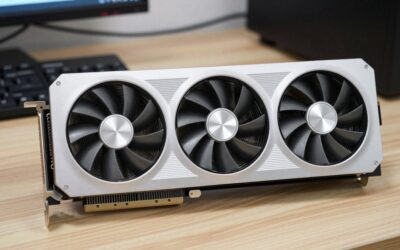
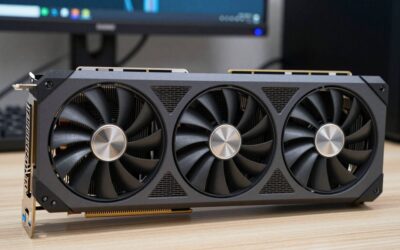
- Premium Choice: XFX Mercury AMD Radeon RX 9070XT OC Magnetic Air Edition with RGB 16GB GDDR6 HDMI 3xDP, AMD RDNA 4 RX-97TMARGB9


RTX 5070 vs AMD 9070 XT is the mid-range showdown most 1440p buyers are wrestling with in 2026, and it is genuinely close: one card leans on NVIDIA’s software and efficiency, the other counters with more memory and raw rasterization for the money. This comparison gives you the fast verdict first, a full specification table, a criteria-by-criteria face-off, a cheaper alternative if both feel too expensive, and a clear “who should buy which” so you can pick the right GPU instead of second-guessing the decision for another week.
RTX 5070 vs AMD 9070 XT: The Quick Verdict and Specs
Both cards target the sweet spot of high-refresh 1440p gaming, but they get there differently. The RTX 5070 prioritizes efficiency and NVIDIA’s feature stack, while the RX 9070 XT leans on a larger memory pool and strong native performance. Before the detailed breakdown, here is the short answer and the raw numbers.
As an Amazon Associate we earn from qualifying purchases at no extra cost to you.




The 30-Second Verdict for Busy Buyers
If you value ray tracing, DLSS 4, lower power draw, and the widest game-support ecosystem, the RTX 5070 is the safer pick. If you want more VRAM for future titles and the strongest native rasterization per dollar, the RX 9070 XT wins.
For a pure 1440p rasterized experience with headroom for years, the 9070 XT’s 16GB is the tie-breaker. For a buyer who plays ray-traced AAA games and leans on upscaling, the 5070’s software edge is worth its price.
If you genuinely cannot decide, let your monitor and your games break the tie. A high-refresh 1440p panel paired with a rasterization-heavy library points to the 9070 XT, while a mix of ray-traced blockbusters and a preference for the most widely supported upscaler points to the 5070. Neither answer is wrong, and both cards will feel like a strong upgrade from anything in the previous mid-range tier.
Full Specification Comparison Table
The core silicon differences below explain most of the performance behavior discussed later in this comparison.
| Specification | RTX 5070 | RX 9070 XT |
|---|---|---|
| Architecture | NVIDIA Blackwell | AMD RDNA 4 |
| Memory | 12GB GDDR7 | 16GB GDDR6 |
| Memory bus | 192-bit | 256-bit |
| Board power (TBP) | ~250W | ~304W |
| Upscaling | DLSS 4 + Frame Gen | FSR 4 |
| Launch price (approx.) | $549 | $599 |
On paper the 9070 XT brings more memory and a wider bus, while the 5070 counters with newer GDDR7 and clearly lower power draw. Neither dominates the sheet, which is exactly why the face-off matters.
Price, Positioning, and What You Actually Pay
The roughly $50 launch gap between the two is small enough that street pricing usually decides it. Sales, bundles, and regional stock routinely swing the real-world total either direction, so the “cheaper” card this week may be the pricier one next week.
Both sit squarely in the upper mid-range, aimed at 1440p high-refresh gamers who want strong performance without paying flagship money. That shared target audience is why this matchup is so heavily searched and so hard to call.
When you calculate value, resist judging purely on the sticker. Add the cost of a suitable power supply, the panel you intend to drive, and any bundled game or warranty differences, then compare the two as complete packages. On that basis the “winner” can flip depending on what you already own, which is why two buyers can look at identical price tags and rationally reach opposite conclusions about which card is the better deal for them.
RTX 5070 vs 9070 XT: Deep-Dive Performance Face-Off
Instead of reviewing each card in isolation, the most useful approach is to pit them directly against each other across the criteria that decide a purchase: raw rasterization, ray tracing and upscaling, and the practical realities of power and cooling. Each section names a winner so the trade-offs stay concrete.
Rasterization and 1440p Gaming Performance
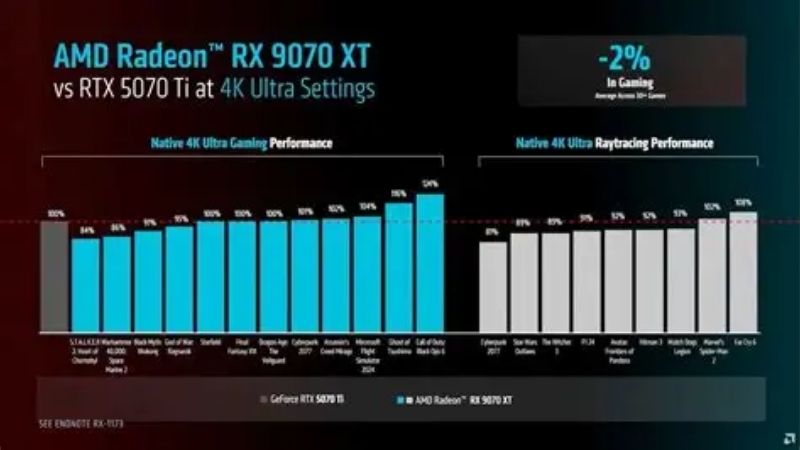
In traditional rasterized 1440p gaming, the RX 9070 XT generally holds an edge thanks to its wider bus and higher power ceiling, delivering strong native frame rates that keep a 144Hz panel fed in most AAA titles. It is the more brute-force option of the two.
The RTX 5070 stays close and frequently trades blows depending on the engine, but its narrower 192-bit bus and 12GB pool mean it relies more on smart features to close gaps. Winner on raw raster: the 9070 XT, though the margin is title-dependent rather than a blowout.
The practical read is that in a rasterized game with upscaling switched off, the 9070 XT’s extra bandwidth and memory give it a slightly firmer floor at 1440p, especially in newer titles with large texture packs. It is not a night-and-day gap, and a single graphics setting can erase it, but if your priority is native frames without leaning on any reconstruction technology, the AMD card is the more natural fit and the one less likely to feel constrained as games grow heavier over the next few years.
Ray Tracing, DLSS 4, and FSR 4 — The Experimental Edge
Ray tracing is where the RTX 5070 pulls ahead. NVIDIA’s dedicated hardware and DLSS 4 with Frame Generation reconstruct and multiply frames aggressively, turning demanding ray-traced scenes into playable, fluid experiences that the AMD card has to work harder to match.
AMD’s FSR 4 has closed much of the historical quality gap and is a real, credible answer, but NVIDIA still leads on ray-traced performance and on the sheer breadth of games that support its upscaler. For buyers betting on where rendering is heading, this forward-looking feature set is the strongest argument for the 5070. Winner on ray tracing and upscaling ecosystem: the RTX 5070.
The gap is widest in the most demanding cases. Path-traced and fully ray-traced showcase titles lean heavily on dedicated hardware and mature frame-generation, and that is exactly where the RTX 5070 stretches its lead into something you can feel rather than just measure. If ray tracing is a novelty you toggle on occasionally, the difference is minor; if it is a core reason you are upgrading, it becomes one of the most decisive factors in the whole matchup, and it tilts the value equation toward NVIDIA even at the slightly lower price.
Power Draw, Thermals, and Real-World Compatibility
Practical fit favors NVIDIA here. At around 250W, the RTX 5070 runs cooler and asks less of your power supply and case airflow, making it the friendlier choice for compact builds or systems with a mid-tier PSU you would rather not replace.
The RX 9070 XT’s roughly 304W draw is not extreme, but it does mean more heat, larger cooler designs, and a slightly higher power-supply recommendation. If you are working inside a small case or a strict power budget, that difference is a genuine deciding factor. Winner on efficiency and compatibility: the RTX 5070.
There is a knock-on cost worth planning for. The higher-draw card can nudge you toward a beefier power supply and better case airflow, and those add to the real total you pay to run it well. For a fresh build that is easy to budget; for an upgrade dropping into an existing mid-tier system, the RTX 5070 is more likely to work with the parts you already own. Factoring the platform around each card, not just the card in isolation, often changes which one is genuinely cheaper to live with.
Choosing Between the RTX 5070 and 9070 XT
With the face-off settled by criteria, the final decision comes down to which trade-offs match your priorities, how the current market affects timing, and whether a cheaper card would actually serve you just as well. This section closes those three loops.
Pros and Cons of Each Card at a Glance
The summary below captures the strengths and weaknesses that matter most for this matchup.
| RTX 5070 | RX 9070 XT | |
|---|---|---|
| Strengths | Best ray tracing, DLSS 4, lower power, widest support | More VRAM (16GB), strong native raster, value per frame |
| Weaknesses | Only 12GB, narrower 192-bit bus | Higher power draw, upscaling ecosystem still catching up |
| Best for | Ray-tracing and upscaling-focused gamers | Pure rasterization and long-term VRAM headroom |
Neither list is a knockout. The right column depends entirely on whether your games lean on ray tracing and DLSS or on raw native frames.
How the Memory Crunch and Rising Prices Affect Timing
This matchup does not happen in a vacuum. Component prices have been trending upward, and memory has been under particular pressure, which pushes street prices on both of these cards above their launch figures at many retailers. When two GPUs sit only about $50 apart on paper, this volatility can easily flip which one is the better buy on any given day, so checking live pricing before you commit is not optional here.
There is a cautiously positive note. The steep climbs seen in late 2025 have eased into a stretch of relative stability, though suppliers still warn that the situation can move again. That makes this a reasonable window to buy if you find a good price, rather than a moment to hold out indefinitely.
Longer term, more supply is coming but slowly: additional DDR5 vendors are entering the market and Micron is building two new plants in Idaho, yet those are not expected to be running until roughly 2027 to 2028. For a buyer weighing the RTX 5070 against the 9070 XT today, the honest read is that real relief is years away, so if either card hits a price you are happy with, waiting for a dramatic drop is more hope than strategy.
The Alternative: What to Buy If Both Feel Too Pricey
If current street prices push both cards past your budget, the most sensible step down is a 16GB RTX 5060 Ti or the standard RX 9070. Both deliver a strong 1440p experience for less money, and the 16GB memory pool on those options guards against the same VRAM worries that shadow the 5070.
For buyers open to the previous generation, a well-priced used or discounted RTX 4070 Super can also land in a similar performance band. Whichever direction you lean, it is worth comparing the live price of the alternative against the two headline cards before deciding, since the gap changes constantly in this market.
The reason this alternative matters is simple: when memory pricing inflates the two headline cards, a step-down model with a healthy 16GB buffer can quietly become the smartest value in the stack, delivering most of the 1440p experience without the price premium. Do not treat it as a consolation prize. Check the current cost of all three, and if the alternative undercuts the pair by a meaningful margin while still covering your games, it may be the rational buy rather than the compromise.
See More:
- NVIDIA
- NVIDIA DeepStream
- NVIDIA GPU driver update
- NVIDIA GeForce NOW download
- NVIDIA RTX A2000 12GB driver
Final Verdict: RTX 5070 vs AMD 9070 XT
The RTX 5070 vs AMD 9070 XT decision ultimately rewards clarity about your own priorities. Buy the RTX 5070 if you want the best ray tracing, DLSS 4, lower power draw, and the broadest game support in a compact-friendly package. Buy the RX 9070 XT if you want 16GB of VRAM, the strongest native rasterization per dollar, and long-term 1440p headroom. Both are excellent at the same target, so once you have matched the card to your games and your build, check current pricing and stock and lock in whichever fits — the value gap between them can shift week to week. Given that meaningful price relief from new memory supply is still years out, a good deal on the right card today is worth acting on rather than waiting for a drop that may not arrive this generation.
Frequently Asked Questions
Which card is faster at 1440p?
The Radeon RX 9070 XT is generally the stronger rasterization performer at 1440p, often by a comfortable double-digit margin, and it carries 16GB of memory against 12GB. The RTX 5070 narrows or reverses the gap once heavy ray tracing is enabled.
How do their VRAM capacities compare for future games?
The 9070 XT has 16GB of GDDR6 on a 256-bit bus versus 12GB of GDDR7 on 192-bit for the 5070. For texture-heavy titles and 4K the AMD card has clearly more headroom, while NVIDIA counters with higher per-pin bandwidth and stronger upscaling to reduce buffer pressure.
What are the power requirements for each?
The 9070 XT is rated near 304W and typically uses two or three 8-pin connectors, with a 750W supply recommended. The RTX 5070 sits at 250W on a single 12V-2×6 input and asks for 650W. The NVIDIA card is the easier fit for an older power supply.
Is FSR 4 competitive with DLSS 4?
FSR 4 moved AMD to a machine learning model and closed much of the image quality gap, particularly in stability and ghosting. DLSS 4 with its transformer model still holds an edge in fine detail and has far wider game support, which matters if you play older titles.
Which is better for streaming and content creation?
NVIDIA retains the advantage. NVENC produces cleaner H.264 and AV1 streams at a given bitrate, and CUDA acceleration is better supported across editing, rendering, and AI applications. Choose the 9070 XT for raw gaming frames per dollar and the 5070 for a mixed workload machine.
Ready to decide? Our #1 pick for 2026 is the Architecture.
Live price & availability on Amazon.

Write Your Review
No reviews yet. Be the first to share your experience!