
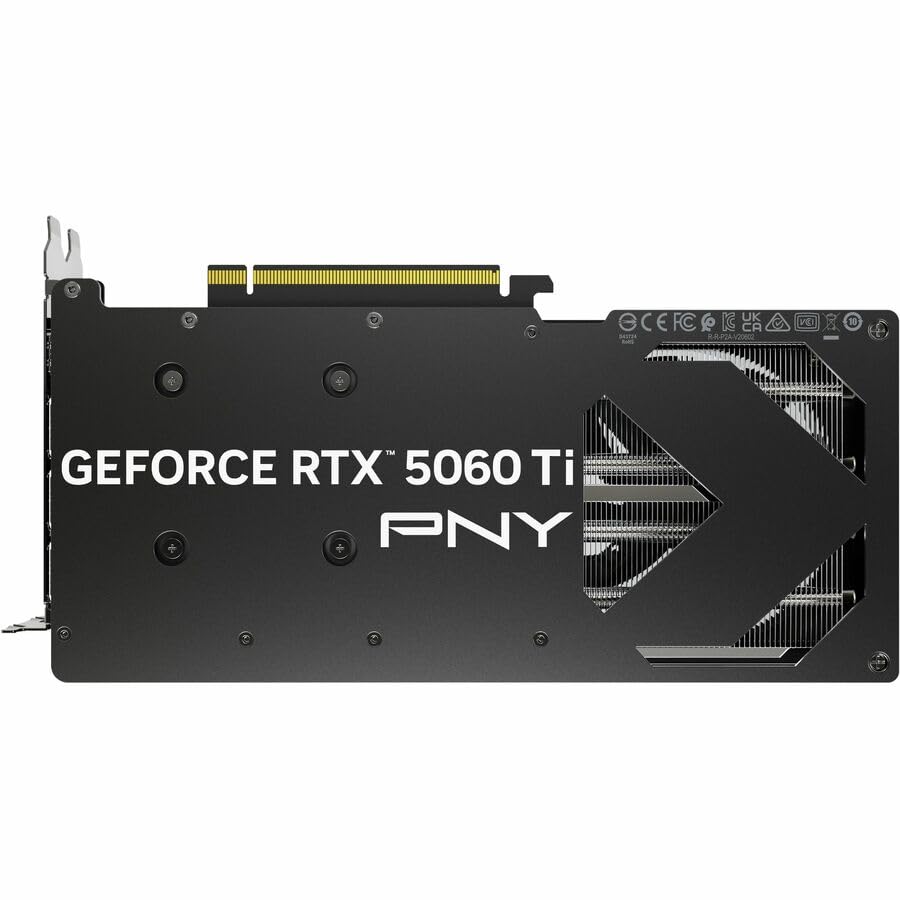

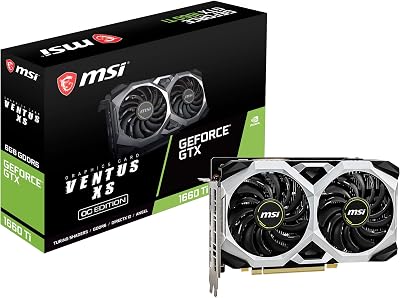


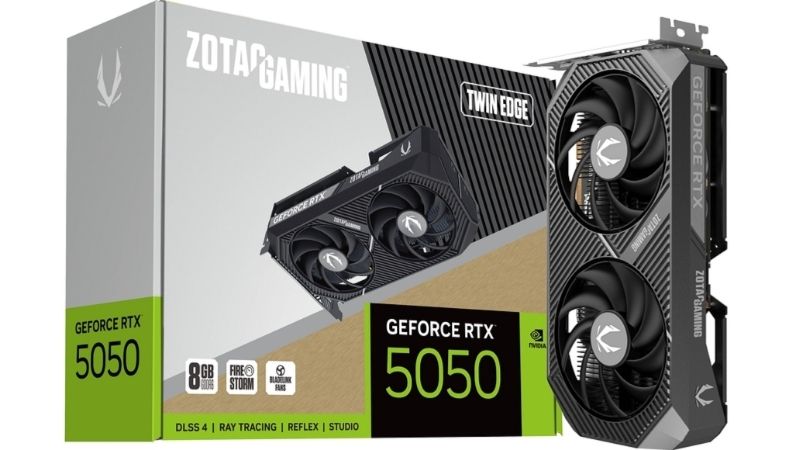
RTX 5050 vs 1660 Ti is a comparison between two cards separated by six years and two architectural eras, and the interesting part is not which one wins — it is by how much, and whether the gap justifies the money. The GTX 1660 Ti arrived in 2019 as the sensible budget pick. The RTX 5050 arrived in mid-2025 as Nvidia’s first $249 desktop card since the RTX 3050. If you own the former and are eyeing the latter, this breaks down exactly what changes, what does not, and where your $250 might do better.
The Quick Verdict
The RTX 5050 wins, decisively, and the margin is larger than raw rasterization suggests. It carries 67% more CUDA cores, 11% more memory bandwidth, 2GB more VRAM, and — the part that actually decides it — hardware ray tracing plus full DLSS 4 with Multi Frame Generation. The GTX 1660 Ti has none of that; its Turing configuration shipped without RT or Tensor cores, which locks it out of the entire modern Nvidia feature stack permanently.
As an Amazon Associate we earn from qualifying purchases at no extra cost to you.




Who Should Upgrade and Who Should Not
Upgrade if you play current AAA titles and your 1% lows have fallen below comfortable. The 1660 Ti is a competent 1080p card for 2019 games and a struggling one for 2026 releases, and no driver update changes that.
Do not upgrade if you play esports titles at 1080p. A 1660 Ti still delivers high frame rates in CS2, Valorant, and Rocket League, and the RTX 5050 will not transform an experience that is already fine.
The Honest Caveat Before You Buy
Reviewers were lukewarm on the RTX 5050, and the criticism is fair: for $50 more, the RTX 5060 offers 50% more CUDA cores and roughly 40% more bandwidth thanks to GDDR7. Against a 1660 Ti the 5050 is a real upgrade. Against its own sibling, it is poor value. That tension runs through this entire comparison.
Comparison Table: The Specs That Decide It
Six years of architecture make a direct spec comparison misleading in both directions — a Blackwell CUDA core is not a Turing CUDA core, and clock speeds are not comparable across process nodes. The table is a starting point, not a conclusion.
| Spec | GTX 1660 Ti (2019) | RTX 5050 (2025) | Delta |
|---|---|---|---|
| Architecture | Turing (TU116) | Blackwell (GB207) | Two generations |
| Die size | 284 mm² | 149 mm² | −47% |
| CUDA cores | 1,536 | 2,560 | +67% |
| RT cores | None | 20 (4th gen) | New capability |
| Tensor cores | None | 80 (5th gen) | New capability |
| Boost clock | 1,770 MHz | 2,572 MHz | +45% |
| VRAM | 6GB GDDR6 | 8GB GDDR6 | +2GB |
| Memory speed | 12 Gbps | 20 Gbps | +67% |
| Bus width | 192-bit | 128-bit | −33% |
| Bandwidth | 288 GB/s | 320 GB/s | +11% |
| TDP | 120W | 130W | +10W |
| Power connector | 1x 8-pin | 1x 8-pin | Same |
| DLSS support | None | DLSS 4 + MFG | Decisive |
| Launch MSRP | $279 | $249 | −$30 |
The Bus Width Detail Worth Understanding
Look at the bus row. The RTX 5050’s memory interface is narrower than the 1660 Ti’s — 128-bit against 192-bit. That is a 33% reduction in interface width on a card six years newer.
Bandwidth still improved, because the memory runs at 20 Gbps against the 1660 Ti’s 12 Gbps. Faster chips on a narrower road produce slightly more throughput: 320 GB/s against 288 GB/s. An 11% gain over six years is not much.
This matters because it caps the card’s ceiling. The RTX 5050 is the only Blackwell desktop GPU using GDDR6 rather than GDDR7 — a cost decision, and the reason its bandwidth advantage over a 2019 card is single digits while its core count advantage is 67%.
Deep Dive Face-Off
Specs establish the shape of the comparison. What follows is where the difference actually shows up, criterion by criterion, and the ordering is deliberate — the last one matters most and the first one matters least.
Rasterization Performance: Real but Unremarkable
In pure rasterization the RTX 5050 lands roughly at RTX 4060 level, or a little below. Independent testing across a large title set put it around 66 FPS average at 1080p high settings, and approximately 3% behind AMD’s RX 7600 in the same suite.
Against a 1660 Ti that is a substantial jump — broadly in the range of 60–80% depending on title, which follows from 67% more cores at 45% higher clocks with only 11% more bandwidth to feed them. The bandwidth is what stops it being larger.
Framed honestly: the RTX 5050 matches the same core count as the RTX 3050 from 2022. Nvidia raised clocks and memory speed rather than widening the configuration. It is a clock-and-feature upgrade, not an architectural expansion.
Feature Set: Where the Comparison Stops Being Close
This is the criterion that settles it. The GTX 1660 Ti is Turing without RT or Tensor cores — Nvidia’s compromise for the budget tier in 2019. That means no DLSS at all, no ray tracing, no frame generation, and no path forward.
The RTX 5050 is the first xx50-class desktop card with Multi Frame Generation. It carries 4th-gen RT cores and 5th-gen Tensor cores rated at 421 TOPS of AI throughput. In titles supporting DLSS, the effective frame rate difference is not 60–80% — it is multiples.
There is a forward-looking piece too. DLSS 4.5 shipped at CES 2026 and DLSS 5 arrives this autumn with real-time neural rendering; Nvidia has not confirmed hardware requirements, but RTX 50 is the expectation. A 1660 Ti is not merely behind — it is on the wrong side of a line that keeps moving away from it.
Be precise about what MFG does. It inserts generated frames between rendered ones, improving smoothness without improving responsiveness, because generated frames carry no new input. On a card with a modest base rate, MFG is best used to take a playable 50–60 FPS to a smooth 120, not to rescue 30 FPS. Used that way, it is genuinely transformative on hardware this size.
Power, Fit, and Practical Upgrade Cost
This is the friendliest part of the comparison. The RTX 5050 runs 130W against the 1660 Ti’s 120W, and both use a single 8-pin connector. Nvidia recommends a 550W supply.
If your 1660 Ti has been running on a decent 550W or 600W unit, that PSU is fine. No new power supply, no 16-pin adapter, no ATX 3.x requirement. Most RTX 5050 models ship in compact dual-fan or SFF designs, so case clearance is rarely an obstacle either.
Thermals are undemanding: reported peaks around 73°C with entry-level coolers, noise around 38 dB. This is the rare modern upgrade where the card is the only thing you buy — which materially changes the total cost against stepping up a tier.
Value: The Uncomfortable Part
At $249 MSRP the RTX 5050 replaces a $279 card from 2019 for less money with more capability, which sounds like progress. Street pricing complicates it — the card has traded above MSRP, in the $269–$310 range for partner models as of July 2026.
At $310, the comparison that matters is no longer against your 1660 Ti. RTX 5060 cards have been available around $299–$339, and the 5060 brings 50% more CUDA cores and GDDR7 at 448 GB/s. Paying more for the 5050 than a 5060 costs is indefensible.
The competition is worse news. Intel’s Arc B570 and AMD’s RX 9060 8GB sit in the same band, and testing has put the 8GB RX 9060 XT roughly 44% ahead at 1080p for around 20% more money.
The Alternative: What to Buy Instead
If the value section gave you pause, that reaction is correct. The RTX 5050 is a fine upgrade from a 1660 Ti and a questionable purchase in isolation, and the gap between those two statements is where the alternatives live.
The RTX 5060: $50 That Buys a Great Deal
The RTX 5060 is the obvious step up: 3,840 CUDA cores against 2,560 (+50%), 8GB of GDDR7 rather than GDDR6, and 448 GB/s against 320 GB/s (+40%). MSRP is $299 against $249.
Bandwidth is the point. The 5050’s 320 GB/s is what holds it back, and the 5060 fixes exactly that. For roughly 20% more money you get about 40% more of the resource that is actually the constraint.
The 5060 has also stayed close to MSRP — around $299–$339 as of July 2026, the tightest MSRP-to-street gap in the RTX 50 stack. When street prices converge, the 5050 stops making sense.
The RTX 5060 Ti 16GB: If You Do More Than Game
At $429 MSRP with 4,608 cores and 16GB of GDDR7, this is the pick if your machine also runs local AI, Stable Diffusion, or video work where 8GB genuinely restricts you. It shares the 5060’s 128-bit bus at 448 GB/s, so it is a capacity upgrade rather than a bandwidth one — but for non-gaming workloads capacity is frequently the binding constraint.
For pure 1080p gaming it is overkill relative to the 5060, and the extra $130 buys VRAM you will not fill.
Keeping the 1660 Ti: A Legitimate Option
Worth stating plainly, because upgrade articles rarely do. If you play esports titles, older games, or anything undemanding, the 1660 Ti is fine and spending $250–$300 buys frames you will not perceive.
The counter-argument is the feature set. You are locked out of DLSS 4 permanently, and modern titles increasingly assume upscaling is available when setting their performance targets. That gap widens every year rather than narrowing.
What the 2026 Market Means for This Decision
The comparison assumes you can buy at list. That assumption has been shaky across this entire generation, and it changes the calculus more than any benchmark here.
Prices Flattened, But Relief Is Years Away
Component pricing has continued trending upward, memory foremost. The good news is real but weak: the steep late-2025 climb has flattened, and Framework has reported a period of relative stability while still warning that volatility persists. New supply is opening — OEMs can source DDR5 from Chinese suppliers such as CXMT, and Micron is building two Idaho fabs — but neither produces until 2027–2028.
There is one quiet advantage here for the RTX 5050. Because it uses GDDR6 rather than the GDDR7 in every other Blackwell card, it is less exposed to the memory contract pressure squeezing the rest of the stack. The cost decision reviewers criticised at launch has become a modest supply insulation.
The H200 Approval and Why Waiting Is Not Free
The United States has approved Nvidia selling the H200 into China. For a budget GPU buyer the relevance is allocation: consumer cards and datacentre accelerators compete for the same advanced packaging and high-bandwidth memory capacity. A large new market for the highest-margin products removes the pressure that would push GeForce pricing down. There have also been reports of Nvidia reducing RTX 50 production in early 2026.
Waiting for a correction is not a plan supported by the evidence. If your 1660 Ti is genuinely limiting you, the cards available now are the cards available for the next couple of years, at roughly the prices they are now.
See More:
- Nvidia beta
- Nvidia CUDA 11.8
- Check CUDA version
- Nvidia GPU for gaming
- PNY GeForce RTX 5080 16GB OC review
Final Verdict and Recommendation
The RTX 5050 vs 1660 Ti verdict is clear on capability and murky on value. The RTX 5050 wins on every axis that matters: 67% more CUDA cores, 45% higher clocks, 2GB more VRAM, hardware ray tracing, and DLSS 4 with Multi Frame Generation against a card that has no upscaling at all. The 1660 Ti is not slow so much as permanently excluded from how modern games are built.
Buy the RTX 5050 if you can get it near its $249 MSRP, you play current AAA titles at 1080p, and you want an upgrade that reuses your existing 550W supply with no other changes. Buy the RTX 5060 instead if the price gap is under $60 — 50% more cores and 40% more bandwidth for $50 is the best value decision in this comparison, and the 5060 has stayed nearer MSRP than almost anything else in the lineup. Keep the 1660 Ti if you play esports and your frame rates are already fine.
The one thing not to do is pay above $300 for an RTX 5050. At that price it is competing with cards that beat it comfortably, including its own sibling. Check the current spread between the 5050 and 5060 before committing — if it has narrowed below $60, the decision makes itself.
Frequently Asked Questions
How much faster is the RTX 5050?
In raw rasterisation expect roughly forty to sixty percent more frames at 1080p than a GTX 1660 Ti, depending on the engine. The far bigger difference is feature access: the 5050 supports DLSS 4 including multi frame generation and has ray tracing hardware, while the 1660 Ti has neither and never will.
Is the upgrade worth around 250 dollars?
If you play recent titles at 1080p, yes. You gain a larger 8GB buffer against 6GB, current driver support, upscaling and frame generation, and a card that will remain supported for years. If you only play esports titles that already run at high frame rates on the 1660 Ti, the money is better saved.
Does the 5050 use GDDR7 like the rest of the 50 series?
No. The RTX 5050 uses 8GB of GDDR6 on a 128-bit bus rather than the GDDR7 fitted to the higher tiers. It still benefits from the Blackwell architecture, the larger cache, and the full DLSS 4 feature set, but memory bandwidth is the area where the entry tier was trimmed.
What power supply do I need?
The 5050 is rated around 130W and typically uses a single 8-pin PCIe connector, comfortable on a quality 450W to 550W supply. The 1660 Ti draws about 120W on the same connector type, so you are not meaningfully increasing system power draw and existing supplies almost always suffice.
Is 8GB enough for a card at this tier?
At 1080p with high rather than ultra textures, yes, for most current games. It is a clear improvement over 6GB and removes the texture compromises the 1660 Ti now forces. Do not plan on 1440p ultra textures with this card; it is a 1080p part and 8GB matches that target.
Ready to decide? Our #1 pick for 2026 is the Architecture.
Live price & availability on Amazon.

Write Your Review
No reviews yet. Be the first to share your experience!