
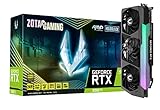
- Top Pick: ZOTAC Gaming GeForce RTX™ 3090 Ti AMP Extreme Holo 24GB GDDR6X 384-bit 21 Gbps PCIE 4.0 Gaming Graphics Card, HoloBlack, IceStorm 2.0 Advanced Cooling, Spectra 2.0 RGB Lighting, ZT-A30910B-10P
- Best Value: Nvidia RTX 3090 TI Founders Edition (Renewed) Founder Video Graphics Card
- Premium Choice: ASUS TUF Gaming Radeon RX 7900 GRE OC Edition 16GB GDDR6 Graphics Card (PCIe 4.0, HDMI 2.1, DisplayPort 2.1), 3 Year Warranty
The RTX 3090 Ti is the faster card, roughly 7-15% ahead of the RX 7900 GRE in rasterized games at 1440p and further ahead in ray tracing and at 4K, but the GRE delivers most of that performance at about 190 W less power in a smaller two-slot package, so it is the more practical buy for most gamers unless the price gap is small or the 3090 Ti’s 24 GB of VRAM is needed for AI or creative work. Both cards are older hardware in 2026, which makes this mainly a used-market decision.
As an Amazon Associate we earn from qualifying purchases at no extra cost to you.


Key Differences in One Table
Nvidia’s RTX 3090 Ti launched on 27 January 2022 at $1,999 as the fully enabled Ampere GA102 flagship. AMD’s RX 7900 GRE launched on 27 July 2023 at $549 as a trimmed RDNA 3 Navi 31 card.
| Specification | RTX 3090 Ti | RX 7900 GRE |
|---|---|---|
| Architecture | Ampere | RDNA 3.0 |
| Release date | 27 January 2022 | 27 July 2023 |
| Launch MSRP | $1,999 | $549 |
| Shader units | 10,752 CUDA cores | 5,120 stream processors |
| Boost clock | 1860 MHz | 2245 MHz |
| Process | 8 nm | 5 nm |
| TDP | 450 W | 260 W |
| VRAM | 24 GB GDDR6X | 16 GB GDDR6 |
| Bus width | 384-bit | 256-bit |
| Bandwidth | 1.01 TB/s | 576.0 GB/s |
| Cache | 6 MB L2 | 6 MB L2 + 64 MB L3 |
| Power connectors | 1x 16-pin | 2x 8-pin |
| Length / width | 336 mm / 3-slot | 276 mm / 2-slot |
| Outputs | 1x HDMI 2.1, 3x DisplayPort 1.4a | 1x HDMI 2.1a, 2x DisplayPort 2.1, 1x USB Type-C |
The 3090 Ti’s memory subsystem is in a different class: 24 GB on a 384-bit bus with roughly 1 TB/s of bandwidth. The GRE relies on its 64 MB Infinity Cache to stretch a narrower 256-bit bus.
Raster Performance by Resolution
GamersNexus’ RX 7900 GRE review placed the GRE roughly level with the RTX 3080 Ti in rasterized games. Tom’s Hardware’s RTX 3090 Ti review showed the 3090 Ti a few percent ahead of the RTX 3090, which itself sits just above the 3080 Ti. Combined with aggregated benchmark data that ranges from a near tie to a 15% lead for Nvidia, the reasonable summary is:
- 1080p: Close, roughly 0-8% in favour of the 3090 Ti, as both cards often hit CPU limits.
- 1440p: RTX 3090 Ti roughly 7-15% faster.
- 4K: RTX 3090 Ti’s lead widens further thanks to its bandwidth and VRAM, often into the mid-teens or more.
As approximate ranges that vary with settings, CPU, game version and drivers, demanding current games at 4K high settings might run around 45-65 FPS on the GRE and around 50-75 FPS on the 3090 Ti before upscaling.
Ray Tracing and Upscaling
Ray tracing is the 3090 Ti’s strongest argument. Ampere’s RT cores, combined with the card’s large shader array and bandwidth, give it a clear advantage over RDNA 3 in heavy ray-traced games and path-traced modes. Reviewers consistently identify ray tracing as the GRE’s weak point, although it stays competitive in lighter RT implementations.
| Feature | RTX 3090 Ti | RX 7900 GRE |
|---|---|---|
| Upscaler | DLSS 4 Super Resolution (transformer model) | FSR 3.1 |
| Frame generation | No DLSS Frame Generation; FSR 3 frame generation in supported games | FSR 3.1 frame generation plus driver-level AMD Fluid Motion Frames 2 |
| Ray Reconstruction | Yes | No |
| Newest-gen upscaler | DLSS 4 upscaling supported | FSR 4 officially RX 9000 only |
| AV1 encoding | No (decode only) | Yes |
In practice, the 3090 Ti has the better upscaler image quality, while the GRE has more flexible frame generation thanks to AMD’s driver-level option.
VRAM: 24 GB Versus 16 GB
For gaming alone, 16 GB is enough for nearly every current title, even at 4K with ultra textures. The 3090 Ti’s 24 GB becomes valuable in:
- Heavily modded games with large texture packs.
- Local AI models such as large language models and image generators, where VRAM capacity determines which models can run at all.
- 3D rendering, video effects and simulation work with large scenes.
Nvidia’s CUDA ecosystem adds to that advantage for creative and AI users, since many tools run best or exclusively on Nvidia hardware. This demand is a major reason why used RTX 3090 Ti prices remain comparatively high.
Power, PSU and Physical Size
The power gap is large. Sizing with GPU power plus CPU power plus about 150 W headroom:
- RTX 3090 Ti: 450 W + 125 W + 150 W = 725 W, so a quality 850 W unit is the realistic minimum, with 1000 W common for overclocked partner cards and high-end CPUs.
- RX 7900 GRE: 260 W + 125 W + 150 W = 535 W, so a good 650 W unit is enough.
The 3090 Ti uses a single 16-pin (12VHPWR) connector, which on older power supplies requires an adapter fed by three or four 8-pin cables. The GRE uses two standard 8-pin connectors. Physically, the reference 3090 Ti measures 336 mm and three slots, and many partner models are longer and heavier, often needing a support bracket. The GRE’s 276 mm, two-slot reference size fits most mid-tower cases easily. The 190 W difference also matters for room heat and fan noise during long sessions.
What the Price Gap Buys
At launch MSRP, with a 1440p index of 100 for the GRE and about 110 for the 3090 Ti:
- RX 7900 GRE: $549 / 100 = about $5.5 per performance point
- RTX 3090 Ti: $1,999 / 110 = about $18.2 per performance point
The used market is far less extreme but still favours the GRE for gaming. In late 2026, a used RX 7900 GRE usually sells for roughly $380-$480, while a used RTX 3090 Ti often goes for roughly $650-$850. Paying around $250-$400 more for roughly 10% more raster performance, better ray tracing and DLSS is hard to justify for gaming alone, especially when the 3090 Ti may also require a PSU upgrade. Current-generation cards such as the RX 9070 XT or RTX 5070 Ti offer a newer feature set in a similar price band and should be part of the comparison.
Recommendation by Use Case
| Scenario | Better pick |
|---|---|
| 1440p gaming, value-focused | RX 7900 GRE |
| 4K gaming with ray tracing and DLSS | RTX 3090 Ti |
| Local AI, rendering, CUDA workflows | RTX 3090 Ti |
| 650 W PSU, mid-tower case | RX 7900 GRE |
| Quiet, cool-running build | RX 7900 GRE |
| Streaming with AV1 | RX 7900 GRE |
The Cost of 190 Extra Watts
Running costs add another angle. At 3 hours of gaming per day, the RTX 3090 Ti’s extra 190 W of board power equals about 0.57 kWh per day, or roughly 208 kWh per year. At $0.15 per kWh that is around $31 per year, rising to around $62 per year at $0.30 per kWh. Over three years, the electricity difference alone can approach $100-$190, on top of the higher purchase price and any power supply upgrade.
That extra energy also becomes heat in the room. In warm climates or small spaces, a 450 W graphics card can noticeably raise room temperature during long sessions, which is worth weighing alongside the frame rate gains.
Frequently Asked Questions
How much faster is the RTX 3090 Ti than the RX 7900 GRE?
In rasterized games, published reviews and aggregated data put the 3090 Ti roughly 7-15% ahead at 1440p, with a larger lead at 4K. In heavy ray tracing the gap widens substantially in Nvidia’s favour. At 1080p the two are close because of CPU limits.
Is 16 GB on the RX 7900 GRE enough for 4K?
For gaming, 16 GB covers almost every current title at 4K with high or ultra textures. Only extreme mod setups or a few outliers with maximum settings and ray tracing push beyond it. The 3090 Ti’s 24 GB matters more for AI and professional applications than for games.
What PSU do I need for an RTX 3090 Ti?
A quality 850 W power supply is the practical minimum, and 1000 W is sensible with a high-end CPU or an overclocked partner card. Ampere cards can spike above their rated power briefly. An ATX 3.0 unit with a native 16-pin cable simplifies wiring.
Does the RTX 3090 Ti support DLSS Frame Generation?
No. The RTX 3090 Ti supports DLSS 4 Super Resolution and Ray Reconstruction but not DLSS Frame Generation, which needs an RTX 40 card, or Multi Frame Generation, which needs an RTX 50 card. It can use FSR 3 frame generation in supported games.
Which card is better for a small case?
The RX 7900 GRE, by a wide margin. Its reference design is 276 mm long and two slots thick with 260 W board power. The RTX 3090 Ti is 336 mm, three slots and 450 W, which demands a large case and strong airflow.
Ready to decide? Our #1 pick for 2026 is the Architecture.
Live price & availability on Amazon.










Write Your Review
No reviews yet. Be the first to share your experience!