
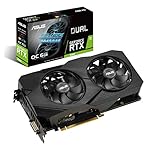
- Top Pick: GIGABYTE GeForce RTX 2060 OC GG Graphics Card, 2X Windforce Fans, 6GB 192-bit GDDR6, Gv-N2060OC-6GD REV2.0 Video Card (Renewed)
- Best Value: ASUS GeForce RTX 2060 Overclocked 6G GDDR6 Dual-Fan EVO Edition VR Ready HDMI DisplayPort DVI Graphics Card (DUAL-RTX2060-O6G-EVO) (Renewed)
- Premium Choice: GIGABYTE GeForce RTX 4060 Ti WINDFORCE OC 8G Graphics Card, 2X WINDFORCE Fans, 8GB 128-bit GDDR6, GV-N406TWF2OC-8GD Video Card (Renewed)
Moving from an RTX 2060 to an RTX 4060 Ti is a worthwhile upgrade that delivers roughly 50-70% more performance plus DLSS frame generation, but owners of the RTX 2060 12GB should choose the 4060 Ti 16GB, because the 8 GB model would actually reduce their VRAM. For 1080p high-refresh and entry 1440p gaming the jump is large enough to feel immediately, while players chasing the best value in late 2026 should still compare it against RTX 50 series pricing.
The RTX 2060 family began in early 2019, and the 12 GB variant covered here arrived later, in December 2021, with more CUDA cores and double the memory of the original 6 GB card. The RTX 4060 Ti launched in May 2023 at $399 for 8 GB and $499 for 16 GB. Both 4060 Ti models are previous-generation cards now, so most upgraders will find them discounted, open-box or used.
As an Amazon Associate we earn from qualifying purchases at no extra cost to you.



Spec Changes at a Glance
| Specification | RTX 2060 12GB | RTX 4060 Ti 8GB | RTX 4060 Ti 16GB |
|---|---|---|---|
| Architecture | Turing | Ada Lovelace | Ada Lovelace |
| Release date | 7 December 2021 | 18 May 2023 | 18 May 2023 |
| Launch MSRP | Not listed | $399 | $499 |
| CUDA cores | 2176 | 4352 | 4352 |
| Boost clock | 1650 MHz | 2535 MHz | 2535 MHz |
| Process | 12 nm | 5 nm | 5 nm |
| TDP | 184 W | 160 W | 165 W |
| Memory | 12 GB GDDR6 | 8 GB GDDR6 | 16 GB GDDR6 |
| Bus width | 192-bit | 128-bit | 128-bit |
| Bandwidth | 336.0 GB/s | 288.0 GB/s | 288.0 GB/s |
| L2 cache | 3 MB | 32 MB | 32 MB |
| Interface | PCIe 3.0 x16 | PCIe 4.0 x8 | PCIe 4.0 x8 |
| Power connectors | 1x 8-pin | 1x 16-pin (reference) | 1x 16-pin (reference) |
| Length | 229 mm | 240 mm | 240 mm |
| Outputs | DVI, HDMI, 2x DP, USB-C | HDMI 2.1, 3x DP 1.4a | HDMI 2.1, 3x DP 1.4a |
The 4060 Ti doubles the core count, adds almost 900 MHz of boost clock and packs ten times the L2 cache. It also uses less power. The surprising regressions are memory bandwidth, which falls from 336 GB/s to 288 GB/s, and, for the 8 GB model, memory capacity.
Performance Uplift
Launch reviews summarized in the 3DCenter roundup placed the RTX 4060 Ti roughly on par with the RTX 3070 at 1080p and slightly behind it at 1440p. Aggregated benchmark data puts the 4060 Ti roughly 58-72% ahead of the standard RTX 2060 at 1080p and 1440p. The 12 GB RTX 2060 has more cores and memory than the original 6 GB model and runs somewhat faster, so the uplift from a 2060 12GB lands at the lower end, around 50-65%. Owners of the original 6 GB card can expect the higher end of the range.
- 1080p: a game that runs at roughly 50-65 fps on high settings on an RTX 2060 typically runs at around 80-105 fps on a 4060 Ti, depending on settings, CPU and patch.
- 1440p: the 2060 is generally a medium-settings card at this resolution; the 4060 Ti makes high settings at 60 fps realistic in many games, often without upscaling.
- Ray tracing: the RTX 2060 has the weakest RT hardware of the RTX family. The 4060 Ti’s third-generation RT cores give an even larger jump with ray tracing on, turning RT from a novelty into a usable option at 1080p.
DLSS: What Is New and What Is Not
The RTX 2060 already supports DLSS 4 super resolution with the transformer model and ray reconstruction, so upscaling image quality stays the same after the upgrade. The meaningful additions on the 4060 Ti are:
- DLSS frame generation (2x): doubles displayed frame rates in supported games when the base frame rate is reasonable, paired with Reflex to limit added latency.
- AV1 encoding: more efficient streaming and recording than Turing’s encoder.
- HDMI 2.1: 4K 120 Hz output for modern TVs.
Multi frame generation at 3x and 4x requires an RTX 50 card, so an RTX 5060 Ti delivers a broader feature set at a similar price band.
CPU pairing matters for this upgrade as well. Many RTX 2060 systems use older six-core processors, and the 4060 Ti is fast enough at 1080p to expose a CPU bottleneck in some games, especially esports titles and large open-world games. In those cases the full uplift appears only at 1440p or with heavier graphics settings that shift the load back onto the GPU.
The VRAM Trap for 12 GB Owners
This is the critical point for anyone with an RTX 2060 12GB. Moving to the 4060 Ti 8GB means giving up 4 GB of VRAM. The 4060 Ti 8GB will still be much faster in games that fit in 8 GB, but in memory-hungry titles at high textures it can stutter where the slower 2060 12GB would not. Frame generation and ray tracing both add to memory usage, making the problem worse.
A practical VRAM guide for current games:
- 1080p high: 6-8 GB in most titles.
- 1080p ultra with ray tracing or frame generation: 8-10 GB in demanding releases.
- 1440p high/ultra: 10-12 GB or more in the heaviest games.
For an RTX 2060 12GB owner, only the 16 GB 4060 Ti is a clear upgrade in every dimension. Owners of the original RTX 2060 with 6 GB gain from either version, though the 16 GB model is still the safer long-term buy.
Platform, Power and Fit
Many RTX 2060 systems are built on PCIe 3.0 motherboards. The 4060 Ti’s PCIe 4.0 x8 interface runs at PCIe 3.0 x8 in those systems, which matters mainly when VRAM overflows, another reason the 16 GB model is preferable for older platforms.
Power demands fall slightly: 184 W for the RTX 2060 12GB versus 160-165 W for the 4060 Ti. Using TDP plus CPU plus around 150 W of headroom, 165 + 105 + 150 = 420 W, so a quality 500-550 W power supply is enough. The reference 4060 Ti uses a 16-pin connector with an adapter for standard PCIe cables, and many partner cards use a regular 8-pin. Length grows only modestly, from 229 mm to 240 mm for the reference designs, and both cards are 2-slot, so most cases that fit a 2060 also fit a 4060 Ti.
Cost per Gain
Assume a 55% uplift from an RTX 2060 12GB. If the old card resells for around $110 and a 4060 Ti 16GB costs $420, the net outlay is $310, or about $5.60 per percentage point of extra performance. Compare that with the price of an RTX 5060 Ti 16GB or Radeon RX 9060 XT 16GB, which in many markets deliver more performance for similar money. A discounted or used 4060 Ti 16GB is the version where the math works best.
| Current card and goal | Best move |
|---|---|
| RTX 2060 12GB, 1440p | RTX 4060 Ti 16GB |
| RTX 2060 12GB, 1080p high refresh | RTX 4060 Ti 16GB (8GB only if much cheaper and textures are managed) |
| RTX 2060 6GB, 1080p, tight budget | RTX 4060 Ti 8GB is a big step up |
| PCIe 3.0 motherboard | RTX 4060 Ti 16GB |
| Want multi frame generation | RTX 50 series instead |
| Mostly esports at 1080p | The RTX 2060 may still be enough |
Used RTX 2060 12GB cards usually sell somewhere around $100-$150, slightly more than the 6 GB version, which helps fund the upgrade. When buying a used 4060 Ti, confirm the memory size, since the 8 GB and 16 GB models look nearly identical in listings.
Frequently Asked Questions
How much faster is the RTX 4060 Ti than the RTX 2060?
Aggregated benchmark data places the RTX 4060 Ti roughly 58-72% ahead of the original RTX 2060. Against the faster RTX 2060 12GB, the uplift is somewhat smaller, around 50-65%. Ray-traced games show an even larger gain.
Is the RTX 4060 Ti 8GB a downgrade from the RTX 2060 12GB?
In memory capacity, yes, it drops from 12 GB to 8 GB. It is still much faster in games that fit within 8 GB, but it can stutter in memory-heavy titles where the 2060 12GB does not. The 16 GB 4060 Ti avoids this trade-off.
Will I need a new power supply?
Usually not. The RTX 4060 Ti draws 160-165 W, less than the RTX 2060 12GB’s 184 W. A quality 500-550 W unit with an 8-pin PCIe lead is generally sufficient.
Does the RTX 2060 support DLSS 4?
Yes, the RTX 2060 supports DLSS 4 super resolution with the transformer model and ray reconstruction. It does not support DLSS frame generation, which requires RTX 40 or newer. That frame generation support is the main new feature gained with the 4060 Ti.
Is an RTX 5060 Ti a better upgrade than the RTX 4060 Ti?
If the prices are close, generally yes. The RTX 5060 Ti adds DLSS multi frame generation and is a newer design. A discounted or used RTX 4060 Ti 16GB can still be the better value when it costs noticeably less.
Ready to decide? Our #1 pick for 2026 is the Architecture.
Live price & availability on Amazon.




Write Your Review
No reviews yet. Be the first to share your experience!