
- Top Pick: Nvidia GeForce GTX 1080 8GB FE Founders Edition GDDR5X Video Graphics Card (Renewed)
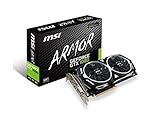
- Best Value: MSI Gaming GeForce GTX 1080 8GB GDDR5X SLI DirectX 12 VR Ready Graphics Card (GTX 1080 ARMOR 8G OC) (Renewed)
- Premium Choice: Gigabyte Radeon RX 6650 XT Gaming OC 8G Graphics Card, WINDFORCE 3X Cooling System, 8GB 128-bit GDDR6, GV-R665XTGAMING OC-8GD Video Card (Renewed)
The RX 6650 XT is the better buy for nearly everyone: it is meaningfully faster than the GTX 1080 in modern games, draws a little less power, and adds ray tracing support, FSR 3 frame generation and AMD Fluid Motion Frames that the Pascal-era GTX 1080 cannot match feature for feature. The GTX 1080 only makes sense if it is far cheaper on the used market or you are running an older PCIe 3.0 system where the 6650 XT’s x8 link and 8 GB buffer could become a constraint in memory-heavy games.
The GTX 1080 was Nvidia’s $599 flagship of 2016, and for years it was the reference point for high-end 1080p and 1440p gaming. The RX 6650 XT arrived six years later at $399 as a refreshed RDNA 2 mainstream card. Both carry 8 GB of VRAM, but the newer architecture gives the Radeon a clear lead in today’s games.
As an Amazon Associate we earn from qualifying purchases at no extra cost to you.


The Spec Sheets Compared
| Specification | GeForce GTX 1080 | Radeon RX 6650 XT |
|---|---|---|
| Architecture | Pascal | RDNA 2.0 |
| Release date | 27 May 2016 | 10 May 2022 |
| Launch MSRP | $599 | $399 |
| Shaders | 2560 CUDA cores | 2048 stream processors |
| Boost clock | 1733 MHz | 2635 MHz |
| Process | 16 nm | 7 nm |
| TDP | 180 W | 176 W |
| VRAM | 8 GB GDDR5X | 8 GB GDDR6 |
| Memory bus | 256-bit | 128-bit |
| Bandwidth | 320 GB/s | 280.3 GB/s |
| Cache | 2 MB L2 | 2 MB L2 + 32 MB Infinity Cache |
| Interface | PCIe 3.0 x16 | PCIe 4.0 x8 |
| Power connectors | 1x 8-pin | 1x 8-pin |
| Size | 267 mm, 2-slot | 2-slot |
| Display outputs | DisplayPort 1.4, HDMI 2.0b, DL-DVI | 1x HDMI 2.1, 3x DisplayPort 1.4a |
The GTX 1080’s 256-bit GDDR5X bus actually provides more raw bandwidth. The RX 6650 XT relies on 32 MB of Infinity Cache to compensate, which works well at 1080p but less so at higher resolutions. That is why the gap between these cards is larger at 1080p than at 4K.
How Much Faster Is the RX 6650 XT?
TechPowerUp’s review of the RX 6650 XT placed it about 13% ahead of the RTX 3060 and about 10% behind the RTX 3060 Ti at 1080p. The GTX 1080 typically sits below the RTX 3060 in modern games, and benchmark data that compares the two cards directly, such as results compiled by Notebookcheck, has the GTX 1080 delivering roughly 65-80% of the RX 6650 XT’s frame rate in games like Control, Borderlands 3 and F1. Putting this together, the RX 6650 XT is roughly 20-35% faster on average, with the lead largest in newer DirectX 12 and Vulkan titles and smallest in older or CPU-bound games, where the two can be close.
Approximate expectations, varying with settings, CPU and patch:
- 1080p high: the RX 6650 XT’s best resolution. Many current games land in a 60-100 fps band; the GTX 1080 typically sits a step lower and needs medium settings in demanding releases.
- 1440p: both are playable with tuned settings. The Radeon’s lead narrows somewhat as its Infinity Cache becomes less effective.
- Newer engines: games built around modern DirectX 12 features favour RDNA 2 strongly. A few recent titles require hardware features Pascal lacks or run poorly on it, such as mesh shaders.
Ray Tracing, Upscaling and Frame Generation
Feature support is one of the biggest differences between these cards:
- Ray tracing: the RX 6650 XT has hardware ray accelerators and can run light RT effects at 1080p with upscaling. The GTX 1080 has no RT hardware; Nvidia enabled DXR in software on Pascal, but performance is not usable in real games.
- Upscaling: neither card supports DLSS (the GTX 1080 lacks Tensor cores) or FSR 4 (limited to RX 9000). Both can use FSR 2, FSR 3 and XeSS through its DP4a path.
- Frame generation: FSR 3 frame generation works on both in supported games. AMD Fluid Motion Frames, driver-level frame generation for many DirectX 11 and 12 games, is exclusive to the Radeon.
- Driver support: Nvidia has moved Pascal-era GTX cards toward the end of their main driver support cycle, so the GTX 1080 will receive fewer game-specific optimisations going forward. RDNA 2 remains in active support.
VRAM: 8 GB Each, Different Risks
Both cards have 8 GB, so neither has a capacity advantage. A practical guide for current games:
- 1080p medium-high: 8 GB is fine for most games.
- 1080p ultra or 1440p high: some new releases exceed 8 GB; texture settings may need to drop a level.
- 4K: neither card is a good fit for modern games.
The RX 6650 XT has one extra risk: its PCIe 4.0 x8 link. When a game overflows VRAM and needs to stream data across PCIe, a PCIe 3.0 motherboard halves that bandwidth. Most of the time the effect is small, but in games that run out of memory it can increase stutter. The GTX 1080’s full x16 link is less exposed to this. Keeping textures within 8 GB avoids the issue on either card.
Power and PSU Sizing
Power ratings are almost identical: 180 W for the GTX 1080 and 176 W for the RX 6650 XT, with a single 8-pin connector on each. The Radeon delivers considerably more performance for that power, so its efficiency per frame is clearly better.
- GTX 1080: 180 W + ~105 W CPU + ~150 W headroom = about 435 W, so a quality 500-550 W unit.
- RX 6650 XT: 176 W + ~105 W + ~150 W = about 430 W, so a quality 500-550 W unit.
Both are dual-slot. The GTX 1080 reference card is 267 mm long; RX 6650 XT partner models range from compact dual-fan to longer triple-fan designs, so check the length of the specific card.
Value Comparison
Using launch MSRPs and an index of RX 6650 XT = 100 and GTX 1080 = about 78 (midpoint of a 20-35% gap):
- GTX 1080: $599 / 78 = about $7.68 per performance point
- RX 6650 XT: $399 / 100 = about $3.99 per performance point
On the used market, a GTX 1080 usually sells for around $90-$130, while a used RX 6650 XT tends to go for around $160-$210. On raw cost per frame, the cheapest GTX 1080s can look appealing, but the gap in features, driver support and efficiency usually justifies the Radeon’s higher price for anyone gaming on new releases.
Buying a Used GTX 1080 or RX 6650 XT
A GTX 1080 is now about ten years old, so wear is the main risk. Fans with worn bearings, dried-out thermal paste and degraded thermal pads are common on cards of this age. None of these are fatal, and a repaste often restores normal temperatures, but they should be reflected in the price. Founders Edition blower-style coolers in particular run loud and hot compared with partner open-air designs.
The RX 6650 XT is younger and less likely to have been heavily used for mining, since it arrived as the 2022 crypto boom was ending. Ask for a short load test showing stable clocks and temperatures, and confirm the card has not been modified with a custom BIOS. Either way, a working return option from the seller is worth more than a small discount.
Choosing by Resolution and Budget
| Scenario | Pick |
|---|---|
| 1080p high settings in new games | RX 6650 XT |
| 1440p with FSR, medium-high settings | RX 6650 XT |
| Esports and older games on a very tight budget | GTX 1080 (if much cheaper) |
| Light ray tracing | RX 6650 XT |
| Older PCIe 3.0 system, VRAM-heavy games | Either; keep textures within 8 GB |
| Long-term driver support | RX 6650 XT |
For buyers considering new hardware, the Radeon RX 9060 XT, GeForce RTX 5060 and Intel Arc B580 are significant steps above both cards and add modern upscaling such as FSR 4, DLSS 4 and XeSS 2.
Frequently Asked Questions
Is the RX 6650 XT better than the GTX 1080?
Yes. Based on published review and benchmark data, it is roughly 20-35% faster on average in modern games. It also adds hardware ray tracing and AMD Fluid Motion Frames, and it receives active driver support.
Is upgrading from a GTX 1080 to an RX 6650 XT worth it?
It is a moderate upgrade rather than a big one. Owners of a GTX 1080 gain speed and features but keep the same 8 GB of VRAM. A card with more VRAM, such as a 16 GB RX 9060 XT, would be a stronger long-term upgrade.
Does the GTX 1080 support DLSS or ray tracing?
It does not support DLSS, because it has no Tensor cores. Software DXR ray tracing was enabled on Pascal, but performance is too low for practical gaming. It can use FSR and XeSS upscaling.
Does PCIe 3.0 slow down the RX 6650 XT?
Usually only slightly, because the card uses a PCIe 4.0 x8 link. The impact grows when a game exceeds the 8 GB frame buffer and has to stream data over PCIe. Keeping texture settings within VRAM limits avoids most of the loss.
What PSU do I need for these cards?
A quality 500-550 W power supply with one 8-pin PCIe connector is suitable for either card with a mainstream gaming CPU.
Ready to decide? Our #1 pick for 2026 is the Architecture.
Live price & availability on Amazon.










Write Your Review
No reviews yet. Be the first to share your experience!