
For raw frame rates at 1440p, the RX 6950 XT is the better card, running roughly 25-40% faster than the RTX 5060 Ti 8GB in rasterized games and carrying twice the VRAM; the RTX 5060 Ti 8GB is the better pick only for compact, low-power 1080p builds where DLSS 4 Multi Frame Generation, a 180 W TDP and a two-slot cooler matter more than outright speed. Since the 6950 XT is out of production, most buyers will be comparing a used 6950 XT with a new 5060 Ti, and that changes the risk calculation as well.
These two cards come from very different places. The RX 6950 XT was AMD’s RDNA 2 flagship refresh at $1,099. The RTX 5060 Ti 8GB is a current Blackwell mid-range card that launched at $379. In 2026 they overlap in price on the used and new markets, which is why the comparison keeps coming up.
Quick answer: Our top pick in 2026 is the Architecture — our #1 rated choice. See the full ranked comparison, alternatives and buying advice below.
The Hardware in Numbers
| Spec | RX 6950 XT | RTX 5060 Ti 8GB |
|---|---|---|
| Architecture | RDNA 2.0 | Blackwell 2.0 |
| Release date | 10 May 2022 | 16 April 2025 |
| Launch MSRP | $1,099 | $379 |
| Shaders | 5120 stream processors | 4608 CUDA cores |
| Boost clock | 2324 MHz | 2572 MHz |
| Process | 7 nm | 5 nm |
| TDP | 335 W | 180 W |
| Memory | 16 GB GDDR6 | 8 GB GDDR7 |
| Bus / bandwidth | 256-bit, 576.0 GB/s | 128-bit, 448.0 GB/s |
| Cache | 4 MB L2 + 128 MB Infinity Cache | 32 MB L2 |
| Interface | PCIe 4.0 x16 | PCIe 5.0 x8 |
| Power connectors | 2x 8-pin | 1x 8-pin |
| Length / width | 267 mm, 3-slot | 241 mm, 2-slot |
| Outputs | 1x HDMI 2.1, 2x DP 1.4a | 1x HDMI 2.1b, 3x DP 2.1b |
The 6950 XT wins on memory capacity, bus width and bandwidth, and its 128 MB of Infinity Cache helps further at 1440p. The 5060 Ti answers with far better efficiency, a newer node and modern display outputs, including DisplayPort 2.1b.
Rasterization: The 6950 XT’s Home Turf
Benchmark aggregates broadly agree that the 6950 XT leads in traditional rendering. Technical City’s aggregate puts it around 27% ahead, HowManyFPS’s multi-game rating shows roughly a 36% lead, and 3DMark Time Spy results compiled by TopCPU show about 35%. At 1440p and 4K the gap tends to grow further, partly because the 5060 Ti 8GB starts running out of memory in demanding titles.
Hardware Unboxed and TechPowerUp both highlighted the 8GB VRAM limit in their 5060 Ti 8GB coverage, noting that some recent games drop sharply in performance or texture quality at high settings once the buffer is full, while the 16GB version of the same GPU does not. The 6950 XT’s 16 GB sidesteps that problem completely.
Approximate performance by resolution
- 1080p: the 6950 XT leads, but the gap is narrower and both cards produce high frame rates in most games; CPU limits matter more here.
- 1440p: the 6950 XT commonly sits in roughly the 80-130 fps range in modern AAA at high settings, while the 5060 Ti 8GB more often lands around 55-90 fps and can stumble in VRAM-heavy titles.
- 4K: the 6950 XT remains playable with upscaling in many games; the 5060 Ti 8GB is not a 4K card.
All ranges vary with game, settings, CPU and patch version.
Ray Tracing and Upscaling: Where the RTX Card Catches Up
RDNA 2 was AMD’s first ray tracing architecture and it shows. In 3DMark Speed Way, a ray-tracing-heavy test, published results put the two cards essentially level, which means the 5060 Ti closes most of its raster deficit once RT is switched on. In games with heavy path tracing, the newer NVIDIA card can come out ahead.
The upscaling gap is larger. The RTX 5060 Ti supports DLSS 4 Super Resolution with the transformer model, Ray Reconstruction, and DLSS Multi Frame Generation, which can insert up to three generated frames per rendered frame in supported games. Generated frames improve smoothness but add some latency, and they work best when the base frame rate is already around 60 fps.
The RX 6950 XT is limited to FSR 3.1 upscaling and frame generation. AMD’s FSR 4, which uses machine learning and looks noticeably better, is officially limited to RX 9000-series cards. XeSS in its DP4a mode is another option on the Radeon.
Power, Heat and Case Fit
The difference here is dramatic. The 6950 XT is rated at 335 W, and partner models often draw more; the 5060 Ti 8GB is rated at 180 W.
PSU sizing worked out
- RX 6950 XT + 120 W CPU: 335 + 120 + 150 = 605 W, so a quality 750 W unit is the realistic target, and AMD’s own guidance for this card was in the 850 W range to cover transient spikes.
- RTX 5060 Ti 8GB + 120 W CPU: 180 + 120 + 150 = 450 W, so a quality 550 W unit is ample.
The 6950 XT needs two 8-pin cables; the 5060 Ti needs one. At 4 hours of gaming per day, the roughly 155 W TDP gap adds up to around 225 kWh per year, a noticeable line on an electricity bill in high-cost regions.
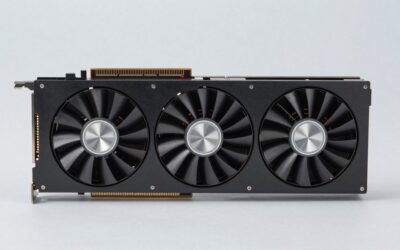
Physically, the 6950 XT reference design is 267 mm and three slots thick, and many partner versions are larger. The 5060 Ti is 241 mm and two slots. Small-form-factor and micro-ATX builds strongly favor the NVIDIA card.
The PCIe 5.0 x8 caveat
The 5060 Ti uses an x8 link. On a PCIe 5.0 or 4.0 board this is fine. On older PCIe 3.0 platforms, reviewers found that performance drops more sharply when the 8 GB buffer overflows, because spilling into system memory travels over a slower link. If your motherboard is PCIe 3.0, that is another point for the 6950 XT.
Value: Launch MSRP vs What You Pay Now
On launch MSRP alone, the comparison is lopsided. Setting the 5060 Ti 8GB at 100% and the 6950 XT at about 130% in raster:
- RX 6950 XT: $1,099 / 130 = about $8.45 per performance point.
- RTX 5060 Ti 8GB: $379 / 100 = about $3.79 per performance point.
The real market is different. Used RX 6950 XT cards usually sell somewhere around $350-$450 in 2026, which puts them in the same bracket as a new 5060 Ti and makes the 6950 XT’s cost per raster frame competitive or better. The trade-off is no warranty in most cases, higher power use, and an older feature set.
Decision Table by Resolution and Priority
| Priority | Better pick |
|---|---|
| 1440p high settings, raster-heavy games | RX 6950 XT |
| Long-term VRAM headroom, modded games | RX 6950 XT |
| 1080p in a small case or with a 550 W PSU | RTX 5060 Ti 8GB |
| DLSS 4 and Multi Frame Generation | RTX 5060 Ti 8GB |
| Warranty and a new card | RTX 5060 Ti 8GB, or ideally the 16GB version |
| Older PCIe 3.0 motherboard | RX 6950 XT |
Worth noting: if NVIDIA’s feature set is the draw, the RTX 5060 Ti 16GB removes the 8GB card’s main weakness for a modest price premium, and is the safer long-term choice among the two 5060 Ti versions.
Buying a Used 6950 XT Safely
Many 6950 XT cards have run hard for years. Check that the fans are quiet, the hotspot temperature stays reasonable under a ten-minute stress test, and there is no coil whine severe enough to bother you. Confirm the seller’s PSU recommendation matches your setup, and ask about remaining warranty, since some partner warranties are transferable.
Frequently Asked Questions
Is the RX 6950 XT faster than the RTX 5060 Ti 8GB?
Yes, in most rasterized games. Benchmark aggregates place it roughly 25-40% ahead, with the gap growing at 1440p and 4K. In heavy ray tracing scenes the two cards are much closer.
Can the RX 6950 XT use FSR 4?
Not officially. AMD restricts FSR 4 to RX 9000-series cards. The 6950 XT supports FSR 3.1 upscaling and frame generation, along with XeSS.
Is 8 GB of VRAM a problem on the RTX 5060 Ti?
In some recent games at high or ultra settings, yes. Reviewers found performance and texture quality drop when the buffer fills. Lowering texture settings helps, and the 16GB version avoids the problem.
What power supply does the RX 6950 XT need?
Plan for at least a quality 750 W unit, with 850 W giving comfortable margin for transient spikes and a high-end CPU. The card requires two 8-pin PCIe cables. The 5060 Ti 8GB, by contrast, runs comfortably on a quality 550 W unit with one 8-pin cable.
Which card is better for streaming?
The RTX 5060 Ti has a newer NVENC encoder with AV1 support, which gives good quality at low bitrates on platforms that accept AV1. The 6950 XT’s encoder is older and lacks AV1 encode. For streamers, that is a meaningful advantage for the NVIDIA card.
Ready to decide? Our #1 pick for 2026 is the Architecture.
Live price & availability on Amazon.


Write Your Review
No reviews yet. Be the first to share your experience!