
A dial indicator turns a movement too small to see into a number you can act on. Mount one against a chuck, a shaft, a vise jaw, or a machine table and it shows runout, misalignment, and surface variation as the part moves. It is a core setup tool for machining, CNC, and lathe work, for truing a workpiece, aligning a fixture, checking a spindle, or confirming a saw blade or printer bed position.
- Quick Answer
- How to Choose
- Mitutoyo 2416S-10 Dial Indicator
- Fowler 52-520-199-0 Magnetic Base and Dial Indicator Set
- Neoteck Dial Indicator and Magnetic Base Set
- Neoteck Digital Indicator with Flexible Arm Magnetic Base
- Qnkaa Dial Indicator with Magnetic Base Holder
- Who Should Skip It
- FAQ
- Final Verdict
- Product and ASIN Reference
Plunger indicators measure straight-line travel and suit runout and height checks. Test indicators use a pivoting lever point for narrow spaces. Digital indicators add a display, inch and metric switching, and button zero setting. Most buyers also need a holder, usually a magnetic base, so this guide mixes bare indicators with complete base sets.
As an Amazon Associate, we earn from qualifying purchases.
Quick Answer
For a single bare indicator, the Mitutoyo 2416S-10 is the strongest pick here, with a 0 to 1 inch range and 0.001 inch graduations. For a ready-to-use setup, the Fowler magnetic base set and the Neoteck analog and digital sets add holding power, while the Qnkaa set suits lighter workshop alignment work.
How to Choose
Start with the movement you need to measure. A plunger indicator reads travel along its spindle, with the point square to the surface, covering chuck and shaft runout, end play, and height differences. A test indicator reads through a swinging lever point, reaching into bores and tight corners. For general setup, a plunger model is usually simpler.
Next, match range to the job. A 0 to 1 inch range is the common general-purpose size, covering most runout and alignment checks. Shorter ranges run out of travel quickly when a part is badly out, and longer travel often brings coarser graduations, so check both numbers together.
Then look at graduation or resolution. An analog model graduated at 0.001 inch lets you read thousandths directly. A digital model showing 0.0005 inch resolution removes parallax, but resolution is not accuracy, and a display can make a rough setup look more certain than it is.
Dial size matters too. A larger face, around 2.25 inches or 57 mm, is easier to read from an angle and usually carries a revolution counter; without one it is easy to misread a result by a full revolution. A rotating bezel lets you set zero anywhere, and tolerance markers help when checking many parts against the same limit.
Mounting decides whether the reading is trustworthy. A magnetic base only helps on ferrous surfaces, and its rated pull assumes clean, flat, thick steel, so thin sheet, paint, aluminum, and round stock all reduce the hold. Look for an on and off switch, fine adjustment, and an arm that locks without sagging, and confirm the stem and clamping hole match.
Finally, check the contact point and back. Inch models often use a standard 4-48 UNF point thread, and a lug back gives a mounting hole for a holder. Keep the spindle clean, preload the point slightly before zeroing, and approach from the same direction each time.
Mitutoyo 2416S-10 Dial Indicator
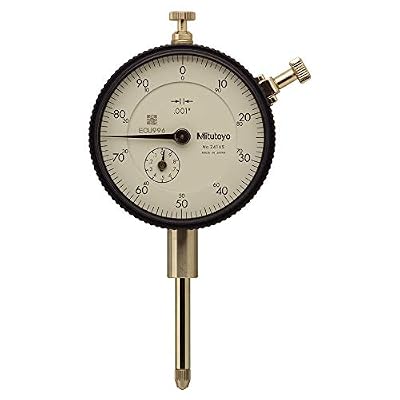
The Mitutoyo 2416S-10 is the bare-indicator pick for buyers who already own a stand or magnetic base. Its listing describes a standard inch indicator with a 0 to 1 inch range, 0.001 inch graduations, a 0-100 reading, and a 57 mm dial diameter. That is the classic general-purpose format: enough travel for runout and alignment, graduations fine enough for most setup corrections, and a face large enough to read without leaning in close.
The stem is 3/8 inch, the point thread is 4-48 UNF, and the back is a lug back, fitting holders built around that common inch pattern. The listing gives accuracy as plus or minus 0.002 inch: this is a setup and comparison tool, not a substitute for a micrometer when the tolerance is smaller than the graduations. Use it for chuck and shaft runout and sweeping a vise, and judge it as the measuring head only.
Specs
| Item | Specification |
|---|---|
| Type | Analog plunger dial indicator |
| Range | 0 to 1 inch |
| Graduation | 0.001 inch |
| Dial reading | 0-100, 57 mm dial diameter |
| Accuracy listed | Plus or minus 0.002 inch |
| Stem and thread | 3/8 inch stem, 4-48 UNF |
| Back | Lug back |
Fowler 52-520-199-0 Magnetic Base and Dial Indicator Set
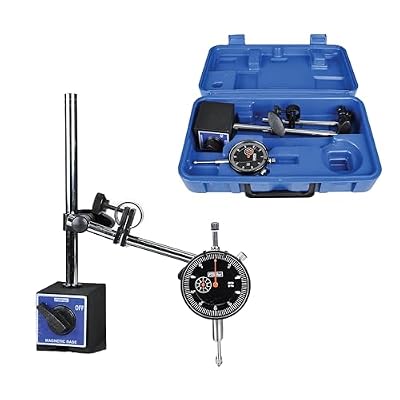
The Fowler set pairs an AGD Group 2 indicator with a magnetic base, fine adjustment, and a fitted case, arriving as a working setup. It has a 2.25 inch dial, 0.001 inch graduations, a 0-100 continuous reading, and a revolution counter of 0.1 inch per revolution. Tolerance markers let you check repeated parts against a marked band at a glance.
The base gives it an 85 lb pull, an on and off switch, a V feature for cylindrical surfaces, and a mount for test indicators with a 1/4 inch post. Fine adjustment helps you set preload and zero without bumping the arm. Choose it for lathe, mill, surface plate, and comparator work on substantial steel. The listing notes hardened stainless steel rack and contact points, and a 1-year warranty.
Specs
| Item | Specification |
|---|---|
| Type | Analog plunger indicator with magnetic base |
| Travel listed | 1 inch indicator |
| Graduation | 0.001 inch |
| Dial | 2.25 inch diameter, 0-100 continuous |
| Revolution counter | 0.1 inch per revolution |
| Magnetic base pull | 85 lb, on and off switch, V feature |
| Includes | Indicator, base with fine adjustment, fitted case |
Neoteck Dial Indicator and Magnetic Base Set

This Neoteck analog set, aimed at lathe, CNC, table saw, and 3D printer setup, includes a magnetic base and case. The listing title gives a 0 to 1 inch range, 0.001 inch graduations, and a maximum base pull of 176 lbs, or 80 kg. That figure assumes a thick, flat ferrous surface, so expect less on thin or uneven material.
The analog format is the appeal: no battery, a mechanical bezel zero, and a needle that shows movement continuously when rotating a chuck by hand. The listing gives dimensions of 11.81 by 7.09 by 3.15 inches and a weight of 4.36 pounds. Lock every joint before zeroing and re-check zero after the first moves, because a settling arm commonly causes drifting readings.
Specs
| Item | Specification |
|---|---|
| Type | Analog plunger indicator with magnetic base |
| Range | 0 to 1 inch |
| Graduation | 0.001 inch |
| Magnetic base pull listed | 176 lbs maximum, 80 kg |
| Color listed | Black |
| Set weight listed | 4.36 pounds |
| Includes | Indicator, magnetic base, storage case |
Neoteck Digital Indicator with Flexible Arm Magnetic Base

This Neoteck set replaces the dial face with a digital display and adds a 13.5 inch flexible arm on a magnetic base. The listing title gives a 0 to 1 inch range and 0.0005 inch resolution, and the reproduced listing content describes a large LCD display, switching between inch and millimeter units, and a zero setting function. For buyers who move between inch drawings and metric fixtures, unit switching removes a conversion step and a common source of setup mistakes.
A flexible arm reaches positions a straight post cannot, around a printer frame or inside an enclosure. Keep it as short as the job allows and leave it alone once zeroed, because touching it moves the reference. The listing identifies the model as NTK248, with 2 LR44 batteries included and a weight of 4.82 pounds. Pick it when readability and reach matter more than needle movement.
Specs
| Item | Specification |
|---|---|
| Type | Digital plunger indicator, flexible arm base |
| Range | 0 to 1 inch, 25.4 mm |
| Resolution listed | 0.0005 inch, 0.01 mm |
| Display | Large LCD, inch and millimeter, zero setting |
| Arm length listed | 13.5 inches, flexible |
| Magnetic base pull listed | 176 lbs maximum |
| Model and power | NTK248, 2 LR44 batteries included |
Qnkaa Dial Indicator with Magnetic Base Holder

The Qnkaa set is a lighter analog option built around a 0 to 1 inch dial indicator, a magnetic base holder, and a fine adjustable long arm. The listing title gives the graduation as 0.001 inch, putting it in the same general setup class as the other analog sets here: runout, alignment, and inspection work where thousandths are the working unit. Fine adjustment helps you bring the point into contact and set preload without shifting the base.
Its listed weight is 1 pound, with the manufacturer listed as XH and model number 1927. A lighter kit moves easily between a lathe, a saw, and a bench fixture, but it deserves a firm pull test on each surface, especially on vertical positions. It suits a home workshop or mold making bench for alignment and comparison work. If the base creeps, fix the mounting first.
Specs
| Item | Specification |
|---|---|
| Type | Analog plunger indicator with magnetic base |
| Range | 0 to 1 inch |
| Graduation | 0.001 inch |
| Holder | Magnetic base, fine adjustable long arm |
| Model number listed | 1927 |
| Manufacturer listed | XH |
| Weight listed | 1 pound |
Who Should Skip It
Skip a dial indicator if your job is an absolute measurement rather than a comparison. An indicator shows how much a surface moves relative to where you set zero; it does not replace a micrometer or caliper for a finished dimension, and it will not certify a part against a drawing on its own. If you need a traceable result for regulated work, buy through a metrology channel with the documentation your process requires.
Also skip magnetic base sets if your tables are mostly aluminum, plastic, wood, or thin sheet. A bare indicator such as the Mitutoyo, paired with a clamp or stand, is the better route. Skip long flexible arms for repetitive checks, and skip a 0.001 inch model if your tolerance is finer than that.
FAQ
What is the difference between a dial indicator and a test indicator?
A dial indicator measures straight-line plunger travel and suits runout, end play, and height checks. A test indicator uses a pivoting lever point, reaching into bores and narrow spaces at an angle. A plunger model is the usual first purchase for general setup.
Do I need a magnetic base for a dial indicator?
You need some rigid holder, and a magnetic base is the most common one for steel machine tables, lathe beds, and fixtures. It only works on ferrous surfaces with good contact. On aluminum or wood, use a clamp, a stand, or a fixture mount instead, and always test the hold before measuring.
How do I read runout with a dial indicator?
Mount the indicator, bring the point into light contact with preload, and set zero. Rotate the part slowly through one full turn and note the highest and lowest readings. The difference between them is the total indicator reading for that surface. Correct the position, then repeat the full turn to confirm.
Is a digital indicator more accurate than an analog one?
Not automatically. Digital displays offer finer resolution and inch and metric switching, but resolution and accuracy are different specifications. Analog models show continuous movement, which helps find high and low points. Compare listed accuracy and holder rigidity first.
Final Verdict
For most buyers, the decision is between a measuring head and a complete kit. The Mitutoyo 2416S-10 is the cleanest choice if you already have a holder and want a standard 0 to 1 inch, 0.001 inch plunger indicator with a common stem and thread. The Fowler set is the most complete traditional package here, pairing that class of dial with an 85 lb base, fine adjustment, and a fitted case.
Choose the Neoteck analog set for a battery-free lathe, CNC, and printer kit, and the digital set when a display and flexible arm solve a real access problem. Take the Qnkaa set for lighter workshop alignment. Whichever you pick, spend the first minutes on the mount: a clean surface, a locked arm, and a re-check of zero matter more than any single specification.
Product and ASIN Reference
| Product | ASIN |
|---|---|
| Mitutoyo 2416S-10 Dial Indicator | B001C11VMM |
| Fowler 52-520-199-0 Magnetic Base and Dial Indicator Set | B00B5HQ1BO |
| Neoteck Dial Indicator and Magnetic Base Set | B09VBQQKBX |
| Neoteck Digital Indicator with Flexible Arm Magnetic Base | B0D7M6CPQV |
| Qnkaa Dial Indicator with Magnetic Base Holder | B08DFKCWX4 |




Write Your Review
No reviews yet. Be the first to share your experience!