
A variable frequency drive, or VFD, is the box that powers and controls a CNC spindle. It converts single-phase shop power to three-phase output and varies frequency, so the spindle can run slowly for large cutters or fast for small engraving bits. This guide covers the drive units only. The site already has a separate article on CNC spindles themselves, meaning the motors, collets, and cooling choices, so nothing here is a spindle or a spindle kit. Every pick is a standalone drive wired between your supply and a compatible three-phase spindle motor.
As an Amazon Associate, we earn from qualifying purchases.
Quick Answer
For most 220V shops, the QNK 2.2kW drive offers the broadest control set, including RS-485 and external braking support. For a 110V circuit, the Huanyang HY02D211B is the direct match for 110V three-phase spindles. The two XCFDP drives cover 1.5kW and 2.2kW 220V spindles simply, while the SZCY drive adds straightforward knob control.
How to Choose
Start with the spindle nameplate, not the drive listing. Read the motor voltage, rated current, rated frequency, and rated power printed on the spindle. Drive output voltage must match motor voltage: a 220V three-phase spindle needs 220V three-phase output, and a 110V spindle needs 110V output.
Match current with headroom. Drive rated output current should meet or exceed motor rated current, because a marginal drive will trip or overheat under load. The 2.2kW drives below are listed at 10A, 11A, 12A, and 20A depending on model and input voltage, so compare amps for your exact motor.
Check your supply honestly. A 110V drive suits a shop without a 220V circuit, but only with a 110V spindle. A 220V drive needs a proper 220V single-phase supply, wired and protected correctly. Do not use a drive as a power source for other equipment, and do not connect capacitive loads to its output.
Output frequency is the next gate. Most high-speed spindles in this size range are rated at 400Hz, corresponding to top speed, so the drive must output 400Hz and you must set its maximum and base frequency to match the motor. All five picks list output reaching at least 400Hz, although one lists a higher ceiling that you should still cap at the motor rating.
Control method decides how the spindle starts and stops. Keypad and knob control suits a router run by hand. External terminals or RS-485 with MODBUS let the CNC controller command speed from the program, after you change the command-source parameters. Finally, consider braking and cooling: only some drives support an external braking resistor, fan-cooled drives need clean airflow, and protection features are a safety net, not a substitute for correct sizing.
Huanyang HY02D211B 2.2kW 110V VFD Drive

This Huanyang HY series drive suits a shop with only a 110V circuit and a spindle wound for 110V three-phase power. The listing describes a 2.2kW, 3HP unit with single-phase or three-phase 110V input and 110V three-phase output. It is not a way to run a 220V spindle from a wall outlet, and the listing warns that the 110V unit applies only to three-phase asynchronous motors, so confirm your motor type first.
Control features are fuller than the basic drives here. The listing names PID control, an easy PLC function with multi-stage speed control, and an RS-485 port using MODBUS, plus auto voltage regulation and error and short-circuit protection. Set frequency and voltage parameters for your motor, and use the stop button before powering off, as the listing instructs.
Honesty note: the listing gives wattage as 2.2kW in its product table and as a lower rounded figure in a separate block, and it prints a broad voltage working range that does not fit a 110V unit. Trust the model number, the stated 110V input and output, and the manual over those stray lines.
Specs
| Item | Detail |
|---|---|
| Model | HY02D211B |
| Rated power | 2.2kW, 3HP |
| Input voltage | 110V, 1 or 3 phase |
| Input frequency | 47-63Hz |
| Output voltage | 110V, 3 phase |
| Output frequency | 0.5-400Hz |
| Output current | 20A |
| Communication | RS-485, MODBUS |
| Dimensions | 6.7 x 5.1 x 6.3 inches |
QNK 2.2kW 220V VFD Converter
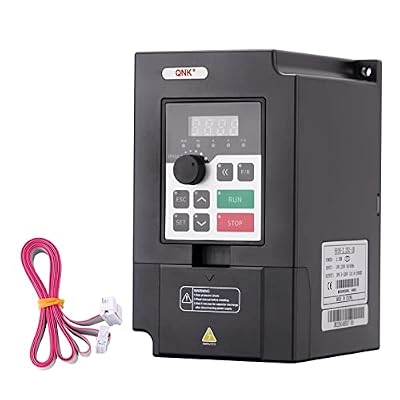
The QNK drive is the most feature-complete 220V option here for a 2.2kW spindle. Its listing describes single-phase 220V input and three-phase output, sine wave PWM control, multi-stage speed control with 8-stage and 16-stage options, program operation, and four acceleration and deceleration time settings.
It also supports an external braking resistor, not included, with the listing giving the example of bringing an engraving spindle down from full speed very quickly, useful for frequent tool changes. RS-485 lets a controller manage start, stop, frequency setting, status monitoring, and feedback. The chassis is described as flame-retardant ABS with an independent cooling air duct.
Honesty note: the listing contradicts itself on current. The product name states 11A, a comparison table in the same listing shows a lower amp figure for the 2.2kW column, and a features block expresses capacity in amp hours, which is not a drive current rating. Treat the delivered unit nameplate and manual as the deciding source, and confirm the amp rating covers your spindle before wiring.
Specs
| Item | Detail |
|---|---|
| Model | 2.2kw220v |
| Rated power | 2.2kW, 3HP |
| Input voltage | 220V plus or minus 15, 1 phase |
| Input frequency | 50/60Hz |
| Output voltage | 0-220V, 3 phase |
| Output frequency | 0-1000Hz |
| Rated current | 11A per product name, see note |
| Communication | RS-485 |
| Braking | External resistor supported, not included |
XCFDP 2.2kW 220V Variable Frequency Drive

This XCFDP drive covers the common 2.2kW, 220V three-phase spindle with a straightforward single-phase input design. The listing gives 220V input with a stated tolerance, 220V three-phase output, 50/60Hz input frequency, and 0-400Hz output frequency, matching most spindles in this class. Its rated current is listed at 12A, the clearest amp figure among the 220V 2.2kW drives here, making the nameplate comparison against your motor simpler.
Hardware focuses on cooling and protection. The listing describes a multi-grid case, a DC cooling fan, and overcurrent, overvoltage, overload, and short-circuit protection. The control panel is removable, with a short panel cable included.
Limits are plain: no external braking resistor support, so choose it for direct keypad control of a 220V three-phase motor. The manual covers multiple models, so follow the AT1 section for this type.
Specs
| Item | Detail |
|---|---|
| Model | 220V 2.2kw 3HP |
| Rated power | 2.2kW, 3HP |
| Input voltage | AC 220V plus or minus 15, single phase |
| Input frequency | 50/60Hz |
| Output voltage | AC 220V, 3 phase |
| Output frequency | 0-400Hz |
| Output current | 12A |
| Control method | PWM control |
| Dimensions | 4.61 x 4.96 x 6.89 inches |
XCFDP 1.5kW 220V Variable Frequency Drive
The smaller XCFDP drive is the right scale for a 1.5kW, 220V three-phase spindle. The listing gives 1.5kW and 2HP with 8A output current, single-phase 220V input, 220V three-phase output, and 0-400Hz output frequency, aligning with a 400Hz-rated 1.5kW spindle for routing, milling, and engraving.
It shares the larger unit traits: removable panel, multi-vent case, DC fan, and the same protection set, with simple panel programming.
The same limits apply: 220V three-phase motors only, and no external braking resistor support. For a benchtop CNC with a genuine 1.5kW spindle, this is a cleaner fit than the 2.2kW version, provided the 8A rating meets your nameplate current.
Specs
| Item | Detail |
|---|---|
| Model | 220V 1.5kw 2HP |
| Rated power | 1.5kW, 2HP |
| Input voltage | AC 220V, single phase |
| Input frequency | 50/60Hz |
| Output voltage | AC 220V, 3 phase |
| Output frequency | 0-400Hz |
| Output current | 8A |
| Control method | PWM control |
| Dimensions | 4.61 x 4.96 x 6.89 inches |
SZCY LLC 2.2kW 220V Variable Frequency Drive

The SZCY drive is a simple, knob-led option for a 2.2kW, 220V three-phase spindle where manual control is the plan. The listing describes terminals plainly, with L and N for single-phase AC 220V input, U, V, and W for output to the three-phase motor, and a ground terminal. The panel uses labeled keys for display switching, programming, data saving, forward and reverse, run, and stop or reset, plus a knob to adjust speed.
The listing describes high accuracy, good anti-interference capability, fast start and stop response, and simple wiring. It also gives guidance for setting a 400Hz maximum for a spindle motor. The drive ceiling must be programmed to the motor, not left at a general-purpose default.
Honesty note: the listing contradicts itself on current, naming 10A in the product title while its specification block states 12A, and its capacity line gives a higher kilovolt-amp figure than the 2.2kW rating alone would suggest. Use the delivered nameplate and manual to confirm current.
Specs
| Item | Detail |
|---|---|
| Model | 220V/2.2KW |
| Rated power | 2.2kW, 3HP |
| Input voltage | AC 220V, single phase, 50/60Hz |
| Output voltage | AC 220V, 3 phase |
| Output current | 10A per title, 12A per specs, see note |
| Capacity | 8.0KVA per listing |
| Control method | V/F closed loop, PWM output |
| Case material | Engineering plastic |
| Package dimensions | 8.78 x 7.83 x 6.42 inches |
Who Should Skip It
Skip every drive here if your spindle is a single-phase motor, a brushed router, or a DC spindle, because none of these units powers those machines. The listings are explicit that output is for three-phase asynchronous motors. Also skip this category if you need a spindle itself, a spindle kit with collets and a mount, or a replacement motor, since this guide covers drive units only.
Skip a 110V drive if your spindle nameplate says 220V, and skip a 220V drive if you have no proper 220V supply. Skip the XCFDP and SZCY drives if your build depends on an external braking resistor or RS-485 automation. Anyone running a spindle larger than 2.2kW, or a motor with unusual voltage or frequency ratings, needs a drive matched to that nameplate instead.
FAQ
Can a 110V VFD run a 220V CNC spindle?
No, not to rated performance. A drive outputs the voltage class it is built for, so a 110V-output drive feeding a 220V spindle leaves the motor underpowered and unable to reach rated speed under load. Choose the Huanyang 110V unit only for a 110V three-phase spindle.
How do I size a VFD for my spindle?
Match output voltage to motor voltage, rated output current at or above motor rated current, and power rating at or above motor power. Then confirm the drive can output the motor rated frequency, commonly 400Hz for high-speed spindles in this size range.
Does a VFD let my CNC controller set spindle speed automatically?
Only if the drive exposes a control path the controller can use and parameters are set for external control. In this group, the Huanyang and QNK drives list RS-485 communication, while the XCFDP and SZCY drives focus on panel and terminal control. Follow the manual wiring and change the command source away from keypad control.
Why does my spindle need 400Hz instead of standard mains frequency?
A high-speed spindle reaches top rated speed at its rated frequency, commonly 400Hz for the spindles these drives serve. Running it only at mains frequency would cap it at a small fraction of intended speed. Set the frequency parameters to the nameplate values and never above the motor rating.
Final Verdict
The QNK 2.2kW drive leads for 220V shops, with RS-485, multi-stage control, and braking support, subject to confirming its current rating on arrival. The Huanyang HY02D211B is the only direct 110V fit here. The XCFDP drives are the simple choices for 220V spindles at 2.2kW and 1.5kW, while the SZCY drive suits an operator who prefers a knob and keypad. Let the spindle nameplate make the decision.
Product and ASIN Reference
| Product | ASIN |
|---|---|
| Huanyang HY02D211B 2.2kW 110V VFD Drive | B0775F4G47 |
| QNK 2.2kW 220V VFD Converter | B0BS2W6H35 |
| XCFDP 2.2kW 220V Variable Frequency Drive | B09KN3MS45 |
| XCFDP 1.5kW 220V Variable Frequency Drive | B09KN54TZN |
| SZCY LLC 2.2kW 220V Variable Frequency Drive | B0811BXHBQ |


Write Your Review
No reviews yet. Be the first to share your experience!