
- Top Pick: NVIDIA Tesla A100 Ampere 40 GB Graphics Processor Accelerator – PCIe 4.0 x16 – Dual Slot
- Best Value: Nvidia RTX 2000 ADA 16GB Graphics Card
- Premium Choice: PNY NVIDIA RTX A2000 12GB
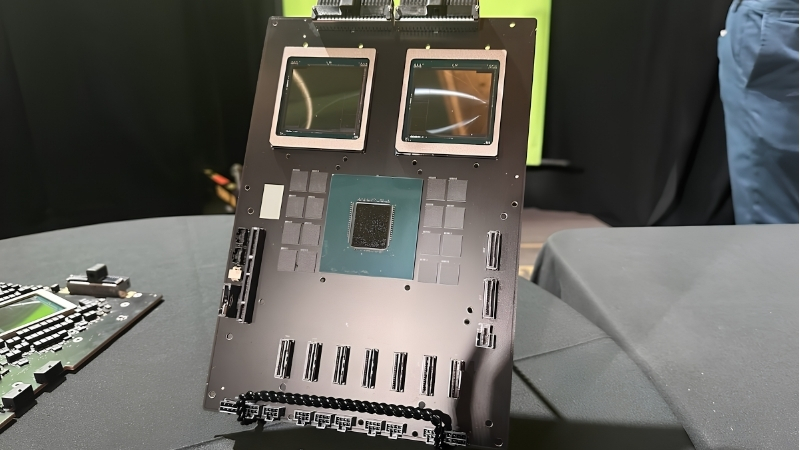
NVIDIA GB200 is the rack-scale powerhouse at the very top of NVIDIA’s AI lineup, a combination of Grace CPUs and Blackwell GPUs built to train and serve the largest AI models on the planet. For AI infrastructure leaders and investors following NVIDIA’s data-center story, the GB200 is where the architecture reaches its full expression. This review explains what the GB200 actually is, how the Grace Blackwell design and the NVL72 rack system work, its performance and market context, and who it is really for, giving the technically fluent reader a concise, grounded overview.
What the NVIDIA GB200 Is
The GB200 is not a single GPU but a superchip that pairs NVIDIA’s Grace CPU with Blackwell GPUs into one tightly integrated unit, and it scales up into full rack systems designed as a single giant accelerator. This is a different concept from a standalone chip: it is a building block for data-center-scale AI. Understanding how the CPU and GPUs combine, and how many of them link into a rack, is essential to grasping why the GB200 sits at the summit of the lineup. Here is what it is.
As an Amazon Associate we earn from qualifying purchases at no extra cost to you.


Grace CPU Plus Blackwell GPUs
The GB200 superchip combines NVIDIA’s Grace CPU with two Blackwell B200 GPUs, connected by an ultra-fast link so the CPU and GPUs share data with very low latency and high bandwidth. This tight coupling is the defining idea.
By integrating the CPU and GPUs so closely, the GB200 avoids the bottlenecks that arise when a separate CPU and GPU communicate over slower connections, which matters enormously for large AI workloads that move huge amounts of data.
The result is a unit where CPU and GPU work almost as one, delivering coordinated performance that separate components cannot match, which is the architectural heart of the GB200.
The inclusion of a purpose-built CPU alongside the GPUs is more significant than it first appears. In many AI systems, the CPU and GPU are separate components connected over a standard interface that becomes a bottleneck when huge volumes of data must move between them. By designing the Grace CPU specifically to sit beside Blackwell GPUs and linking them with a dedicated high-bandwidth connection, NVIDIA removes much of that friction, so the CPU can feed the GPUs and handle coordination without starving them of data. For workloads that constantly shuttle information between processing and orchestration, this integrated design is a meaningful advantage over assembling equivalent parts from separate vendors.
The GB200 NVL72 Rack System
The GB200 scales into the NVL72, a rack-scale system linking many GB200 superchips, 72 Blackwell GPUs, connected by NVIDIA’s high-speed NVLink into what behaves as one enormous GPU. This is the form most hyperscalers actually deploy.
The point of the NVL72 is to train and serve models so large that no single chip or server could handle them, treating an entire rack as a unified accelerator. It represents data-center AI at its most integrated.
This rack-scale approach is what makes the GB200 a platform rather than a chip, and it is why the largest AI operators build around it for frontier-scale work.
Key Specs and Capabilities
The GB200’s specifications reflect its role as a top-tier, integrated AI platform. The essentials below capture what matters to infrastructure planners evaluating it.
| Aspect | NVIDIA GB200 |
|---|---|
| Composition | Grace CPU + 2x B200 GPU |
| GPU architecture | Blackwell |
| Interconnect | High-speed NVLink |
| Rack system | NVL72 (72 Blackwell GPUs) |
| Focus | Frontier-scale AI training and inference |
| Deployment | Hyperscale data centers |
The combination of Grace CPUs, dual Blackwell GPUs per superchip, and rack-scale NVLink integration is what sets the GB200 apart, delivering coordinated compute and memory far beyond any single accelerator.
The GB200 in Real Deployments
The GB200’s value shows in how it performs at rack scale and in the market realities that determine who deploys it, both of which matter more than any single spec. Its integrated design targets the workloads that break lesser hardware, and it operates in a demand- and policy-shaped environment. This section covers rack-scale performance, the market context including recent export developments, and the honest trade-offs for operators. Here is the grounded view.
Performance at Rack Scale
The GB200’s strength is coordinated performance across an entire rack. By linking 72 Blackwell GPUs with NVLink and pairing them with Grace CPUs, the NVL72 can train and serve enormous models with far less of the communication overhead that slows loosely connected clusters.
For the largest models, this integration translates into faster training and higher-throughput inference than assembling the same number of GPUs in a conventional, less tightly linked setup. The whole is genuinely greater than the sum of its parts here.
The practical result is that the GB200 lowers the time and, at scale, the cost to reach frontier AI results, which is exactly why hyperscalers prioritize it despite its complexity and expense.
Rack-scale integration also changes what is even possible, not just how fast it happens. Some frontier models are now large enough that they cannot fit or train efficiently on loosely connected clusters, where the delays of moving data between separate machines become the dominant cost. By making 72 GPUs behave as one tightly coupled accelerator, the NVL72 lets a single model span the whole rack with far less of that penalty, enabling training runs that would be impractical to coordinate otherwise. For the largest AI labs, this is the real draw: the GB200 is less about incremental speed and more about making certain enormous workloads feasible in the first place, which is a different and higher bar than raw performance figures convey.
Market Context: Demand and Export Rules
The GB200 sits in a market defined by intense demand and active export policy, both of which shape its availability and strategic value. Demand for top-end NVIDIA AI systems has consistently exceeded supply, so allocation and lead times are as much a part of the story as raw capability.
Export policy is a live factor across NVIDIA’s data-center lineup. A significant recent development is that the United States has moved to allow NVIDIA to sell the H200, one of its most powerful AI chips, into the China market. While that decision concerns the Hopper-generation H200 rather than the GB200, it is meaningful context, because it reshapes how NVIDIA’s tiers of accelerators are permitted to flow and how global demand distributes across the lineup.
For investors, opening a market as large as China to high-end chips expands NVIDIA’s addressable demand and is among the larger swing factors in its data-center outlook, which indirectly supports demand and pricing power for flagship systems like the GB200. For infrastructure operators, the operational lesson is that securing top-tier systems is about more than choosing the best platform: allocation, supply timelines, and evolving export rules determine what you can actually deploy and when. In a market this constrained and policy-sensitive, planning around availability is as important as specifications, and the GB200’s position at the top of the lineup makes it especially subject to these dynamics.
Pros and Cons for Operators
Because the GB200 represents an enormous investment and a strategic commitment, weighing its strengths against its demands is essential. Here is the honest balance for operators.
Pros: unmatched integrated performance at rack scale, tight Grace-Blackwell coupling that cuts communication overhead, leadership for the largest training and inference workloads, and efficiency gains that lower cost per unit of AI work at scale. Cons: extreme cost, very tight supply and allocation, demanding power and cooling and data-center requirements, and no relevance outside hyperscale deployment, since it is not something individuals or smaller teams buy.
What the GB200 Means for You
The GB200’s relevance depends entirely on your scale, and for the vast majority of readers it is context rather than a purchase, accessed indirectly if at all. Matching its role to your real situation is what makes the information useful. This final section covers who the GB200 is genuinely for, how most people actually access this class of power, and the bottom line on NVIDIA’s flagship AI system.
Who the GB200 Is For
The GB200 is for hyperscalers, major cloud providers, and the largest AI labs training and serving frontier models at massive scale, organizations with the capital, infrastructure, and workloads to justify rack-scale AI systems. For them, it is the leading platform.
It is not for individual developers, smaller companies, or anyone without hyperscale data-center infrastructure, since it is sold and deployed at a scale far beyond typical use. Its relevance to most readers is understanding the technology, not buying it.
Recognizing that the GB200 targets the very top of the market, and that most AI work does not require it, is the mark of realistic infrastructure thinking.
This matters because there is a natural temptation to assume the best-known chip is the right tool, when in reality the vast majority of AI projects run perfectly well on far more modest hardware. Fine-tuning smaller models, running inference for typical applications, and most research fit comfortably on single GPUs or small clusters rather than rack-scale systems. Reaching for GB200-class power when your workload does not demand it is not just unnecessary, it is impractical given the cost and scarcity, which is why matching hardware to genuine need is a more valuable skill than chasing the top of the lineup.
How Most People Access It and Alternatives
Nearly everyone who benefits from GB200-class power does so indirectly, through cloud providers that deploy these systems and rent access by the hour. This is how startups, researchers, and enterprises tap frontier compute without owning any of it.
For local development, experimentation, and learning, workstation-class RTX GPUs offer an accessible entry point at a tiny fraction of the cost, and quality reference materials help teams understand and design AI infrastructure regardless of the hardware they ultimately use.
If you are building or learning below the hyperscale tier, compare current prices on workstation RTX graphics cards and AI infrastructure reference books through the links on this page.
See More:
- NVIDIA Broadcast vs OBS
- RTX HDR settings
- NVIDIA App download
- NVIDIA RTX Video Super Resolution
- GeForce Experience alternative
Final Verdict
The GB200 is the pinnacle of NVIDIA’s AI platform, an integrated Grace Blackwell system that delivers rack-scale performance unmatched for frontier AI, and for hyperscalers and top AI labs it is a strategic centerpiece. As the top of the lineup, it defines the cutting edge.
For everyone else, it is context and cloud-accessed capability rather than a purchase, operating in a market shaped by scarcity and export policy. Understand it as the summit of the architecture, and match your own approach to your real scale.
In the end, the NVIDIA GB200 is the Grace Blackwell superchip and NVL72 rack system built for frontier AI at hyperscale, pairing Grace CPUs with Blackwell GPUs into a tightly integrated platform, all within a market shaped by scarcity and shifting export rules like the recent opening of H200 sales to China. It is essential for the largest operators and cloud-accessed for everyone else. If you are working below the hyperscale tier, check the recommended workstation RTX cards and AI reference materials through the links here.
Top-Rated Picks


| Product | Brand | Rating | Reviews | Price |
|---|---|---|---|---|
| ARCTIC MX-4 (4 g) – Premium Performance Thermal Paste… | ARCTIC | ★ 4.8 | 104k | $4.99 |
| ARCTIC MX-4 (incl. Spatula, 4 g) – Premium Performanc… | ARCTIC | ★ 4.8 | 71.9k | $5.49 |
| Crucial 8GB DDR4 RAM 3200MHz (PC4-25600), Downclockab… | Crucial | ★ 4.8 | 62.8k | $74.99 |
| AMD Ryzen 5 5600X 6-core, 12-thread unlocked desktop … | — | ★ 4.8 | 30.2k | $177.60 |
| NVIDIA Shield Remote; Voice Search, Motion-Activated,… | — | ★ 4.7 | 10.6k | $25.99 |
Frequently Asked Questions
What does a GB200 superchip contain?
Each GB200 pairs one 72-core Grace CPU with two Blackwell GPUs over NVLink-C2C, providing 384GB of HBM3e across the two GPUs plus the Grace module’s LPDDR5X. The flagship deployment is the NVL72 rack, which links 36 Grace CPUs and 72 Blackwell GPUs into a single NVLink domain that software can address almost like one enormous accelerator.
Why does the NVL72 rack need liquid cooling?
A fully populated NVL72 draws on the order of 120kW, roughly ten times a typical dense server rack. Air simply cannot remove that heat within a standard footprint, so direct-to-chip liquid cooling with facility-level coolant distribution units becomes mandatory. Most existing datacentres need plumbing and power upgrades before they can host one.
How much faster is it than Hopper for LLMs?
NVIDIA cites up to roughly 30x inference throughput on very large mixture-of-experts models at rack scale, driven by FP4 precision, the second-generation Transformer Engine and the huge 72-GPU NVLink domain that keeps expert weights resident. Real gains on smaller dense models are far more modest, typically in the two-to-four times range.
Can you buy a single GB200 board?
Not in the way you buy a PCIe card. GB200 is sold through OEM and cloud partners as complete compute trays and racks with matched networking, power and cooling. Smaller buyers generally access it through cloud instances rather than on-premise purchase, since minimum viable deployments are extremely expensive.
Is FP4 precision accurate enough for production?
For inference, yes, when combined with per-block scaling and calibration; quality loss on most chat and code models is small and measurable. Training still relies on FP8 and BF16 for stability. Always validate FP4 quantisation against your own evaluation set rather than trusting vendor benchmarks.



Write Your Review
No reviews yet. Be the first to share your experience!