
Top Rtx 3070 4070 Same Cores Picks for 2026
Here are our current top rtx 3070 4070 same cores picks, compared on real Amazon owner reviews, price, and features. Live prices update below.
- Top Rtx 3070 4070 Same Cores Picks for 2026
- RTX 3070 vs 4070: Quick Verdict and the Identical-Core Experiment
- Deep Dive: What One Generation Did With the Same Cores
- The 2026 Used Market: Why Neither Card Is Getting Cheaper
- Final Verdict: Who Should Buy Which Card?
- Conclusion
- Related Guides
- Frequently Asked Questions
- Related Articles




RTX 3070 vs 4070 is the cleanest controlled experiment Nvidia ever shipped: two cards with exactly 5,888 CUDA cores each, separated by one architecture generation — and by roughly 30 percent of performance. The 3070 was 2020’s $499 value champion; the 4070 followed in 2023 at $599 with the same core count, 50 percent more memory, and lower power draw. In 2026 both live on the used market at prices close enough to tempt budget builders toward the wrong one. This comparison uses their unique like-for-like core counts to show exactly what an architecture buys, then turns those numbers into a clear purchasing decision with today’s prices attached.
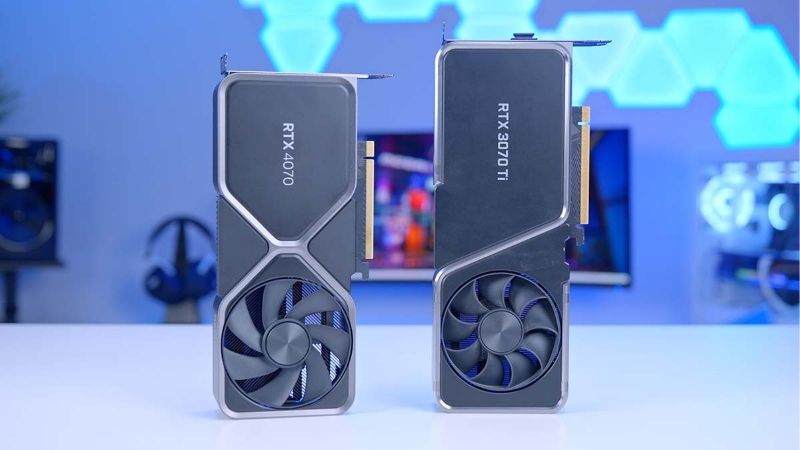
RTX 3070 vs 4070: Quick Verdict and the Identical-Core Experiment
Matching core counts strip away the usual excuse-making in cross-generation comparisons: every difference between these cards comes from architecture, clocks, cache, and memory. The verdict first, then the spec sheet that makes this matchup so instructive.
The Quick Verdict for Busy Buyers
The RTX 4070 wins decisively. From the same 5,888 cores it extracts roughly 25 to 35 percent more performance, carries 12GB of VRAM against a now-painful 8GB, supports DLSS 3 Frame Generation, and does it all at 20W less. Used prices around $360 to $400 against the 3070’s $220 to $250 make the premium real but justified.
The 3070’s case survives only at the very bottom: under $230 with a return window, it remains a serviceable 1080p and light-1440p card for short-horizon builds. For everyone else, the 4070 — or the new RTX 5070 at $549 with a warranty — is the answer. Check live Amazon listings for all three before deciding; this segment’s spreads move weekly.
Specification Comparison Table
Read the core-count line twice: it is the same number, and everything below it is what one generation of engineering did with it.
| Specification | RTX 3070 | RTX 4070 |
|---|---|---|
| Architecture | Ampere (2020) | Ada Lovelace (2023) |
| CUDA Cores | 5,888 | 5,888 |
| Boost Clock | 1.73 GHz | 2.48 GHz |
| VRAM | 8GB GDDR6 | 12GB GDDR6X |
| Memory Bandwidth | 448 GB/s | 504 GB/s |
| L2 Cache | 4MB | 36MB |
| Board Power | 220W | 200W |
| Launch Price | $499 | $599 |
The 43 percent clock advantage and nine-fold cache increase are the experiment’s results: identical engines, one simply running faster and wasting fewer trips to memory.
Pros and Cons of Each Card
A fair RTX 3070 vs 4070 reading admits the older card still earns its used price floor — and names the spec that caps it.
RTX 3070 pros: the cheapest competent 1440p-capable card on the used market; conventional GDDR6 runs cooler than its X-suffixed siblings; standard 8-pin power suits any aging build; enormous supply keeps sellers honest. Cons: 8GB of VRAM now forces texture compromises even at 1080p in some releases; no frame generation, ever; heavy mining-era exposure; performance per watt two generations behind.
RTX 4070 pros: 25 to 35 percent faster at lower power; 12GB buffer with years of comfortable runway; DLSS 3 Frame Generation; efficient 200W draw on a 650W supply; barely three years old, so wear risk is modest. Cons: no DLSS 4 Multi Frame Generation; 16-pin adapter on most models; used pricing brushes close enough to the new RTX 5070 to demand a careful check before paying.
Deep Dive: What One Generation Did With the Same Cores
With core counts controlled, the matchup decomposes into four clean lessons — performance, memory, running costs, and money — each one a section a budget buyer can act on directly.
Gaming Performance at 1080p and 1440p
At 1080p both cards are comfortable: the 3070 posts 80 to 110 fps in demanding AAA titles at high settings, the 4070 lands at 105 to 140 fps. The gap is visible on a 144Hz panel and decisive on anything faster, but neither card embarrasses itself at this resolution — yet. Esports titles run past 200 fps on both, so pure competitive builds can score this paragraph a draw and read on for the lines that actually separate them.
At 1440p the experiment turns one-sided. The 4070 holds 80 to 110 fps at high settings with frame times kept flat by its oversized cache; the 3070 manages 60 to 85 fps and, more damningly, starts colliding with its 8GB ceiling in texture-heavy titles, where one-percent lows collapse into stutter that average charts politely omit.
Add frame generation and the cards separate by category rather than degree: DLSS 3 lifts the 4070’s presented frame rates by 60 to 90 percent in supported titles, a multiplier the 3070’s generation never received and never will. As more engines ship the technology as a baseline assumption, this absence converts from a feature gap into an experience gap one release at a time.
The VRAM Verdict: 8GB vs 12GB in 2026
The memory line deserves its own section because it is the comparison’s only irreversible difference. Game memory budgets have climbed every year of this console generation, and 8GB has crossed from “adequate” to “managed” — several 2025-2026 releases exceed it at high textures even at 1080p, forcing settings drops on otherwise capable silicon.
The 4070’s 12GB sits on the comfortable side of the same trend with realistic headroom through 2028 at 1440p, and DLSS reduces memory pressure further in exactly the titles that push hardest. The practical translation for buyers: the 3070 is a card you adjust settings for; the 4070 is a card you install and forget. That difference compounds annually and explains most of the used-price spread between them.
Power, Heat, and System Fit
Practical requirements favor the newer card in every column despite its higher performance: 200W against 220W, cooler-running memory, and quieter partner designs across the board. A quality 650W power supply serves either; the 3070’s standard 8-pin connectors plug into anything, while most 4070s use the 16-pin adapter — seat it fully, no sharp bends near the plug.
Used-condition diligence differs by generation: 3070s lived through the mining era, so demand stress tests and check fan bearings; 4070s post-date it, making their used market measurably lower-risk — a hidden component of their price premium.
Both fit compact builds, but the 4070’s efficiency gives it the wider case compatibility — its low-airflow tolerance is the best in this price class. Idle and media-playback draw also favor Ada, a small permanent saving for machines that double as daily drivers.
Value per Frame: The Cost Math
Run the 2026 numbers. A used 3070 at $240 averaging 72 fps in a 1440p suite costs $3.33 per frame. A used 4070 at $380 averaging 95 fps costs $4.00 per frame — the old card is about 17 percent cheaper per frame on day one.
Horizon flips it, as it usually does: the 3070’s 8GB gives it perhaps eighteen months of comfortable service before settings management becomes routine, while the 4070 credibly serves through 2028. Per comfortable year, the newer card is the cheaper purchase, and its resale will reflect the same VRAM logic when you eventually sell.
The decision boundary lands cleanly: a 3070 below $230 for a short-horizon build is rational; a 4070 below $390 for anything longer is the better spend; and if a 4070 listing crosses $420, the new RTX 5070’s warranty at $549 enters the conversation uninvited.
The 2026 Used Market: Why Neither Card Is Getting Cheaper
Both sides of this comparison trade on the used market, which makes current price dynamics — unusual ones — part of the decision. Two industry forces explain why the traditional wait-for-the-drop strategy is failing this segment.
The H200 China Approval Cascades Downward
The United States has approved Nvidia selling the H200 — one of its most powerful AI accelerators — to China, releasing data-center demand that competes with all GeForce production for memory, packaging, and wafer allocation. New cards tighten first; the demand they cannot absorb spills into the used market within a quarter, setting floors under exactly the cards in this matchup.
Used 4070 listings have already stopped their slide, and even the humble 3070’s band has held flat — a six-year-old 8GB card refusing to depreciate is the clearest signal of how unusual this market is. Completed-sale prices, not asking prices, tell the true story — check them before trusting any listing’s framing of a fair deal.
Rising Component Prices Anchor the Budget Tier
Simultaneously, laptop and PC component prices are climbing industry-wide, led by memory — the cost line that hits budget cards proportionally hardest. As new GPU prices firm, used equivalents reprice upward against them continuously, compressing the discounts that justify buying older silicon at all.
For this comparison the consequence is specific: the $140 gap between these cards is more likely to narrow than widen, and a narrowing gap favors the better card. Time works for the 4070’s case and against the 3070’s.
Buy Now or Wait?
If you need a card this year, buy inside today’s bands: a 3070 under $230 or a 4070 under $390, both with return windows, both stress-tested in week one.
Set Amazon alerts on both plus the new 5070, and let the first target that triggers make the decision — prepared buyers have beaten patient ones in this market for two consecutive years.
Final Verdict: Who Should Buy Which Card?
The experiment’s conclusion converts directly into three buyer profiles, with the third pointing past both cards entirely.
Who Should Buy the RTX 3070
Buy a used 3070 only under $230 with recourse, only for 1080p or esports-leaning 1440p, and only as a deliberate one-to-two-year bridge. Inside that lane it remains the used market’s best raw frames per dollar.
Accept its terms knowingly: texture settings are a dial you will touch, and the card’s resale clock is already running.
Who Should Buy the RTX 4070
The 4070 is this comparison’s recommendation for most readers: a genuine generational step from identical silicon resources, 12GB of runway, frame generation, and a used market young enough to shop with confidence. Under $390 it is the budget-to-midrange sweet spot of 2026.
Prefer Amazon Renewed-style listings with returns over private deals, and verify the exact model — Ada-era naming traps catch hurried buyers.
The Alternative: RTX 5070 New
If your 4070 search keeps surfacing $420-plus listings, stop and reprice the new RTX 5070 at $549: roughly 20 percent faster again, GDDR7, DLSS 4 Multi Frame Generation, and a full warranty.
The used market only wins when its discount is real — and Amazon’s live 5070 price is the measuring stick that keeps every listing in this comparison honest.
See More:
- Nvidia Reflex low latency
- RTX 4070 vs 5060 Ti
- Zephyr RTX 4070
- RTX 3080 Ti price
- Nvidia RTX 2060 Super
Conclusion
The RTX 3070 vs 4070 matchup is the rare comparison that doubles as a lesson: identical 5,888-core engines, separated by one architecture, finishing 25 to 35 percent apart — with the 4070’s 12GB buffer, frame generation, and lower power turning the benchmark gap into a category gap. Buy the 3070 only as a sub-$230 bridge; buy the 4070 under $390 as the segment’s smart money; and let the new 5070 referee any listing that climbs too high. With the H200 export approval and rising component prices holding used values firm, waiting buys nothing here. Settle your side of the RTX 3070 vs 4070 question, check today’s Amazon prices, and act inside the bands while they hold.
Frequently Asked Questions
What is the best rtx 3070 4070 in 2026?
The best rtx 3070 4070 depends on your budget and how you plan to use it. The options compared above are our top-rated picks based on real customer ratings, build quality, and overall value — start with the highest-rated model that fits your budget.
How much should I expect to spend on a rtx 3070 4070?
Prices vary by brand and features. Budget options cover the essentials, while mid-range and premium models add durability, performance, and extra features. Compare the prices in the list above to find the best value for your needs.
What should I look for when buying a rtx 3070 4070?
Focus on what matters most for your use case — build quality, compatibility, performance, warranty, and verified customer reviews. Every pick above is selected to balance these factors.
Are budget rtx 3070 4070 options worth it?
Yes. For most people a well-reviewed budget or mid-range rtx 3070 4070 delivers excellent value. You only need to spend more if you specifically require premium materials or top-tier performance.
How did we choose these rtx 3070 4070 picks?
We compare current Amazon ratings, review counts, key features, and price to surface the options with the best real-world value. The list is refreshed as ratings and availability change.










Write Your Review
No reviews yet. Be the first to share your experience!