
- Top Pick: Skytech Gaming Blaze 5 Gaming PC, Intel i7 14700F 2.1GHz, NVIDIA RTX 5070 12GB VRAM, 1TB Gen4 NVMe SSD, 16GB DDR4 RAM 3200, 850W Gold ATX 3 PSU, 360 ARGB AIO, Wi-Fi 5, Windows 11, Desktop
- Best Value: msi Vector 16 HX AI Gaming Laptop 16" 144Hz Display Intel Core Ultra 7 255HX 16GB DDR5 RAM 1TB PCIe SSD NVIDIA GeForce RTX 5070 Ti 12GB Windows 11 Cosmos Gray VECTOR16HXA2275
- Premium Choice: VIPRTECH Reaper 3.0 Gaming PC, Ryzen 7 8700F, RTX 5070, 16GB/1TB Onyx Black


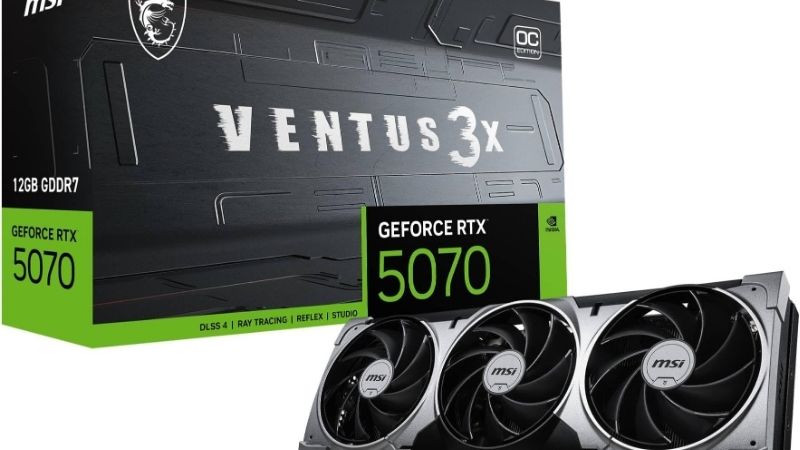
RTX 5070 12GB vs 16GB is a comparison that cannot happen as stated, and knowing why saves you from a $200 mistake. Nvidia does not make a 16GB RTX 5070. The card ships with 12GB of GDDR7 and there is no other configuration. The 16GB card you have seen listed is the RTX 5070 Ti — and it is not a 5070 with extra memory. It uses a different die with 46% more cores and a wider bus. This breaks down what you are actually choosing between, and whether the gap is worth the money.
The Quick Verdict
You are comparing the RTX 5070 (12GB, $549 MSRP) against the RTX 5070 Ti (16GB, $749 MSRP), and the memory difference is the least interesting thing separating them. The Ti brings 8,960 CUDA cores against 6,144, a 256-bit bus against 192-bit, and 896 GB/s against 672 GB/s. The VRAM is a symptom of the wider bus, not a feature bolted on.
As an Amazon Associate we earn from qualifying purchases at no extra cost to you.


Which One Should You Buy?
For 1440p Ultra with ray tracing, or any 4K ambition, the RTX 5070 Ti. The extra $200 buys 46% more cores and 33% more bandwidth, not just 4GB.
For 1440p at high rather than Ultra, or 1080p high-refresh, the RTX 5070 is sufficient and the $200 is better spent elsewhere in the build.
The Catch Nobody Mentions
Neither card sells at MSRP, and one of them may not be selling at all. As of July 2026, RTX 5070 Ti cards list around $979–$1,049 against their $749 MSRP. More importantly, AIBs have reported the 5070 Ti as end of life — ASUS told Hardware Unboxed at CES 2026 that Nvidia stopped supplying the die, though Nvidia disputes this. The RTX 5070’s 12GB has kept it out of that fight: it is the card in this comparison still in normal production.
Comparison Table: Two Different Cards, Not Two Memory Options
The single most useful thing here is the die row. These are not the same chip binned differently — they come from different silicon families, which is why the gap is wider than the naming implies.
| Spec | RTX 5070 (12GB) | RTX 5070 Ti (16GB) | Delta |
|---|---|---|---|
| Die | GB205-300-A1 | GB203-300-A1 | Different silicon |
| CUDA cores | 6,144 | 8,960 | +46% |
| RT cores | 48 | 70 | +46% |
| Tensor cores | 192 | 280 | +46% |
| VRAM | 12GB GDDR7 | 16GB GDDR7 | +33% |
| Bus width | 192-bit | 256-bit | +33% |
| Bandwidth | 672 GB/s | 896 GB/s | +33% |
| Boost clock | 2,512 MHz | ~2,452 MHz ref | Ti slightly lower |
| TDP | 250W | 300W | +50W |
| PSU recommended | 650W | 750W | +100W |
| Founders Edition | Yes | No — AIB only | — |
| MSRP | $549 | $749 | +$200 |
Why the VRAM and the Bus Are the Same Story
The 12GB versus 16GB difference is not a marketing choice. It falls out of the bus width. A 192-bit interface addresses memory in multiples that produce 12GB with standard 2GB modules; a 256-bit interface produces 16GB. Nvidia could not ship a 16GB RTX 5070 without redesigning the memory controller — at which point it would be a 5070 Ti.
This is why “just get the 16GB version” is the wrong mental model. You are not paying $200 for 4GB. You are paying for a wider memory subsystem that happens to carry more capacity, plus 46% more shader hardware attached to it.
Note the clock row: the 5070 actually boosts slightly higher than the 5070 Ti’s reference figure. Clock speed is not what separates them, which is a useful corrective for anyone reading spec sheets top-down.
Deep Dive Face-Off
The table establishes the shape. What follows is where each difference actually surfaces, and the ordering runs from least to most consequential.
Rasterization: The Gap Tracks Bandwidth, Not Cores
The RTX 5070 Ti delivers roughly 20–25% more rasterization performance at 4K than the RTX 5070. That is less than its 46% core advantage suggests, and the reason is that neither card is purely shader-bound.
The gap narrows at 1440p and narrows further at 1080p, where the pixel load is low enough that both cards have bandwidth to spare and the CPU starts to matter. At 1080p the two are closer than $200 justifies.
Framed against the tier above: the 5070 Ti sits at 85–90% of an RTX 5080 at 4K. The step from 5070 to 5070 Ti is larger than the step from 5070 Ti to 5080 — exactly backwards from what the naming implies, and the single most useful thing to understand about this part of the lineup.
VRAM: Where 12GB Actually Bites
12GB is adequate at 1440p today and tight at 1440p Ultra in a handful of recent titles. It is the specification most likely to age badly, because texture budgets have climbed steadily and show no sign of stopping.
Be careful reading VRAM monitoring tools, though. Allocation is not usage — games reserve more than they need when it is available, so a graph showing 11.5GB allocated on a 12GB card does not mean it is starved. The symptom of genuine exhaustion is stutter in 1% lows as assets swap over PCIe, not a high allocation number.
For non-gaming work the calculation is different and clearer. Local AI inference, Stable Diffusion at higher resolutions, and video timelines consume VRAM in ways games do not, and 16GB is meaningfully more capable than 12GB there.
Power, Fit, and the Hidden Cost
The 5070 runs 250W and Nvidia recommends a 650W supply. The 5070 Ti runs 300W and wants 750W, with 850W comfortable alongside a modern high-TDP CPU.
If your existing PSU is a 650W unit, the 5070 drops in and the 5070 Ti adds a power supply to the bill. That turns a $200 gap into $280–$350 and changes the answer for budget-constrained builds.
One structural difference: there is no Founders Edition RTX 5070 Ti. Every one is an AIB card with its own cooler, clocks, and price, and the spread between the cheapest and most expensive on identical silicon regularly exceeds $150. Shop the variant, not the chip.
The Defect Check Worth Doing on Either Card
A small fraction of early RTX 50 production — reported under 0.5% of units — shipped with a disabled ROP unit. The card posts, games, and reports normally in Device Manager while running a few percent below spec.
GPU-Z shows the count. An RTX 5070 Ti should report 80 ROPs; the RTX 5070 retained its full count. Check it inside the return window, because nothing in Windows will tell you and the shortfall is small enough to pass for normal variance if you are not looking for it.
The Alternative: If Neither Fits
The $200 MSRP gap becomes a $400+ street gap in practice, and that pushes some buyers out of this comparison entirely. Two options are worth weighing before committing.
The RTX 5060 Ti 16GB: 16GB for Much Less
If the 16GB figure is what drew you here, this card has it at $429 MSRP. The catch is the one this whole article is about: it runs a 128-bit bus at 448 GB/s — half the 5070 Ti and a third less than the 5070.
That makes it a strong 1080p card and a compromised 1440p one. If you wanted 16GB for local AI or creative work at 1080p, it is the value pick. If you wanted 16GB to game at 1440p Ultra, it does not do what you want, and buying it for the VRAM number repeats the exact mistake this comparison exists to prevent.
The RTX 5080: Worth Checking at Street Prices
At MSRP the 5080 is $250 above the 5070 Ti, which is a lot for 10–14%. At street prices the maths shifts: 5070 Ti cards have run $979–$1,049 while 5080s start around $1,249. That gap is roughly $200–$270 rather than the $250 on paper, for a card with 10,752 cores and 960 GB/s.
It is still not obviously worth it. But if you were already stretching to a $1,049 5070 Ti, run the comparison rather than assuming.
AMD’s RX 9070 XT: The Comparison Nvidia Would Rather You Skip
The RX 9070 XT competes directly with the RTX 5070 Ti and does so credibly at 1440p rasterization with FSR 4 handling upscaling. At street prices where the 5070 Ti has drifted $230–$300 above MSRP, the value case genuinely flips for some buyers.
The counter-argument is ray tracing and DLSS 4, where Nvidia remains ahead. If heavy RT matters to you, that settles it. If it does not, the comparison deserves a look.
What the 2026 Market Does to This Decision
Everything above assumes list prices. That assumption has not held for this generation, and the distortion changes which card is actually the right buy.
MSRP Is Not the Price You Pay
Supply has been constrained since launch, driven primarily by DRAM shortages. As of July 2026, the RTX 5070 Ti lists at $749 and sells around $979–$1,049, with marketplace sellers reaching $1,299 and above.
The good news is real but weak and distant. The steep late-2025 climb has flattened, and Framework has reported a stretch of relative stability while still warning of volatility. Supply is opening — OEMs can source DDR5 from Chinese suppliers such as CXMT, and Micron is building two Idaho fabs — but those plants do not produce until 2027–2028. Prices stopped climbing steeply; they have not fallen.
Why the 12GB Card Has Quietly Become the Safer Buy
The memory shortage has inverted this comparison. At CES 2026, ASUS told Hardware Unboxed that Nvidia had stopped supplying GB203 dies for the RTX 5070 Ti and placed it into end-of-life status, alongside the RTX 5060 Ti 16GB. Nvidia publicly disputed this, saying all SKUs remain in production; ASUS later called the reports incomplete. The argument is unresolved — the price data is not. Retailers went weeks without stock, prices climbed from roughly $730 in November to $830 by January, and one major US retailer moved from $835 to $990 overnight.
The RTX 5070 was spared for the same reason it loses this comparison on paper: 12GB on a 192-bit bus consumes fewer GDDR7 modules than 16GB on a 256-bit one. Nvidia’s allocation has shifted toward parts that use less memory, which leaves the 5070 in normal supply while its bigger sibling becomes a scavenger hunt. The spec that makes it the weaker card is the spec keeping it on shelves.
Why Waiting for an 18GB RTX 5070 Super Is Not a Plan
Rumours point to an RTX 5070 Super with 18GB, using 3GB GDDR7 modules on the same 192-bit bus. That would give the 5070 the memory capacity people searching for a “16GB RTX 5070” are actually after.
The timing has moved repeatedly — from early 2026 to Q3 2026 and, in other reports, toward 2027, with GDDR7 supply named as the constraint every time. Nvidia has never confirmed a date and no product embargo document has surfaced. Waiting means waiting on an unannounced card built from the component in shortest supply.
The H200 Approval and What It Signals
The United States has approved Nvidia selling the H200 into China. For a GeForce buyer the relevance is allocation: consumer cards and datacentre accelerators compete for the same advanced packaging and high-bandwidth memory. Handing the highest-margin product line a large new market removes the downward pressure that would normally correct GPU pricing. Reports of Nvidia reducing RTX 50 production in early 2026 point the same direction.
See More:
- Nvidia beta
- Nvidia CUDA 11.8
- Check CUDA version
- Nvidia GPU for gaming
- PNY GeForce RTX 5080 16GB OC review
Final Verdict and Recommendation
The RTX 5070 12GB vs 16GB comparison resolves the moment you know the 16GB card is a different product. There is no 16GB RTX 5070 and there will not be one, because 12GB falls out of the 192-bit bus. The 16GB card is the RTX 5070 Ti: a different die, 46% more cores, and a 256-bit bus at 896 GB/s. You are not buying 4GB for $200 — you are buying a bigger GPU.
Buy the RTX 5070 Ti if you game at 1440p Ultra with ray tracing, want 4K with DLSS, or run AI and creative workloads where 16GB matters — and buy it the moment you find one near list, because AIBs have declared it end of life while Nvidia disputes the claim and stock thins either way. Buy the RTX 5070 if you game at 1440p high or 1080p high-refresh, if your 650W supply would otherwise need replacing, or simply if you want a card you can actually order today. Consider the RTX 5080 if you need 16GB and cannot find a 5070 Ti — it is now the main 16GB part still clearly in production.
Read the bandwidth column before the VRAM column. That habit prevents most bad GPU purchases in this generation, and it is exactly what the “12GB vs 16GB” framing obscures. But this year, check availability before either — the 12GB card you were comparing unfavourably may turn out to be the only one you can buy, and it was never a bad card. It was only ever the smaller one.
Frequently Asked Questions
Is there really a 16GB RTX 5070?
The standard RTX 5070 is a 12GB card on a 192-bit bus. When listings advertise a 16GB 5070 they are almost always describing a 5070 Ti, which is a different and larger GPU with 16GB on a 256-bit bus. Check the exact model name on the box and in the product code before buying.
What is the actual difference between the two GPUs?
The 5070 uses the smaller GB205 die with a 192-bit bus, around 250W board power and roughly 672GB per second of bandwidth. The 5070 Ti uses the larger GB203 die with a 256-bit bus, around 300W and roughly 896GB per second. The Ti is typically twenty to thirty percent faster, not a memory variant of the same card.
Is 12GB going to be a problem at 1440p?
For most current titles at 1440p, 12GB is adequate, including with DLSS and moderate ray tracing. It becomes tight with high resolution texture packs, heavy path tracing, or 4K ultra textures. If you play at 4K or intend to keep the card for several years, the extra 4GB on the Ti is worth the step up.
Do they use different power connectors?
Both use a 12V-2×6 connector on most designs. Nvidia recommends roughly 650W for the 5070 and 750W for the 5070 Ti. Seat the connector fully until it clicks and keep the cable straight for the first few centimetres, since a partially seated or sharply bent connector is the usual cause of overheating reports.
How do I avoid buying the wrong card?
Match the product code on the retailer page against the manufacturer product page, and treat any 5070 listing quoting 16GB as a mislabelled 5070 Ti until proven otherwise. Confirm the bus width and board power in the specification table; those two numbers separate the two GPUs unambiguously regardless of marketing names.


Write Your Review
No reviews yet. Be the first to share your experience!